Tools
Tools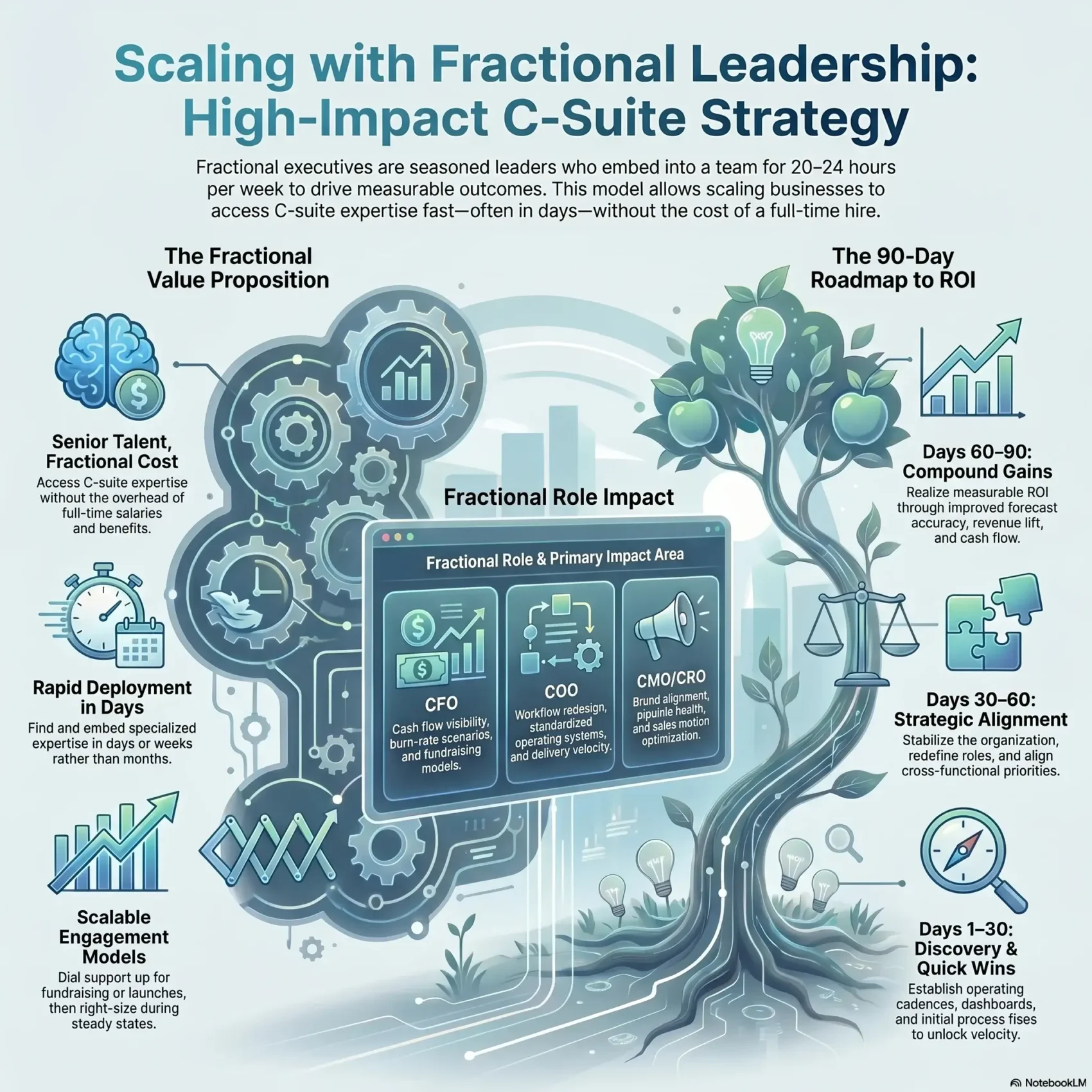
Last Updated on June 25, 2026
You may be seeking high-caliber leadership without hiring a full-time C-suite salary. A fractional executives model gives seasoned business leaders who embed with your team and deliver measurable outcomes, often working 20–24 hours per week.
These leaders provide C-level expertise across finance, operations, marketing, revenue, and technology. They guide strategy, streamline operations, and drive growth with immediate impact and objective insight.
Because this approach is cost-effective and scalable, you get access to rare expertise fast—normally in days or weeks instead of months. You’ll also gain flexibility while keeping momentum toward growth milestones.
Use this Buyer’s Guide to evaluate fit, scope, and ROI. Learn typical Day 1–30 wins, trade-offs versus interim or full-time leadership, and practical steps to structure successful engagements.
Key Takeaways
- High-impact, cost-efficient leadership: get C-suite skill without a full-time hire.
- Fast access: find specialized expertise in days or weeks.
- Domains that move the needle: finance, ops, marketing, revenue, and tech.
- Clear time-to-impact: expect measurable Day 1–30 wins linked to longer plans.
- How to evaluate fit: scope, governance, and ROI guide confident decisions.
- Practical next step: compare options and consider vetted providers for white-glove matching.
- Learn more about flexible work models: review flexible scheduling insights at flexible work schedules.
What You Need to Know First: Defining Fractional Executives and the Buyer’s Guide You’re Reading
Before you hire, clarify how part-time senior leaders embed with your team and take responsibility for key results.
What a fractional executive is (and isn’t)
You’ll define a fractional executive as a senior leader who works on a part-time basis to drive outcomes, not just give advice. They own specific roles and deliver against KPIs with accountability.
They aren’t a hands-off advisor, a slide-deck consultant, or a temporary band-aid. Expect implementation, not only recommendations.
Work is scheduled on a weekly time basis and tied to outcomes. Hours scale up during fundraising, launches, or M&A prep, then right-size afterward. Governance—weekly cadences and documented priorities—keeps pace with your initiatives.
Who this guide is for and how to use it
- Startups and scaling businesses that need embedded leadership without full headcount.
- Use this guide to evaluate your needs, clarify scope, shortlist candidates, and run trial periods.
- Expect pattern-based insights and practical guidance from leaders with repeatable management experience.
Why Businesses Choose Fractional Leadership: Benefits, Value, and Strategic Impact
When you need fast, senior-level help, a part-time leadership model delivers targeted results.
Cost-effective access to executive expertise without full-time commitment
You get senior-level expertise at a fraction of the cost, avoiding full-time salary and benefits while freeing budget for product, customer acquisition, or runway.
Flexibility and scalability aligned to your growth and changing needs
With flexible engagement, you can scale hours up for launches and fundraising, then dial back when steady-state returns.
Immediate impact, objective insights, and faster execution
These leaders bring objective insights from cross-industry experience. That shortens diagnostics and speeds decisions in cash flow, GTM, and systems.
Cross-functional alignment that reduces friction and improves performance
Embedded leaders connect finance, operations, marketing, and technology to lift performance. They set reporting cadence, clarify decision rights, and remove blockers.
“For many teams, the true value is quick wins plus a repeatable operating rhythm that keeps growth on track.”
- Fast wins: weekly cadences or a 90-day roadmap that unlocks measurable gains.
- Reduced ramp time: avoid long hiring cycles and maintain momentum.
- Sustained growth: sequencing priorities into documented, repeatable processes.
In short, you gain clear benefits: lower cost, timely impact, and practical expertise that moves the needle on growth and performance.
Six Clear Signals You’re Ready for Fractional Executives
If coordination breakdowns are costing time and cash, adding part-time senior talent can restore momentum.
Rising complexity outpacing your capacity
Your company stalls when founder bandwidth can’t keep up with multiple priorities.
Slow decisions, unclear owners, and repeated firefights are telltale signs you need extra leadership.
Cross-functional misalignment and spend leakage
When budgets omit headcount and hiring plans ignore product timelines, inefficiency grows.
Pattern recognition from experienced leaders helps align finance, people, and GTM to stop leakage.
Recovering from a mis-hire or sudden transition
Bring in an embedded partner who stabilizes the org, redefines the role, and keeps execution on track during a transition.
Preparing for pivotal events
Fundraising, major launches, expansion, or M&A require scaled support. Dialing up short-term senior help reduces risk.
- Identify when complexity exceeds current capacity.
- Spot cross-functional gaps that drive wasted spend.
- Use interim support to stabilize after a mis-hire or sudden change.
- Match scope to immediate needs across finance, ops, marketing, revenue, and tech.
Use these signals as a readiness checklist to decide if now is the right moment to add fractional leadership to your bench.
Fractional Executive vs. Full-Time Executive vs. Interim Executive: Choosing the Right Fit
When choosing senior help, you must weigh speed, cost, and how deeply the leader will embed in your culture.
Cost, commitment, and time-to-impact trade-offs
Full-time executives provide stability and deep cultural integration. They demand a higher salary, benefits, and a longer hiring cycle. A full-time hire makes sense when you need ongoing ownership.
A part-time model offers faster time-to-impact with lower overhead and flexible engagement. Interim leaders usually commit 40+ hours per week and drive full immersion for a set duration.
Depth of integration and cultural influence
Interim leaders bring deep day-to-day influence during transitions. Part-time leaders are high-leverage and focused on priority areas. Match depth to the mission and your team’s capacity.
Best-use scenarios
- Choose a full-time executive for durable mandates and stable growth stages.
- Use part-time engagement for scaling, transformation, or specialized skill gaps.
- Bring in interim leadership to stabilize after a change or during a defined transition.
“Map urgency, scope, and resources to the model that gives you the fastest path to clear outcomes.”
Where a Fractional Leader Moves the Needle: Roles, Responsibilities, and Use Cases
Bringing experienced leaders into defined roles lets you fix the biggest blockers to growth fast. You’ll map common roles and see concrete use cases that connect to measurable outcomes.
Fractional CFO
chief financial officer support focuses on cash flow visibility, tight budgeting, and disciplined forecasting. Expect a financial model for fundraising, burn-rate scenarios, and short-term cost optimization.
Fractional COO
An operating officer redesigns workflows, removes bottlenecks, and standardizes an operating system. They drive execution excellence across teams and improve delivery velocity.
Fractional CMO/CRO
chief marketing and revenue partners align brand, demand, pipeline health, and sales motion. The result is predictable pipeline growth and clearer attribution of marketing spend.
Fractional CIO/CTO
Technology leaders set architecture strategy, ensure scalability, and build roadmaps that support product and platform growth. They balance short-term stability with innovation.
CEO-level Guidance
Senior CEO-level support clarifies vision, restructures the org, and improves leadership alignment. They help set priorities and create governance that sustains momentum.
“Select the role that fixes your biggest constraint first, then expand scope as outcomes are proven.”
- Implementation focus: each role embeds to implement strategy and hit milestones.
- Use cases: weekly operating systems, fundraising models, and GTM revamps.
- Cross-functional wins: align finance and sales plans or unify marketing with revenue ops.
Costs, Engagement Models, and Time Commitment You Can Expect
Expect clear pricing tiers and predictable weekly hours that match the work you need done. On a practical basis, leaders typically deliver up to 20–24 hours per week. During peak initiatives like fundraising or launches, support can scale down or up from about 5 to 20 hours weekly.
Hourly, project-based, and value-based pricing on a part-time basis
You’ll compare three common pricing models: hourly for tactical work, project-based for defined deliverables, and value-based when outcomes matter more than hours.
- Hourly: best for short tactical scopes and predictable tasks.
- Project-based: good when you can define deliverables and milestones.
- Value-based: aligns incentives to results and can protect your runway.
Typical bandwidth ranges and how to scale support up or down
Plan weekly capacity around priorities. Start light for advisory work and increase commitment during sprints.
- Budget by linking spend to milestones and measurable results.
- Structure engagement terms with renewal checkpoints and rightsizing clauses.
- Compare candidates on ROI, not just rates, by checking past outcomes.
“Match cost, time, and flexibility to the specific problem you need solved, so you’re neither overpaying in steady state nor under-resourced in critical moments.”
How to Select the Right Fractional Partner: Criteria, Fit, and Due Diligence
Begin with a simple scorecard that maps results to the role you need. Build criteria that focus on repeatable outcomes, cultural humility, and clear ownership of work.
Proven results and pattern recognition in scaling environments
Look for verifiable wins: case studies, metrics, and references that show the partner replicated success in similar stages.
Industry expertise balanced with cross-industry insights
Prefer talent that combines domain knowledge with lessons from other sectors. That mix brings practical, fresh insights without tunnel vision.
Cultural fit, humility, and operational integration
Prioritize leaders who earn trust fast and run rituals that embed with your team. Check for soft skills like coaching and facilitation.
Flexible engagement models and clear scope ownership
Choose partners who offer adaptable contracts and take ownership of outcomes—not just deliverables on a slide deck.
Reputation: references, ratings, and case studies you can verify
- Score candidates on results, pattern recognition, and repeatable experience.
- Verify references, third-party ratings, and public case studies.
- Run a short sprint to validate fit and skills before expanding scope.
“Balance talent quality with availability and pricing to pick the best-fit leader for your stage.”
From Hire to Impact: Your Implementation Plan and Success Metrics
Begin with a one-page plan that ties the role to business milestones and short-term wins. That plan becomes your north star for scope, governance, and measurable outcomes.
Define scope, KPIs, and governance from day one
Translate goals into a clear strategy with documented scope, outcomes, and success metrics. Set weekly standups, monthly reviews, and quarterly planning to keep accountability tight.
Embed the leader and unblock execution
The leader should embed with your team, clarify decision rights, and align stakeholders. Prioritize initiatives by impact and effort, focusing the first 30 days on quick wins that unlock velocity.
Measure, refine, and document for repeatability
Create dashboards to track performance and manage risks. Use iterative reviews to refine the plan, reallocate resources, and address changing needs.
- Management cadence: weekly standups, monthly metrics, quarterly strategy reviews.
- Support needs: access to data, stakeholders, and cross-functional cooperation.
- Outcomes: capture learnings into playbooks and tie results to ROI visible to leadership and the board.
“Clear scope, embedded alignment, and tight cadences turn hires into measurable business impact.”
Risks, Red Flags, and How to Mitigate Them
Every hire carries risk; part-time senior help is no different and can introduce hidden pitfalls. You need to watch for vague scopes, overpromising, and engagements that stay on slides instead of in the org.
Common red flags
- You’ll recognize challenges like unclear outcomes or scope creep that derail progress and trust.
- Overpromising shows up as aggressive timelines without measurable milestones.
- Slide-deck consulting appears when leaders give advice but don’t embed or take operational ownership.
Practical mitigation
Insist on a validated plan tied to measurable milestones and a short trial period or sprint to test fit.
- Define responsibilities, decision rights, and reporting expectations up front.
- Set alignment rituals: weekly cadences and monthly reviews to keep priorities synced.
- Ensure the leader has authority and resources to act, not just advise.
“Use short trials and clear governance to convert guidance into lasting results.”
Structure the engagement to balance flexibility with commitment, align stakeholders early, and keep a playbook of lessons learned to speed future hiring and improve ROI.
Timelines, ROI, and What “Day One to Day 90” Looks Like
Fast diagnostic work followed by focused action is how you convert limited hours into disproportionate impact.
Expected quick wins and measurable improvements
On Day One you’ll get discovery, access to data, and prioritized quick wins. Within Day 7–14, expect operating cadences, basic dashboards, and initial process fixes that free up time for core work.
By Day 30 you should see runway visibility, clearer pipeline, or roadmap alignment that proves early impact. Day 60–90 targets compound those gains into improved forecast accuracy, cycle time reductions, or better conversion rates.
Sustaining gains through quarterly planning and org alignment
Sustainability comes from quarterly planning that ties goals to capacity and investment. Clarify leadership roles inside the operating system so accountability stays with owners.
- You’ll tie improvements to growth metrics like revenue, margins, and cash flow.
- You’ll quantify ROI by linking initiatives to performance improvements and risk reduction.
- You’ll balance quick wins with foundational fixes and build a plan to right-size the engagement as internal skills grow.
“Short, measurable sprints convert early wins into long-term performance uplift.”
Top Providers to Consider in the United States Right Now
If you need proven talent quickly, these U.S. providers offer broad networks and tested placement processes.
Fractional Jobs — HQ New York, launched 2024. The largest global network with 20,000+ profiles, white glove matching, and a one-time referral fee. Good when your company wants fast access across CEO, CFO, CMO, CTO, and COO roles.
Chief Outsiders — HQ Houston, est. 2009. A bench of 100+ CMOs and CSOs focused on growth strategy and chief marketing work for scaling businesses.
CMOx and Authentic Brand — Part-time CMOs who lead team strategy. CMOx emphasizes hands-on growth leadership. Authentic Brand (HQ Minneapolis, est. 2017) uses the Authentic Growth methodology to align brand and demand.
TechCXO — HQ Atlanta, est. 2003. Over 100 partners offering on-demand C-suite support across finance, sales, marketing, HR, and tech to aid expansion.
- Digital Authority Partners — HQ Chicago, est. 2015. Data-driven CMOs for SaaS, healthcare, and fintech.
- HireDNA — AI-matched sales leadership tuned for SaaS GTM and revenue skills.
- TurnKeyZRG — HQ Haddonfield, est. 1996. Deep placement experience in sports, entertainment, and media with 1,500+ placements.
- Betts Recruiting — HQ San Francisco, est. 2009. Fast access to pre-vetted tech, sales, and marketing leaders when hiring is urgent.
- Cerius Executives — HQ Irvine, est. 2005. A vast network for fractional, interim, and direct-hire roles; clients include Yelp, Starbucks, and Intuit.
- RVR Consulting — HQ Winter Park. On-demand CFO, operating officer, CMO, CRO, and CHRO leadership to navigate growth and change.
How to compare: weigh network depth, vetting rigor, and speed-to-hire so your company can move with confidence. Shortlist by sector fit, role coverage (including chief financial officer and COO), and clear proof points that match your stage.
“Pick a provider that aligns model, timeline, and onboarding support with your management needs to make the hire work fast.”
Conclusion
strong, clear outcomes matter most when you add part-time senior help. Choose a partner who can embed, own work, and show early wins.
When you hire a fractional leadership partner, you gain timely access to senior guidance and hands-on expertise. This model scales for fundraising, launches, or steady growth while keeping cost and time predictable.
Anchor your strategy in defined outcomes, a 90-day plan, and governance that aligns your team. Shortlist providers, run a focused trial, and pick leaders whose experience and skills map to your goals.
Do this and you’ll turn gaps into clearer decisions, faster execution, and measurable ROI. Then expand or right-size the engagement as your business grows.