Tools
Tools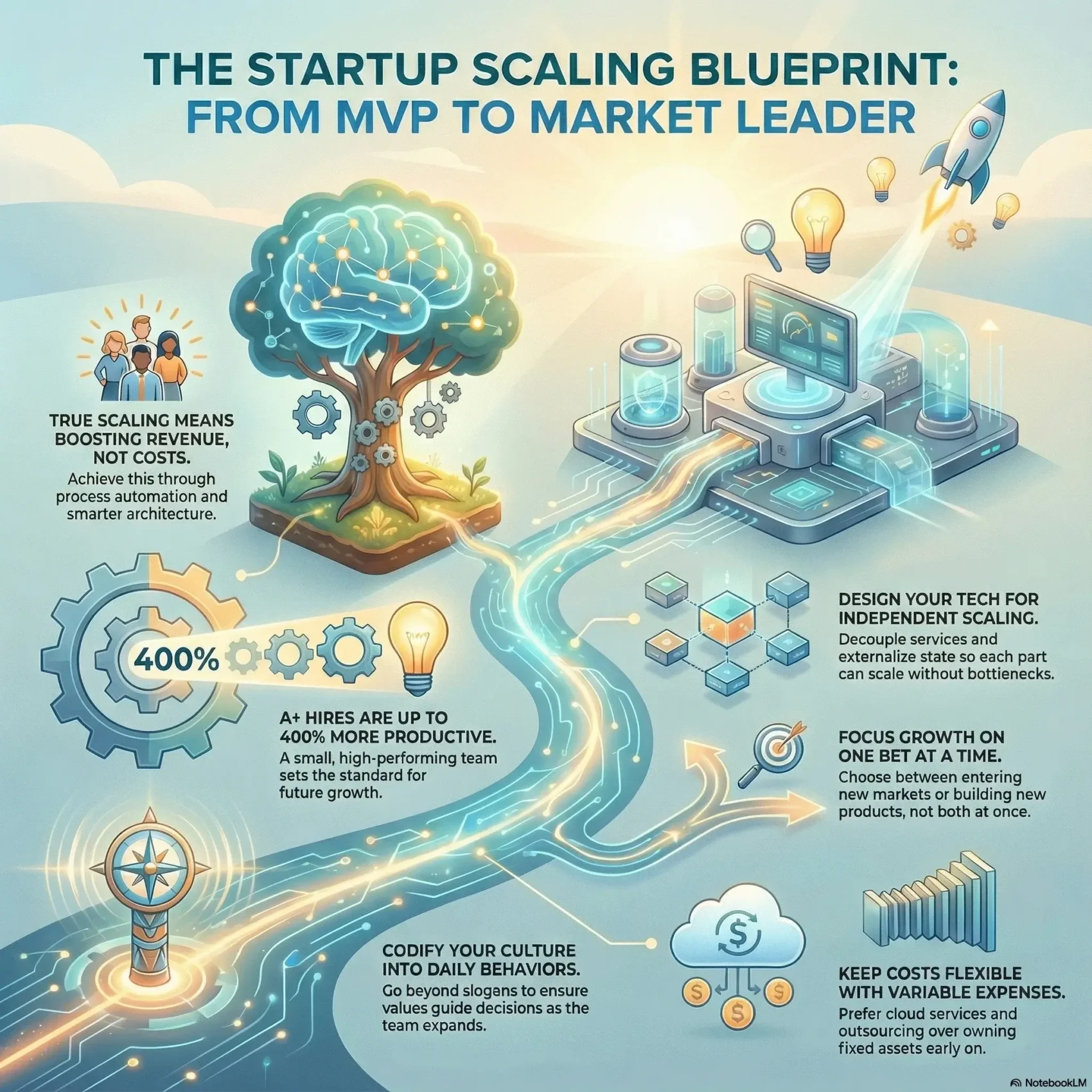
Last Updated on January 16, 2026
You’re building a business and you want growth without breaking the model. This guide gives a friendly, practical roadmap to raise performance and revenue while keeping costs flexible.
Scaling here means increasing capacity to meet demand and drive revenue without a proportional cost jump. We show how to tell growth from true scalability, set clear goals, and pick the right approach when time is right.
You’ll learn where most companies stumble—people, process, culture, systems, and funding—and how to spot those challenges early. We pair proven business frameworks with concrete tech patterns like autoscale and stateless design so your company can handle load and protect customer experience.
By the end, you’ll have a short, actionable plan to decide when to scale, how to use data and resources wisely, and how to measure results that map to your market and customers.
Key Takeaways
- Define scalability vs. simple growth so you act at the right time.
- Use metrics and data to trigger capacity changes, not guesswork.
- Keep costs flexible with cloud and third-party services to preserve agility.
- Align teams, resources, and processes to protect performance and customers.
- Lean on proven frameworks and architecture patterns to reduce common risks.
Why scaling from MVP to market leader requires a different mindset
Moving from an MVP to a market leader forces you to trade pure speed for repeatable systems and clearer choices. You must align your product, ideal customer, and internal processes before you expand volume. Without that alignment, effort multiplies while results stall.
Rayport’s Six S Framework—Staff, Shared values, Structure, Speed, Scope, Series X—helps you focus on people and culture as much as tech. Make founders’ implicit values explicit so culture supports, not blocks, growth.
Technical debt grows fast when you push features. Pay it down while you build durable systems. Favor decoupled components, avoid singletons, and keep services stateless with external session state so each part can scale independently.
“You move from founder heroics to enabling your team to repeat success without you in every decision.”
- Shift from “ship fast” to disciplined management that balances speed and long-term requirements.
- Use data to pick what to expand and when, focusing on real constraints over pet projects.
- Align people, processes, and strategy so each step improves customer outcomes.
For guidance on leadership that supports this change, read more about future leadership skills.
Scaling vs. growing: how to know when you’re truly ready to scale
Before you add headcount or servers, confirm your company can increase output without a matching jump in costs. That shift separates simple growth from sustainable scale.
What “scale” really means for your business model and costs: It’s increasing revenue or capacity while keeping marginal costs low. You get this by tightening processes, adding automation, or re-architecting services so each dollar of spend yields more performance.
Readiness signals to watch
Use data to validate readiness. A common rule of thumb is six months of sustained revenue growth.
Look for worn-out teams, a CRM pipeline you can’t close fast enough, or repeat missed delivery SLAs. Those signs mean demand outpaces throughput.
Real-world example and trade-offs
- Hiring more reps: Faster market coverage but higher fixed costs and onboarding time.
- Investing in AI tools: Can double qualified leads with the same employees and keep costs variable.
- Technical requirement: Vertical upgrades boost one server’s power; horizontal adds instances for resiliency and elasticity.
“Size the gap between demand and your team’s throughput, then choose the mix of people and tech that protects margins.”
In your plan, map goals to outcomes and tie each step to data. That keeps costs aligned with results as you scale into new markets.
People, processes, and culture: build your scalable core
Invest in talent, habits, and simple systems now so your company handles more work later with fewer headaches.
Staff first: hire A+ employees early. High performers can be 400% more productive than average and even up to 800% as roles grow complex (McKinsey). A small group of top hires sets standards and recruits others who match those norms.
Shared values
Document culture as behaviors you expect, not slogans on a wall. Make values visible in hiring, feedback, and daily rituals so the team keeps consistent habits during rapid growth.
Structure and delegation
Delegate decisions and create specialized roles so work moves faster. Use onboarding to transfer context and set expectations. Clear ownership prevents decision gridlock and misaligned incentives.
Speed with discipline
Keep a sustainable pace by tracking technical debt openly. Use an explicit register, assign owners, and schedule paydown cycles so performance stays high while you move fast.
“A few exceptional hires multiply impact; structure and processes let that impact scale without founder bottlenecks.”
- Raise the talent bar: a small A+ team outweighs a larger average one.
- Codify behaviors: culture that repeats beyond founders avoids fragmentation.
- Design for leverage: clear roles and onboarding multiply each hire’s value.
Systems and scalability: design your technology and data for performance
Designing systems that meet real demand starts with clear boundaries and measurable load signals. Choose an approach that fits your workload: vertical for indivisible components; horizontal for distributed services that need resilience and elasticity.
Partition data and define explicit scale units (for example, 100 VMs + 2 queues + 3 storage accounts). This groups resources that grow together and spreads work so performance stays predictable as capacity rises.
Decouple and externalize state
Avoid singletons and client affinity. Use fan-out/fan-in, pipes-and-filters, and asynchronous messaging so any instance can handle a request.
Put session state in distributed caches or databases and pick a consistency level that matches your data model to reduce locking and improve throughput.
Autoscale with guardrails
- Pick meaningful metrics: CPU, memory, queue depth, SQL query rate, or HTTP queue length.
- Set hard boundaries, add buffers for spikes, and configure hysteresis to prevent flapping.
- Use Deployment Stamps to add scale units as repeatable capacity increases.
“Design for small, measurable steps—then grow capacity in repeatable chunks.”
Align your infrastructure and systems so the technology and data paths help ensure steady performance and predictable capacity as demand grows. For trends that affect these choices, see cloud capacity trends.
Product scope and market expansion: focus your growth opportunities
A clear plan for what to expand and what to keep stable keeps customers happy while you test growth. Pick a single path at a time so your company does not dilute effort or burn cash on multiple bets.
Extend existing products vs. build new services
Extend first when the market for your current product shows repeated demand in new regions or segments. That keeps delivery models and operations familiar while you grow.
Build new services when current customers ask for adjacent offerings that increase lifetime value. Use quick pilots to prove product-service fit before major investment.
Balance speed and scope: pay down tech debt without losing momentum
Schedule short tech-debt sprints that align with product launches. This prevents fragile systems from capping growth and lets you move fast safely.
Use customer and competitor data to rank opportunities. Avoid heavy fixed-cost commitments, like owned fulfillment, until demand and margins are clear.
- Map options: new markets with the same product or new services for current customers—pick one and test.
- Light experiments: run low-cost pilots to validate demand before committing to higher costs.
- Compound strengths: prioritize scope that leverages your team and tech for the biggest wins.
- Protect reliability: schedule paydowns so scope moves don’t degrade performance.
- Use data: quantify opportunities and align costs to the most likely business wins.
“Validate demand with small tests, then expand delivery once the plan and margins are proven.”
Financing and cost structure to support growth without waste
Tie every funding decision to a clear, measurable business requirement before you commit cash. That keeps your plan honest and prevents premature fixed costs that can slow your company later.
Keep costs flexible
Prefer variable over fixed expenses until your unit economics prove out. Choose cloud and third-party services instead of owning fulfillment centers or data centers early on.
Variable costs let you adjust capacity and protect cash if demand shifts. Founders who convert spend to fixed too soon lose agility and raise burn.
Align capital with hiring and infrastructure
Make your financing plan match hiring ramps, infrastructure choices, and process work. Use funding rounds to unlock the resources that remove real constraints—not to mask poor performance.
- Buy vs. build: define requirements for when to convert variable spend into fixed assets.
- Resource allocation: target the highest-return constraints first.
- Protect capacity: keep cash buffers so the company can scale up or down safely.
“Use capital to enable proven capacity, not to subsidize experiments that hide weaknesses.”
Customer experience, measurement, and operating cadence for sustained scalability
Keep your customer experience steady as volume rises by mapping every handoff from lead to renewal. Blueprinting end-to-end workflows preserves quality and protects customer outcomes as demand grows.
Design end-to-end workflows that protect quality as volume grows
Document each step customers travel—lead capture, onboarding, support, renewal—and assign clear owners. That makes it easier to spot bottlenecks and keep teams sane.
Use simple process checks so employees follow the same path. Consistent processes reduce errors and improve retention for your customer base.
Test scaling: load tests, Deployment Stamps, and background task offloading
Run load tests to verify capacity before spikes arrive. Combine Deployment Stamps with competing consumers to offload CPU and I/O-heavy work to background jobs.
Drive autoscale with meaningful metrics—queue depth, latency, error rate—and add buffers to avoid flapping. This keeps the user path fast and protects performance.
Risk assessment rhythms: prevent common scaling challenges before they spike
Set an operating cadence: weeklies for tactical fixes, monthlies for performance reviews, and quarterlies for architecture decisions. Link dashboards for throughput, backlog, and latency to clear thresholds.
- Blueprint processes from lead to renewal so quality holds as volume grows.
- Measure throughput and latency, then tie metrics to business results.
- Run recurring risk assessments to help ensure issues never become customer-facing failures.
“Monitor experience and throughput to protect the pipeline and keep customers returning.”
scaling strategies you can apply today
Start with quick wins that free your team: automate routine HR, finance, and GTM tasks so people can focus on product, customers, and growth.
Invest in automation across HR, finance, and GTM to free capacity
Use AI-driven recruiting to shortlist candidates, automate payroll, and link invoicing to bookkeeping. These moves cut errors and save hours each week.
The result: fewer manual handoffs, faster hiring, and more time for strategic work that lifts performance.
Use data-driven planning: scenarios, constraints, and service scaling boundaries
Model demand scenarios and map each service’s scale limits so you avoid surprise failures. Tie plans to real metrics—queue depth, latency, and cost per transaction.
That approach helps you prioritize resources and protects customer experience when demand spikes.
Outsource non-core functions and use PaaS to support growth efficiently
Move payroll, legal, and admin to trusted providers and adopt PaaS for app hosting. Outsourcing reduces infrastructure drag and keeps overhead variable.
This lets your team focus on product-market fit while platforms handle load balancing and state management.
Set goals and KPIs that connect people, processes, technology, and customer results
Define a few clear KPIs: time-to-hire, invoice cycle time, throughput, and retention. Link them to team targets and weekly operating reviews.
- Quick wins: automate one HR and one finance task this month.
- Plan with data: run a scenario test for a 3x demand spike.
- Rollout example: pilot PaaS for one service, then outsource back-office work in parallel.
“Apply small, measurable changes that free resources and help ensure your business can handle more demand without breaking operations.”
Conclusion
Finish by aligning your team, infrastructure, and data so growth delivers consistent results.
Use a clear framework (for example, the Six S) to focus the areas that matter most. Apply architecture patterns such as decoupling, externalized state, and autoscale with guardrails so systems meet demand without surprises.
Keep goals tight: pick one product service or market opportunity, test demand with quick pilots, then expand capacity only when metrics prove the case.
Measure often, refine requirements, and protect customer experience as you scale. This way your business keeps performance high, margins intact, and teams aligned for rapid growth.