Tools
Tools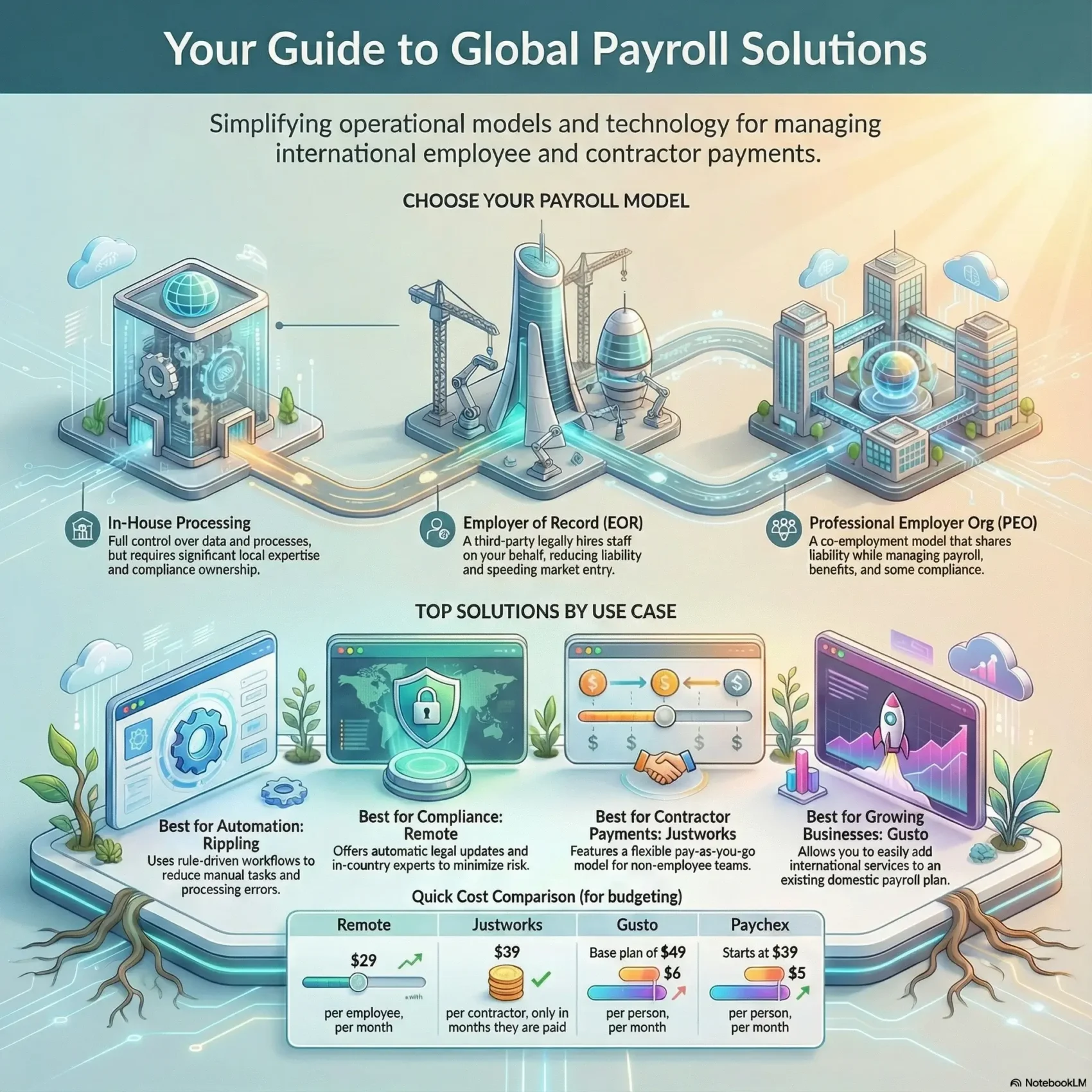
Last Updated on January 24, 2026
Managing pay across borders shouldn’t be a guessing game. You need clear processes that keep employees paid on time and help your business stay compliant. This intro shows how modern platforms centralize payroll, streamline payments, and cut manual work.
You’ll learn which services fit your needs, from contractor-focused tools to enterprise-grade platforms. Names like Rippling, Deel, Gusto, Remote, and Workday show different approaches to automation, local rules, and support.
In short: pick a model that matches your growth stage, whether you pay a few contractors or thousands of employees across many countries. Use centralized portals, real-time analytics, and in-country experts to reduce risk and free up time for strategy.
Key Takeaways
- Centralize payroll: one hub reduces errors and speeds up payments.
- Match services to goals: contractor pay differs from full-employee management.
- Watch compliance: local experts and automatic rule updates matter.
- Predict costs: per-employee or per-contractor pricing helps budgeting.
- Scale thoughtfully: choose providers that integrate with your systems.
What You’ll Get From This Product Roundup on Global Payroll Solutions
Expect a concise comparison that highlights payments, compliance, and reporting across top providers. You’ll see how vendors like Rippling, Deel, Remote, Gusto, and Workday differ on automation, pricing, and support.
This roundup saves you time. You get apples-to-apples views of services so you can shortlist vendors that match your needs now. Pricing notes include per-contractor and per-employee models, plus typical add-ons.
We focus on the capabilities that matter most to your business: accurate payroll execution, clear data visibility, and fast payments. You’ll learn which platforms integrate with HRIS and accounting tools to cut manual work.
- Side-by-side features: compliance, onboarding, and integrations.
- Pricing clarity: sample rates and cost models for budgeting.
- Support and rollout: onboarding options and local expertise.
- Reporting: real-time analytics to spot trends and control costs.
- Fit guidance: match providers to team size and complexity.
Understanding Global Payroll and Your Commercial Options
Choosing the right model starts with one question: do you want maximum control or faster market entry?
In-house processing fits firms with mature systems and local expertise. You keep autonomy and data control, but you also own compliance, tax filings, and overhead for multiple countries.
EOR (Employer‑of‑Record) vendors take on legal hiring, contracts, payroll processing, and compliance with tax and labor laws. That speeds expansion and cuts liability, but it can be pricier and limit autonomy.
In-house vs. EOR vs. PEO
PEOs create co‑employment: they manage payroll, benefits, and some compliance while you retain day‑to‑day control. You share liability, which can be a middle ground on cost and risk.
Employees vs. international contractors
Classification rules vary by country. Control, role scope, and how you pay influence whether someone is an employee or a contractor. Misclassification risks fines under local regulations.
- When to choose EOR: rapid entry or high‑risk countries.
- When to stay in‑house: you have scale and local teams.
- Hybrid: keep core processing internally and outsource complex markets.
Tip: map budget, hiring timelines, and compliance needs to pick the right service and avoid costly mistakes.
How We Evaluated the Best Global Payroll Providers
Here we lay out the methodology that turned vendor claims into measurable scores and clear recommendations.
Features and compliance weighting: We gave features the largest share of the score (44%). That weighted tax compliance, contractor payments, analytics, tax filing and payments, automated payroll, secure portals, onboarding, and expense reimbursement most heavily.
Expert score, value, and sentiment: Our expert score made up 20% (standout features 8%, value 8%, ease of use 4%). Value accounted for 16%. Consumer sentiment—an aggregate from three major review sites—counted for 15% to reflect real user experiences.
Hands-on testing and real-world fit
We started with 31 vendors, narrowed to 12 candidates, and ran deep tests on the top 10 providers. Tests verified reporting, secure portals, onboarding flows, and expense handling using live data and workflows.
- Tax filing and payment accuracy influenced features scores.
- Support channels and knowledge base added service credit.
- Mobile app accessibility got minor but important weight.
Outcome: This framework helps you read each score confidently and mirror the same criteria in your RFP to pick the right provider for your business.
Quick-Glance Picks: Best Global Payroll Solutions by Use Case
Use this quick snapshot to match each provider to the core strength you need for fast, compliant team pay.
Rippling — Best for automation. Ideal if you want prebuilt flows and time-saving rules.
Justworks — Best for international contractor payments. Pay-as-you-go at $39 per contractor only when you pay them.
Gusto — Best for growing businesses. Core plan and add-on international services at $49 + $6 per person.
Remote — Best for compliance. $29 per employee with automatic rule updates and in-country experts.
TriNet, Paylocity, Deel, Workday, UKG One View, Paychex — each earns a short callout:
- TriNet: partner coverage across 180 countries.
- Paylocity: Blue Marble for consolidated payments in a single currency.
- Deel: $29 per employee with 24/7 local support.
- Workday: deep integrations with hundreds of systems.
- UKG One View: management-first platform for multinational teams.
- Paychex: all-in-one SMB bundle at $39 + $5 per person.
How to use this list: match your budget, desired services, and target countries to pick demos that test integrations, FX handling, and end-to-end payments.
Rippling: Best for Global Payroll Automation
Rippling compresses routine pay tasks into rule-driven flows so your team spends less time on manual entry.
Why it stands out for preconfigured and custom automations
Prebuilt and custom workflows remove repetitive steps each cycle. That saves time and reduces human error when you run payroll.
The platform runs automated checks and flags anomalies before you finalize runs. You get faster closes and fewer off-cycle fixes.
Coverage and contractor payments in 185 countries, 50 currencies
Rippling supports contractor payments across 185 countries and 50 currencies, so cross-border payments are simpler from day one.
- You’ll see how preconfigured and custom automations cut manual work every cycle.
- Automation-driven checks reduce processing errors and keep accuracy high.
- System-driven workflows surface anomalies before you run payroll, helping you stay on schedule.
- Streamlined payments and broad currency coverage make paying international contractors straightforward.
- Entry pricing starts near $20 — weigh that against gains in speed, accuracy, and reduced workload for your services team.
Justworks: Best for International Contractor Payments
Justworks focuses on contractors, giving you flexible billing and fast onboarding for non‑employee teams. Its pay‑as‑you‑go model charges $39 per contractor in the month you run payments, so you only pay when work is active.
Pay-as-you-go contractor pricing and onboarding support
The platform includes self‑service onboarding tools that speed setup and reduce back‑and‑forth. That helps your teams get contractors ready for payroll and compliant documentation.
- You’ll see how month‑by‑month billing lowers costs when contractor activity fluctuates.
- Onboarding tools simplify tax forms, ID checks, and record keeping for hired contractors.
- Justworks’ contractor‑first services streamline processes in supported countries, even if coverage is narrower than some rivals.
- Access to live support guides you through setup, policies, and payment questions.
Bottom line: If you hire many contractors and need predictable per‑contractor costs plus fast onboarding, Justworks is a focused service that keeps payments practical and compliant.
Gusto: Best for Growing Businesses Expanding Globally
Gusto makes it simple to add international capabilities to the payroll you already run today. If you use Gusto for domestic staff, you can layer on international services rather than rebuild systems.
Adding international services to existing payroll
Why this matters: you keep familiar workflows while adding cross‑border contractor payments and reporting. That lowers friction as your headcount grows.
- Pricing: base plan starts at $49 plus $6 per person — factor this into monthly costs as you add countries.
- You must buy a payroll plan to pay international contractors, which helps centralize configuration and reporting.
- Gusto is designed as a steady growth path for small business teams moving from domestic to global payroll.
- Consider trade‑offs: simplicity and tight HR integration versus advanced features you might need later.
“Layering international support onto an existing payroll can speed rollout and reduce setup errors.”
Use Gusto if you want a friendly, stepwise approach that aligns with your management goals and existing HR workflows.
Remote: Best for International Compliance
Remote centers compliance into a single workflow so your team never misses a legal or tax update. The platform combines automatic rule updates with local expertise to translate regulations into concrete payroll steps you can act on.
Automatic rule updates with in‑country experts
Automatic updates keep your processes current when labor laws and tax regulations change in each country. That reduces manual policy work and lowers legal exposure.
Monitoring changes via Remote Watchtower
Remote Watchtower proactively tracks regulatory shifts and flags required actions. You get notifications and system updates so deadlines and filings aren’t missed.
- Compliance made automatic: system updates enforce new rules across your payroll runs.
- Local interpretation: in‑country experts turn complex laws into clear steps for your team.
- Risk reduction: IP Guard aligns intellectual property transfers with local legal needs.
- Value check: at $29 per employee, weigh the cost against reduced penalties and less manual work.
Bottom line: If your risk tolerance is low and your country footprint is expanding, Remote’s compliance-first services help you stay current without constant hands-on monitoring.
TriNet: Best for EOR and PEO Integrations
If you need a mix of EOR and PEO offerings, TriNet’s partner network gives you flexible hiring paths. The model lets you expand staff across markets without forming local entities.
Global workforce coverage via top partner network
TriNet delivers payroll outsourcing through partnerships that span 180 countries. That access helps you hire where you need headcount fast.
When to pick EOR vs. PEO: choose EOR for low-risk, fast entry and PEO when you want co‑employment and shared administration. Match the choice to the type of workforce you deploy.
- Connected systems: TriNet ties payroll to HR admin so data and reporting stay consistent.
- Speed to market: leveraging established providers accelerates compliant setup in new countries.
- Trade-offs: outsource more for speed and compliance or keep regional control for strategic needs.
“Map TriNet’s coverage to your rollout plan and prioritize countries where you need quick, compliant set-up.”
Paylocity: Best for Treasury Management and FX
If treasury headaches and multiple bank fees slow you down, Paylocity’s Blue Marble partnership can help.
Blue Marble consolidates international payments so you can make transfers from a single currency. That reduces FX complexity and cuts bank fees when you pay teams across several countries.
Why this matters: paying from one currency streamlines reconciliation and improves treasury management for finance teams handling many transfers.
How the platform helps your finance team
- Consolidated payments: fewer cross-border transactions reduce FX exposure and banking costs.
- Simpler reconciliation: single-currency runs make audits and month-end closes faster.
- Scales with you: best fit when you manage payroll across multiple countries and currencies, not ideal for very small overseas footprints.
Decide based on scale: if you run pay in many markets, the deeper treasury controls and approval workflows can cut delays and errors as you grow.
Deel: Best for Global Workforce Expansion
Deel streamlines hiring across borders by combining 24/7 support with deep system connectivity. You get round‑the‑clock help and in‑country experts who guide setup, compliance, and first payroll runs so hires are ready on day one.
24/7 support and local experts
Reliable support is available any time you need it. Local professionals handle tax forms, filings, and rules so you avoid common setup mistakes.
Enterprise-grade integrations and open API
Deel’s platform connects to 110+ integrations and is Workday GPC‑certified. It links SAP SuccessFactors, UKG, HiBob, BambooHR, and more so your systems stay in sync.
- You’ll see how 24/7 support and local experts help you expand your workforce confidently.
- 110+ integrations keep HR, finance, and operations aligned across systems.
- The platform scales across 120 payroll countries and 150+ EOR regions.
- At $29 per employee, weigh cost versus rapid market entry and broad services.
- Open APIs connect payroll to ERP, accounting, time, LMS, expenses, and benefits.
“Reliable support and in-country expertise reduce setup friction and day-one compliance risks.”
Workday: Best for Third-Party Payroll Integrations
For teams moving from SMB tools to enterprise-grade management, Workday offers the integrations you’ll rely on. The platform links payroll to hundreds of third‑party systems so your HR, finance, and ops data live in one place.
Enterprise-grade links to hundreds of systems
Workday focuses on consolidated data and tight controls. That means changes in HR flow directly into payroll runs without rekeying, cutting errors and cycle time.
- Connected data: integrations sync HR, finance, and ops to support smarter decisions.
- Fit for scale: ideal as you move from SMB tools to mid‑market and enterprise management needs.
- Streamlined workflows: updates in one system propagate to payroll and downstream services automatically.
- Better reporting: consolidated data improves forecasting, governance, and audit trails.
- Provider ecosystem: evaluate whether Workday’s platform depth aligns with your IT roadmap and compliance stance.
“Centralizing core employee data reduces manual work and gives finance cleaner inputs for forecasting.”
Bottom line: choose Workday if you need enterprise integration across systems, standardized processes for multi‑country operations, and a single source of truth for payroll and management data.
UKG One View: Best for Global Payroll Management
When leaders need fast answers about headcount and costs, UKG One View provides unified visibility across regions. The platform is built to help you manage payroll centrally while supporting complex, multinational operations.
Managing distributed multinational teams
Centralized payroll management simplifies operations across countries so your HR and finance teams work from the same data. That reduces reconciliation time and shortens close cycles.
Best for midsize and larger enterprises: the system scales to match complex headcounts and advanced reporting needs you’ll face as you grow.
- You’ll see how unified dashboards help leadership manage costs, headcount, and compliance obligations across regions.
- Standardized workflows cut errors and keep every payroll cycle on schedule.
- Country coverage, analytics, and visual reporting support better decision‑making at scale.
Evaluate fit: check whether UKG’s services align with your internal processes and reporting expectations before you commit. If you need consolidated control and clearer governance, One View often delivers the oversight larger teams require.
“Consolidation and consistent workflows reduce mistakes and speed up month‑end closes.”
Paychex: Best All-in-One for Global Small Businesses
For small firms testing overseas hires, Paychex combines recruiting, benefits, and payroll into a single, budget-friendly package. This makes it easier to start hiring internationally without building many systems first.
Bundled HR, recruiting, and international payroll
Paychex bundles HR and recruiting with international payroll so you manage fewer platforms while you learn cross-border hiring. That reduces admin and speeds onboarding for your first hires.
Pricing and value for small business growth
Entry pricing starts at $39 plus $5 per person, which helps you pilot hires without a large upfront investment. You’ll see whether the service fits before you commit to heavier customization.
- You’ll see how bundled HR, recruiting, and payroll simplify an all-in-one setup for hiring abroad.
- You’ll understand the budget-friendly pricing that helps your business test expansion with limited risk.
- You’ll learn how bundled benefits and HR tools streamline onboarding and ongoing payments for initial overseas hires.
- You’ll evaluate whether Paychex fits your provider preferences when you want fewer systems to manage.
- You’ll map a path to scale from pilots to broader coverage as your team grows.
“If you prefer a single vendor to reduce complexity early, Paychex offers a practical entry point.”
Global payroll solutions: Features That Matter Most Right Now
Pick features that stop errors before they happen and give you fast, reliable visibility. When you evaluate platforms, look for controls that reduce risk and speed decision‑making.
Compliance, tax filing, analytics, and reporting
Compliance checks, built‑in tax filings, and on‑time remittances cut exposure and fines. You want automated validations during each run.
Good reporting turns payroll data into actionable insights for finance and HR so you catch anomalies early.
Secure portals, onboarding, and expense reimbursement
Role‑based portals protect sensitive records while speeding collaboration. Smooth onboarding and integrated expense reimbursement remove duplicate work.
Support for multiple countries, currencies, and payment rails
Choose services that handle diverse countries and currencies so payments settle reliably. Deep automation reduces manual steps and lowers operating cost.
“Real‑time dashboards help you fix variances before they affect pay day.”
- Built‑in tax and remittance workflows
- Custom reports in local currency
- Secure client portal with real‑time analytics
Implementation, Timelines, and Total Cost of Ownership
A realistic timeline turns a complex rollout into manageable weekly milestones everyone can follow. You’ll want a clear plan that names owners, deadlines, and validation points so the implementation moves smoothly.
From zero to paid: plan for a ten-week go‑live. IRIS Global typically gets payroll live in about 10 weeks, aligning your data, banking, and local checks to reach the first paid run.
Typical 10‑week go‑live
Split the 10 weeks into discovery, data collection, testing, parallel runs, and cutover. Assign internal owners for data, approvals, and bank setup so nothing stalls the schedule.
Pricing models to forecast TCO
Compare per‑employee, per‑contractor, and monthly subscriptions. Remote and Deel list around $29 per employee per month, while Justworks charges $39 per contractor only in months you pay them. IRIS Global offers a centralized portal and starts near $300/month for subscription services.
Scaling across countries with local experts
Local experts accelerate onboarding by translating statutory needs into specific tasks. IRIS has compliance experts in 135+ countries who help register entities, set up banking, and validate tax items faster.
- Plan milestones: discovery, test runs, parallel payroll, first live payment.
- Map rollout: prioritize banking readiness and statutory registrations by country.
- Control costs: model month‑over‑month charges as employee and contractor counts grow.
- Assign roles: owners for data, testing, and approvals keep the process on schedule.
“Set parallel runs and clear approval gates to validate accuracy before full cutover.”
For a practical cost comparison when evaluating platforms and integrations, see this short guide on accounting tools and expense workflows: Expensify vs QuickBooks.
Integrations, Data, and Automation for Error Reduction
When data flows cleanly between systems, your team spends less time fixing issues and more time analyzing trends. Connected tools cut manual entry and keep a single source of truth for every pay run.
Workday GPC, SAP SuccessFactors, UKG, HiBob, BambooHR
Deel offers 110+ integrations and is Workday GPC‑certified, so you’ll tie employee records to core HR platforms like SAP SuccessFactors, UKG, HiBob, and BambooHR.
That connection eliminates duplicate updates and reduces processing errors that often creep in during copy‑and‑paste work.
Open APIs for ERP, accounting, time, LMS, expenses, benefits
You can also use open APIs to sync with ERP, accounting, time systems, LMS, expense tools, and benefits providers.
Automated validations check inputs and flag anomalies before you run payroll, lowering the chance of mispayments and last‑minute fixes.
Centralized portals, real‑time analytics, and triaged tasks
IRIS Engage centralizes approvals, triaged tasks, and deadlines in one portal. Dashboard indicators surface issues and guide your team to what needs attention first.
- You’ll connect payroll data to HR and finance systems to stop manual reentry.
- You’ll leverage open APIs to keep workflows synchronized across systems.
- You’ll use real‑time reporting and analytics to spot trends, outliers, and compliance gaps early.
“Make the platform your single source of truth so changes propagate once and accurately.”
Evaluate vendor certifications like Workday GPC to ensure secure, future‑proof integrations that support good data management and smoother processing.
Compliance and Risk: Reducing Penalties and Payment Errors
Keeping legal shifts from derailing payroll runs starts with continuous monitoring and fast, practical updates.
Staying current with evolving labor and tax laws
You’ll keep pace with changing laws and regulations by using services that monitor and apply updates automatically.
Remote Watchtower and in‑country experts turn rule changes into concrete steps so filings and remittances happen on time.
Insurance value: cost avoidance through accuracy and timeliness
Think of accuracy as insurance: timely runs prevent steep fines from misclassification or late filings.
- You’ll reduce penalties when filings, payments, and reporting align with local tax rules every cycle.
- You’ll adopt controls that cut errors, using pre‑run audits and post‑run reconciliations to catch variances.
- In‑country experts translate complex steps and keep documentation ready for audits.
- IP Guard and data protections limit legal exposure when you operate across jurisdictions, protecting your companies and staff.
“Proactive alerts and clear dashboards let you prioritize tasks that truly reduce compliance risk.”
Who Should Choose Which Provider?
Start by listing what must work on day one, then pick a provider that covers those bases cleanly. That keeps your evaluation practical and focused on real requirements.
Small business vs. scaling mid‑market vs. enterprise
For a small business, simplicity matters most. Pick services that reduce admin and get hires paid fast.
Gusto and Paychex are good fits when you want bundled HR and easy setup.
As you scale, look for vendors like Deel or Remote that support broader workforce footprints and more countries.
Large enterprises often need deep integrations and strict controls. Workday and UKG suit complex data and many employees.
Contractor-first teams vs. full-time international staff
If your team is contractor-first, Justworks’ pay-when-you-pay model keeps costs tied to activity. That helps control cash flow while you test markets.
When you hire full-time staff across countries, choose a partner that handles tax, filings, and benefits at scale—TriNet or Deel often fit that need.
- Match size to strengths: Paychex/Gusto for small business simplicity; Deel/Remote for expansion; Workday/UKG for enterprise control.
- Align to workforce mix: avoid buying enterprise features if you only need contractor pay.
- Document requirements: integrations, support levels, countries covered, and SLAs so providers can respond accurately.
- Plan operations: factor in pay cycles, approval flows, and who owns cutover tasks for a smooth first payroll.
- Roadmap: start with essential coverage and add analytics and automation as your team grows.
“Match your immediate hiring needs to a provider that solves day‑one problems, then scale features as you grow.”
Conclusion
Conclusion
Finish by focusing on the trade‑offs that matter when you expand into new markets. Match a provider’s strengths—automation, compliance, contractor support, or integrations—to your immediate goals and budget.
Remember: weigh per‑employee or per‑contractor pricing against the level of support and the expected time to value. Plan for an average ten‑week implementation and use centralized portals to keep approvals and data in one place.
Prioritize demos from vendors with the right coverage and in‑country experts. That approach reduces risk, speeds accurate payments, and helps your teams scale across the world with confidence.