Tools
Tools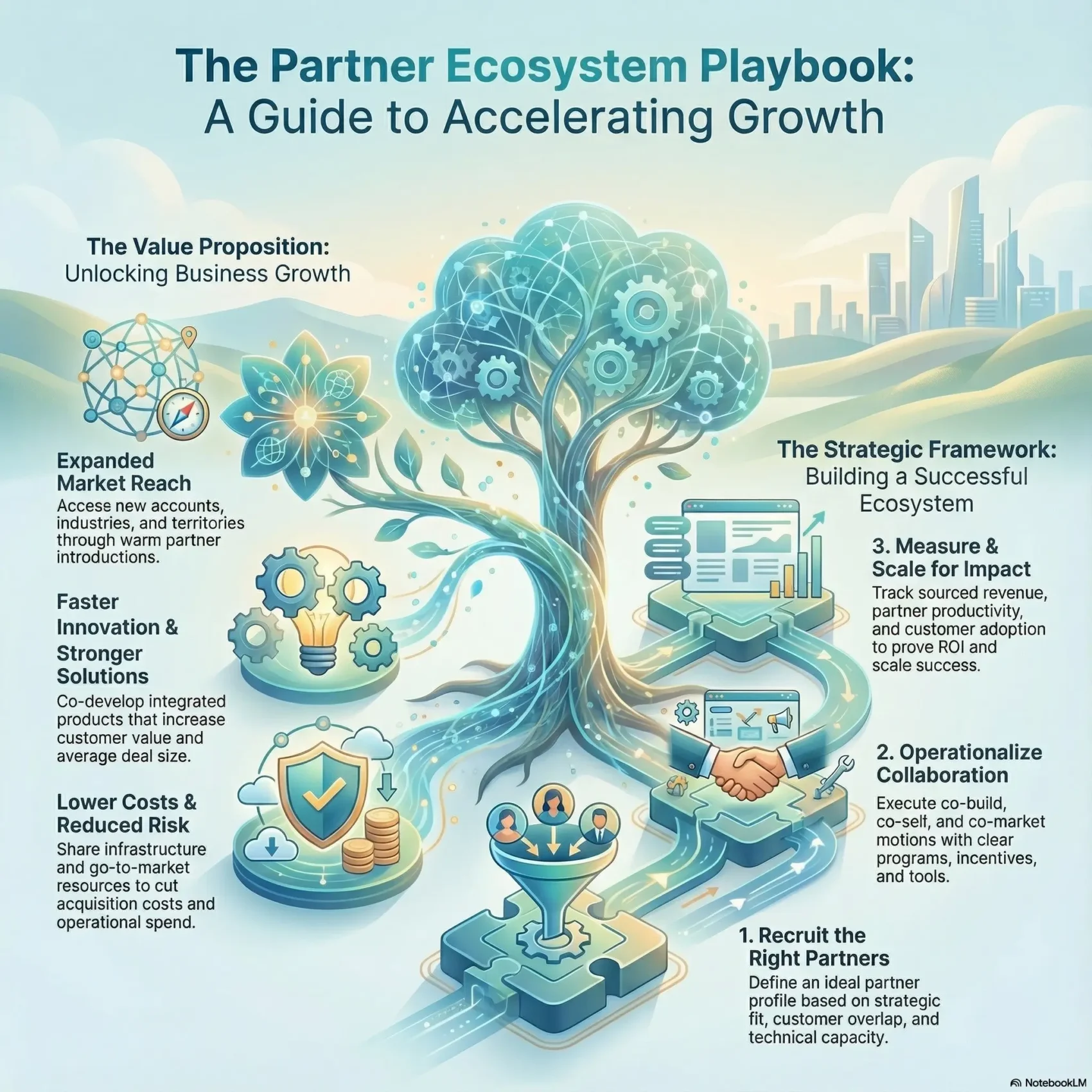
Last Updated on December 13, 2025
A partner ecosystem is a practical network of organizations that work together to co-create offerings, expand reach, and deliver more value to your customer.
In simple terms, it moves beyond one-off deals and centers on long-term collaborations that share outcomes across companies. This approach lowers risk while speeding innovation and opens new channels for growth.
Why it matters now: industry data shows ecosystems will drive a large share of global sales by 2025, and firms like Salesforce and Microsoft use certifications, marketplaces, and co-selling to scale impact.
What you’ll get in this guide: clear steps to select the right partners, set governance with data-driven KPIs, and bundle services and integrations so offerings feel seamless to customers.
Key Takeaways
- Learn a practical definition and why long-term alliances outperform ad-hoc deals.
- See how ecosystems unlock reach, expertise, and cost savings for your business.
- Understand market scale: major value projections from Accenture and McKinsey.
- Preview operational models used by top companies to make partnerships scalable.
- Get a roadmap to choose partners, track outcomes, and turn collaboration into measurable success.
Partner ecosystem fundamentals: what it is and why it matters now
A partner ecosystem is a multi-company system that connects complementary capabilities so buyers get complete solutions without piecing products together themselves.
How it creates customer value: by bundling products, integrating services, and coordinating support, these networks reduce friction and shorten time to value.
Why the timing is urgent
Market signals are clear: most digital networks include firms from four or more industries. Sales teams report rising impact from partner selling—84% say it matters more than a year ago. McKinsey and Accenture forecast ecosystems will drive a huge share of global sales and economic value soon.
Programs versus broader networks
Think of programs as structured tracks for recruiting, certifying, and rewarding collaborators. The larger system spans many partnership types and use cases.
- Scale: networks bring new markets and capabilities.
- Governance: programs provide rules, incentives, and measurement.
- Tools: emerging management software links account mapping, attribution, and co-selling data into one layer.
“Ecosystem management platforms are becoming a distinct category in the channel software stack.”
Business benefits you can unlock with a mature ecosystem
Scaling through trusted collaborations lets you reach new markets faster and with less risk. A mature alliance model delivers clear business benefits you can measure: lower costs, greater reach, and stronger customer outcomes.
Expanded reach and warmer paths to customers
You’ll tap partners’ introductions to enter new accounts, industries, and territories. This reduces cold outreach, shortens sales cycles, and opens immediate opportunities for qualified leads.
Faster innovation and bundled solutions
Co-development pairs your R&D with specialized expertise from other companies. The result: integrated products and services that add value and increase average deal size.
Lower costs, less risk, and stronger retention
Sharing infrastructure and go-to-market resources cuts CAC and operational spend. You also spread execution risk when entering unfamiliar markets.
- Increase revenue through co-sold and co-marketed deals.
- Improve customer experience with end-to-end, full-stack offerings.
- Build credibility via endorsements and shared certifications.
“Ecosystems help reduce sales costs and drive higher retention through bundled solutions.”
Common challenges (and how you’ll overcome them)
Working with other firms often surfaces three main hurdles: finding complementary fits, building trust, and keeping strategies aligned. You’ll face complexity when multiple stakeholders, tooling, and competing priorities converge.
Finding fit and building durable trust
You’ll create an ideal partner selection rubric that scores strategic fit, customer overlap, technical compatibility, and cultural alignment. This helps you choose the right partners quickly and objectively.
Trust is deliberate: share transparency, set mutual incentives, and measure joint success to make collaboration stick.
Managing complexity and coopetition
Use a clear program charter, codified escalation paths, and joint account governance so conflicts resolve fast. Define where you’ll compete and where you’ll collaborate up front.
- Establish a single source of truth for partner data, deal registration, and content.
- Standardize playbooks for services delivery, handoffs, and customer success cadences.
- Invest in partner management capacity and tools to coordinate work and measure outcomes.
“Clear governance and shared data turn friction into predictable progress.”
Finally, use data to assess partner productivity and optimize the program over time. That keeps both companies focused on joint value and long-term success.
Types of partners and roles within your ecosystem
Different types of collaborators play distinct roles in scaling reach, building integration depth, and delivering services at scale.
Technology, ISVs, and integration alliances
Technology partners add complementary integrations and hardware or software compatibility. ISVs build apps on platforms; for example, Salesforce AppExchange hosts 7,000+ apps that extend core products.
Why it matters: coordinated roadmaps and shared APIs increase solution depth and speed time to value.
Resellers, distributors, and MSPs
Resellers expand reach and sometimes implement solutions. Distributors scale logistics and channel motion.
MSPs bundle your technology with ongoing managed services to capture recurring revenue and improve retention.
System integrators and GSIs
SIs and GSIs design and deliver large transformation programs. They bring methodology, governance, and domain expertise to co-sell and co-deliver mission-critical projects.
Advisors, referrers, and marketing allies
Consultants, listing sites, and advisor networks influence vendor shortlists and create warm demand. QuickBooks ProAdvisors is a clear example of how advisors drive selection and adoption.
- Map which types help you land vs. expand and which drive cloud migrations or vertical plays.
- Segment by capability, geography, and industry to route deals to the right providers.
- Tier and certify top performers so customers find specialists fast and reduce implementation risk.
“Well-defined roles and incentives turn a loose network into predictable growth.”
partner ecosystem strategy: your step-by-step roadmap
Begin with the outcomes you want and work backward to the roles and resources that will deliver them.
Define goals tied to pipeline, influenced revenue, adoption, retention, and customer outcomes. Factor in your customers’ needs and buying journeys so objectives are measurable and time-bound.
Define goals, customer needs, and an ideal partner profile
List the gaps in your offering and the capabilities required to close them. Create an ideal profile that scores solution fit, industry overlap, technical capacity, sales reach, and cultural alignment.
Recruit and assess fit: value exchange, alignment, and readiness
Craft outreach that states the value exchange, shows proof points, and explains the path to joint success. Use a structured assessment to validate readiness, referenceability, and commitment.
Onboard, enable, and govern: programs, incentives, and clear roles
Centralize assets in a partner portal with training, certifications, playbooks, demo scripts, and deal registration. Pair enablement with incentives and MDF to spark demand.
Govern with clear roles, territories, conflict resolution, and a regular cadence for pipeline reviews and executive check-ins.
Iterate continuously using feedback, data, and partner input
Monitor activation, sourced and influenced opportunities, win rates, and cycle time. Use those metrics and qualitative feedback to update programs, content, and incentives.
- Set specific goals tied to measurable business outcomes.
- Assess readiness before you invest time and services.
- Celebrate wins with shared case studies and scale scope as capability proves out.
“Continuous feedback and clear metrics turn collaborations into repeatable growth.”
For tactical guidance on aligning sales and channel efforts, review our piece on omnichannel strategies.
Go-to-market motions that drive revenue with partners
When you synchronise integrations, account mapping, and joint delivery, deals close faster and expand in size.
Co-build and integrate to add value and create differentiation
Co-building focuses on integrations, joint roadmaps, and bundled products that competitors can’t easily copy.
Incentive programs reward engineers and sellers for launching joint features and packaged solutions. This creates clear value for customers and increases deal size.
Co-sell and account mapping to accelerate pipeline and deal size
Use account mapping tools to find shared customers and whitespace. Platforms that introduce sellers align reps on the highest-propensity accounts.
Operationalize co-selling with clear roles, meeting cadences, and a simple intro request process so pipeline moves predictably.
Co-market and co-serve to increase adoption and customer success
Run ABM plays, co-authored content, webinars, and events to reach the right market personas with multi-solution stories.
Co-servicing pairs delivery teams and aligns success plans to ensure smooth go-lives, higher adoption, and measurable outcomes.
“Bundled solutions and warm introductions increase deal size and reduce sales cycles.”
- Structure integrations and joint roadmaps around differentiated solutions.
- Map accounts, run co-selling cadences, and track sourced and influenced revenue.
- Equip field teams with mutual action plans and a repeatable collaboration checklist.
Your technology stack for partner ecosystem management
Your stack is the operational backbone that turns collaboration plans into repeatable revenue. Choose tools that centralize enablement, control access, and make outcomes measurable. Start with a clear data model so systems share the same customer and deal truth.
PRM, CRM, and co-selling platforms as your single source of truth
Anchor the stack with CRM as the customer record and PRM as the workspace for content, training, and deal registration. Add co-selling platforms to map accounts and align sellers securely across firms.
Data analytics, attribution, and ecosystem health dashboards
Implement analytics to track sourced and influenced pipeline, engagement, adoption, and retention. Build dashboards that show activation, productivity, and coverage by segment and region.
Integrations across cloud and tools to streamline operations
Integrate email, calendars, file storage, and marketing automation so workflows run in the tools teams already use. Define field mappings, data-sharing rules, and security to keep boundaries clear.
- Automate content distribution, lead routing, and co-marketing approvals.
- Standardize templates and configs so programs scale fast.
- Provide support docs and onboarding for providers to connect systems.
“Forrester notes growth in the ecosystem management category as market demand rises.”
Measure what matters: metrics to prove ecosystem impact
Measure what moves the needle: track metrics that link collaboration to business outcomes. Clear measures show how joint work creates pipeline, closes deals, and improves customer success.
Ecosystem-sourced and influenced pipeline and revenue
Define sourced vs. influenced so you capture full impact. Track sourced pipeline, influenced opportunities, and closed-won revenue attributed to collaborative motion.
Set goals tied to pipeline coverage and revenue mix so leadership can see ROI quickly.
Engagement, activation, and partner productivity indicators
Monitor activation signals: onboarding completed, certifications issued, and enablement milestones hit.
Also track engagement: introductions made, meetings set, and account plans created. Measure productivity by opportunities created, win rates, cycle time, and attach rates for services.
Adoption, retention, and white space vs. overlap opportunity
Quantify customer adoption and retention lifts from joint deployments and integrations. Use usage and multi-solution patterns to link success to collaboration.
Run white space analysis to find untapped segments and markets. Run overlap analysis inside shared accounts to prioritize cross-sell and upsell plays.
“Use dashboards and a published battle plan so teams and partners know roles, messaging, and next steps.”
- Tier partners with data to route MDF and tailor enablement.
- Publish a battle plan with roles, messaging, and execution steps for multi-company pursuits.
- Review dashboards in regular management cadence to celebrate wins and close gaps fast.
Real-world examples to inspire your approach
Real-world company playbooks show how scaled programs turn certifications and marketplaces into predictable growth engines. You’ll see how specific firms use training, listings, and co-marketing to move products and services faster.
Salesforce and Microsoft: programs, certifications, and scale
Salesforce runs an AppExchange with 7,000+ ISV apps and a mix of consulting, ISV, reseller, and system integrator partners. That program pairs certifications, enablement, and marketing support to turn providers into revenue drivers.
Microsoft’s Partner Network does the same at enterprise scale. It offers technical support, training, and co-marketing across ISVs, SIs, MSPs, and resellers so you can tap a large customer base.
AWS and Google Cloud: networks that fuel innovation
AWS APN and Google Cloud Partner Advantage enable consulting, technology, MSP, reseller, and training providers. These cloud channels accelerate migrations and drive industry-specific services and integrations.
QuickBooks, Notion, Apple, and Squarespace: advisors, ambassadors, and marketplaces
QuickBooks uses ProAdvisors to guide small businesses and boost product adoption. Notion leverages Ambassadors and Certified Consultants plus integrations to amplify marketing and delivery.
Apple’s App Store and Squarespace’s designer marketplace show how a large app or service catalog improves customer choice and speeds launches.
- Repeatable capabilities: certifications, marketplaces, co-selling, and co-marketing.
- Collaboration patterns: joint roadmaps, enablement paths, and shared support.
- Practical next steps: adapt these elements to your program and industry to show quick wins.
“Use examples to pick the tactics that fit your company and customer needs.”
Conclusion
Start small, measure fast, and scale what works.
A focused partner ecosystem can be one of the fastest ways to add value and accelerate growth for your business.
Define clear goals, recruit a few aligned partners, and enable them with programs and services that make joint selling easy.
Operationalize go-to-market motions, invest in PRM, CRM, and co-selling tools, and track sourced and influenced revenue over time.
Hold regular reviews to align priorities, surface opportunities, and adjust incentives so collaboration compounds results.
Act now: recruit high-fit collaborators, prove benefits quickly, and use early wins to expand. This way, your company becomes a magnet for top partners and sustainable market growth.