Tools
Tools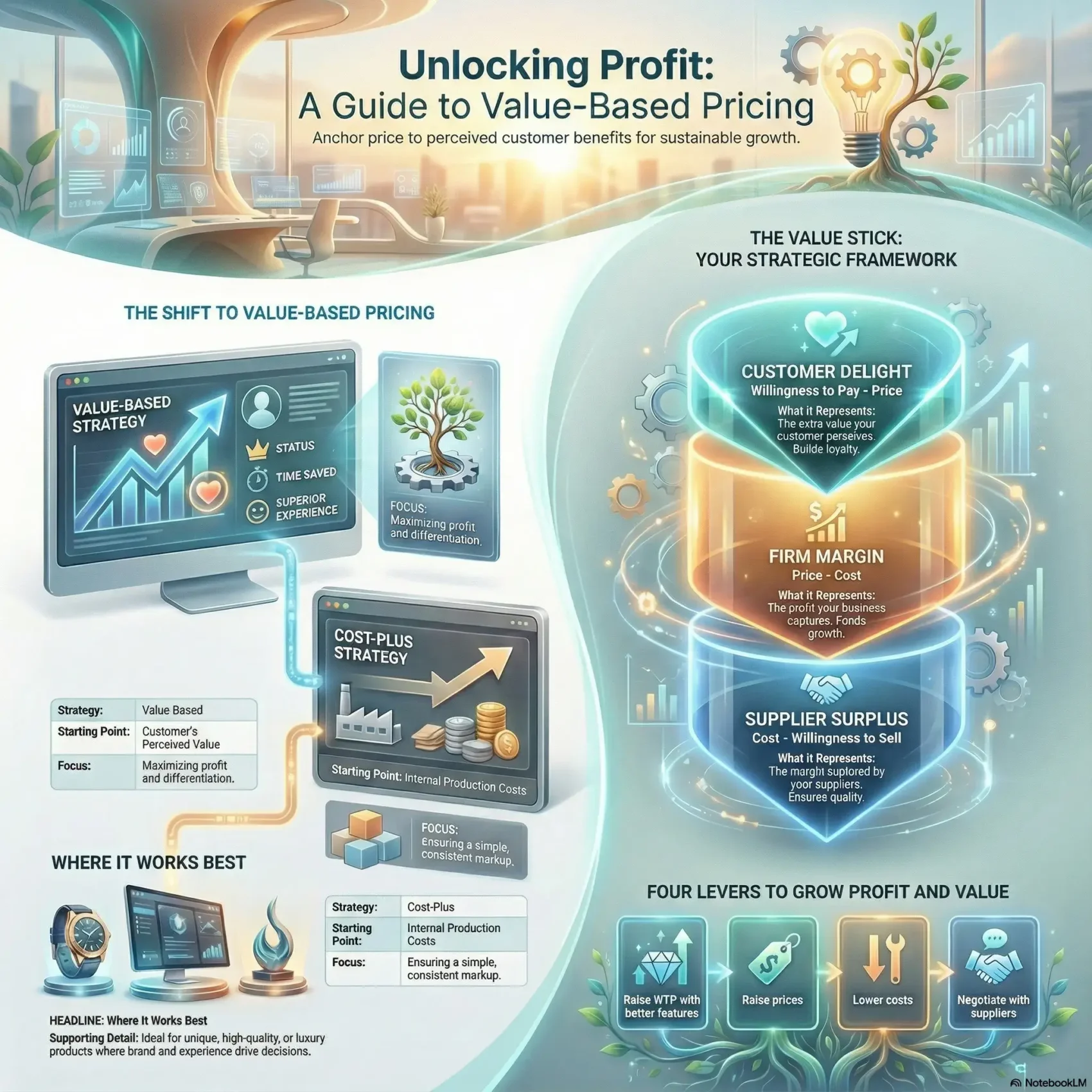
Last Updated on January 11, 2026
You can set prices around what customers truly value instead of just marking up costs. This approach works best when your product or service is unique, high quality, or delivers an experience that raises a buyer’s self-image.
Unlike cost-plus methods, this strategy relies on customer feedback and perceived value to set price points. That helps your business capture more profit and build loyalty over time.
To succeed, you must invest in customer research, clear communication, and cross-team alignment. The value stick shows how willingness to pay, price, cost, and willingness to sell split value into customer delight, your margin, and supplier surplus.
Expect higher ceilings for brand equity and profit, but also plan for the trade-off: some price-sensitive buyers may look elsewhere. With a clear roadmap, you can roll out a controlled pricing change and measure results fast.
Key Takeaways
- Focus on what customers value to justify higher prices and stronger brand positioning.
- Use research and feedback to map willingness to pay before you change prices.
- Align product, marketing, sales, and finance around one pricing strategy.
- Watch KPIs like margin, conversion, churn, and customer lifetime value.
- Value stick analysis helps you see how gains split between customers, your firm, and suppliers.
- Balance the upside for profit and loyalty against the risk of alienating price-sensitive buyers.
value-based pricing: foundations and key concepts
Great pricing begins with the benefits your product delivers, measured in real customer choices. You anchor a price to perceived value gathered from research, feedback, and how people actually buy.
What it is and how perceived value shapes price
You identify outcomes customers care about — status, time saved, reliability — and translate those gains into a price the market will accept. That perceived value sets the ceiling for what you can charge.
Willingness to pay, willingness to accept, and delight
Willingness to pay (WTP) is the highest price a customer tolerates. Willingness to accept (WTA or WTS) is the supplier floor. When your price sits below WTP, you create customer delight and earn loyalty.
How this differs from cost-based approaches
Instead of adding a markup to production costs, you start with customer value, then test if costs and margins align. This strategy fits unique or luxury products and differentiated services better than simple cost add-ups.
- Quick example: a larger laptop screen can raise perceived value and support a higher price product.
- Use voice-of-customer studies and win/loss interviews to build a defensible pricing model.
Using the Value Stick to shape your pricing strategy
The value stick turns a complex pricing problem into a clear framework you and your team can use every day. It plots four points — willingness to pay (WTP), the price you set, your cost, and suppliers’ willingness to sell (WTS). That view makes trade-offs visible and repeatable.
Breaking down the points: WTP, price, cost, and WTS
Plot WTP to see the maximum your customer will accept. Then mark your price, your internal cost, and the supplier floor.
When any point moves, the three value wedges shift: customer delight, your firm margin, and supplier surplus.
Finding the right balance between delight, margin, and surplus
Guardrails matter: keep price under WTP for target segments and watch cost versus WTS so quality stays intact.
Balance short-term margin gains with long-term brand and customer relationships.
Four levers to grow profit and total value
- Raise prices when demand is tight and differentiation is clear.
- Raise WTP by adding product features, bundling, or better UX.
- Lower costs through process improvements or smarter procurement.
- Lower WTS by giving suppliers predictability, volume, or shared investments.
Practical tip: build a simple dashboard that tracks WTP, price, cost, and WTS so you can test which lever grows profit without eroding customer value.
When value-based pricing works best in today’s market
Some categories give you room to charge more because ownership boosts status or creates a memorable experience. Use this approach where perceived benefits matter more than cost alone.
High-differentiation and luxury signals
High-differentiation and luxury signals
Products that signal prestige—convertibles, handcrafted watches, or boutique services—let you command higher price points. Buyers often read a higher number as proof of superior design, service, and attention.
Brand strength, craftsmanship, and after-sales care sustain the premium you set without quickly eroding demand among your target customers.
Commodities and staples
Commodities and staples
When products are interchangeable—think milk or basic flour—market willingness to pay narrows how far you can push prices. Competition and low differentiation force margins to follow the market.
Branded ecosystems are a useful middle ground. For example, a sweeper with proprietary pads can charge more for replacements because convenience and fit raise perceived value for installed customers.
- Use premium tactics where the product creates status or exceptional experience.
- Favor cost and efficiency where the market sets tight bounds.
- Segment your portfolio so you apply the right strategy to each product line.
From features to value: building differentiation customers will pay for
Start with the problems your customers face, then show how features deliver measurable improvements.
Translating product and service features into perceived value
Turn specs into outcomes: faster workflows, better reliability, or higher status. Quantify those outcomes with simple metrics so you can justify a higher price.
Quality, brand communication, and experience as value drivers
Every touchpoint should reinforce why your product is worth more. Use case studies, third-party reviews, and clear marketing to show benefits. Packaged bundles and warranties can lift perceived value and make upgrades easier to buy.
Open customer relationships to surface needs, data points, and price signals
Keep interviews, surveys, and usage analytics running. Those inputs reveal what customers will actually pay and guide a focused roadmap.
Practical next steps:
- Map top attributes that move WTP and double down on them.
- Prioritize a small set of features that drive the most value.
- Use behavioral signals via behavioral analytics to catch early price cues.
Implementing value-based pricing step by step
Start by mapping which customer segments gain the most from your offer and why those gains matter in dollars or time.
Identify target segments and value drivers
Use conjoint tests, Gabor‑Granger, win/loss interviews, and usage data to isolate the features that move willingness to pay. Focus on 3–5 drivers per segment so research stays actionable.
Quantify WTP and adapt your pricing model
Translate WTP ranges into a practical pricing model: per‑seat, usage, feature tiers, or hybrids. Model unit economics to ensure price stays above cost while leaving room for customer delight.
Pilot tests, tiering, and versioning
Run small pilots by cohort or market. Create clear good/better/best ladders that nudge self‑selection into higher tiers without cannibalizing entry offers.
Align teams and govern change
Make it cross-functional. Product, marketing, finance, and sales should agree on hypotheses, guardrails, and success metrics. Set quarterly reviews, dashboards, and an escalation path to keep prices aligned with strategy.
Practical tip: pick one lever first—raise prices slightly, add a high-impact feature to lift WTP, or cut cost—and measure before scaling.
Price communication that reinforces value and preserves loyalty
Clear, customer-first communication turns a higher number into a believable promise, not a surprise. When you lead with outcomes, customers focus on benefits—time saved, performance gains, or superior support—rather than the bare price.
Messaging the value story, not just the price point
Craft messages that show proof: case studies, metrics, or demos that link each feature to a real result. Equip your sales and support teams with short talk tracks that tie capabilities to customer jobs.
Anchor any increase to clear improvements—new features, faster SLAs, or expanded service levels—so the change reads like added value, not a surcharge.
Managing price-sensitive customers while sustaining brand equity
Segment your audience. Offer entry tiers, bundles, or committed-use discounts for price-sensitive buyers while presenting the full value story to premium segments.
Practical rule: give notice, offer easy tier switches, and use empathetic language to protect trust and loyalty.
- Use competitive comparisons that highlight total cost of ownership.
- Monitor sentiment and support volume after changes and respond quickly.
- Set selective grandfathering or credit policies to balance fairness and progress.
Measuring impact and optimizing your pricing over time
Track outcomes fast and keep your strategy grounded in data. Start by choosing a compact KPI set you update weekly or monthly.
Core KPIs: margin, conversion, churn, profit, and CLV
Focus on gross margin by offer, conversion rates, average revenue per customer, churn cohorts, and customer lifetime value.
Link shifts in these metrics to the value stick: did customer delight rise, did your margin expand, or did supplier surplus change?
Feedback loops: customer data, competitors, and market shifts
Capture surveys, interviews, and product analytics. Watch competitors and macro moves that reset expectations.
Adapting as perceptions change
Measure feature adoption, support outcomes, NPS, and willingness-to-pay studies over time. Run A/B tests on packaging, price points, and discounts so your company improves without harming the base business.
Practical rule: review costs and supplier terms quarterly, align service levels to tiers, and document learnings so your pricing model compounds wins.
Advantages, limitations, and misconceptions you should know
When you tie price to clear customer gains, your company can earn more and build stronger loyalty.
Benefits: You can support higher price points, lift brand value, and deepen customer loyalty by focusing on the outcomes that matter most. This approach also uncovers what customers will actually pay and feeds product roadmaps with usable feedback.
Challenges to plan for
Collecting the right data takes time and budget. You must invest in tests, surveys, and analysis to set credible prices.
Perceptions shift, so your team needs governance and review cycles to avoid surprises. One price rarely fits all segments, so offer tiers or bundles to match different needs.
Myths debunked
Not every feature needs its own price tag. Focus on the few attributes that drive the most perceived value.
Also: brand alone rarely justifies a premium without clear, differentiated performance. And this approach isn’t a silver bullet—competitor moves, execution, and timing still shape outcomes.
Practical rule: compare against cost-plus methods to show why anchoring price product to customer value often captures more upside.
- Weigh upside versus investment in data and analysis.
- Use segmentation and governance to protect fairness and agility.
- Track costs, customer response, and key points on the value stick to course-correct quickly.
Conclusion
Close the loop by testing one segment, measuring outcomes, and repeating quickly.
You now have a clear blueprint to anchor price in what your customers value. Use the value stick to balance customer delight, margin, and supplier relationships over time.
Implement value-based pricing with focused research, WTP tests, tiered packaging, and cross‑team alignment so changes land smoothly. Track KPIs—margin, conversion, churn, and CLV—and keep feedback loops tight.
Pick one segment, run a small pilot, and learn fast. Over time, refine product features and communication so your pricing tells the story of the value you deliver.