Coworking has stopped being a side bet. By the end of Q1 2026, the United States alone counted 9,136 active coworking locations across roughly 164 million square feet of flexible space. Supply is no longer the hard part. Standing out is.
That is where partnerships come in. A well-built alliance between your space and outside organizations bundles real perks — discounts, co-hosted events, shared services, favorable lease terms — into something members actually use and competitors cannot copy overnight.
This guide walks you through the full cycle: set goals, vet partners, pitch a mutual offer, and nurture the relationships that move retention and revenue. You will also find the numbers that matter in 2026, the tech stack that keeps perks manageable, and a 30-day plan to get your first pilot live.
Key Takeaways
- Flexible space is mainstream: roughly 58% of corporate occupiers now use it in some form, so differentiation beats expansion.
- Partnerships add tangible perks that lift retention and win company accounts.
- Local deals and brand alliances raise visibility without a big ad budget.
- Platforms like Cobot, Optix, Nexudus and OfficeRnD make perks simple to run and measure.
- Follow one repeatable process: set goals, research, network, pitch, measure, iterate.
Why Coworking Partnerships Matter More in 2026
The flexible workspace market has matured, and maturity changes the game. Global estimates put the sector somewhere between US$21 billion and US$29 billion in 2026, with roughly 41,000 to 42,000 spaces worldwide serving 5.5 to 6 million members.
U.S. growth is now steady rather than explosive. Operators added 282 locations in Q1 2026, a 3.2% quarterly gain. Location count grew slightly faster than square footage, which tells you something useful: the pipeline is filling with smaller neighborhood sites, not giant downtown flagships. The average U.S. location now sits just under 18,000 square feet.
Enterprise demand keeps climbing alongside it. Analysts describe 2026 as the first genuinely flex-first year for commercial real estate, with large and mid-sized companies using shared space to right-size footprints they no longer want to lease for ten years.
What this means for your space
Members and company accounts can find a desk almost anywhere now. What they cannot find everywhere is a space that saves them money on the gym downstairs, hosts the workshop their team needed, and lets one finance contact book eight desks in three cities on a single invoice.
- Differentiation: perks cost far less to add than square footage.
- Reach: co-marketing puts you in front of a partner’s audience at no media cost.
- Credibility: aligning with known local brands shortens the trust cycle with corporate buyers.
When your space becomes part of a wider local network, you unlock programming and revenue models you cannot build alone. Our overview of coworking spaces and the future of office space covers the broader shift, and Is the Office Dead? explains why hybrid schedules keep feeding this demand.
What Partnerships Actually Deliver
A curated set of perks turns a workspace from functional into meaningful. Bundle useful services and local deals, and retention climbs while your brand gets noticed for free.
A better member experience
Members benefit from discounts at cafés, gyms, yoga studios and mental health providers. You can also negotiate preferred rates for legal, accounting, marketing and IT services — the things small teams overpay for.
Partner-led workshops, pop-up talks and themed events keep engagement high. These programs turn casual desk renters into people who show up on days they did not have to.
Visibility, operational support and new revenue
Co-marketing — social swaps, newsletter features, in-space signage — lifts visibility without ad spend. Referral fees and revenue shares on onsite catering add income that does not depend on selling another desk.
- Map the benefits members use daily, not the ones that sound impressive.
- Use curated perks to lift satisfaction and reduce churn.
- Monetize through referral fees, profit shares and premium partner packages.
- Package legal, accounting, marketing and IT services into member bundles.
Which partner category fits which goal
| Partner type | Main benefit | Typical effort |
|---|---|---|
| Cafés, gyms, retail | Daily perks, foot traffic | Low — days to launch |
| Professional services | Member savings, referral fees | Low to medium |
| Landlords and developers | Rent relief, prime locations | High — months to close |
| Software and access vendors | Lower admin, better data | Medium — one-time setup |
| Associations and accelerators | Credibility, member pipeline | Medium — ongoing |
Start in the top rows. Quick wins fund the patience the bottom rows require.
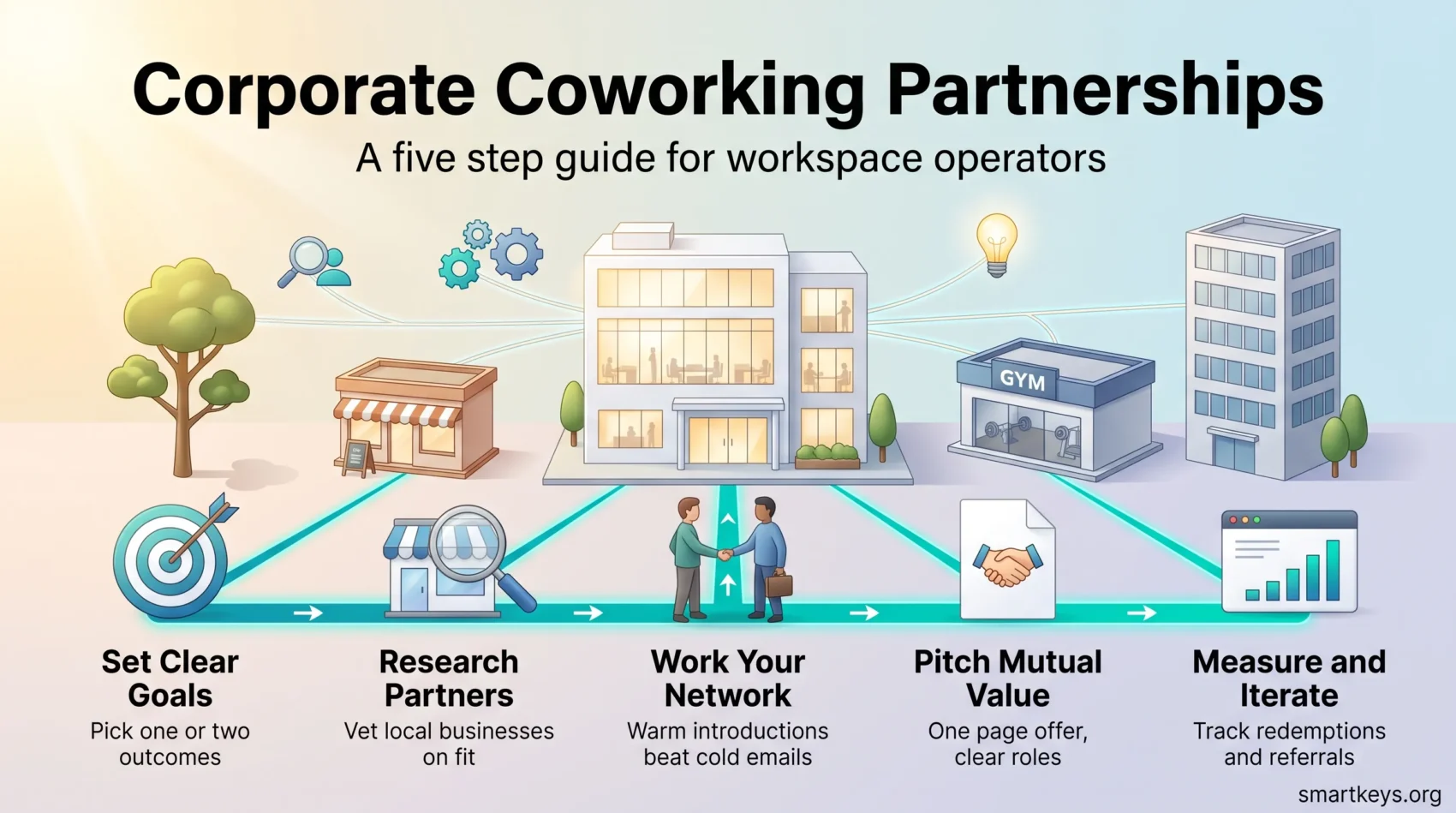
How to Build Corporate Coworking Partnerships: Five Steps
1. Pick one or two outcomes
Decide what you are actually buying with your time: member acquisition, visibility, engagement or revenue. Every outreach then has a metric attached, and you can tell a good partnership from a busy one.
2. Research and shortlist
Vet local partners on fit and reputation. Google Business Profiles, social accounts and a two-question member survey will tell you most of what you need. Prioritize businesses that solve a problem your members already complain about.
3. Work your network
Show up where decision-makers gather — chambers of commerce, industry meetups, neighborhood associations. A warm introduction converts far better than a cold email, and it costs you an evening.
4. Pitch a mutual offer
Spell out the exposure they get, the audience they reach, the timeline and who does what. Keep it to one page. A partner who can picture the whole deal in two minutes can say yes in two days.
5. Measure, then iterate
- Track perk redemptions, event attendance and referral sign-ups.
- Use Optix Perks or Cobot to surface offers and handle billing and bookings.
- Hold quarterly check-ins, run co-hosted workshops, and adjust terms based on what the data shows.
Clear goals and simple metrics make every partnership easier to evaluate — and easier to end when it is not working.
Local Business Partnerships That Build Community
Local vendors turn your space into a neighborhood hub with fast, high-impact activations. Start by mapping the cafés, retailers and service providers your members already visit.
Cafés, restaurants and retail
Offer member discounts, in-space catering or revenue-share pop-ups. The retail-plus-workspace model has real precedent: Staples partnered with Workbar to put coworking inside stores, and Office Depot built its Workonomy hubs into existing retail footprints. The logic runs both directions — you gain a perk, they gain daytime traffic.
Health, wellness and mental health
Partner with gyms, yoga instructors and counselors for weekly classes or monthly workshops. Wellness activations are among the most reliable retention levers because they create a reason to come in that has nothing to do with the desk.
Seasonal events and networking
Plan festival tie-ins, conference perks and themed meetups to reach new audiences. Social swaps, newsletter features and in-store signage extend reach and drive referrals both ways.
If your community skews remote or distributed, pair physical events with online ones. Our guide to virtual coworking spaces and the piece on co-working sessions and accountability partners show formats that work for members who only visit twice a month.
Real Estate and Enterprise Partnerships
A smart activation can turn a long-vacant property into a revenue-generating hub for both landlord and operator. With traditional office vacancy still elevated in many U.S. markets, landlords are more open to this conversation than they were five years ago.
Repurposing underused space with landlords
Start with a low-risk ask: short-term rent relief, shared fit-out costs, or a pilot activation with a defined end date. You prove demand without heavy capital, and they get an activated floor instead of an empty one.
This is now standard practice at the top of the market. Building owners partner with operators like Industrious under management agreements where the owner keeps the asset and the operator runs the space — a structure that spreads risk rather than concentrating it in a long lease. The technology reshaping these deals is covered in our piece on PropTech and real estate business models.
Prime locations in mixed-use developments
Mixed-use sites hand you built-in amenities — gyms, cafés, parking — that lift your offer immediately. You gain foot traffic and a stronger pitch without building the infrastructure yourself.
Enterprise flex programs for distributed teams
Design packages that match team size, security requirements and booking patterns. Corporate buyers in 2026 are comparing operators on access, control and data across locations, not on brand alone. Align bookings, access control and billing so a company gets one seamless experience.
- Pitch landlords with occupancy numbers, planned improvements and community programming.
- Differentiate your enterprise offer: team offsites, recurring project rooms, hybrid-day allocations.
- Network partnerships matter — WeWork’s Coworking Partner Network added 75+ third-party locations across 50 new markets by pairing with Vast Coworking Group.
Companies buying flex space usually have a written policy behind the purchase. Understanding it helps you sell into it — see our hybrid work policy template for the language corporate buyers actually use.
Technology and Association Partners
A modern tech stack is what keeps a perks program from becoming a second job. Start with the core systems: automated billing, bookings and smart access.
Your 2026 tech stack
Choose tools that integrate rather than tools that impress. Cobot connects with access hardware including Kisi, Salto KS and Tapkey, and handles payments through PayPal, Stripe, GoCardless and Adyen. Optix leads on mobile experience and keyless entry through the member app. Nexudus and OfficeRnD go deepest for multi-location operators, with Nexudus adding AI churn prediction that flags disengaging members before they cancel. Archie and Spacebring suit smaller spaces that want fast setup over feature depth.
Whatever you pick, make sure it can display partner offers and track redemptions. A perk you cannot measure is a perk you cannot renegotiate. For the wider category of scheduling and space tools, see our roundup of hybrid workforce tools.
Security and compliance as a sales argument
Security sells to enterprise buyers. Follow GDPR and comparable frameworks, document how member and visitor data is handled, and be ready to answer a procurement questionnaire. Corporate accounts increasingly ask before they sign. Our guide to building digital trust in distributed teams covers the policies these buyers expect to see.
Industry associations
Groups such as the Global Workspace Association, the European Coworking Assembly and GCUC offer training, benchmarking data and advocacy. Membership also gives you peer operators to compare notes with, which is often worth more than the research itself.
Incubators and Accelerators
Running an incubator turns early-stage teams into long-term members and predictable revenue. A focused program raises your profile by producing visible success stories in your own building.
Why they work
Incubators bring longer commitments, premium pricing and program fees. They also attract mentors and investors who raise your standing with the next cohort.
Program structure
Design a clear curriculum with milestone check-ins. Recruit experienced mentors, run regular workshops and track progress against stated goals rather than vibes.
Strategic partners
Align with universities, angel groups and corporate connectors for pilots, funding and research support. Established programs such as Techstars offer a model worth studying even if you build your own.
Marketing your program
- Use demo days and founder stories to show impact.
- Host taster events to recruit high-potential teams.
- Activate alumni as advocates and mentors for the next cohort.
Select fewer, higher-potential teams and measure outcomes. A small cohort that ships beats a large one that churns.
Activating Partnerships: Co-Marketing and Events
Frame partner offers as things members can redeem in minutes, not programs they have to understand. Start small: a newsletter feature, a social swap, clear in-space signage.
Co-branding that expands reach
Think of dual-brand plays like Uber and Spotify, where each side lent the other relevance. You can mirror that at local scale by bundling sustainable office supplies or offering a remote-work software package with a partner brand.
- Run launch nights and demo days that bring both audiences into the same room.
- Create shared promos — discount codes, trial access, bundled perks redeemable in your member app.
- Track redemptions so you know what to keep and what to quietly drop.
Monetization models
Referral fees, profit-sharing on onsite catering and premium add-ons all lift revenue with little extra lift. Set clear KPIs from day one: redemptions, qualified leads, incremental revenue.
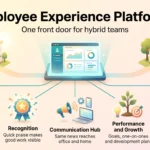
Share timelines and assets in a one-page playbook so partners know what good looks like. And keep the member experience central — the same principle that drives employee experience platforms applies to your members.
Your First 30 Days
- Week 1: Survey members on two questions — what they spend money on nearby, and what they wish the space offered.
- Week 2: Shortlist five local businesses that answer those gaps. Draft a one-page offer for the top two.
- Week 3: Pitch both. Agree a 90-day pilot with a defined perk, a promotion plan and one shared metric.
- Week 4: Load the offer into your member app, announce it, and set a calendar reminder to review redemptions at day 45.
Conclusion
One well-chosen collaboration can reshape how your space serves members and the neighborhood around it. Landlord deals that reactivate vacant floors, vendor discounts that members use weekly, tech integrations that cut admin hours — these compound across local business, real estate and association networks.
You now have a blueprint for building and activating partnerships that add value for members and make your business more resilient in a market where flexible space is no longer a novelty. Prioritize quick wins with a nearby café or service provider, then layer in technology, programs and association support for the long game.
Your next step: pick one partner category, agree on a single shared metric, and start a 90-day pilot this month. Small pilots become durable networks.
Found this useful?
Make SmartKeys a preferred source on Google, and our articles will surface more often in your Top Stories, AI Overviews, and AI Mode.
Add as Preferred Source