
The EU now puts a carbon price on some imports. The tool behind it is the Carbon Border Adjustment Mechanism, or CBAM. In plain words, CBAM is a charge on the CO2 emitted while certain goods, such as steel, aluminium or cement, were made outside the EU.
For more than two years, CBAM only meant paperwork. That changed on January 1, 2026, when the definitive period began. Goods imported in 2026 now create a real payment obligation, even though the first certificates will only be sold in February 2027.
This guide explains how the carbon border tax works, who it covers, what it costs and which deadlines matter.
Key Takeaways
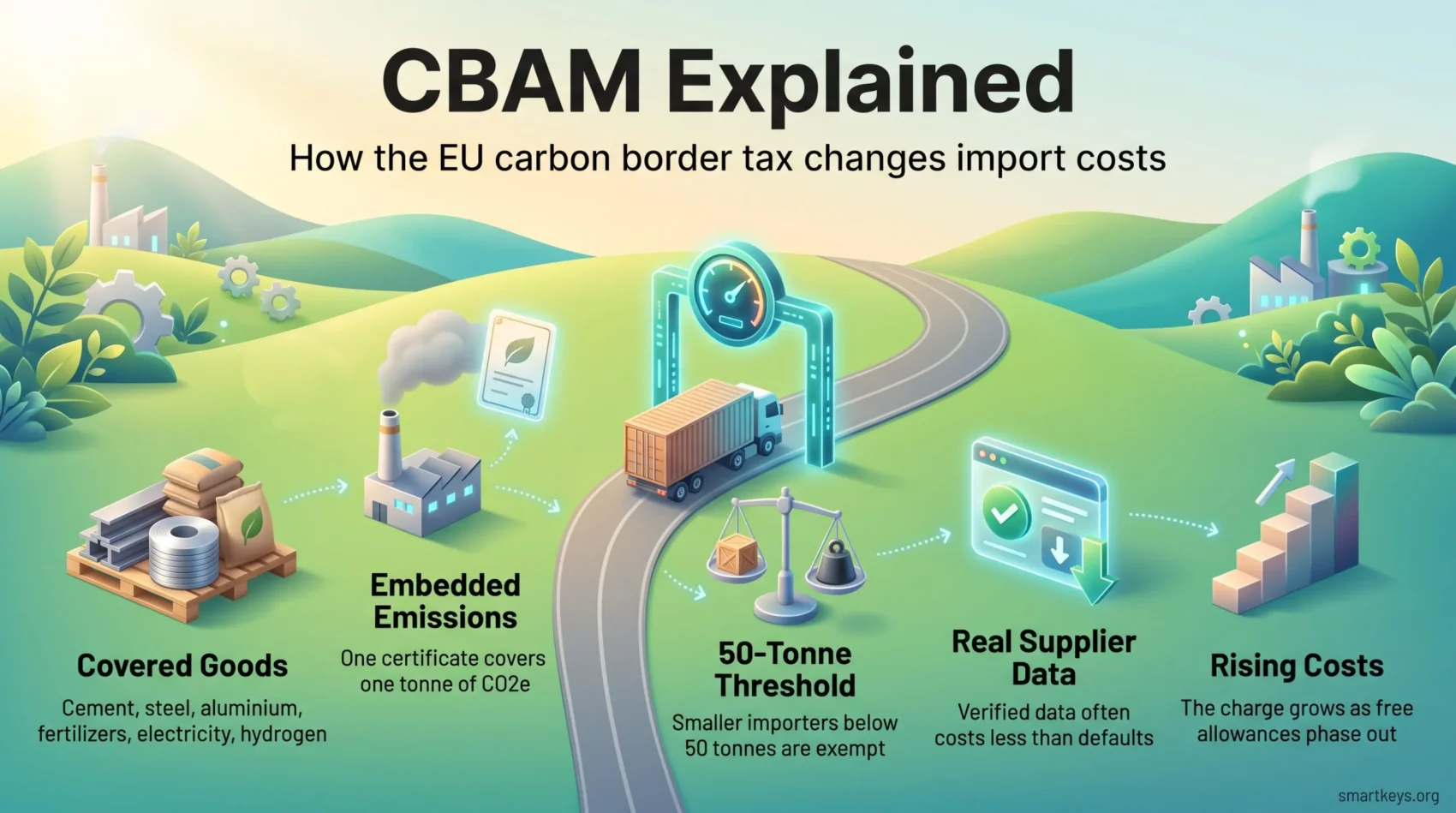
- CBAM puts a carbon price on imported cement, iron and steel, aluminium, fertilizers, electricity and hydrogen.
- Since January 1, 2026, imports create a payment obligation. Certificates go on sale from February 1, 2027.
- Importers of less than 50 tonnes of covered goods per year are exempt (except for electricity and hydrogen).
- The first annual declaration for 2026 imports is due by September 30, 2027.
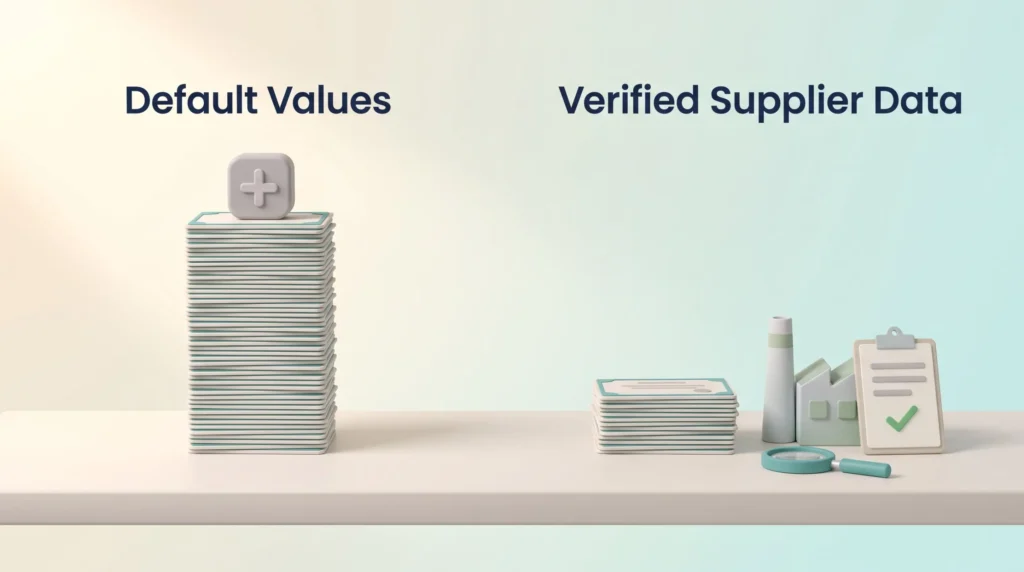
- Real supplier emissions data usually costs less than the EU’s conservative default values.
What CBAM Is and Why the EU Introduced It
Start with the EU Emissions Trading System (ETS), the EU’s carbon market. Factories and power plants must hold an allowance for each tonne of CO2 they emit. That makes emitting expensive for EU producers.
Foreign producers do not pay this price. This creates carbon leakage: production moves to countries with weaker climate rules, and the emissions simply happen elsewhere.
CBAM closes that gap. Importers pay roughly the carbon price an EU producer would pay for the same product. It is part of the EU’s Fit for 55 package, which targets a 55 percent emissions cut by 2030 compared with 1990. If your company tracks its own carbon neutrality goals, CBAM is where supplier emissions start to show up on import invoices.
How the Carbon Border Tax Works
CBAM is not a duty charged at the border. Instead, importers buy CBAM certificates. One certificate covers one tonne of CO2 equivalent (CO2e, a unit that also counts other greenhouse gases) embedded in the goods. “Embedded emissions” are the greenhouse gases released while the product was made.
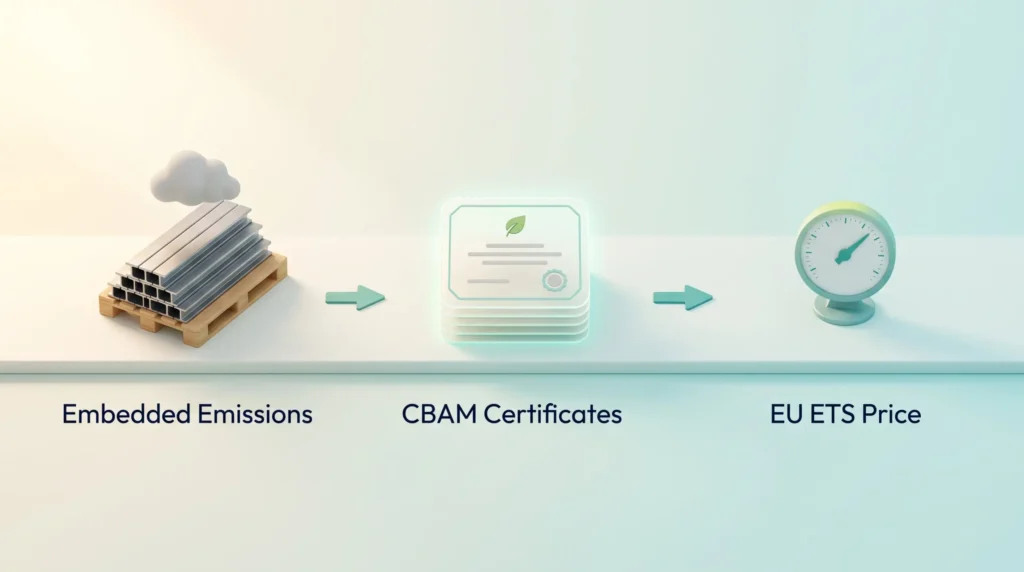
The certificate price follows the EU ETS price. For 2026 imports, the European Commission publishes a quarterly average. According to the Commission’s CBAM price page, it was €75.36 per tonne for Q1 2026 and €75.28 for Q2 2026. For Q3 2026, it rose to €82.32. From 2027, prices will be set weekly.
A Simple Example
Assume, for illustration, that you import steel with 1,000 tonnes of verified embedded emissions. At the Q3 2026 price of €82.32, the gross exposure is roughly €82,000.
Your actual 2026 bill is much lower. The number of certificates you owe is reduced to reflect the free allowances (emission permits handed out at no cost) that EU steelmakers still receive. If the producer already paid a carbon price in its home country, you can also claim a deduction, as long as you can document it.
Why the Cost Rises Over Time
CBAM phases in as free ETS allowances for EU producers are phased out. Under current law, 2.5 percent of the gap is charged in 2026, rising to 48.5 percent in 2030 and 100 percent in 2034.
This may change. On July 17, 2026, the Commission proposed an ETS review that would slow this phase-out and extend it to 2038, as reported by the International Carbon Action Partnership. Until it is adopted, plan with the current schedule.
Which Products and Importers Are Covered
CBAM currently applies to six groups of carbon-intensive goods:
- Cement
- Iron and steel
- Aluminium
- Fertilizers
- Electricity
- Hydrogen
Some upstream materials and simple metal products, such as screws and bolts, are included too. The scope is defined by customs codes (CN codes), so check each product line, not just the category name. Imports from Iceland, Liechtenstein, Norway and Switzerland are exempt.
The 50-Tonne Threshold
Since simplification regulation (EU) 2025/2083 took effect on October 20, 2025, importers of less than 50 tonnes of covered goods per calendar year are exempt. The threshold counts cement, fertilizers, iron, steel and aluminium combined. It does not apply to electricity or hydrogen.
The Commission designed it to remove about 90 percent of importers, mostly small businesses, while keeping around 99 percent of embedded emissions in scope. Watch your volumes: if you pass 50 tonnes at any point, all imports for that year fall under CBAM.
More Products Are Coming
In December 2025, the Commission proposed adding around 180 downstream products made mostly of steel or aluminium from January 1, 2028. The Council backed about 200 products in June 2026. On September 15, 2026, the European Parliament voted for around 457 product lines. The three EU institutions are now negotiating the final list, so makers of metal-intensive goods should follow this closely.
Key CBAM Deadlines for 2026 and 2027
The transitional period ran from October 1, 2023, to December 31, 2025, with quarterly reports but no payments. These are the dates that matter now:
- January 1, 2026: Definitive period starts. Imports above the threshold create a certificate obligation.
- March 31, 2026: Deadline to apply for authorised CBAM declarant status while continuing to import. Later applicants need approval before importing above the threshold.
- February 1, 2027: Certificate sales start on the EU’s central platform.
- From 2027: At each quarter-end, you must hold certificates for at least 50 percent of the embedded emissions imported so far that year.
- September 30, 2027: First annual declaration for 2026 imports and surrender of the matching certificates.
An authorised declarant is the company registered to import CBAM goods and file the declaration. An EU-based customs representative can take on this role for you.
What CBAM Means for Your Import Costs
Your bill depends on how much you import, how carbon-intensive the production was, and how you prove it. The last point is often the biggest lever.
Default Values vs. Real Supplier Data
Without supplier data, you must use the EU’s default values. These are deliberately conservative and include a markup that rises over time. Actual data must be measured at the plant and checked by an accredited verifier. That takes effort, but it often cuts the bill and rewards cleaner suppliers.
Pricing and Sourcing
Most importers will try to pass CBAM costs on. Review your pricing strategy and build the expected certificate cost into quotes and contracts. CBAM often hits the same shipments as customs duties, so plan both together in one tariff strategy.
CBAM also changes supplier comparisons. A cheap supplier with high emissions can end up costing more than a cleaner one. Add carbon cost to your scorecards in digital procurement and to any nearshoring or reshoring decision. Include the payment dates in your cash flow planning as well.
How to Prepare: A Practical Checklist
- Map your imports. List products by CN code and country of origin, and check whether your yearly volume can pass 50 tonnes.
- Secure declarant status. If you are above the threshold and not yet authorised, apply now or appoint a representative.
- Request supplier data. Ask for installation-level emissions data and verification reports, and write data duties into new supply chain contracts.
- Estimate your 2026 bill. Compare the result with default values and with real data.
- Keep data in one place. Good data governance makes the annual declaration easier. The same figures often feed CSRD reporting and carbon accounting software.
- Track the risk. Treat scope changes and price swings like any other regulatory risk in your risk management framework and your supply chain resilience planning.
Conclusion
CBAM has moved from reporting to real money. Since January 2026, covered imports above the threshold carry a carbon cost, and the first bill falls due in September 2027.
For most small importers, the 50-tonne threshold removes the obligation. For everyone else, costs will rise as free allowances disappear and the product list grows. Companies that know their volumes and get real supplier data will pay less. Together with rules like the Digital Product Passport, CBAM makes transparency a lasting supply chain trend.
Found this useful?
Make SmartKeys a preferred source on Google, and our articles will surface more often in your Top Stories, AI Overviews, and AI Mode.
Add as Preferred SourceFAQ
What is the purpose of the carbon border adjustment mechanism?
CBAM exists to prevent carbon leakage, meaning production moving out of the EU to countries with weaker climate rules. EU producers pay for their CO2 emissions through the EU Emissions Trading System. CBAM makes importers of certain goods pay a comparable carbon price, which keeps competition fair. It also gives foreign producers a reason to cut emissions, because cleaner goods face a lower charge in the EU.
Which products are affected by this adjustment?
CBAM currently covers cement, iron and steel, aluminium, fertilizers, electricity and hydrogen, plus some upstream materials and simple metal products such as screws and bolts. The exact scope is defined by customs codes, so check each product line. The list is likely to grow: the EU is negotiating an extension to downstream products made mostly of steel or aluminium, which the Commission proposed to apply from 2028.
Do I need to pay CBAM if I import less than 50 tonnes?
No. Since October 2025, importers of less than 50 tonnes of covered goods per calendar year are exempt. The threshold counts cement, fertilizers, iron, steel and aluminium combined. It does not apply to electricity or hydrogen. Monitor your volumes during the year: if your imports pass 50 tonnes at any point, all imports for that year become subject to CBAM, including those made before you crossed the line.
What does a CBAM certificate cost in 2026?
For 2026 imports, the price is the quarterly average of the EU ETS carbon price. The European Commission published €75.36 per tonne of CO2e for Q1 2026, €75.28 for Q2 and €82.32 for Q3. One certificate covers one tonne of embedded emissions. What you actually pay is lower than volume times price, because the certificate count is reduced to reflect free allowances EU producers still receive.
How do I comply with the reporting obligations?
You need authorised CBAM declarant status, or an EU-based representative who holds it for you. Then collect the embedded emissions of your imports, ideally as verified supplier data, otherwise using EU default values. From February 2027, you buy certificates on the EU’s central platform. By September 30 each year, you file a declaration for the previous year’s imports and surrender the matching certificates.
When will the carbon border adjustment mechanism be fully operational?
CBAM has carried real payment obligations since January 1, 2026. Certificates go on sale on February 1, 2027, and the first annual declaration is due by September 30, 2027. The full carbon price phases in gradually: under current law, 2.5 percent of the cost gap applies in 2026, rising to 100 percent in 2034. A Commission proposal from July 2026 would extend this to 2038, but it is not yet adopted.
What are the potential impacts on prices for imported goods?
Prices for covered imports are likely to rise, because importers will pass on at least part of the certificate cost. The effect is small in 2026 but grows each year as EU free allowances are phased out. It will not be equal for all goods. Products from carbon-intensive plants, or declared with default values, carry a higher charge than goods from cleaner, well-documented suppliers.