
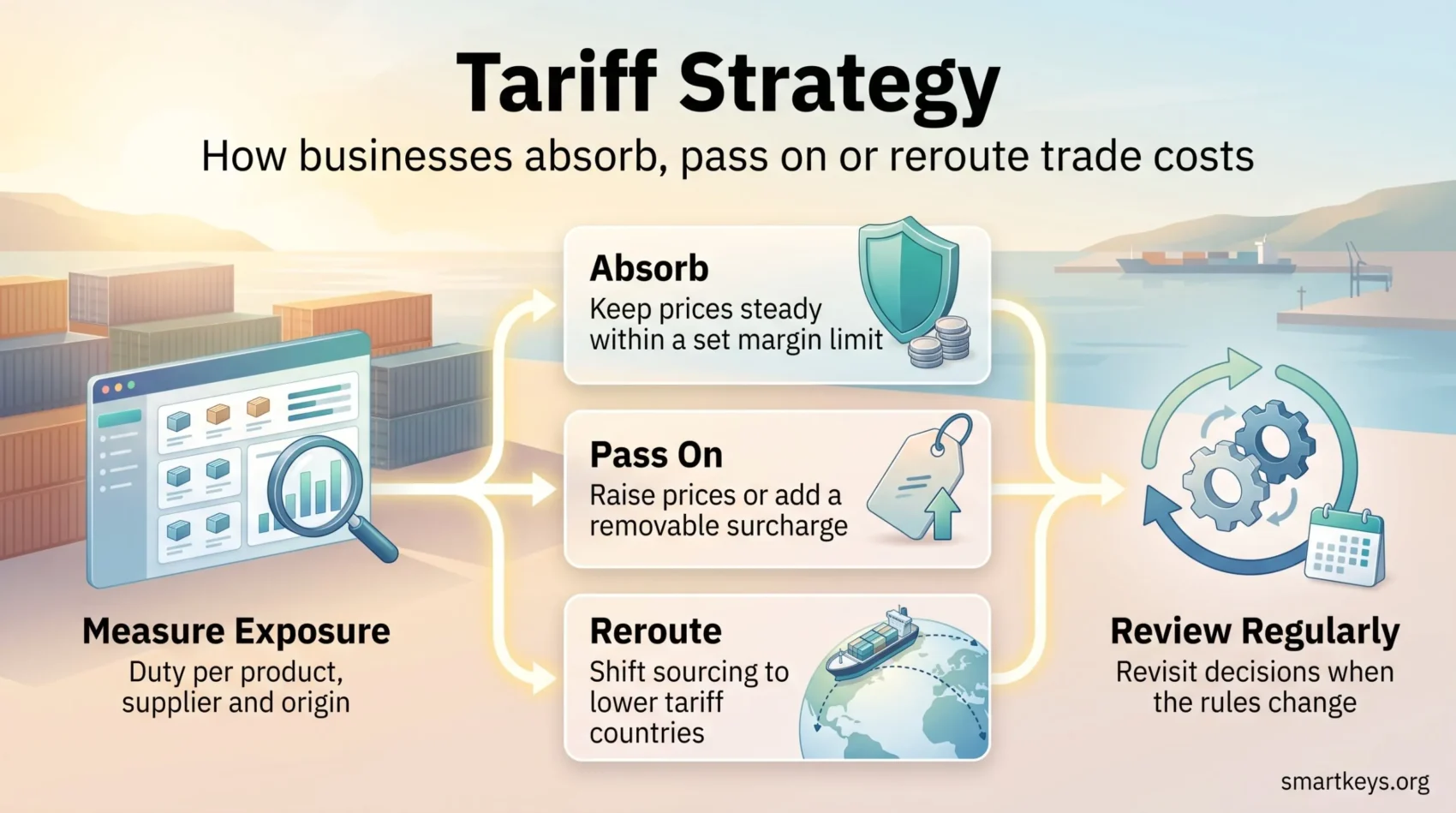
A tariff is a tax on imported goods. In the United States, the company that brings the goods into the country (the importer of record) pays it to U.S. Customs and Border Protection (CBP) when the shipment clears. What happens next is a business decision: you can absorb the cost, pass it on to customers through higher prices, or reroute your sourcing so less of it applies. Your tariff strategy is the way you make and revisit that decision, product by product.
2026 has made this harder than usual. In February, the U.S. Supreme Court struck down the tariffs imposed under emergency powers. A temporary replacement tariff ran until July. Since then, a new set of country tariffs, special duties on Canada and a flood of refund claims have kept the rules moving. According to the Tax Foundation’s tariff tracker (updated September 10, 2026), new tariffs apply to 54% of U.S. goods imports this year.
This guide explains where U.S. tariffs stand in September 2026, how to measure what they cost you, and how to choose between the three options without guessing.
Key Takeaways
- A tariff strategy decides, per product, whether to absorb, pass on or reroute tariff costs, and when to review that choice.
- The Supreme Court ended the emergency (IEEPA) tariffs on February 20, 2026. Section 301, 232 and 338 tariffs now carry most of the load.
- The Tax Foundation puts the average effective tariff rate at 7.2% for 2026, but your own rate depends on product codes and countries of origin.
- Start with exposure data by product, supplier and origin. Without it, every pricing decision is a guess.
- Importers who paid IEEPA tariffs may be owed refunds through CBP’s CAPE process.
What a Tariff Strategy Actually Is
A tariff strategy is a repeatable process, not a one-time reaction to a headline. It has four parts. You measure how much duty you pay and on which products. You decide who carries that cost. You adjust sourcing, pricing and inventory. And you review the decision when the rules change.
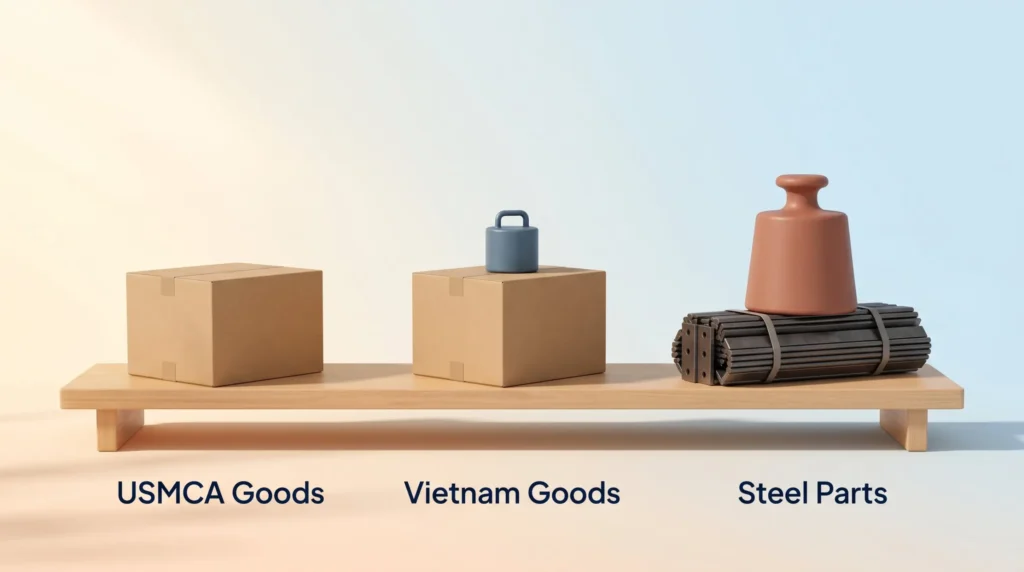
The word “strategy” matters because tariffs rarely hit a whole business evenly. A retailer might pay nothing on goods from Mexico that qualify under the trade agreement, 12.5% extra on goods from Vietnam and far more on steel parts. One blanket answer, such as “raise all prices by 5%”, will overcharge some customers and still lose money on other products.
For a small business, the process can live in one spreadsheet and a monthly meeting. For a larger company, it usually involves finance, purchasing, logistics, sales and legal. The logic is the same in both cases.
Where U.S. Tariffs Stand in September 2026
Before you can choose a response, you need to know which tariffs actually apply to you. U.S. tariffs rest on several different laws, and each one works differently. This section covers the ones that matter most right now.
The Supreme Court Ended the Emergency Tariffs
On February 20, 2026, the Supreme Court ruled in Learning Resources, Inc. v. Trump that the International Emergency Economic Powers Act (IEEPA), a 1977 sanctions law, does not allow the president to impose tariffs. That wiped out the broad “reciprocal” tariffs and the fentanyl-related tariffs that had been collected under it since 2025.
Right after the ruling, the administration switched to Section 122 of the Trade Act of 1974. This law allows a temporary tariff of up to 15% for a maximum of 150 days. The administration used it for a 10% tariff on imports from all countries, which expired on July 24, 2026.
Section 301 Tariffs Now Cover 60 Economies
Section 301 lets the U.S. Trade Representative put tariffs on countries it finds treat U.S. trade unfairly. On July 24, 2026, new Section 301 tariffs replaced the expired Section 122 tariff. According to law firm Holland & Knight, they add 10% or 12.5% on imports from 60 economies, depending on the country.
Two details change the math. For the EU, Japan, South Korea, Switzerland and Taiwan, the rate works as an all-in ceiling that includes the normal duty. For most other countries, it is added on top. Chinese goods also keep the older Section 301 tariffs from 2018 and 2019. Goods from Canada and Mexico that qualify under the U.S.-Mexico-Canada Agreement (USMCA) are exempt from the new Section 301 tariffs.
Section 232 Tariffs Target Specific Products
Section 232 allows tariffs on products the Commerce Department considers a national security concern. These tariffs apply by product, not by country. As of July 2026, steel and aluminum faced 50% for most countries and copper 25%, and hundreds of products made from these metals are also covered. If your products contain metal parts, check each tariff code carefully, because these rates are the highest in the system.
Section 338 Duties on Canada
In July 2026, the administration invoked Section 338 of the Tariff Act of 1930 for the first time. This rarely used law allows duties of up to 50% on countries that discriminate against U.S. commerce. It placed a 50% duty on roughly $20 billion of Canadian goods, including dairy, alcoholic beverages and a wide list of other products, from August 2026.
Unlike most tariffs on Canada, these duties apply even when goods qualify under USMCA. Canada answered with counter-tariffs of 15%, 25% or 50% on C$27.6 billion of U.S. goods from September 8, 2026, according to law firm Blakes. If you export to Canada, check whether your products are on that list.
China and Announced Future Tariffs
The U.S.-China trade truce agreed in late 2025 was due to end on November 10, 2026. In September, both sides extended it to January 10, 2027. Treat that date as a planning checkpoint, not a guarantee.
Some tariffs are announced long before they apply. In July 2026, the president announced tariffs on imported generic drugs of 100% from August 2028 and 200% from August 2029. The legal basis has not been published. Announcements like this belong in your scenario plans, not yet in your prices.
What Tariffs Cost the Economy and Your Customers
The national numbers matter because they shape your customers’ budgets. The Tax Foundation estimates that tariffs raised taxes by an average of $1,000 per U.S. household in 2025 and will raise them by $820 in 2026. The drop reflects the end of the IEEPA tariffs.
It also helps to understand two different rates. The applied rate is the average of the tariff rates on paper, which the Tax Foundation puts at 11.8% for 2026, up from 1.5% in 2022. The effective rate is what importers actually pay once exemptions and shifts in buying are counted. The Tax Foundation projects 7.2% for 2026. The Penn Wharton Budget Model measured 6.7% in July 2026, compared with 2.3% in January 2025.
Over the long run, the Tax Foundation expects current tariffs to reduce U.S. economic output by 0.4%, the capital stock by 0.3% and employment by 338,000 full-time-equivalent jobs. For your planning, the practical point is simple: many customers are already absorbing higher prices elsewhere, which limits how much more they will accept from you. Rising costs are also a top concern in our overview of small business trends.
Step One: Measure Your Tariff Exposure
Every good tariff decision starts with the same question: how much duty do we pay, on what, and from where? Your exposure is the share of your costs that tariffs touch.
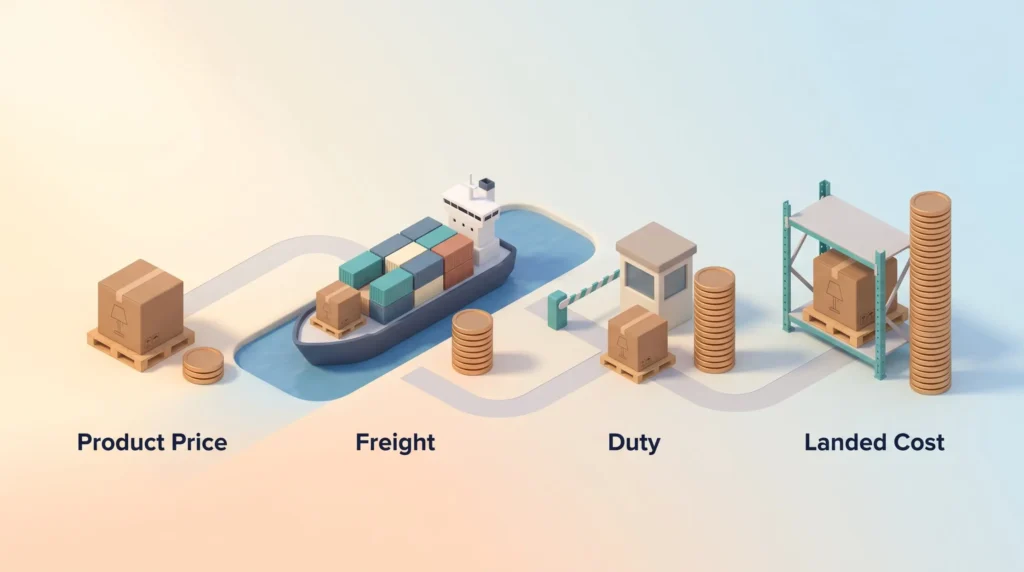
Build a table with one row per product or SKU (stock-keeping unit, the code you use to track each item). For each row, record:
- The tariff code (HTS code) the product enters under
- The country of origin, which is where the product was last substantially changed, not the port it shipped from
- Every tariff that applies, with its legal basis (Section 301, 232, 338 or normal duty)
- The landed cost, meaning product price plus freight, insurance, duties and fees
- The selling price and contribution margin, which is what is left after variable costs
- Annual volume and the customers or contracts tied to it
Here is a simple example. A company imports a lamp from Vietnam for $40 and pays $4 in freight. A 12.5% additional tariff on the $40 customs value adds $5. If the lamp sells for $80, the margin drops by $5 per unit, and across 20,000 units that is $100,000 a year. Seen per product, the problem becomes a set of specific choices instead of a vague threat.
If cash is tight, add the timing too. Duties are due when goods clear customs, often weeks before customers pay. Our guide to cash flow management shows how to build a 13-week forecast that captures this gap.
The Three Core Options: Absorb, Pass On or Reroute
Once you know your exposure, you can compare the three basic responses. Most companies end up using all three, each for different products.
Absorb the Cost
Absorbing means you pay the tariff and keep your prices steady. It makes sense when the tariff is small, when you expect it to be temporary, or when a price rise would push customers to a competitor who is not affected.
The risk is slow margin erosion. Absorbing works best with a clear limit, for example “we absorb up to 3 points of margin for six months, then review”. You can also offset part of the cost by cutting other expenses or renegotiating with suppliers, who may share the burden to keep your business.
Pass It On to Customers
Passing on means raising prices to cover some or all of the tariff. It works when competitors face the same tariff, when your product has few substitutes, or when customers value reliability more than price.
How customers react to a price change is called price elasticity. You can test it before committing: raise prices on one product line or region first and watch volume. Explain the change honestly, and consider a separate tariff surcharge that you can remove when the tariff ends. Business customers often accept that more readily than a permanent list price increase.
Reroute Your Sourcing
Rerouting means moving purchases or production to a country with lower tariffs, or closer to home. Options include a supplier in a different country, reshoring or nearshoring production, or qualifying more goods under USMCA.
Rerouting is the slowest and most expensive option. New suppliers need qualification, tooling and quality checks, and domestic production often costs more in labor and energy. Tariff rules also change faster than a factory can move, so a country that looks cheap today may face a new rate next year. Only reroute when the savings hold up under several tariff scenarios, not just the current one.
Technology can narrow the cost gap of producing closer to home. Robotics and automation reduce the labor share of domestic production, and 3D printing lets some companies make spare parts locally instead of importing them.
One warning: moving goods through a third country without real processing does not change their origin. CBP treats this as transshipment, and it can bring penalties on top of the unpaid duties.
Legal Ways to Lower the Duty Itself
Between absorbing and moving a factory, there are several tools that reduce the duty you owe. Each one depends on your products and paperwork, so check with a licensed customs broker or trade lawyer before relying on it.
- Check your classification. The HTS code sets the rate. A product classified under the wrong code may carry a higher duty than necessary. You can request a binding ruling from CBP to get certainty.
- Confirm origin and USMCA status. Keep certificates of origin and supplier declarations for every qualifying product. Without them, you pay the full rate.
- Use a Foreign-Trade Zone. Goods stored in these special areas do not pay duty until they enter the U.S. market, and goods re-exported from there often pay none.
- Claim duty drawback. If you import goods and later export them, or export products made from them, you can reclaim most of the duties paid.
- Review the customs value. Duties are charged on the declared value. In some supply chains, the “first sale” rule lets you declare the price the middleman paid the factory instead of the higher price you paid.
Contracts matter too. Add clauses that say who pays if tariffs change, and review your Incoterms, the standard trade terms that set where responsibility passes from seller to buyer.
Recovering IEEPA Tariffs: The Refund Process
If you paid IEEPA tariffs in 2025 or early 2026, you may be owed money. CBP handles refunds through a system called CAPE (Consolidated Administration and Processing of Entries) inside its ACE portal. Only the importer of record or its licensed customs broker can file.
According to trade consultancy GHY International, CBP had accepted $134.7 billion in potential and certified refunds by September 11, 2026. Refunds usually follow 60 to 90 days after acceptance and include interest. A third phase covering entries that were already finally liquidated (closed out by CBP) is planned for October 6, 2026.
If you bought from a distributor who was the importer, you cannot file yourself. Ask whether your supplier will share the refund, especially if they raised your prices because of the tariff. Check CBP’s IEEPA refund page for current deadlines.
Plan for Currency Swings and Sudden Changes
Tariffs rarely move alone. They often shift exchange rates, freight costs and demand at the same time. A weaker dollar makes imports more expensive on top of the tariff, while a stronger dollar partly offsets it.
If you buy in foreign currencies, talk to your bank about forward contracts, which fix an exchange rate for a future payment. Buying and selling in the same currency, known as a natural hedge, also reduces risk.
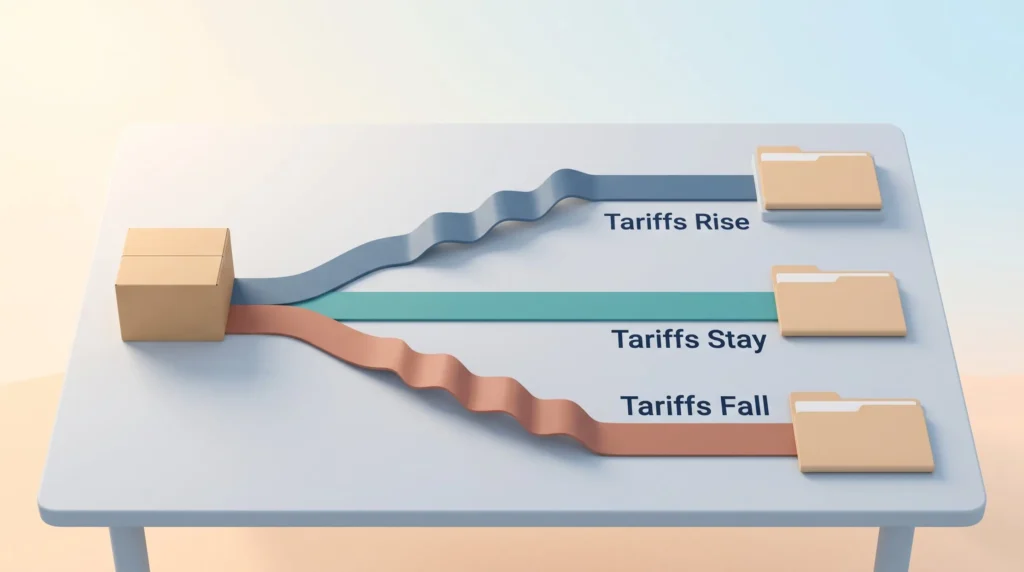
Then run scenarios. A useful minimum is three cases for your top products: current tariffs stay, tariffs rise by 10 points, and tariffs fall back. For each case, note what you would do: absorb, raise prices or switch suppliers. When a change is announced, you already have a plan instead of an emergency meeting. The approach in our guide to supply chain resilience helps you find the weak points that tariffs expose, such as a single supplier in one country.
A Simple Decision Framework
To keep decisions consistent, set thresholds in advance. The table below is a starting point to adapt to your margins.
| Situation | Default response |
|---|---|
| Tariff adds less than 2% to landed cost, competitors unaffected | Absorb and review each quarter |
| Tariff hits the whole market equally | Pass on, ideally as a removable surcharge |
| Tariff is large and expected to last, alternative supplier available | Reroute, after testing samples and lead times |
| Tariff is large, no alternative, low margin product | Redesign, reprice or discontinue the product |
| Tariff announced but not yet in force | Model it, prepare contracts, do not reprice yet |
Resist the urge to keep a losing product alive because you have already invested in it. Our article on the sunk cost trap explains why only future costs and revenues should count in that decision. If you choose to redesign a product with fewer tariffed components, a structured method such as design thinking keeps the customer in view while you change the bill of materials.
Who Should Own Your Tariff Strategy
Tariff decisions touch several departments, so give one person clear ownership. In a small company, that is often the founder or finance lead. In a larger one, a small cross-functional group works well: finance for margins, purchasing for suppliers, logistics for customs, sales for customer reaction and legal for contracts.
Set a fixed review rhythm. A monthly check of new rulings and announcements is enough for most businesses, with a deeper review every quarter. A quarterly planning day is a natural place to revisit your thresholds. When a price change or supplier switch affects many people, the steps in our change management guide help the team carry it out.
Tariffs are one part of a wider shift in trade. For background, read how globalization is changing business and which supply chain trends actually changed in 2026. Online sellers should also see our guide to cross-border e-commerce, which covers the end of duty-free small parcels. If you sell into the EU, the carbon border charge covered in our carbon neutrality roadmap adds a separate import cost for goods such as steel and aluminum.
Conclusion
Tariffs in 2026 have changed faster than most contracts, price lists and supply chains can follow. The Supreme Court ruling, the expiry of Section 122, the new Section 301 tariffs and the duties on Canada all arrived within six months. More changes are likely.
A good tariff strategy does not try to predict every move. It gives you clear data on your exposure, preset rules for when to absorb, pass on or reroute, and a regular review to adjust. If you have paid IEEPA tariffs, check your refund position now. And whatever you decide, write it down, so the next change triggers a plan instead of a scramble.
This article is general information, not legal or tax advice. Tariff rules change often, so confirm details with a customs broker or trade lawyer before acting.
Found this useful?
Make SmartKeys a preferred source on Google, and our articles will surface more often in your Top Stories, AI Overviews, and AI Mode.
Add as Preferred SourceFAQ
What is a tariff strategy?
A tariff strategy is the process a business uses to decide who carries the cost of tariffs on its imports and how to reduce that cost. In practice, you first measure which products are affected and by how much. Then you choose, per product, whether to absorb the tariff, pass it on through higher prices or change sourcing. It also includes legal ways to lower the duty, such as correct classification or trade agreement benefits, and a fixed schedule for reviewing decisions when the rules change. The goal is to protect margins without losing customers.
Who actually pays a tariff?
The importer of record pays the tariff to U.S. Customs and Border Protection when goods enter the country. That is usually the U.S. company buying the goods, not the foreign supplier. The cost then gets shared along the chain. The importer may absorb it, push part of it back onto the supplier in price talks, or pass it on to customers. Economists study how this split works out in practice, and it varies by product and market. For your business, the key point is that the legal duty to pay sits with whoever is named as importer on the customs entry.
Should my business absorb tariffs or pass them on to customers?
It depends on the size of the tariff, how long you expect it to last and what your competitors face. Absorbing makes sense for small or likely temporary tariffs, especially when competitors are unaffected and a price rise would cost you customers. Passing on works better when the whole market faces the same tariff or your product has few substitutes. Many businesses combine both: they absorb part of the cost up to a preset margin limit and pass on the rest, often as a separate surcharge they can remove later. Test price changes on one product line first to see how customers react.
How do tariffs impact supply chains?
Tariffs raise the landed cost of imported materials and products, which pushes companies to rethink where they buy. Some add suppliers in lower-tariff countries, some move production closer to home, and some build extra inventory before a tariff takes effect. Each of these choices has its own costs: new suppliers need qualification and testing, domestic production often costs more, and extra inventory ties up cash. Because tariff rules can change within months, diversification is usually safer than one big move to a new country. That means more than one qualified supplier for critical items.
How do trade agreements like USMCA affect the tariffs I pay?
Goods that qualify under a trade agreement can enter at lower or zero duty, but only if you can prove they meet the agreement’s rules of origin. Under USMCA, qualifying goods from Canada and Mexico are exempt from the Section 301 tariffs introduced in July 2026. There is an important exception: the 50% Section 338 duties on certain Canadian goods apply even when those goods qualify under USMCA. To benefit where exemptions do apply, keep certificates of origin, supplier declarations and production records for each product, and review them whenever a supplier or bill of materials changes.
Can I get a refund for IEEPA tariffs I already paid?
Yes, if you were the importer of record. After the Supreme Court struck down the IEEPA tariffs in February 2026, CBP set up the CAPE process in its ACE portal to handle refund claims in bulk. Only the importer of record or its licensed customs broker can file, and approved refunds include interest. The process is rolling out in phases, with a phase for finally liquidated entries planned for October 2026. If a distributor imported the goods for you, you cannot claim directly, but you can ask whether they will share any refund. Check CBP’s official refund page for current deadlines.
How can businesses mitigate currency risks associated with tariffs?
The most common tool is a forward contract, which fixes the exchange rate for a future payment so a currency swing cannot add to your tariff costs. Businesses that both buy and sell in a foreign currency can also use a natural hedge, where income in that currency covers costs in the same currency. Some negotiate with suppliers to invoice in dollars, which moves the currency risk to the supplier. Whatever tools you use, include exchange rate changes in your tariff scenarios, because tariff news often moves currencies at the same time and the two effects can add up.