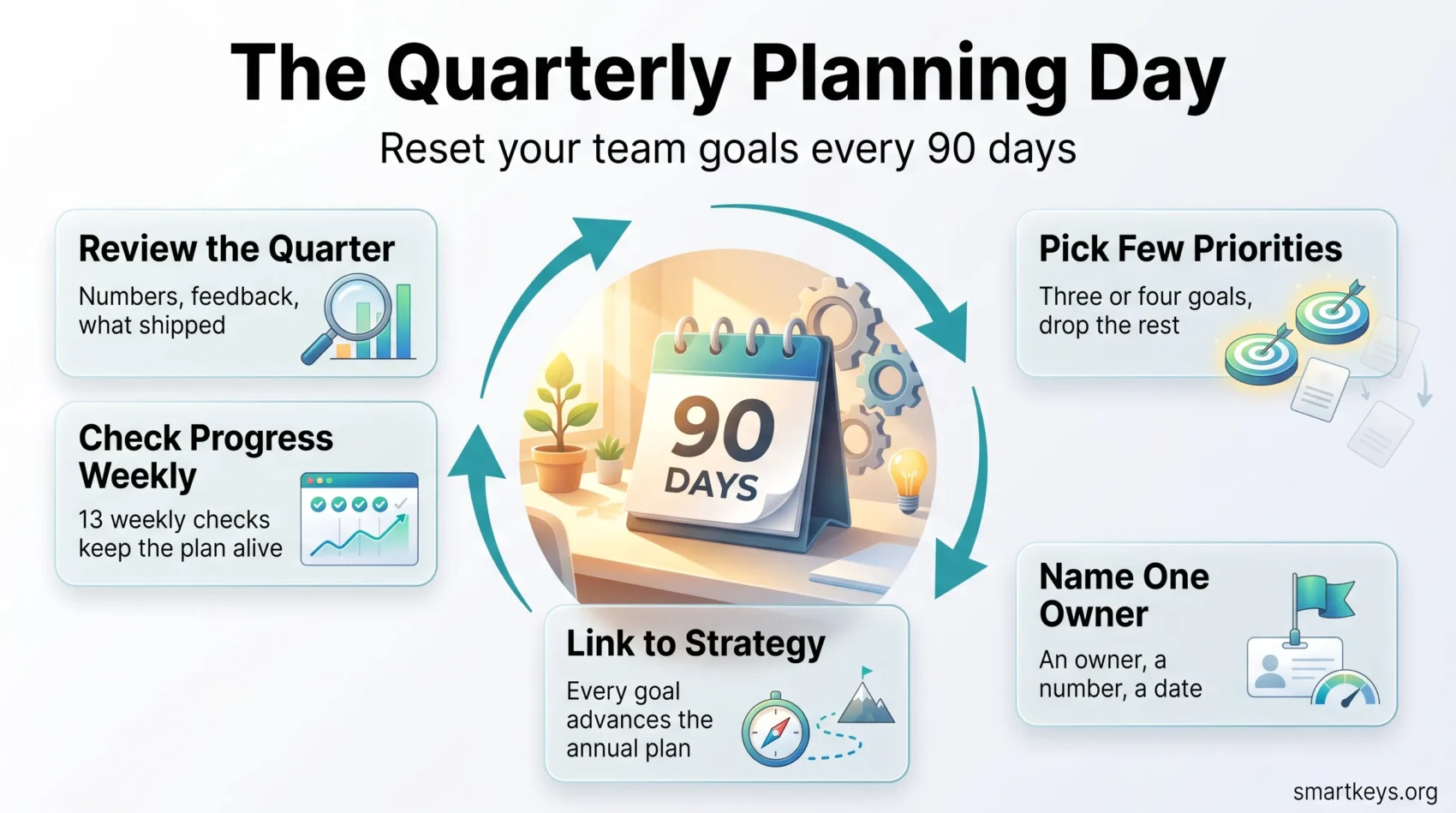
Every 90 days you get a natural chance to stop, see what actually happened, and decide what the team does next. That is what a quarterly planning day is for: one session where leaders review the quarter that just ended, agree on a few priorities, and write down who owns what.
An annual plan sets the destination. A quarterly plan turns that destination into work people can start on Monday. Waiting a full year to correct course is risky, because customers, budgets and markets rarely stay still for twelve months.
Key Takeaways
- A quarterly reset turns annual strategy into work the team can start immediately.
- Goals only create accountability when they have an owner, a number and a date.
- Frequent, visible progress checks are the part most teams skip and most need.
Introduction to Quarterly Planning
Quarterly planning is a repeating three month rhythm. Leadership reviews performance, decides what matters most next, and assigns ownership. The output is not a slide deck. It is a short written plan naming goals, owners, deadlines and the measures that show whether the work succeeded.
A quarter is short enough that people can hold the whole plan in their head, and long enough to finish something real. Its checkpoints expose drift early, while an annual cycle usually does not.
What is Quarterly Planning?
Each goal is written down, given an owner, and tied to a measure. A goal with no owner and no number is a wish, not a plan.
Many people already run this rhythm alone. A personal OKR framework, which links long term ambitions to quarterly objectives, is the individual version. OKR means objectives and key results: one statement of what you want, plus the numbers that prove you got there.
The Importance of a Periodic Reset
A reset gives the team permission to drop work that no longer matters. Most plans fail not because the goals were bad, but because old commitments never get removed and capacity quietly runs out.
Clarity is the other reason. Gallup’s employee engagement indicator put the share of US employees who know what is expected of them at work at 49 percent in May 2026, with 20 percent of employees engaged globally. A plan that names owners and measures is one concrete way to move that first number inside your own company.
Benefits of a Quarterly Planning Day
The first benefit is focus. When the team agrees on three or four priorities, everything else becomes a “not now” rather than a background worry. That is the team version of single tasking, doing one thing properly instead of several things partly.
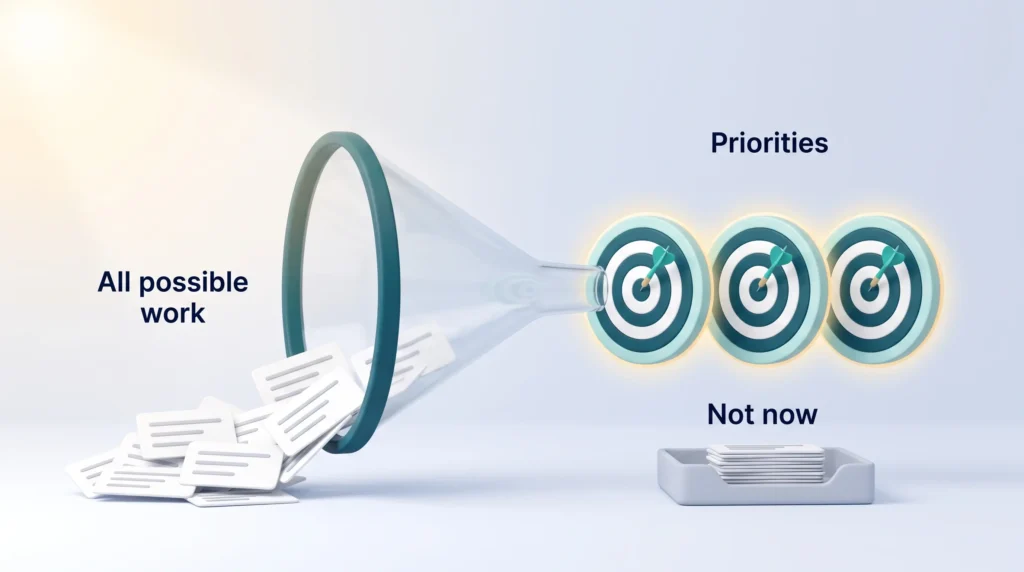
The second is visible progress. A 90 day milestone can actually be reached, so people get to finish something. Annual goals rarely offer that, which is why motivation fades around month four.
The third is early warning: a quarterly review surfaces roadblocks while there is still time to move budget or people. The fourth is coordination. When Sales, Marketing, Product and Operations set priorities together, they find conflicting plans on the day rather than six weeks later.
Key Components of a Quarterly Plan
A usable plan has four parts: goals, initiatives, timelines and owners.
Setting SMART Goals
SMART goals are specific, measurable, achievable, relevant and time-bound. The checklist turns vague intentions into something you can verify. “Improve support” is not checkable. “Cut average first response time to under four hours by 31 December, owner Maya” is.
Pick the measure before the target. If you cannot say where the number comes from and who reads it, the goal will not survive a busy quarter. Our guide to goal setting strategies that hold up in a real workweek covers when a learning goal beats an outcome goal.
Defining Initiatives and Timelines
Initiatives are the projects that deliver each goal. They answer the question “how”. A goal to lift trial conversion might have two: rebuild the onboarding emails, and ship in-app guidance for the first session.
Write down milestones and dependencies, so the team sees which piece has to finish before the next starts. A bottleneck that appears in the plan is cheap; one that appears in week eleven is not. Set real dates too, because work expands into whatever time is available, an effect described by Parkinson’s Law and the case for shorter deadlines. Keep the list short: most teams can carry a handful of major goals per quarter, not a dozen.
Reflecting on Past Quarter Performance

Start by looking backwards. The review should rest on evidence: the numbers you agreed to track, customer feedback, and what actually shipped. Opinions about how the quarter “felt” are a poor input. Three questions are enough:
- Which goals were hit, and which missed expectations?
- Did the quarter move the annual plan forward, or just keep the lights on?
- What evidence supports each answer?
For goals that slipped, look for the cause rather than a culprit. The usual suspects are capacity that was never really available, ownership that was shared and therefore absent, and a dependency nobody negotiated. Capacity problems often point at work that should not sit with your team at all, and delegating low value work to someone else frees the hours the plan assumed you had. Customer feedback deserves the same weight as internal numbers, which is the practical core of a customer-centric culture.
One chart with a sentence explaining what changed beats a wall of figures, which is the craft of turning data into a narrative people act on. The review is for learning, not blame. If people expect blame, the evidence quietly gets worse.
How to Run an Effective Quarterly Planning Session
A planning day fails on preparation more often than on facilitation. These steps carry most of the weight:
- Keep the room small. Bring leaders who can commit resources, plus the people who will do the work. Large groups debate; small groups decide.
- Send the material in advance. Share performance data, annual objectives and the questions you will ask. Reading time inside the session is wasted time.
- Name a facilitator. One person watches the agenda and the clock instead of arguing for their own team.
- Use breakouts for feasibility. Let team leads test in small groups whether a goal is achievable with the people they actually have.
- Write decisions down live. Record goal, owner, measure and deadline in one document, in the room. Anything captured afterwards tends to change shape.
Close by reading the commitments back aloud. If an owner hesitates, you have found a problem worth ten more minutes today.
Aligning Quarterly Goals with Annual Strategy
Before you finalise priorities, put the annual plan back on the screen. Each goal should visibly advance it. If nobody can explain the connection in a sentence, the goal belongs to next year or to nobody.
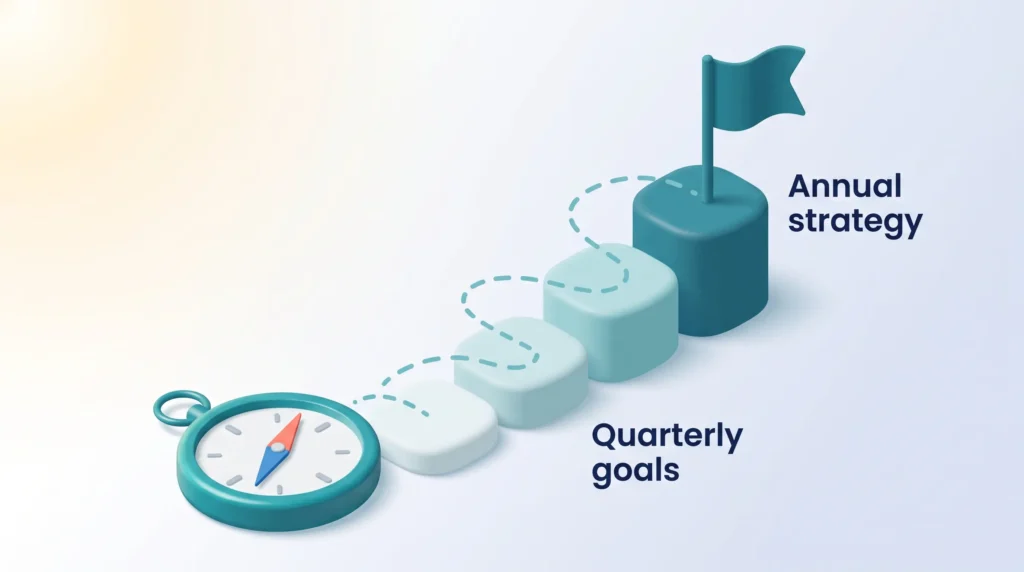
Short term goals will still shift when the market moves. That is the point of the cycle. What should not shift is the destination set during annual planning. Shared values help here, because a team with an explicit standard decides faster when two good priorities want the same engineer.
Then make the link visible. A dashboard showing each initiative against the annual goal it serves keeps the connection alive between planning days. A goal tracking template that makes progress visible over time is usually enough; you do not need new software.
Maximizing Your Quarterly Planning Day
A written agenda with times attached separates a planning day from a long meeting. Publish it beforehand so people know when their topic comes up. A workable shape for a half day session: half an hour on the quarter that ended, roughly 45 minutes on what the annual plan now demands, then at least an hour choosing and assigning priorities. That last block is where the real disagreements live, so protect it. Most agendas cover:
- Financial targets and the cash flow the plan assumes
- Company level goals
- Goals owned by each leader
- Risks and what would have to be true
- How the plan gets communicated to everyone else
Utilizing Templates and Tools for Streamlined Planning
You do not need a dedicated planning platform. You need one document everyone can find, and a place where progress is visible.
If you work in Atlassian tools, several free templates map onto this cycle. Confluence has project planning and product management template categories, including a product roadmap template that connects near term initiatives to longer term goals. Jira’s product roadmap template does the same job inside the tracker your engineers already use, and a scrum template organises work into sprints with a visible backlog.
Teams running several tools often find the plan drifting between them. Who owns which system is part of the wider revenue operations problem, which is aligning sales, marketing and customer teams around shared data.
Overcoming Common Challenges in Quarterly Planning
The most common failure is not a bad plan. It is a good plan nobody opens again until the next planning day.
Treat the quarter as a 13 week execution cycle and check progress weekly. A meta-analysis by Harkin and colleagues, published in Psychological Bulletin in 2016, pooled 138 studies with almost 20,000 participants and found that prompting people to monitor progress improved goal attainment. The effect was stronger when progress was recorded or reported to others. Most of those studies covered personal health goals, so treat this as directional rather than proof. A short weekly planning routine is the cheapest way to build that check in.
Beyond the cadence, four habits help:
- Open with the goals that are off track. Ask which decision, budget or person would fix it. Vague concern changes nothing.
- Do not ignore the amber ones. A capacity squeeze is far cheaper to solve in week four than in week eleven.
- Plan for the obvious risks. Workforce contingency planning maps critical roles before you lose one, and talent retention strategies address why people leave.
- Allow the plan to change. A better opportunity should be able to displace a committed goal. Make the swap explicit, so capacity moves rather than doubles.
Fostering Cross-Functional Collaboration
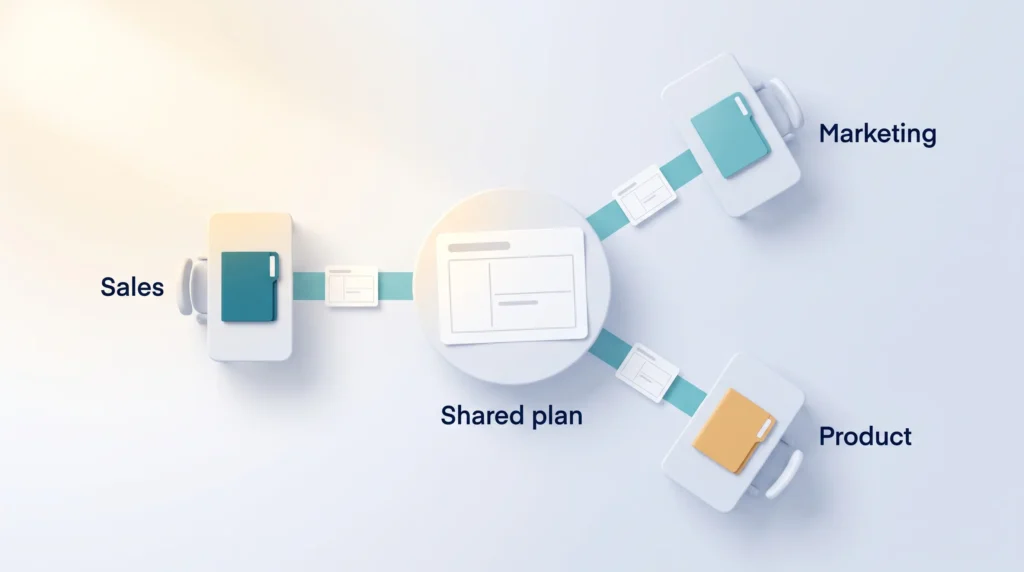
Goals set inside one department tend to collide with goals set inside another. Bringing the right people together early is cheaper than fixing that collision in week nine.
Involving Key Stakeholders
You need three perspectives. Executives set direction and release resources. Managers translate direction into work. Frontline staff know where the process actually breaks, which is why giving employees a real voice in decisions improves the plan rather than just morale.
Keep the decision group small even so; five to ten people can still have a proper argument. Wider input can arrive in writing beforehand, and through regular one-on-one check-ins afterwards.
Creating a Unified Vision Across Teams
Invite the functions the plan will touch: Sales, Marketing, Customer Service, Product, Operations and People. If a launch is in scope, whoever owns the go-to-market plan should be there when its dates are set.
Then publish the plan widely, including what was dropped, so people outside the session can raise a dependency you missed. A plan that stays inside the leadership team creates the silos it was meant to prevent.
Conclusion
Four times a year you check what happened, reset priorities, and translate strategy into work with names and dates on it. The parts that matter are unglamorous: a short list of goals, one owner for each, a measure you can actually pull, and a weekly look at progress. Those 13 weekly checks are where the plan survives or quietly dies.
Before the next quarter starts, put the date in the calendar, send the review material ahead of time, and decide who is in the room. Then write the plan down and let everyone read it.
Found this useful?
Make SmartKeys a preferred source on Google, and our articles will surface more often in your Top Stories, AI Overviews, and AI Mode.
Add as Preferred SourceFAQ
What is the purpose of a quarterly planning session?
The purpose is to review what the last three months produced and decide, in writing, what the team does next. A good session ends with a short list of goals, one named owner per goal, a measure for each, and a deadline. It also ends with a list of things the team has agreed to stop doing, which is the part most companies skip. That way nobody has to guess which of their many possible tasks actually matters this quarter.
How long should a quarterly planning day take?
Half a day is enough for a small team; larger organisations with several departments often need a full day. A workable split is roughly 30 minutes reviewing the quarter that ended, about 45 minutes on what the annual plan now demands, and at least an hour choosing and assigning new priorities. Protect the block. A planning day broken up by other meetings produces a plan nobody quite committed to. If you cannot find a clear block, move the session by a week rather than run it badly.
What should I include in my quarterly plan?
Four things: goals, initiatives, timelines and owners. The goals say what success looks like and how it will be measured. The initiatives say how you get there, broken into projects with milestones and dependencies. The timelines put real dates on those milestones. The owners put a single name next to each goal, because shared ownership usually means nobody owns it. Add a short section on known risks. Keep the document short enough to read in ten minutes and remember.
How do I track progress on quarterly goals?
Pick one place where every goal, its measure and its current status are visible without asking anyone. Then look at it in a fixed weekly slot rather than when you happen to remember. Research on goal monitoring suggests that checking progress more often, and recording or reporting it rather than keeping it private, improves the odds of reaching the goal. Keep the status simple: on track, at risk, or off track, plus one sentence on why. An abandoned tracker is worse than a plain one.
What are the most common quarterly planning mistakes?
Taking on too many goals is the most common one, usually because nothing from last quarter was removed. Close behind are goals with no measure, goals owned by a whole department, and plans nobody opens again after the session. Another frequent mistake is planning capacity as though nobody takes holiday, leaves, or gets pulled into support work. Finally, watch for goals that only make sense inside one team; those collide with another department’s plan.
How do I involve stakeholders outside the leadership team?
Collect input before the session and share decisions after it. Ask managers and frontline staff in advance what is slowing them down and what they would prioritise, then bring those answers into the room. Keep the decision group itself small, ideally five to ten people, so it can still reach conclusions. Once the plan is set, publish it to everyone it affects, including what was deliberately not chosen. Other teams can then flag a dependency you missed in time.