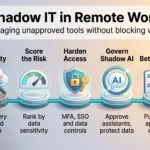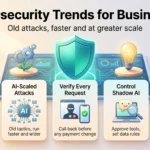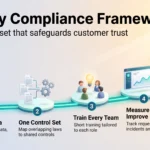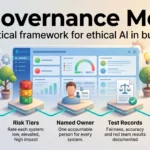
Somewhere in your company today, someone pasted a customer list into a chatbot. Not to cause harm. They had a report due, the approved tools were slow, and a free AI tool did the job in thirty seconds. That is shadow AI: the use of artificial intelligence tools at work without approval or oversight from IT and security.
It is now one of the fastest growing workplace security risks. IBM’s Cost of a Data Breach Report 2026 found the share of security incidents involving shadow AI more than doubled in a year, to 43 percent. More than two thirds of organizations still have no governance process to limit it.
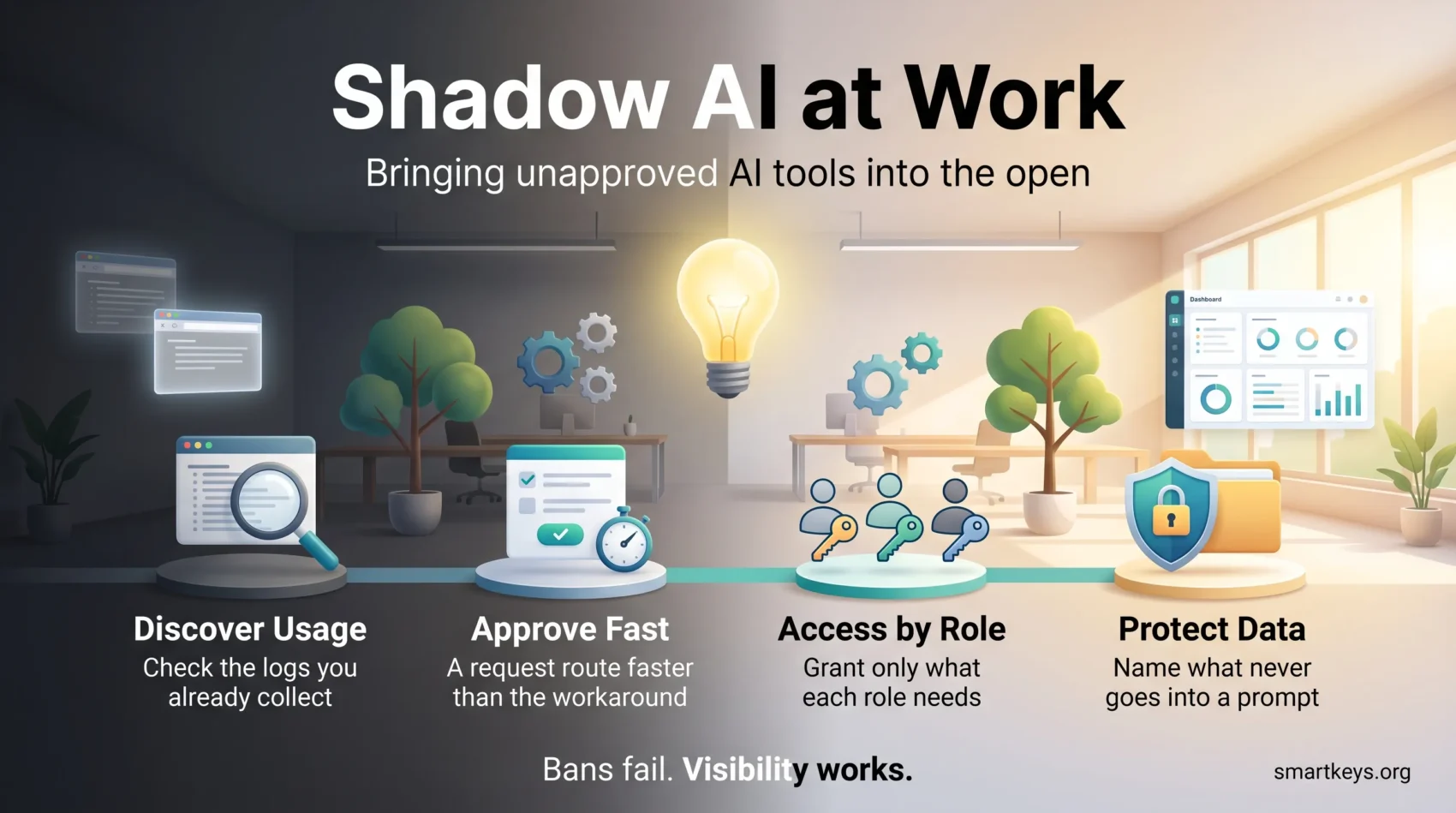
This guide explains what shadow AI is, why sensible employees keep reaching for unapproved tools, and what brings that usage back into the open. The short version: banning tools fails, while visibility, a fast approval path and role-based access work.
Key Takeaways
- Shadow AI means using AI tools at work without approval from IT or security.
- Shadow AI appeared in 43 percent of security incidents in 2026, more than double the year before.
- The core risk is data: prompts can carry customer records, source code and credentials to third parties.
- Most unapproved use signals an unmet need, not bad intent.
- Discovery, a lightweight approval route and role-based access beat blanket bans.
What Shadow AI Actually Means
Shadow AI is the use of AI tools, models or AI features inside a company without the knowledge or approval of the people responsible for security. A marketer using a free writing assistant, a developer calling a model API on a personal key, an analyst uploading a spreadsheet to a chatbot: it all counts.
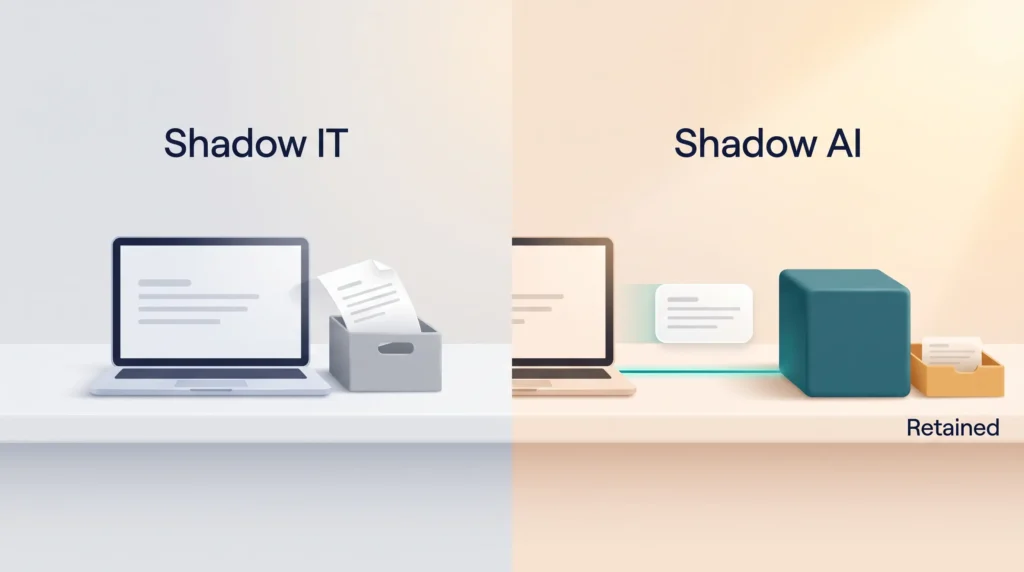
It is a branch of shadow IT in remote teams, the older problem of unsanctioned software and devices. The difference matters. Shadow IT usually means data sitting where it should not. Shadow AI means data being sent out, processed by a model you cannot inspect, and sometimes retained for training.
Three things make AI tools their own category. Prompts often carry far more context than a file upload would. Outputs can be wrong or biased in ways that are hard to spot. And adoption is trivial, because most tools are a browser tab away. That is why a bring your own app policy written for SaaS in general rarely covers them.
Why Employees Reach for Unapproved Tools
Almost nobody adopts shadow AI to break rules. They adopt it because the sanctioned option is missing, slow or worse.
Consider an analyst who needs a customer survey summarized before a Thursday meeting. The approved assistant is licensed to one team, procurement takes six weeks, and a public chatbot does it over lunch. The behaviour is rational. The exposure is real.
Three forces make this easy. Most AI tools are free at entry, so no invoice appears in finance. They run in a browser, so no install triggers an endpoint alert. And they improve monthly, so the gap between the consumer tool and the company one keeps widening.
Treating each incident as misconduct hides a useful signal. If three teams independently adopt the same transcription tool, that is a procurement requirement, stated in the clearest way your staff have available.
The Real Risks, in Order
Not every risk deserves equal attention. These four cause the damage.
Data Leaving Without a Record
This is the main event. Netskope’s Cloud and Threat Report 2026 found that 47 percent of workplace generative AI users work through personal accounts rather than company-managed ones. That is down from 78 percent a year earlier, but still close to half. Personal accounts sit outside your logging, your retention rules and your legal agreements.
The volume has grown sharply. Netskope measured data sent to software-as-a-service generative AI apps growing sixfold in a year, from around 3,000 to 18,000 prompts per month per organization. Data policy violations doubled over the same period. The material involved included source code, regulated data, intellectual property and login credentials.
Access You Never Granted
IBM found that 92 percent of organizations attacked through their AI models had failed to properly control access to them, and only about four in ten limit access to their AI systems at all. Browser extensions and AI plugins often request broad permissions across mail, files and calendars, and those grants persist long after the person stops using the tool.
Compliance Exposure
Unapproved tools bypass the paperwork regulators expect. Under the GDPR, serious infringements can carry fines of up to 20 million euros or 4 percent of worldwide annual turnover. The harder problem is evidence: you cannot show how a decision was made in an account you did not know existed. Our guide to employee data privacy rules in 2026 covers what employers must document.
Unchecked Outputs
An unreviewed model answer can be confidently wrong. When it feeds a pricing decision, a customer reply or a job posting, the error travels. Here explainable AI and a human review step matter more than any technical control.
How Widespread Is It?
Wide enough that assuming you have none is the riskiest position available.
Palo Alto Networks’ State of GenAI report, based on 2024 traffic, found generative AI traffic rising 890 percent in a year, an average of 66 generative AI applications per organization, and roughly 10 percent of those classed as high risk. Research by CybSafe and the National Cybersecurity Alliance found that 38 percent of employees who use AI at work admit sharing sensitive work information without their employer’s knowledge.
The trend line matters most. IBM’s 2025 report put shadow AI at 20 percent of breached organizations, adding as much as 670,000 dollars to the average breach cost. A year later it reached 43 percent of security incidents, while the average breach cost rose 12 percent to around 5 million dollars.
Finding Shadow AI in Your Own Environment
You cannot govern what you cannot see. Discovery comes first, and in most companies it needs no new tooling.
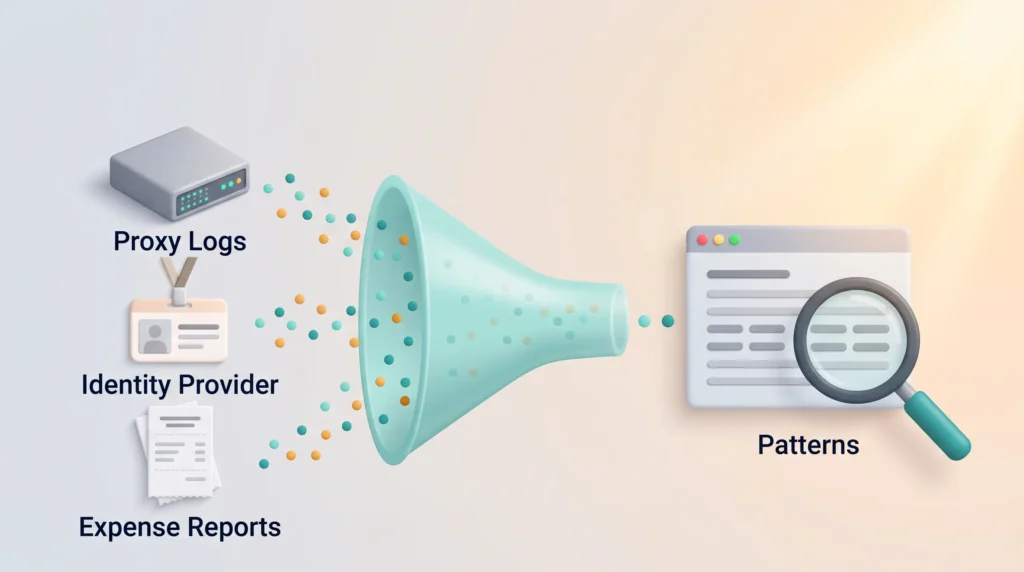
Start with data you already collect. Web proxy and firewall logs show repeated connections to consumer AI domains and model APIs. Your identity provider shows which third-party apps employees signed into with their work account. Extension inventories reveal AI assistants on managed devices, and expense reports catch personal subscriptions.
Then look for patterns rather than single events. One visit to a chatbot is noise. A department connecting daily, or a service account calling a model API at a steady rate, is a workflow that has already formed. Existing cybersecurity practice for remote work and zero trust access controls surface most of this once you know what to look for.
Finally, ask people. An anonymous two-question survey about which AI tools they use, and for what, usually beats any scan, provided honest answers carry no penalty.
Building an Approval Path People Will Actually Use
The most effective control is a request route faster than the workaround. If approval takes six weeks and the free tool takes six seconds, no policy will hold.
A workable version has four parts:
- A short intake form. What is the tool, what will it do, what data goes in, who needs it. Five fields, not fifty.
- A risk tier, decided quickly. Low risk requests with no sensitive data can be approved in days by one reviewer. Anything touching customer records, personal data, source code or regulated material gets a fuller review.
- Role-based access instead of company-wide yes or no. Developers may need model API access for prototyping while marketing needs only drafting support. Narrow grants reduce exposure without blocking work.
- An expiry date. Approve tools for six to twelve months, then review. AI vendors change retention terms and data handling often enough that a one-time approval ages badly.
Publish the approved list where people will find it, with a sentence on what each tool may be used for. Most shadow AI is not defiance; it is people not knowing a sanctioned option exists. Clear generative AI usage guidelines do more work here than a ban.
Protecting the Data Itself
Approval decides which tools are allowed. Data rules decide what may go into them, and that is the part employees need in plain language.
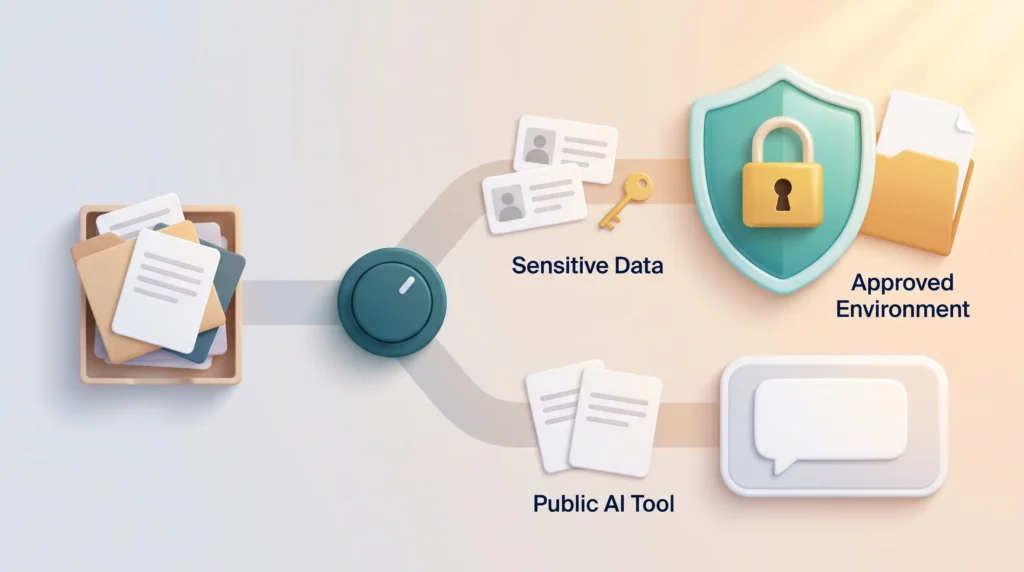
- Name the categories that never leave. Personal data, payment and health information, credentials, unreleased financials, source code, legal files and HR records. A short list people remember beats a taxonomy nobody reads.
- Explain that prompts are not private. Consumer accounts may retain inputs, metadata and conversation history, and terms differ between free and business plans. Say so rather than assuming people know.
- Offer a safe alternative for each blocked case. If customer records cannot go into a chatbot, name the approved environment where that analysis can happen.
- Check vendor terms first. Retention, training on customer data, subprocessors and deletion rights. A data governance strategy gives you a consistent standard.
- Apply the controls you already own. Classification, least privilege, encryption, logging and data loss prevention rules tuned for AI destinations.
Where you operate matters too: data localization laws can rule out a tool however good its security is.
Governance and the 2026 Rulebook
Governance sounds heavy. At minimum it answers four questions: who may use AI, for what, with which data, and who is accountable when it goes wrong.
Two reference frameworks do most of the work. The NIST AI Risk Management Framework structures how you identify and manage AI risk without prescribing tools. ISO/IEC 42001 is a certifiable AI management system standard, useful when customers ask for proof. An AI governance model built on either is easier to defend than one invented in-house.
The European position has moved, so state it precisely. Under the EU AI Act, AI literacy duties and the ban on prohibited practices have applied since 2 February 2025. The Article 50 transparency duties, covering disclosure when people interact with AI, apply from 2 August 2026. Obligations for high-risk AI systems were deferred to 2 December 2027 and, for AI embedded in regulated products, 2 August 2028. Our guides to EU AI Act compliance and wider AI regulation in 2026 cover the detail.
Governance also needs an owner. Some companies appoint an AI ethics officer; others give it to security or legal. What fails is leaving it unassigned. A privacy compliance framework and, at scale, compliance automation keep the evidence trail in one place.
Controls That Reduce Exposure
Once you know what is in use and what is allowed, a few measures narrow the gap.
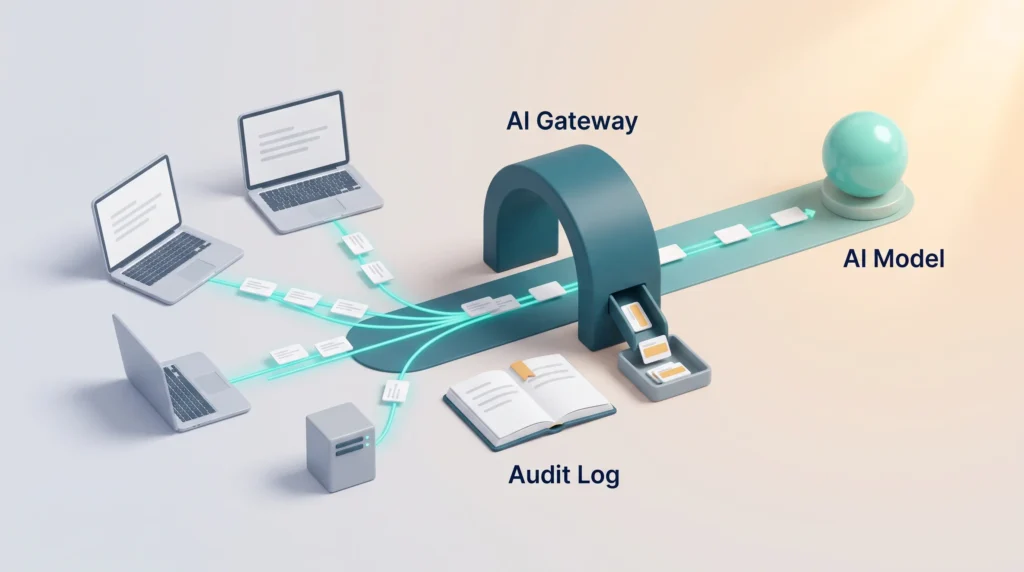
An AI gateway routes model traffic through one point where prompts, responses and API calls are logged and filtered. It turns invisible usage into reviewable records and lets you strip sensitive fields before they leave. Companies running models at scale fold this into a broader approach to managing large language models.
Alongside it: tune data loss prevention rules for AI destinations, restrict which browser extensions may be installed, and review third-party app grants on a schedule. Provide company accounts for the tools you approve, so usage stops running through personal logins.
One warning: blocking the well-known tools pushes people toward obscure ones with worse security and no logging. Block what is genuinely dangerous and provide a good alternative for the rest.
Three Situations You Are Likely to Recognize
These are illustrative scenarios, not reported incidents. Each maps to a control above.
The summarized strategy deck. A product manager pastes an internal roadmap into a personal chatbot account before a board meeting. Unreleased dates and partner names now sit in a consumer account with no company retention agreement. The fix is a sanctioned assistant with enterprise terms, not a rule against summarizing.
The helpful internal chatbot. A developer builds a support bot on a model API and points it at a customer ticket export. It works, so it spreads. No data protection assessment was done and the API key sits in a personal account. The fix is a registration route for internally built AI, plus managed keys.
The campaign visuals. A designer uploads unreleased product imagery to a free AI image tool. Brand assets now sit with a third party under terms nobody read. The fix is one approved creative tool.
In each case the employee solved a real problem. The organization’s failure was offering no supported way to solve it.
A Ninety Day Starting Plan
Month one: run discovery from logs you already have, and publish a short list of approved AI tools with the data rules attached. Month two: open the intake form, commit to a decision time, and set role-based access. Month three: review third-party app grants, tune data loss prevention for AI destinations, and brief managers so they can answer questions in their own teams.
Measure two things: how many AI tools you know about, and how long an approval takes. If the first rises and the second falls, shadow AI is shrinking. Treat AI use as ordinary working practice, alongside AI ethics at work and the wider data privacy trends shaping the rules.
Conclusion
Shadow AI is not a discipline problem. It is a supply problem: people need capability your approved stack does not deliver, and free tools fill the gap in seconds.
The numbers point the wrong way. Shadow AI appears in 43 percent of security incidents, most organizations have no process to limit it, and nearly half of workplace AI use still runs through personal accounts. No policy alone fixes that.
What works is unglamorous. See what is in use. Make approval fast enough to be worth using. Grant access by role. Say which data may never go into a prompt, and offer a safe route for the cases you block. Do that, and most of the shadow disappears on its own, because there is no longer a reason for it.
Found this useful?
Make SmartKeys a preferred source on Google, and our articles will surface more often in your Top Stories, AI Overviews, and AI Mode.
Add as Preferred SourceFAQ
What is shadow AI?
Shadow AI is the use of artificial intelligence tools at work without approval or oversight from IT and security. It covers public chatbots on personal accounts, AI features switched on inside approved software, browser extensions, and internally built tools that call a model API without registration. It is a branch of shadow IT with one difference that matters: data is not merely stored in the wrong place, it is sent to a third-party model you cannot inspect and may be retained. Most of it is well intentioned, which is why it spreads quietly and rarely triggers a security alert.
How common is shadow AI in 2026?
Common enough that most organizations have it. IBM’s Cost of a Data Breach Report 2026 found the share of security incidents involving shadow AI more than doubled year over year to 43 percent, against 20 percent of breached organizations in the 2025 edition. Netskope’s Cloud and Threat Report 2026 found 47 percent of workplace generative AI users still working through personal accounts. CybSafe and the National Cybersecurity Alliance found 38 percent of employees who use AI at work share sensitive work information without their employer’s knowledge. If you have found none, you probably have not looked in the right logs.
How do we detect unapproved AI tools without new software?
Start with data you already collect. Web proxy and firewall logs show repeated connections to consumer AI services and model APIs. Your identity provider lists third-party apps employees signed into with work accounts, including the permissions granted. Device inventories show installed browser extensions, and expense claims reveal personal AI subscriptions. Look for patterns rather than single visits: a team connecting daily, or a service account calling a model API at a steady rate, means a workflow has already formed. An anonymous survey asking which tools people use, and why, often gives the most complete picture, provided honest answers carry no penalty.
Should we simply ban unapproved AI tools?
A blanket ban usually makes visibility worse. Blocking well-known AI services pushes people toward obscure alternatives with weaker security and no logging, and moves the activity onto personal devices where you cannot see it at all. Targeted blocking still has a place for tools with genuinely unacceptable terms. The more effective combination is a fast approval route, a published list of sanctioned tools with clear data rules, role-based access instead of company-wide decisions, and company accounts for what you allow.
What data should never be entered into an AI tool?
Keep the list short enough that people remember it: personal data about customers or staff, payment and health information, credentials and API keys, unreleased financial results, proprietary source code, legal files and HR records. Netskope’s 2026 research found source code, regulated data, intellectual property and credentials among the material most often sent to generative AI apps. The rule works better paired with an alternative. If customer records cannot go into a general chatbot, name the approved environment where that analysis is allowed, or the work moves somewhere you cannot see.
What are the compliance consequences of shadow AI?
The immediate exposure is data protection. Under the GDPR, serious infringements can attract fines of up to 20 million euros or 4 percent of worldwide annual turnover, whichever is higher, and unapproved tools skip the assessments and records regulators expect. The EU AI Act adds duties on a staged timetable: AI literacy and prohibited practices since 2 February 2025, general-purpose AI provider obligations since 2 August 2025, Article 50 transparency duties from 2 August 2026, and high-risk system obligations deferred to December 2027 and August 2028. The practical difficulty is evidence: you cannot show how a decision was reached if the processing happened in an account nobody recorded.