Tools
Tools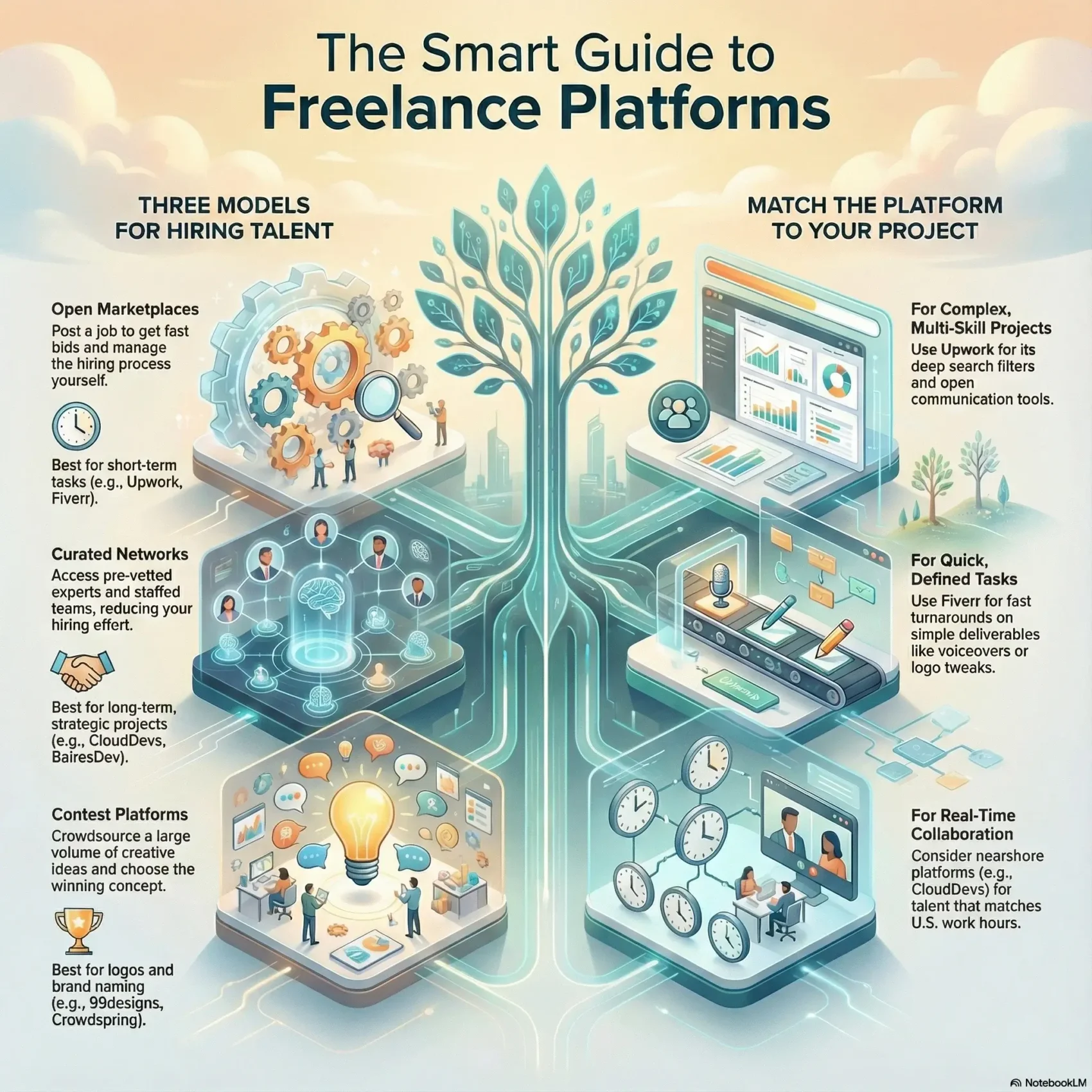
Last Updated on January 20, 2026
You can tap a global pool of specialists to move faster on key work without adding full-time headcount.
Over the past decade, small-business owners turned to web marketplaces like Upwork, Fiverr, 99Designs, and Crowdspring to hire experts for short and long projects.
Real examples show quick wins: a naming contest that produced hundreds of ideas in a week and long-running hires for legal help and podcast production on Upwork.
Each platform differs in fees, onboarding steps, and communication rules. That matters when you set budgets, pick collaborators, and protect payments.
In this guide, you’ll learn where these services shine, when to seek a retainer, and how to match your project needs to the right option.
Key Takeaways
- You can scale work quickly without long recruiting cycles.
- Marketplace, curated networks, and contest models serve different goals.
- Fees, messaging rules, and verification affect cost and speed.
- Long-term relationships can replace agencies for ongoing needs.
- Time zones, cultural fit, and nearshore options shape collaboration.
What You’ll Get From This Buyer’s Guide
This guide helps you sort channels, shorten the hiring process, and find the best candidates fast. Use it as a practical workbook to move from idea to hire without wasted time.
Who this guide is for and how to use it
You’re the audience if you need a clear way to compare options and narrow candidates for your next hire. That includes a startup client or an established company building a roster of specialists.
How we evaluate services: quality, speed, flexibility, and cost
We test real posting and screening flows. Upwork’s filters boost proposal quality and save time. Fiverr is fast for clear work but limits messaging. Contra gives polished matches; Guru can delay posting with verification. goLance removes client fees and adds time tracking and reporting.
- Practical steps: define timeline and budget, shortlist two or three sources, then post with tailored screening prompts.
- What we weigh: proposal depth, profiles, time to first viable candidates, contract flexibility, and total fees plus payment safety.
- Quick checks: skim portfolios, client reviews, and role-specific achievements to judge fit before interviews.
Understanding the Types of Freelance Talent Platforms
Not all hiring channels behave the same: some flood you with bids, others send pre-vetted candidates, and a few invite dozens of creative directions before you pick one.
Open marketplaces like Upwork and Fiverr let you post a job and get bids fast. You can hire individual freelancers for short-term tasks, assemble a team per project, and control screening. This approach fits when your team can manage interviews and reviews.
Curated networks (BairesDev, Arc, CloudDevs, X-Team, Aloa, Index.dev) pre-vet candidates and often supply staffed pods or dedicated teams. These options reduce hiring lift and work best for longer, strategic projects that need reliable processes.
Contest sites such as 99Designs, Crowdspring, DesignCrowd, and Squadhelp crowdsource ideas for logos or web design. Use contests when you want many directions up front and to award rights to a single winning service provider.
- Match short-term tasks to marketplaces and longer work to curated models.
- Decide if a single freelancer can finish the project or if a multi-disciplinary team is required.
- Consider contracts: hourly or fixed-price gigs versus staffed squads and managed services.
For a view of where hiring is headed, see the future of freelancing for trends that affect how you pick a platform.
Freelance Talent Platforms: Your Shortlist at a Glance
A tight shortlist helps you move from brief to hire faster. Match each service to the scope, time, and oversight you need before you post the job.
Best for complex projects: Upwork
Upwork gives you deep search filters, screening questions, and open communication. Use it when you need thoughtful proposals and multi-skill candidates for longer scopes.
Best for quick, executional tasks: Fiverr
Fiverr is fast for well-defined deliverables like logo tweaks or voiceovers. Expect quick turnaround, but note that messaging stays inside the site.
Promising up-and-comer: Contra
Contra surfaces polished, professional matches and tidy profiles. It can speed discovery, though occasional UX quirks may slow your process.
Low-fee hiring alternative: goLance
goLance charges clients zero fees and supports hourly or fixed contracts. Built-in time tracking, reporting, and multi-currency payouts make it a good fit when ongoing oversight matters.
- Match complex scope to Upwork and micro-tasks to Fiverr.
- Consider Contra for curated matches and goLance for low-cost, tracked work.
- Factor communication rules, candidate range, and proposal quality into your process.
How to Choose the Right Platform for Your Project
Before you post, nail down scope, deadlines, and how your team will work together.
Clarify scope, timeline, and collaboration needs. Write a concise brief that states success criteria, milestones, and communication rules. A tight job posting filters out unfitting candidates and speeds the hiring process.
Time zone alignment and nearshore advantages for U.S. teams
If your project needs real-time feedback, consider nearshore options in Latin America. Teams from CloudDevs, BairesDev, and Index.dev often match U.S. working hours, which reduces delays and improves quality.
Vetting, screening, and speed-to-hire considerations
Use quick vetting steps: portfolio checks, a short screening task, and targeted questions to judge fit. Open marketplaces surface many candidates fast, while curated services give fewer but pre-vetted choices.
Pricing models, fees, and total cost of ownership
Compare payment options—hourly with time tracking or fixed-price milestones—and note fee differences. Upwork supports escrow and mixed payments; goLance removes client fees and offers multi-currency payouts and reporting tools. Factor built-in tools into your total cost calculation.
- Process tip: choose the communication rules that match project complexity to avoid friction.
- Scale plan: pick an ecosystem that can grow from one contractor to a small dedicated team.
- Business value: weigh speed, flexibility, and payment control against platform fees.
Upwork: Robust Tools and Deep Talent Pools
When projects need multiple skills and careful coordination, Upwork is often the fastest way to assemble the right team.
When Upwork shines for multi-discipline work
You’ll use Upwork when your job spans research, design, and development. The site evolved from Elance and oDesk and relaunched in 2015 with stronger search and matching tools.
Clients report long relationships—an IP attorney retained for a decade and a producer handling 60 podcast episodes are common examples.
Posting, screening questions, and filters that save time
You’ll speed shortlisting by writing tight postings and adding screening questions. Use filters to find profiles with the exact mix of tools and industry experience you need.
Focus on tailored proposals and depth of work history and feedback when you evaluate candidates.
Payment options, contracts, and communication freedom
You’ll choose hourly contracts with time tracking or fixed-price milestones with escrow to protect budgets. Open messaging makes it easy to move from chat to live calls during hiring.
“Upwork gives clients the flexibility to iterate while keeping payment controls in place.”
- Set clear budget, timeline, and deliverables when posting a job.
- Make a small, interview-ready shortlist and run structured calls.
- Consider Business Plus if you want concierge access to top freelancers and admin support.
Fiverr: Fast, Affordable Execution for Clear Deliverables
When you need a rapid turnaround on clear deliverables, Fiverr often delivers outcomes in hours instead of weeks.
Where it fits: You’ll pick Fiverr for narrowly scoped design and content tasks where speed beats deep strategy. Think logo polish, simple video edits, audio cleanup, or short voiceovers. The site evolved from $5 gigs to broader price ranges and now hosts many reliable services.
Using filters, reviews, and portfolios to gauge quality
Save time by filtering sellers by delivery time, price, and reviews. Scan profiles and sample work to verify consistency for jobs like logo adjustments or quick edits.
Best practices:
- Order a small test project to confirm style and turnaround.
- Provide a precise brief, brand assets, and examples to limit revisions.
- Compare service tiers to match budget, revision counts, and delivery time.
- Plan for messaging-only communication; it works when the job is well defined.
“Fiverr is ideal when a fast, budget-friendly execution beats long discovery.”
Contra: Polished Matches With Early-Stage Quirks
You’ll find Contra pulls in polished profiles that cut down screening time for many hires. The site tends to surface candidates whose skills align closely with your job description. That reduces null matches and speeds interviews.
Professional profiles and relevant matches
Profiles on Contra often include clear portfolios and role-specific summaries. You’ll spend less time on basic vetting and more time validating fit for the project and team.
Early experiences show occasional broken links, odd formatting, and confusing post fields. These issues can slow the posting process, especially on your first job.
“The system is responsive to feedback and iterates quickly.”
- You’ll still run portfolio checks and small test tasks to confirm quality.
- Plan hiring steps around platform behaviors like when you can reject after messaging.
- Document your first projects to streamline future postings and save time.
Contest Platforms for Design and Naming
When you need many creative directions quickly, contest-driven design services deliver volume and variety.
How contests work: you post a brief, designers submit concepts, you give feedback, and then pick a winner. 99Designs excels for logos, web design, and graphics. Crowdspring pairs naming with brand marks. DesignCrowd covers business collateral like cards and brochures. Squadhelp focuses on naming contests.
Write a contest brief that lists brand attributes, target audience, must-haves, and examples you like. Be specific about tone and color limits so designers produce on-brand concepts.
- Run short iterative rounds and give clear, actionable feedback.
- Assess finalists for versatility across web design, print, and social.
- Check originality to avoid trademark issues and confirm rights transfer on award.
“A Crowdspring naming contest produced hundreds of ideas from 20+ countries and yielded a new brand name within a week for a few hundred dollars.”
Tip: set prize levels that attract experienced designers and consider hiring the winner for future projects to keep branding consistent.
Alternatives to Toptal and Nearshore Options
If Toptal’s premium model feels too slow or pricey, a wider market of options can give you faster matches at different rates.
Why look beyond Toptal: you might need more pricing flexibility, faster turnaround, or a partner that syncs with U.S. hours for real-time collaboration. That trade-off matters when speed and burn rate affect delivery.
LatAm for real-time collaboration
Nearshore teams often overlap your workday, so feedback cycles shrink and meetings are simpler. CloudDevs, for example, matches pre-vetted LatAm developers in ~48 hours, quotes $45–$70/hour, and offers a 7-day trial to reduce risk.
Which services to consider
- BairesDev — IT staff augmentation and autonomous engineering teams for longer engagements.
- CloudDevs — quick matches, clear rate bands, and short trials for fast hires.
- Arc, Aloa, Index.dev — curated shortlists and screening tools; Index.dev adds a 30-day risk-free period.
- X-Team — full-time remote developers on flexible contracts for scaled teams.
“Match the service to your project: choose dedicated squads when you need continuity, or curated candidates when you need a fast, precise hire.”
Weigh vetting depth, trial periods, and payment models when you compare options. Prioritize overlap in hours, clear rates, and how the provider handles onboarding to keep projects on time and on budget.
Platforms to Approach With Caution
Some services deliver great hires fast; others add hidden steps that cost you days. When speed and clarity matter, pick where you post carefully. A slow onboarding system or noisy proposal stream can waste your time and push deadlines.
Guru: onboarding friction and confidence concerns
Guru requires identity and payment verification that can take significant time. You may try to add a payment method and hit failures that delay approval.
If you need to hire quickly, factor this extra time into your process.
Freelancer.com: auto-bids, upsells, and quality issues
Freelancer.com often generates instant auto-bids and recruiter upsells. That inflates noise in your candidate pool and buries thoughtful proposals.
Watch for generic replies that ignore screening questions — they’re red flags for quality.
PeoplePerHour and ServiceScape: approval and scope limitations
PeoplePerHour can block postings or surface uneven proposal quality, which disrupts your hiring flow.
ServiceScape limits categories and feels dated; posting options are sometimes unclear. This constrains the kinds of work you can list and the freelancers you’ll reach.
- You’ll factor Guru’s onboarding steps into any tight hiring timeline.
- You’ll protect your time with tight briefs, tailored screening questions, and small paid tests.
- You’ll document the whole experience — onboarding, posting, messaging, and hiring — to decide where to invest effort next time.
“Proposals that skip your screening prompts usually signal low attention to detail — treat them accordingly.”
Budgeting, Workflow, and Quality Control
Clear budgeting and a tight workflow cut risk on every project you hire for. Start by matching payment method to scope: choose hourly when work will evolve, or fixed-price with milestones when deliverables are well defined. Upwork supports escrow and time tracking; goLance removes client fees and offers hourly or fixed contracts plus multi-currency payouts.
Setting budgets, milestones, and payment methods
Set realistic budgets and break the job into milestone payments tied to tangible deliverables. This keeps clients and professionals aligned and reduces scope creep.
Tip: use escrow for fixed-price work and time tracking for hourly contracts to reconcile invoices against actual work.
Vetting steps: portfolios, screening questions, and trial tasks
Run lightweight vetting to confirm fit before full engagement. Review profiles and portfolios, ask focused screening prompts, and pay for a short trial task to validate quality.
Small paid tests reveal how candidates handle feedback and deadlines. Record skills, rates, and availability to speed future hiring.
Workflow tools to streamline work: time tracking and reporting (goLance)
Pick a system with built-in time tracking, activity logs, and clear reporting. goLance provides work diaries, zero client service fees, and company tools for managing a team across projects.
Create a QA checklist for each handoff—file formats, performance benchmarks, and brand compliance—so every delivery meets your bar.
- You’ll standardize candidate records to simplify re-engagement.
- You’ll assign approval roles across your internal team and external professionals.
- You’ll capture lessons from each engagement to improve scope and estimates next time.
“A repeatable workflow that ties payments to milestones protects your schedule and budget.”
Conclusion
Choose the hiring route that matches your deadline, budget, and the depth of expertise your project requires.
Be pragmatic, scope work tightly and pick the channel that fits your needs. Write clear briefs, run a small paid test, and set milestones so hiring moves from search to delivery fast. Use contest sites for branding bursts, curated services for complex builds, and marketplaces when speed and flexibility matter.
Track outcomes and keep a short roster of reliable freelancers. Over time you’ll reduce overhead, sharpen briefs, and compound experience so your business gets the right expertise exactly when you need it.