A workplace wearable is any computer you can put on: a smartwatch on the wrist, a sensor clipped to a belt, a hard hat with a gas detector, a frame worn on the shoulders that takes some of the load off your back. The idea is simple. Instead of asking a worker to report how the shift went, the device measures part of it while the work happens.
That idea has moved well past the pilot stage in heavy industry, logistics and construction. In offices it has mostly stayed inside voluntary wellness programmes. This guide sets out what wearables at work genuinely do in 2026, what the research supports, what the market is worth, and the privacy rules that now decide whether a programme is legal at all.
Key Takeaways
- Wearables are strongest where the risk is physical: fatigue, heat, gas exposure, lifting and lone working.
- A 2026 systematic review of 60 studies found solid evidence for real-time risk detection, but little proof yet of lasting accident reduction.
- US private employers still reported 2.5 million nonfatal injuries and illnesses in 2024, which is the problem most safety wearables target.
- Since 2 February 2025 the EU AI Act bans using AI to infer employees’ emotions from biometric data, with only narrow medical and safety exceptions.
- Programmes fail on trust and comfort far more often than on technology. Voluntary participation and aggregated reporting are what keep them alive.
What Counts as a Workplace Wearable
Most workplace devices fall into four groups. Knowing which group you are buying from matters, because they solve different problems and carry different risks.
Inertial sensors measure movement and posture. Clipped to a belt or a vest, they count how often someone bends, twists or reaches overhead. Safety teams use them to find the specific tasks that cause back strain, which connects directly to everyday workplace ergonomics decisions.
Biosensors measure the body: heart rate, skin temperature, blood oxygen. In hot or high-exertion work they flag heat strain before the worker notices it.
Smart personal protective equipment puts sensors into gear people already wear. A connected hard hat can detect a fall, sense gas, and let a supervisor find the wearer on a large site.
Exoskeletons are worn frames that support the body rather than measure it. Passive versions use springs to hold a tool or an arm in position; powered versions add motors. We cover the category in detail in our guide to exoskeletons in the workforce.
Smart glasses sit slightly apart. They display information rather than collect it, and they have their own record of what they deliver at work.
The Problem Wearables Are Meant to Solve
The business case rests on injury numbers, so it is worth starting there. US private industry employers reported 2.5 million nonfatal workplace injuries and illnesses in 2024, at a rate of 2.3 recordable cases per 100 full-time equivalent workers, according to the Bureau of Labor Statistics. The rate has been falling for years, but the absolute count is still large.
The type of injury matters more than the total. Overexertion, repetitive motion and related bodily conditions accounted for 946,290 cases involving days away from work, job restriction or transfer, with a median of 24 days away. These are lifting injuries, strains and wear-and-tear damage: exactly the category that posture sensors and exoskeletons are built for.
That is the honest framing. Wearables are not a general productivity upgrade. They are aimed at a specific and expensive class of physical harm.
Where Wearables Actually Earn Their Place
Safety Monitoring and Hazard Alerts
The clearest wins are situations where a person cannot easily notice their own risk. Heat strain is the standard example: core temperature rises before most people feel unwell, so a chest strap or wrist sensor that flags the trend gives a supervisor time to rotate someone out.
Lone working is the second. A device that detects a fall and sends a location turns a silent emergency into a dispatched response. Gas sensing in confined spaces works the same way, warning of something the human senses cannot detect at all.
Proximity alerts round out the group. In a warehouse aisle where forklifts and pickers share space, a tag that buzzes when a vehicle gets close is a cheap layer on top of the physical separation that already exists. These systems sit naturally alongside the robotics already running in modern workplaces.
Exoskeletons and Physical Support
Exoskeletons attack the overexertion problem directly. A passive shoulder unit that holds an overhead tool removes most of the static load from the arms, which is why automotive assembly lines were early adopters. Back-support frames reduce spinal compression during repeated lifting.
The evidence here is encouraging but narrower than vendor material suggests. Laboratory and short-term field studies consistently show reduced muscle activity in the supported area. What is much harder to show is a drop in recorded injuries over years, partly because the devices sometimes shift load elsewhere in the body. Treat an exoskeleton as one control among several, not as a replacement for redesigning the task.
Hands-Free Information at the Point of Work
Smart glasses and wearable scanners let someone follow a procedure without putting down a tool or walking to a terminal. Warehouse picking, field maintenance and complex assembly are the usual settings, and the value is straightforward: fewer interruptions and fewer trips to look something up.
The same hardware underpins a growing slice of on-the-job AR training, where a trainee sees the next step overlaid on the equipment in front of them. Our review of AR and VR in the workspace covers how that market consolidated after Microsoft retired HoloLens.
Health and Wellness Programmes
Consumer wearables reach far more people than industrial ones. Rock Health’s 2025 Consumer Adoption Survey of 8,000 US adults found 57% own at least one wearable or connected device, and 46% own a wearable specifically. Most bought it themselves.
That installed base is why employers keep building wellness programmes on top of it. Step challenges, sleep insights and subsidised device purchases cost little because the hardware is already on the wrist. Done well, this fits into a broader approach to employee wellness in a distributed workforce and can support early burnout prevention.
Done badly, it becomes surveillance with a fitness logo on it. The line is drawn by who sees the individual data, which brings us to the parts most implementations get wrong.
What the Evidence Shows, and What It Does Not
A systematic review published in 2026 in Applied Sciences examined 60 studies on wearables in occupational safety and health, published between 2020 and 2026 across 28 countries. It is the most useful single summary available, and its conclusion is measured rather than promotional.
The review found strong potential for real-time monitoring, risk detection and data-informed decisions. It also found that consistent evidence of sustained accident reduction remains limited, because most studies were controlled or short-term rather than long real-world deployments.
The barriers it identified are worth reading as a checklist before you buy:
- Technical: devices from different vendors rarely talk to each other, and few have been validated in real industrial conditions.
- Human: comfort, usability and worker acceptance, with trust in surveillance the recurring sticking point.
- Organisational: purchase and maintenance costs, thin training capacity, and weak links into existing safety management systems.
- Ethical and legal: data governance and GDPR compliance, plus the risk that safety data quietly becomes performance data.
The practical reading is this: buy wearables for a named hazard you can already describe, and expect to prove the benefit yourself. Do not buy them on a promise of a general safety improvement.
Privacy: The Rules Changed
Wearable data is health data, and health data is regulated more tightly than almost anything else an employer holds. Two developments matter most.
First, the EU AI Act. Article 5(1)(f) prohibits AI systems that infer a person’s emotions from biometric data in the workplace, and that prohibition has applied since 2 February 2025. The exceptions are narrow and cover medical or safety purposes only. Under the Commission’s guidelines, general wellbeing monitoring such as stress detection does not qualify. If a vendor offers to score your team’s mood or engagement from physiological signals, that product is not sellable into an EU workplace.
Second, consent at work is weak consent. Under the GDPR, regulators treat employee consent with suspicion because the power imbalance makes refusal costly. A wellness programme that is technically opt-in but practically expected will not survive scrutiny. In the US, state biometric and privacy laws add their own duties, and our guide to the 2026 rules for employee data sets out what applies where. The wider regulatory picture is covered in our overview of current data privacy trends.
The same concerns drive scrutiny of AI in employee monitoring, and the boundary between the two is thinner than most vendors admit. A device that tracks posture for safety can also track how long someone stood still.
How to Run a Wearable Programme People Trust
The technology decisions are the easy part. These five choices decide whether the programme lasts.
Start from a named hazard. Write down the risk you want to reduce and how you will measure it before you look at devices. If you cannot name it, you are buying a solution without a problem.
Keep participation genuinely voluntary where safety does not require it. Mandatory gas detection in a confined space is defensible. Mandatory sleep tracking is not.
Report in aggregate, decide in aggregate. Managers should see that a particular task causes twice the bending of any other, not that one named person bent 400 times on Tuesday. Individual data belongs to the individual and, where relevant, to occupational health.
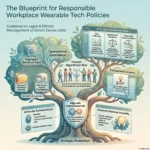
Write the policy before the pilot. Say what is collected, who can see it, how long it is kept, what it will never be used for, and how someone withdraws. A written wearable tech policy is what turns a promise into something enforceable.
Budget for the boring parts. Charging, cleaning, replacement, sizing for different bodies and a helpdesk that answers when a device fails. Comfort problems kill more pilots than data problems.
Market Size and Where Adoption Is Heading
The enterprise wearable market, meaning devices bought by organisations rather than consumers, was valued at about USD 280 million in 2026 by Fortune Business Insights, growing at a forecast 26.3% a year to 2034. North America holds the largest regional share and manufacturing the largest application share.
Two things follow from those figures. The market is growing quickly, and it is still small. Enterprise wearables remain a specialist purchase concentrated in industries where physical risk is high, not a general workplace fixture.
Three shifts are shaping the next few years. Sensors are getting cheaper and lighter, so the comfort barrier is falling. Connectivity is improving, which matters because a safety alert that arrives late is not a safety alert; this is where wearables overlap with the wider industrial internet of things and with connected devices in healthcare. And regulation is tightening, which is pushing vendors away from inference about people and towards measurement of conditions.
For office work specifically, the realistic outlook is modest. Wearables will keep supporting voluntary health programmes and will keep feeding into how organisations think about office design, hybrid working and wellbeing and remote employee engagement. They are unlikely to become the productivity instrument some vendors describe, and the rules now make that use case harder rather than easier.
Conclusion
Wearable technology at work is a real tool with a narrow, well-defined job. It is genuinely useful where the hazard is physical and where a person cannot reliably sense their own risk: heat, gas, falls, lone working and repeated lifting. In those settings the case is strong enough to act on now.
Everything beyond that deserves scepticism. The research supports the monitoring capability but not yet the long-term safety payoff, so treat vendor claims about accident reduction as a hypothesis you have to test in your own operation. And treat the data as what it is, which is health information about identifiable people, governed by rules that got stricter rather than looser.
The organisations that get value from wearables are the ones that pick one hazard, measure it honestly, keep individual data out of management reporting and write the policy before the first device arrives.
Found this useful?
Make SmartKeys a preferred source on Google, and our articles will surface more often in your Top Stories, AI Overviews, and AI Mode.
Add as Preferred Source