
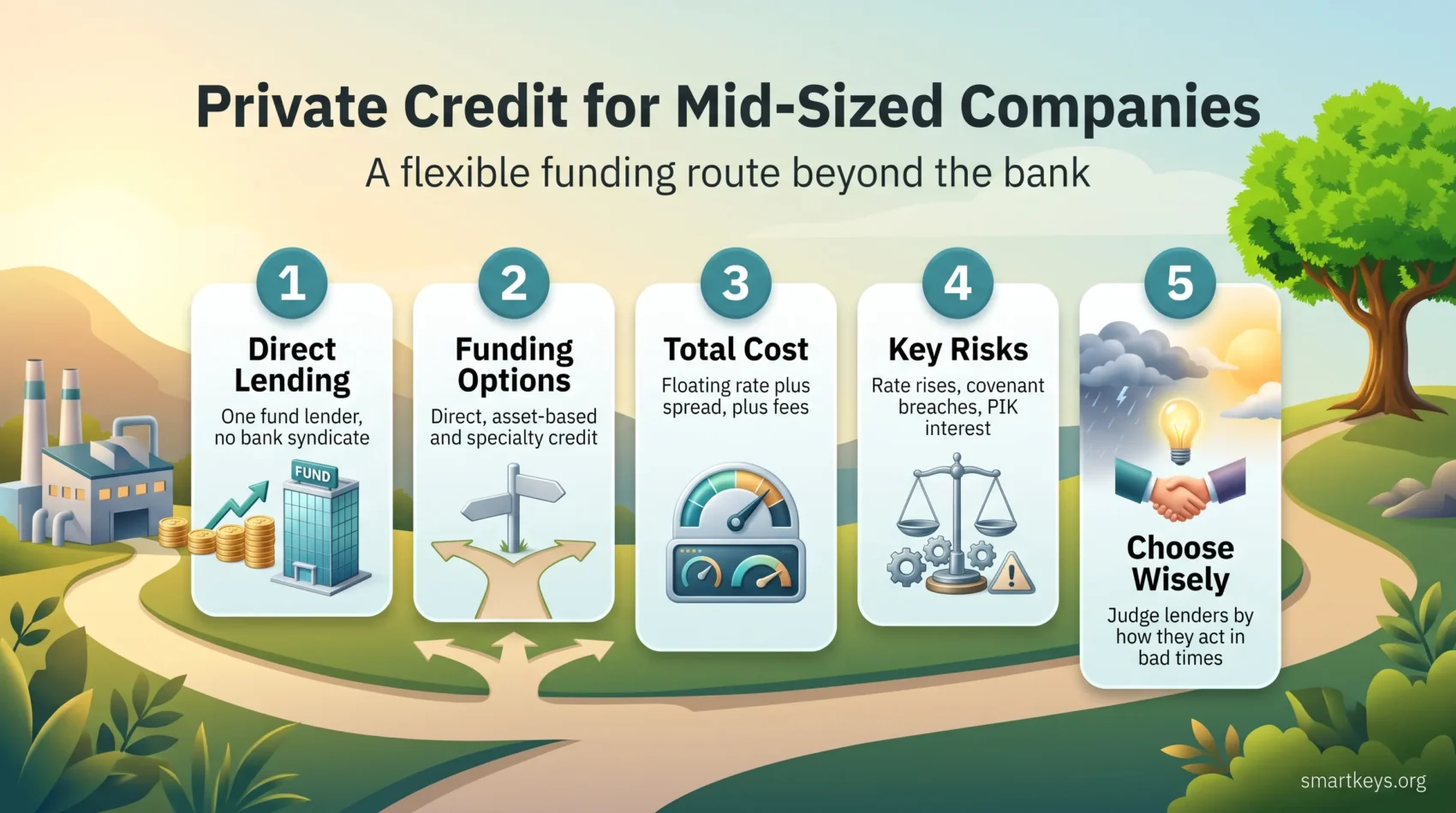
If your company is too big for a small business loan but too small for the bond market, getting money for growth can be hard. For many mid-sized companies, private credit has become the answer. It means borrowing directly from an investment fund or another nonbank lender instead of from a bank.
The market has grown fast. Moody’s expects private credit assets under management to pass $2 trillion in 2026 and approach $4 trillion by 2030. That growth brings more choice for borrowers. It also brings more scrutiny, after a run of high-profile failures and fund withdrawals in 2025 and 2026.
This guide explains how private credit works, what it costs, where the risks sit and how to judge a lender. It is written for founders, CFOs and managers who want a clear picture before they sign a term sheet.
Key Takeaways
- Private credit is a loan negotiated directly with a nonbank lender, usually a fund.
- It is often faster and more flexible than a bank loan, but usually more expensive.
- Most deals use floating rates, so your interest bill rises when benchmark rates rise.
- Covenants, fees and prepayment terms matter as much as the headline interest rate.
- Choose a lender for its behavior in bad times, not just for the price in good times.
What Private Credit Means for Mid-Sized Companies
Private credit is an umbrella term for loans that are not made by banks and not sold to the public. The lenders are mostly asset managers. They raise money from pension funds, insurers and wealthy investors and lend it to companies.
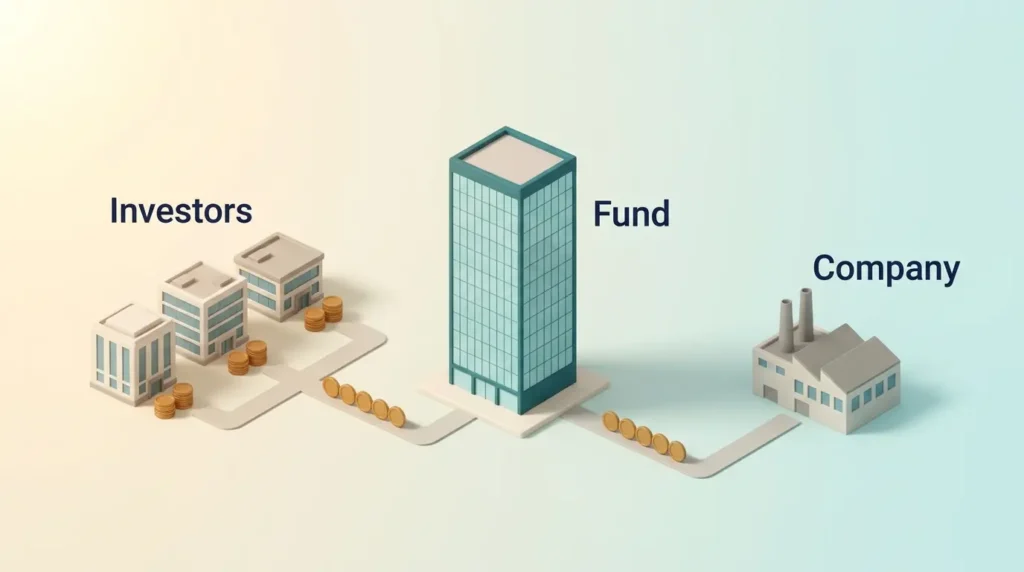
The most common form is direct lending. Here, one lender or a small group negotiates the loan with your company. There is no bank syndicate, the group of banks that usually splits a large loan.
Many direct loans are first-lien, senior-secured loans. “Senior” means the lender gets repaid before other creditors and shareholders. “Secured” means the loan is backed by company assets. “First lien” means the lender has the first claim on those assets.
Here is how private loans differ from traditional financing:
- They are negotiated one to one and are not traded on public markets.
- They have no daily market price, so they are harder for the lender to sell.
- Terms, collateral and repayment schedules can be shaped around your business.
Direct lending focuses on the so-called middle market. There is no single official definition. Lenders usually describe it by EBITDA, which is earnings before interest, taxes, depreciation and amortization, a rough measure of operating cash profit. A company with a few million dollars of EBITDA sits in a different bracket from one with a hundred million, and each lender draws the lines a little differently.
Why the Private Credit Market Has Grown
After the 2008 financial crisis, regulators made banks hold more capital against risky loans. Many banks pulled back from lending to mid-sized companies that already carried a lot of debt.
Asset managers moved into that gap. Private equity firms, which buy companies using a mix of their own money and debt, needed lenders for their deals. Funds that could write large loans quickly became natural partners.
Three other trends added fuel:
- Companies stay private longer. They need debt for growth, acquisitions and working capital without going public.
- Borrowers value speed and certainty. A single lender can commit faster than a syndicate of banks.
- Investors want income. Floating-rate loans paid attractive yields when interest rates rose in 2022 and 2023.
Even so, private credit is still a minority of corporate borrowing. Long Angle, citing industry data, puts it at about 20% of the leveraged credit market but only about 9% of all corporate borrowing.
Market size figures also vary with the definition. Moody’s counts one set of strategies. The Alternative Credit Council and EY, which include asset-backed, real estate and infrastructure debt, reported around $3 trillion as early as 2024.
Private Credit Funding Options to Consider
Private credit is not one product. The right option depends on your purpose and your collateral.
Direct lending for growth, acquisitions and buyouts
Direct lending is the core of the market. It funds acquisitions, leveraged buyouts, expansion and the refinancing of existing debt. A common structure is the unitranche loan, which combines senior and junior debt into a single loan with one interest rate and one set of documents.
Asset-based finance backed by business assets or cash flows
Asset-based finance lends against specific assets, such as receivables, inventory, equipment or recurring contracts. The amount you can borrow depends on the value of those assets rather than only on your overall earnings. This can suit a company with strong assets but uneven profits. For a related model that avoids buying equipment at all, see our guide to robotics as a service.
Specialty and opportunistic credit
Some funds focus on niche situations: equipment leasing, royalty financing, litigation finance or companies in a turnaround. These deals carry more risk and therefore cost more. Read their terms with extra care.
How Loan Structure Affects Your Company’s Capital
Once you know which type of loan fits, the next question is how it sits in your capital structure, the mix of debt and equity that funds your business.
Debt is repaid in a fixed order. Senior debt comes first, subordinated debt next and equity last. A lender higher in that order takes less risk, so it usually charges less. A lender lower down wants a higher return.
Collateral strengthens the lender’s position. If your company struggles, the lender can claim the pledged assets. For you, this means those assets become harder to use for other borrowing.
Covenants are the rules written into the loan. A maintenance covenant might say your debt must stay below a set multiple of EBITDA, tested every quarter. Breaking a covenant does not automatically mean default, but it gives the lender the right to renegotiate, charge fees or demand changes. Make sure the limits leave you room.
Finally, check the maturity. Private loans usually run for several years, and the repayment date should line up with your cash flow plans and any expected refinancing.
Interest Rates, Fees and the Cost of Private Credit
Most private loans have a floating rate. The rate is set as a benchmark plus a fixed margin, called the spread. In the US, the benchmark is usually SOFR, the Secured Overnight Financing Rate, which tracks the cost of overnight borrowing between financial institutions.

Spreads are quoted in basis points. One basis point is 0.01%, so 500 basis points equals 5 percentage points. According to Long Angle, direct lending spreads have held at roughly 500 to 700 basis points over SOFR since 2023. Morgan Stanley’s private credit team described typical first-lien and unitranche spreads for non-software companies at around 475 to 525 basis points in the second quarter of 2026. Your spread depends on size, sector and leverage.
A simple example shows why the floating rate matters. If SOFR is 4% and your spread is 5.5%, you pay 9.5% a year. If SOFR rises by one point, you pay 10.5% without changing anything in your business. Many loans also include an interest-rate floor, a minimum benchmark that protects the lender when rates fall.
The spread is only part of the cost. Watch for these charges:
- Upfront fees paid at closing
- Original issue discount, where you receive slightly less than the face value of the loan
- Commitment fees on money promised but not yet drawn
- Amendment fees each time terms are changed
- Prepayment premiums, also called call protection, if you repay early
Two offers with the same spread can have very different total costs once these are added up.
Potential Benefits of Private Credit for Your Business
So why pay more than a bank would charge? For many companies, the answer is flexibility and certainty.
- Tailored terms. You can negotiate repayment schedules, covenants and collateral that match your business model, including seasonal swings.
- Speed. One lender can usually move faster than a bank syndicate, which matters when an acquisition has a deadline.
- Certainty of funding. Once committed, the money does not depend on public market conditions on the day you need it.
- A single relationship. If you hit a rough patch, you negotiate with one counterparty you already know.
Picture a manufacturer that wants to buy a smaller competitor within eight weeks. A bank may need longer and may cap the loan below what the deal requires. A direct lender that knows the sector can underwrite the deal and commit to the full amount, at a higher price. For that company, the extra cost may be worth it.
Risks and Trade-Offs to Weigh Before Borrowing
The flip side of flexibility is cost and dependence.
Rate risk. With a floating rate, a rise in SOFR raises your interest bill straight away. Model what happens if rates climb and growth slows at the same time.
Covenant pressure. A weak quarter can trigger a covenant breach. That can lead to extra fees, tighter reporting or, in serious cases, the lender taking more control.
Payment-in-kind interest. Some loans allow PIK interest, where unpaid interest is added to the loan balance instead of paid in cash. It eases short-term cash flow but makes the debt grow. Moody’s lists PIK loans among the financial tools the market is leaning on more than ever in 2026.
Market stress. The sector has had a turbulent stretch. In September 2025, auto parts maker First Brands and subprime auto lender Tricolor collapsed amid allegations of double-pledged collateral. Long Angle notes that most of that exposure sat with banks rather than private credit funds. Still, these cases raised wider questions about lending standards, and several funds that sell to individual investors, including vehicles run by Blue Owl, capped withdrawals in the first half of 2026.
Default rates depend on who is counting. Trackers cited by Morgan Stanley for early 2026 range from under 2% to above 5%, depending on method. The same report calls defaults contained and below prior cycle averages. For borrowers, the practical lesson is simple: a lender under pressure from its own investors may be less patient with you. A structured risk management framework helps you test these scenarios before you sign.
How Private Credit Compares With Other Funding Routes
Private lenders versus bank loans and syndicated credit
- Price: Banks are usually cheaper when they are willing to lend.
- Negotiation: With a private lender you deal directly with the decision maker.
- Speed and certainty: Private lenders can often commit faster and hold the whole loan.
- Flexibility: Covenants and repayment terms are easier to tailor, though not always looser.
Private credit versus public bonds and private equity
- Public bonds suit large companies with credit ratings. They require public disclosure and are usually out of reach for mid-sized firms.
- Private equity gives you capital without fixed repayments, but you give up ownership and some control.
- Private credit keeps ownership with you but adds fixed obligations and lender oversight.
If you are an early-stage company, venture capital or newer models may fit better. Our overviews of startup funding trends, P2P lending and embedded finance cover those routes. Smaller firms will find the wider borrowing picture in our small business trends report. For a wider view, see fintech trends and green finance trends.
How to Assess a Lender and Choose the Right Financing

Price matters, but the lender’s behavior in a downturn matters more. Treat the choice like a key hire:
- Check sector experience. Ask which companies like yours the lender has financed, at what size and leverage.
- Ask about tough times. How did the lender handle borrowers that missed covenants? Ask for references from those companies, not only happy ones.
- Understand the fund behind the lender. Is the money from long-term institutional investors or from a fund that individuals can withdraw from? The answer affects how patient the lender can be.
- Compare total cost. Put spreads, fees, original issue discount and prepayment terms into one spreadsheet. Finance automation tools and predictive analytics can speed up this modelling.
- Stress-test the deal. Run your revenue forecast with higher rates and lower revenue. Make sure you would still meet the covenants.
- Get expert help. An experienced finance lawyer and, if you lack in-house depth, a fractional CFO can spot terms that look harmless but are not.
A clear decision-making model keeps your leadership team focused on criteria rather than on the loudest voice.
Conclusion
Private credit has grown from a niche into a mainstream funding source for mid-sized companies. Direct lending, asset-based finance and specialty strategies each serve different needs and risk levels. They can open a path to capital when banks or public markets do not fit.
The trade-off is cost and closer lender oversight. Check the full terms, compare lenders on how they act under pressure and test your cash flow under tougher conditions.
Used carefully, private credit can fund growth without giving up ownership. Pair it with a sharp focus on profitability and a realistic scaling plan, and it becomes a tool rather than a trap.
Found this useful?
Make SmartKeys a preferred source on Google, and our articles will surface more often in your Top Stories, AI Overviews, and AI Mode.
Add as Preferred SourceFAQ
What is private credit?
Private credit is lending by nonbank institutions, mostly investment funds, directly to companies. The loans are negotiated privately and are not traded on public markets. Mid-sized companies use private credit for acquisitions, growth projects, buyouts and refinancing. The most common form is direct lending, where one lender or a small group provides the whole loan. Terms can be tailored to the borrower, but interest is usually higher than on a comparable bank loan.
What are the advantages of private loans over bank loans?
The main advantages are speed, flexibility and certainty. A private lender can often commit faster than a bank syndicate and may lend amounts or structures a bank would refuse. Repayment schedules, covenants and collateral can be shaped around your business. The trade-off is price: private loans usually carry higher spreads and fees, and often closer monitoring. You also deal with one counterparty, which can make later changes easier.
How are interest rates and fees set on private credit loans?
Most private credit loans use a floating rate made of a benchmark plus a spread. In the US the benchmark is usually SOFR, the Secured Overnight Financing Rate. When SOFR rises, your interest payments rise too. On top of interest, expect upfront fees, original issue discount, commitment fees on undrawn amounts, amendment fees and prepayment premiums. Compare offers on total cost over the expected life of the loan, not on the spread alone.
Is private credit only for companies owned by private equity?
No, but private equity-backed companies make up a large share of direct lending. Lenders like these deals because a sponsor brings capital, a business plan and the ability to inject more money in a crisis. Founder-owned and family-owned companies can also borrow from private lenders, especially through asset-based finance or lenders that focus on non-sponsored deals. Without a sponsor, expect closer scrutiny of your management team, reporting quality and collateral, and possibly tighter pricing.
What does payment-in-kind (PIK) interest mean?
Payment-in-kind interest is interest that is added to the loan balance instead of paid in cash. This can help a company through a period of tight cash flow or heavy investment. The downside is that the debt keeps compounding, so you owe more when the loan matures. Analysts watch rising PIK usage closely because it can hide cash flow strain. If a lender offers a PIK option, model the full balance at maturity before you accept it.
What risks should I consider before borrowing?
The biggest risks are rising interest costs, covenant breaches and dependence on a single lender. Because most loans are floating rate, higher benchmark rates increase your payments immediately. A weak quarter can breach a covenant and lead to fees, tighter reporting or tougher terms. A fund facing investor withdrawals may also be less patient with you. Run your forecast with higher rates and lower revenue to see whether you could still meet every obligation.
What should I look for when assessing a lender?
Look first at how the lender behaves when borrowers struggle. Ask for references from companies that went through a covenant breach or restructuring with them. Check whether the lender has financed businesses of your size, sector and leverage. Find out where its money comes from, because long-term institutional capital usually means more patience than funds open to daily or quarterly withdrawals. Then compare the full package, not just the spread.