Tools
Tools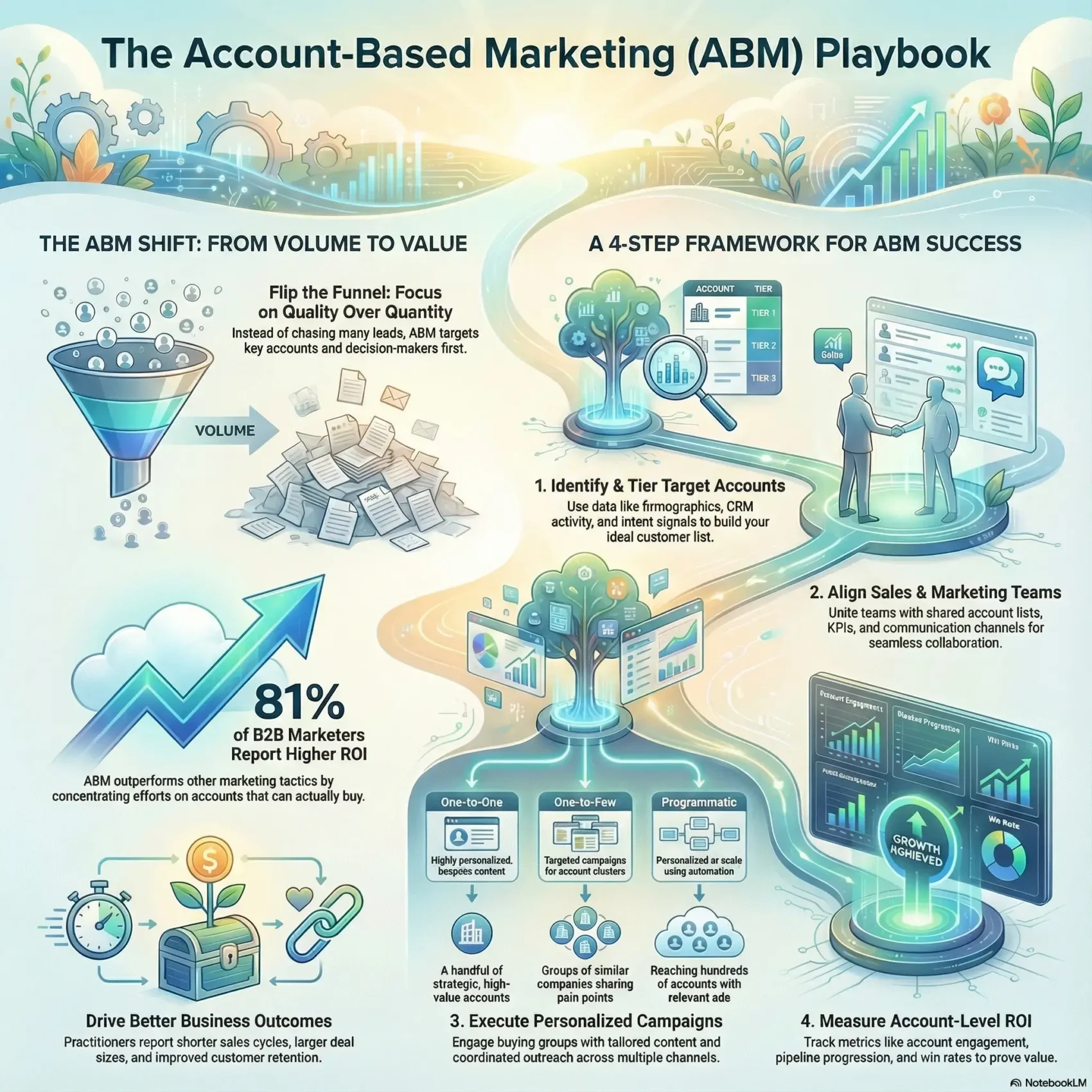
Last Updated on January 19, 2026
You need a clear way to focus your sales and marketing teams on the accounts that matter most. This introduction shows how an account-based approach flips the funnel, starting from target accounts and specific decision-makers to speed pipeline and lift ROI.
Account-based marketing (abm) pairs personalized campaigns with tight sales alignment. It uses CRM tools and marketing automation so your team spends time where it creates the most value, not chasing volume.
Practitioners report big gains: higher ROI, shorter sales cycles, and larger deal sizes. In this article you’ll learn how to pick high-value accounts, build joint account plans, and run campaigns that scale while protecting margin.
Key Takeaways
- You’ll learn why focusing on target accounts improves ROI and shortens sales cycles.
- Alignment between sales and marketing is essential to operational success.
- Personalized campaigns and tools let you scale outreach without losing relevance.
- Prioritize high-value accounts to protect margin and boost retention.
- Practical steps will show how to launch, govern, and measure your plan.
What You’ll Learn in This Ultimate Guide to High‑Value Accounts
We’ll walk you through a repeatable process to identify top-fit companies and engage buying teams with purpose. You’ll see how account-based marketing pairs with inbound work to focus your resources on target accounts that deliver the most value.
Follow a clear, practical path:
- Pick and tier high-value accounts so your team spends time where impact is biggest.
- Map marketing tactics and channels—email, social media, and content—to warm buying roles before sales outreach.
- Set KPIs that track account progress, not just lead counts, so you measure real success.
- Align marketing and sales plans so everyone works the same account list and shares wins.
- Use repeatable personalization to solve customer pain points without wasting time.
By the end you’ll have a compact playbook to scale your marketing strategy, shorten cycles, and win bigger deals for your company.
Defining ABM: How Account-Based Marketing Relates to Your Inbound Engine
This approach starts by naming the companies you want to win, then builds tailored content and outreach for the decision-makers inside them.
ABM flips the funnel: instead of chasing many leads, you focus on target accounts and create offers that speak to real pain points. That raises quality, shortens time-to-value, and makes attribution clearer across the account journey.
Inbound marketing still matters. SEO and helpful content generate awareness and signals across your market. When inbound reveals interest from a high-fit account, your focused plays convert that signal into action.
Define an account by company fit and the buying group inside it. Map content to roles, set cadence and channels, and tier your accounts so you invest the right time per company.
- Align sales and marketing on one shared list of target accounts.
- Use content that answers concrete pain points for buying teams.
- Measure account progress, not just lead counts, to see real ROI.
Why ABM Now: Present-Day Benefits That Move the Needle
Delivering tailored content to specific buying groups speeds decisions and builds trust with key stakeholders. Right now, focused programs are proving they work: 93% of practitioners rate their work very or extremely successful, and 81% of B2B marketers report higher ROI than other tactics.
Higher ROI, shorter sales cycles, and better deal sizes
Quality over quantity lets you spend time on accounts that can actually buy. That removes low-fit leads and shortens cycle time.
This focus often increases deal sizes because your sales team talks to decision-makers with relevant use cases and value metrics.
Maximized relevance through highly targeted campaigns
When your content matches a company’s initiatives, meeting acceptance and engagement rise. Highly targeted creative ties content to the account’s KPIs.
Consistent customer experiences that drive retention
Consistency from first touch to expansion builds trust. Your company becomes the reliable partner for high-value accounts by aligning messages across marketing and sales.
“Translate outcomes—velocity, deal size, efficiency—into business language leaders understand.”
- Proof of impact: better ROI and measurable pipeline efficiency.
- How to sustain it: rigorous account selection, disciplined orchestration, and ongoing optimization as best practices.
- Leadership value: communicate wins in revenue, time saved, and customer lifetime value.
Align Sales and Marketing to Work Together on Target Accounts
Start by uniting sales and marketing around a single list of high-priority accounts and clear outcomes. This reduces wasted effort and makes every handoff feel intentional.
Shared goals, budgets, and KPIs for sales teams and marketing
Agree on outcomes. Set joint KPIs, allocate budgets, and rank target accounts so both sales and marketing move toward the same revenue goals.
Collaboration workflows and account-specific communication
Define who owns what: content creation, orchestration, and meeting facilitation. Clear roles cut confusion and protect time.
- Create account-specific channels (Slack/Teams) and shared account plans to keep updates fast and visible.
- Hold regular joint pipeline reviews and engagement standups driven by live data to prioritize next actions.
- Use simple tools and dashboards so everyone sees account progress from first touch to expansion.
Consistent messaging matters. Use templates and shared playbooks so the customer experiences a seamless conversation across teams and over the life of the account.
Build Your ICP and Identify Target Accounts Using Data
Build a repeatable test that turns anonymous site traffic into prioritized target accounts. Start by defining the ideal customer profile (ICP) with firmographics, tech stack, and buying group dynamics. That gives you a clear filter for selecting high-fit companies.
Qualifying high-value accounts with firmographics and buying group insights
Use basic firmographics—industry, company size, and revenue bands—to remove low-fit prospects fast. Add buying group mapping so you know which roles to engage inside each target account.
Using CRM, website visitors, and social media to surface intent signals
Mine your CRM and marketing automation for recent activity. Combine that with visitor-ID tools and social signals to validate intent signals. Companies that repeatedly visit pricing or product pages often belong at the top of your list.
- Tier accounts by fit and engagement to focus time where it matters.
- Enrich records with simple tools and automate alerts for sales follow-up.
- Example: CloudTalk used Leadfeeder to find 1,000 prospects monthly, then targeted 20 active accounts and gained ~20 extra enterprise trials per month.
“Turn web behavior into prioritized accounts, then let sales and marketing act together.”
Types of ABM: One‑to‑One, One‑to‑Few, and Programmatic
Choose the right delivery model to match how much time your team can spend on each account. The three common approaches trade depth for scale so you can invest where impact is highest.
Strategic ABM for high-value accounts and executives
One-to-one focuses on a handful of key accounts with bespoke content, executive briefings, and tailored ROI cases. Use this when a single win moves the revenue needle.
ABM lite for clusters that share pain points
One-to-few groups similar companies into clusters. You reuse core assets but customize messages for buying roles. This saves time while keeping relevance for specific accounts.
Programmatic ABM for scalable reach
One-to-many uses automation and dynamic creative to personalize at scale. Programmatic campaigns let you target hundreds with industry- or size-based variations.
- Pick key accounts for bespoke plays and executive engagement.
- Create ABM lite clusters from shared firmographics and needs.
- Use programmatic tools to run broad, targeted campaigns without losing fit.
Practical example: a SaaS vendor builds bespoke white papers for an HMO, clusters similar health providers for semi-custom outreach, and runs programmatic ads that swap creative by industry.
Balance effort across tiers and follow best practices to protect ROI.
account-based strategy: A Practical Framework You Can Follow
A practical framework brings sales and marketing together so you can focus on the accounts that truly move revenue. Start with clear roles, measurable outcomes, and a shared account qualification method so teams work in lockstep.
Marketing-sales alignment, account qualification, and go‑to‑market
Agree on an ICP that blends revenue potential with buying-group shape. Use that filter to tier target accounts and set the go‑to‑market motion for each tier.
Define who does what: sales owns outreach; marketing provides content, ads, and nurturing. Both share KPIs so you measure progress by account movement, not just leads.
Resource allocation and governance across the account journey
Allocate resources by tier so high-potential accounts get more tools and time. Formalize governance: meeting rhythms, decision rights, and playbooks.
- Governance: weekly win-and-risk reviews, owner assignment, and documented next actions.
- Resources: dedicated tools and enablement for top tiers; programmatic campaigns for broader lists.
- Data: track TAM, buying-group mappings, and engagement signals to inform choices.
“Plan governance upfront to create seamless transitions and premium experiences across the account journey.”
Set simple dashboards that show account health, pipeline stage, and next best actions. That keeps your teams focused, aligned, and able to move target accounts forward week by week.
ABM Tactics That Drive Account Engagement
Drive deeper conversations by weaving personalized ads with thoughtful content and timely outreach. Use a few coordinated plays so each touch nudges the buying group forward instead of creating noise.
Personalized ads, content marketing, and direct outreach
Combine personalized ads, dynamic landing pages, and targeted direct outreach to raise response rates across buying teams. Pair bespoke creative with tailored content marketing to answer role-specific questions.
Equip sales with messaging blocks and account-specific assets so outreach feels native and helpful.
Social media plays (especially LinkedIn) for key stakeholders
Use social media to surface thought leadership and meaningful touchpoints. LinkedIn works best for reaching decision-makers with context-rich posts, sponsored content, and conversation starters.
Coordinate public posts with private outreach to create familiarity before a sales call.
Channel orchestration across email, events, and paid media
Map campaigns across email, events, and paid media so touches build momentum. Create a weekly plan that mixes a targeted ad, a personalized email, and a short social follow-up.
- Align marketing and sales cadences with shared triggers and next actions.
- Use simple tools and templates—dynamic pages, message blocks, and alerts—to scale personalization.
- Measure account engagement and iterate on what moves target accounts.
“Coordinated tactics win attention; consistency wins conversations.”
Create Content That Speaks to Specific Accounts and Pain Points
Create assets that answer the exact questions buying teams ask when evaluating vendors. Your content should solve concrete pain points and fit the buyer’s timeline. That makes outreach feel helpful, not promotional.
Hyper-personalized assets: case studies, ROI calculators, and white papers
Build role-specific case studies that mirror a target account’s environment. Use real metrics so finance and ops see the value quickly.
Create ROI calculators that let a prospect plug in their numbers. Those tools turn abstract benefits into tangible savings and speed internal buy-in.
Mapping content to buying roles across the target account
Map each piece to a buying role and stage: awareness, evaluation, or decision. That ensures your campaigns reach the right person with the right message.
- Plan by role: CFO briefs, IT playbooks, and exec one-pagers.
- Align with sales: content briefs match call scripts for consistent conversations.
- Reuse smartly: core stories adapted with account-specific metrics keep work efficient.
“Tailored content reduces friction: buyers understand impact faster and move decisions forward.”
Automation Tools and ABM Stack to Scale Personalization
The right mix of platforms helps your team personalize content at scale and act fast. Build a stack that connects CRM visibility with marketing automation, web personalization, and analytics so you spot signals and respond in real time.
- CRM for unified account records and buying-group maps.
- Marketing automation to deliver role-based emails and nurture flows.
- Web personalization platforms to identify returning companies and tailor pages.
- Analytics to blend campaign performance with pipeline movement.
Use data enrichment to fill missing contacts and firmographics so sales always has current intel. Automation tools can trigger alerts when key contacts visit pricing or product pages, keeping outreach timely and relevant.
Lean stack example: a CRM, a marketing automation platform, a web-ID tool like Leadfeeder by Dealfront, and a lightweight analytics dashboard. This setup balances resources and scale for growing teams.
“Connect signals to action: alerts, enriched records, and dashboards let you prioritize accounts that matter.”
Turn Data into Action: Intent Signals and Account Insights
When you blend who visits your site with outside intent data, you get a live map of buying momentum. This lets your teams move from guessing to timely outreach that adds real value.
Combining first‑party engagement with third‑party research
First‑party data—site visits, content downloads, and feature page activity—shows raw interest. Layer third‑party research to confirm signals and reveal signals from accounts you don’t yet know.
Unifying both sources helps you see account engagement across multiple roles instead of just single contact clicks.
Prioritizing target account outreach based on signal strength
Build a scoring model that weights behaviors across the buying group. Give higher scores to actions that indicate purchase intent and to multiple stakeholders showing consistent activity.
- Rank target accounts by combined signal strength so marketing and sales align on next moves.
- Use simple tools to push alerts when new stakeholders engage, enabling timely outreach.
- Map signal patterns to next best actions—content to share, meetings to propose, or executives to involve.
- Review signal quality over time to reduce false positives and focus on accounts that matter.
To learn how behavioral inputs refine scoring and engagement, explore real-world behavioral analytics with behavioral analytics. That approach keeps your company focused and your outreach fast.
Enterprise ABM: Winning Complex Deals with Key Accounts
Enterprise deals move on relationships, not single touches. You must map influence, hidden champions, and the true flow of decisions across divisions. That mapping turns confusion into clear next steps.
Navigating buying committees and hidden influencers
You’ll map buying committees and identify hidden influencers so outreach fits how decisions actually happen. Engage visible sponsors and covert champions with tailored content and timely asks.
Scalable personalization across divisions, regions, and products
Personalize at scale by building modular assets. Reuse core content while swapping metrics and use cases for each division. This keeps messages consistent for high-value accounts across long cycles.
Cross‑functional collaboration with product and customer success
Create an operating model where sales, product, and customer success share data and playbooks. That alignment solves custom requirements faster and turns vendor conversations into insight-led advisor talks.
“Move from vendor to strategic partner by aligning executive engagement, data integration, and sustained nurturing.”
- Map stakeholders, plan engagement paths, and keep data synced.
- Use cross-functional resources to handle complex asks and protect momentum over 18–24 months.
- Prioritize executive conversations that tie your solution to measurable business outcomes.
Measure What Matters: ABM Metrics and ROI
Tie every major play to an account-level KPI so teams can see what actually drives deals. Start with a compact scorecard that tracks how accounts engage, how they progress through stages, and whether the sales cycle length is improving.
Account engagement, progression, and sales cycle length
Track engagement at the account level: total touches, cross-role activity, and content interactions. Use progression rates between stages to spot bottlenecks early.
Measure sales cycle length by tier so you know which accounts need faster attention or different content to move forward.
Win rates, CAC vs. CLV, and account churn rate
Quantify ROI with clear metrics: win rates by tier, customer acquisition cost versus customer lifetime value, and account churn. These figures translate program performance into terms leadership understands.
Attribution and impact across the enterprise
Apply multi-touch attribution that reflects complex buying groups and cross-region influence. Map marketing and sales touches to outcomes so you credit the right plays.
- Build a scorecard that flags low engagement or slow progression.
- Use tools and shared data to create a single source of truth for reporting cadence.
- Benchmark by tier to reveal where small changes unlock the biggest business value.
- Turn insights into action: prioritize fixes that improve win rates and lower churn first.
“Measure at the account level and tie metrics to business outcomes to prove value and guide investments.”
ABM Case Studies and Examples You Can Learn From
Real-world wins show how visitor intent and simple automation turn anonymous traffic into closed business. In this section you’ll study practical case studies that map data to outreach, content, and sales motion so you can copy what works.
Leadfeeder: using intent and website visitors to grow key accounts
Leadfeeder used visitor intelligence and automation to surface high-fit accounts at scale. The platform grew to 60,000+ client accounts by prioritizing active companies and pushing alerts to sales teams.
Agency and SaaS examples: targeted campaigns with measurable outcomes
CloudTalk turned visitor signals into ~1,000 new prospects monthly and converted about 20 extra enterprise trials each month by prioritizing the most active accounts.
LMCS used visitor info to contact 75 companies, booked 14 appointments, and sent 12 offers with focused email campaigns. Those numbers show efficient execution and strong conversion from targeted outreach.
- What you’ll learn: case studies showing how companies used website visitor intelligence to identify and convert key accounts.
- Leadfeeder playbook: use intent signals and automation to scale account identification and engagement.
- Replicable tactics: filtering criteria, messaging frameworks, and content alignment that resonate with buying committees.
“Connect content, data, and sales motions to create a repeatable blueprint for account success.”
To dive deeper into how CRM trends enable this work, see CRM trends. Use these examples to build your own plays that tie visitor data to timely outreach and measurable business results.
Your Step‑by‑Step ABM Implementation Roadmap
Begin with a clear six-step roadmap that turns visitor signals and CRM records into prioritized accounts you can act on today.
From building lists to tiering, ranking, and outreach
Follow a practical six-step path: identify companies using visitor tools and CRM, tier accounts, locate contacts, rank by fit and engagement, create personalized content, then activate outreach across channels.
Prioritize owners and time. Assign a single owner per target account so marketing and sales teams know who moves each deal. Use simple tier templates so people spend more time on high-impact accounts.
Monitoring, optimizing tactics, and iterating for success
Track ROI and engagement from day one. Run weekly reviews that translate signals and data into changes in tactics, creative, or sequencing.
- Use alerts for hot behaviors (guide downloads or repeated pricing page views) — Triuvare treats these as hot leads.
- Apply templates for tiered messaging and multi-touch outreach — LMCS and CloudTalk show measurable lifts with focused campaigns.
- Map required tools and resources at each step so your company can scale without overextending the team.
“81% of B2B marketers report programs like this outperform other tactics.”
Start small and iterate. Launch a pilot with 10–30 target accounts, measure short cycles, then expand the playbook. This approach keeps your marketing and sales work aligned and focused on real success.
Conclusion
, Wrap up with a clear call: pick a tight list of target companies and move quickly from pilot to scale. Focus your marketing and sales work so time buys measurable business outcomes.
You now know how account-based marketing pairs with inbound to attract, engage, and convert the right accounts. Use the tools and resources that make personalization and measurement practical for lean teams.
Start small, measure engagement and progression, then iterate. Your next step is to launch a short pilot, prove value, and expand the program across the company with clear metrics that show success.