You compete in a market where products converge and price decides. When rivals match your specs within a quarter, discounting becomes the only lever left — and it is the one lever that destroys margin. The manufacturers pulling ahead have stopped selling boxes and started selling outcomes: uptime, output, or performance, billed on a recurring basis.
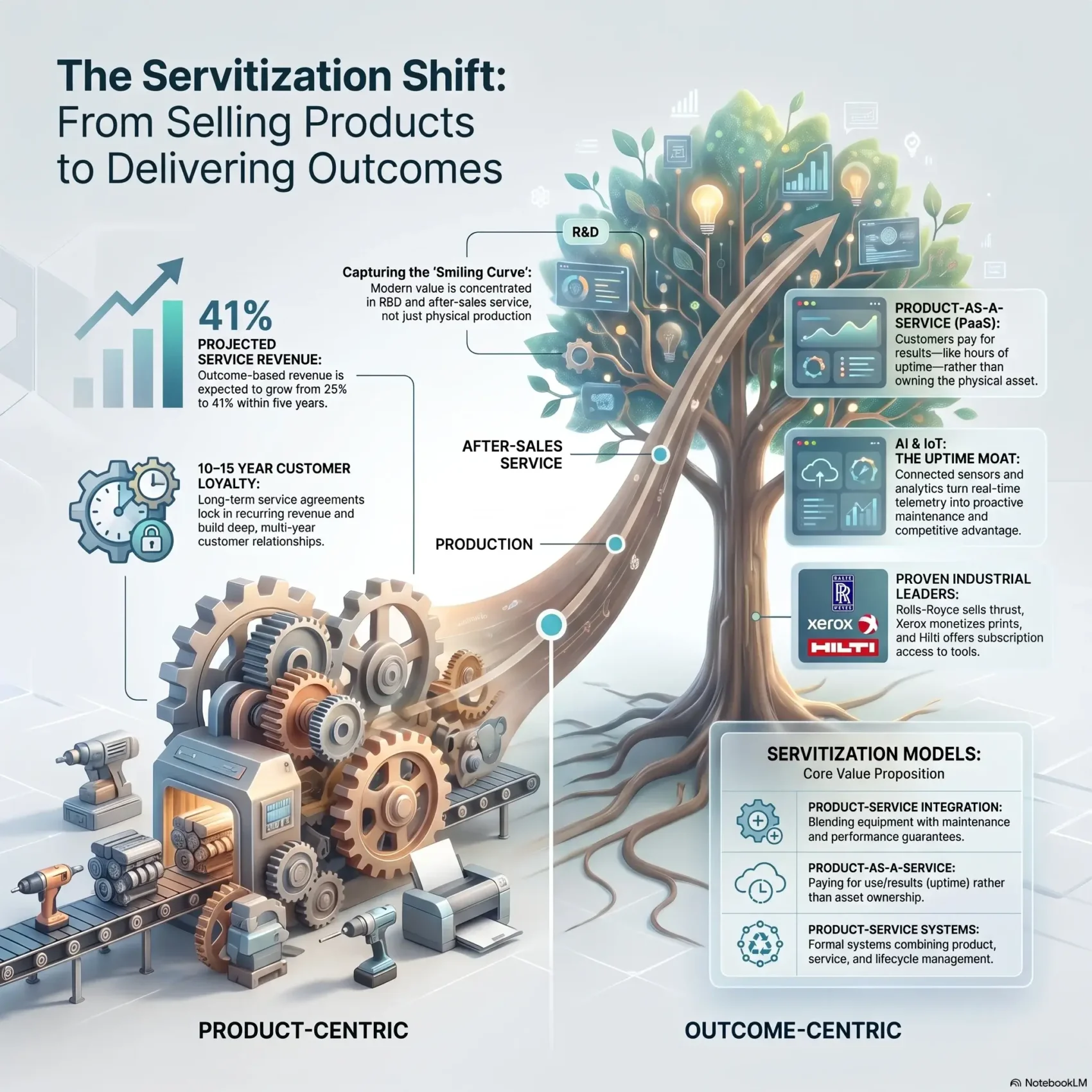
That shift has a name — servitization — and it changes the shape of your revenue. A one-off transaction becomes a multi-year relationship, often 10–15 years, with predictable income and far deeper lock-in. When you absorb maintenance, your customer converts fixed engineering headcount into a variable cost that you carry and price.
The economics follow the smiling curve: most value in a manufacturing chain sits at R&D and branding on one end and after-sales service on the other, while assembly in the middle earns the least. Moving into services moves you toward the profitable ends of that curve.
The evidence is operational, not theoretical. Rolls‑Royce sells thrust by the flying hour. Xerox charges per page. Caterpillar delivers monitored machinery as a service. Cheap telemetry, IoT, and AI made proactive upkeep viable at scale — which is exactly what turns a guaranteed-uptime promise from a liability into a product.
Key Takeaways
- Selling outcomes instead of units protects margin in commoditized markets.
- Multi-year agreements convert one-off sales into predictable recurring revenue.
- After-sales service and design capture more value than assembly — the smiling curve.
- EU repair and ecodesign rules landing in 2026 turn lifecycle data into an asset you can monetize.
- Analysts expect outcome-based models to move from 25% to 41% of service revenue within five years.
- Start with one product line and one customer segment, then scale on proven unit economics.
What changed for the servitization trend in 2026
Three developments this year should reset how you plan.
Regulation now pushes in the same direction
The EU Right to Repair Directive (EU) 2024/1799 must be applied by member states from 31 July 2026, and the Ecodesign for Sustainable Products Regulation is rolling out the Digital Product Passport through delegated acts between 2026 and 2030, with batteries first in line.
Read that as a service opportunity, not a compliance cost. If you already have to document repairability, spare-part availability, and lifecycle data, you are building the exact data foundation an outcome contract requires. The same logic drives the move toward circular manufacturing models, where keeping an asset in service beats replacing it.
The “platform first” playbook got a reality check
For a decade, GE’s Predix was the reference example in every servitization deck. That story has ended. GE split into three independent companies in April 2024, and in March 2026 GE Vernova completed the $600 million sale of its Proficy manufacturing software business to TPG.
The takeaway is not that industrial software failed. It is that the platform was never the strategy. Your installed base, your service contracts, and your ability to price risk are the strategy — software only makes them deliverable.
Service capability is being bought, not just built
Xerox closed its $1.5 billion acquisition of Lexmark in 2025 and now positions itself as the market leader in managed print services. The interesting part is what it bought: service delivery scale and an installed base, not just hardware.
Meanwhile, Syncron research puts outcome-based models on a path from 25% to 41% of service revenue over five years. The direction of travel is no longer in question — only the pace at which you follow it.
Servitization explained: from selling products to delivering outcomes
When you stop shipping hardware and start promising performance, everything downstream changes — contracts, pricing, staffing, and the balance sheet. Three models cover most of what manufacturers actually do.
| Model | What the customer buys | How you bill | Risk you carry |
|---|---|---|---|
| Product-service integration | Equipment plus support, maintenance, and a performance guarantee | Purchase price plus a service contract | Moderate — service cost overruns |
| Product-as-a-Service (PaaS) | Use of the asset, not ownership | Per hour, per unit, or subscription | High — asset on your books, utilization risk |
| Outcome-based (PSS) | A guaranteed result | Per outcome: uptime %, units produced, energy saved | Highest — performance penalties and forecasting error |
Each step down that table raises both the return and the risk you absorb. Choose deliberately: this is a business model decision, not a packaging exercise.
What is driving the shift
- Commoditization. Differentiation windows keep shrinking, so features stop being a moat. Service, data, and guaranteed results last longer.
- Customer budget pressure. Buyers want CapEx off the books and costs that scale with actual use.
- Value migration. Independent aftermarkets capture a large share of parts and maintenance revenue. A service model wins that back.
- Cheap telemetry. Retrofit sensors and cloud analytics dropped the cost of knowing what a machine is doing to near zero.
Who is already doing it
- Aviation: Rolls‑Royce’s TotalCare bills airlines by engine flying hour and monitors engine health continuously.
- Print: Xerox managed print services charge per page and bundle supplies, maintenance, and fleet management.
- Heavy equipment: Caterpillar pairs connected assets with predictive maintenance and pay-for-use options.
- Tools and robotics: Hilti puts tools on subscription through fleet management; ABB and KUKA lease robots with proactive maintenance.
- Lighting and flooring: Signify sells light as a service; Tarkett retains ownership under flooring-as-a-service and takes material back at end of life.
Notice the pattern: none of them started with a full outcome contract. Each began with maintenance and monitoring, then priced the risk once the data existed.
“Selling outcomes means building the capability to measure, guarantee, and bill performance — in that order.”
The technology stack behind service-led growth
You cannot guarantee uptime you cannot see. Connected assets are what make the promise fundable.
Telemetry. IoT sensors stream condition data from field units, and retrofit gateways bring older machines online without replacing them.
Analytics and AI. Models turn that stream into ranked actions: which asset to touch, when, and with which part already on the van. The result is fewer truck rolls, less unscheduled downtime, and smaller spare-parts inventory.
Simulation. Digital twins replicate the customer environment so you can test changes and find bottlenecks before they cost you an SLA penalty.
Service lifecycle management. An SLM platform joins field data with ERP and CRM so you see one asset from install to renewal — and know its true cost to serve.
Billing. Usage-based and outcome-based invoicing, revenue recognition, and contract management. This is where most pilots stall, so validate it early rather than last.
Challenges to plan for
Customers now judge you on evidence
Buyers expect transparent SLAs, live reporting, and invoices that visibly track performance. A monthly PDF will not do. Reliability you cannot demonstrate is reliability you cannot charge for, and demonstrated reliability compounds into renewals the same way it drives customer loyalty in any recurring model.
Sales and service have to become one motion
Commission on a closed unit sale works against a ten-year contract. You need incentives tied to contract value and retention, consultative selling skills, and service teams involved before the deal is signed rather than after it.
Choose pilots where performance can be improved quickly and visibly, then use those early wins to fund the harder changes.
Pricing risk is the hard part
Underpriced commitments are the most common way outcome contracts fail. Start from a cost-to-serve analysis, layer in real usage data, and test tiers in a pilot before you publish a price list. The discipline that underpins dynamic pricing applies here too: price the risk, not just the work.
Watch for subscription saturation as well. Buyers increasingly resist another recurring line item, so your offer has to remove a cost they already carry rather than add one. Subscription fatigue is measurable behavior in consumer markets, and B2B procurement teams are running the same audits.
Ecosystems and financing
When you retain ownership, assets sit on your balance sheet. Financiers, insurers, and leasing partners let you underwrite that without tying up capital. Partners also close capability gaps in regions where you have no field presence.
Tighten controls on recurring billing, credit risk, and renewals before you scale — this is where revenue operations discipline pays for itself.
Data, security, and legacy integration
Retrofit sensors and middleware connect older machines, and phased integration avoids disruption. Prioritize high-value assets first to prove ROI.
Then treat security as contractual rather than optional: encrypted device connections, access controls, and explicit rules on who owns and may use the customer’s operational data.
“Sequence the work: modernize the data layer, pilot one segment, then scale once the standards hold.”
A practical first 90 days
- Days 1–30 — Pick the asset. Choose one product line with a large installed base, high downtime cost, and either existing connectivity or an easy retrofit path.
- Days 31–60 — Establish the baseline. Measure current failure rates, response times, parts consumption, and true cost to serve. Without this, you cannot price an outcome.
- Days 61–90 — Sell one contract. Offer a monitored maintenance agreement with a modest availability commitment to a friendly customer, and bill it through your real systems rather than a spreadsheet.
Only then decide whether to move up to pay-per-use or full outcome pricing — with numbers instead of assumptions.
Conclusion
Turning a product into a dependable service takes a defined scope, measurable commitments, and technology that makes the promise visible. The direction is clear: outcome-based service revenue is projected to climb from 25% to 41% within five years, and EU repair and ecodesign rules arriving through 2026 and 2027 push manufacturers toward lifecycle responsibility whether or not they choose to monetize it.
Start narrow. Instrument one product line, price one contract honestly, and prove the unit economics before you rebuild the org chart. When sales, pricing, and operations point at the same number, recurring revenue follows — and so does a customer relationship competitors find genuinely hard to unpick.