A phased retirement program lets an experienced employee cut back to part-time hours instead of leaving on a single day. In most designs the person works two or three days a week, starts drawing part of their pension, keeps their health coverage, and spends part of the reduced schedule training whoever takes over.
The idea answers a problem most employers recognise. When a 30-year veteran walks out on a Friday, the payroll cost disappears and so does everything they knew about the annual audit, the difficult customer, and the system nobody documented. A phased exit spreads that departure over months, so the knowledge leaves in writing rather than in someone’s head. For the employee, it turns an irreversible decision into a test run while a paycheck is still arriving.
Key Takeaways
- Phased retirement means reduced hours plus partial pension income, not early retirement.
- Formal programs are rare; most phased arrangements are informal manager-level deals.
- The federal model is the clearest published blueprint: half-time work, half the annuity, a fifth of the hours mentoring.
- Health coverage, pension credit and Social Security earnings limits decide whether the maths works.
- Start the conversation a year out, and see work-life balance guidance for the non-work half.
What phased retirement means and why it matters now
Reducing your hours over months or years lets you test a new routine without losing income right away. Common shapes include a permanent part-time role, seasonal work tied to busy periods, a fixed-term project assignment, and job-sharing, where two people split one post. What they share is a planned step rather than a cliff edge.
The demographics behind this are not speculative. US Bureau of Labor Statistics projections put labor force participation for people aged 65 to 74 at 26.7% in 2025, rising to a projected 29.1% by 2035; for the 75-and-over group the projection moves from 8.5% to 10.1%. The 25th Annual Transamerica Retirement Survey (March 2025) found that 52% of workers plan to work at least part-time in retirement.
Employers feel the same shift, as our overview of how work adapts to demographic shifts explains.
How common phased retirement really is
Formal programs are the exception, not the rule. The most-cited count comes from a 2017 US Government Accountability Office report, which found that only 5% of employers had a formal phased retirement program while 11% used phased arrangements informally.
Most phased retirements happen anyway, as a private deal between one manager and one long-serving employee. That usually works, but it is invisible to HR, inconsistent between departments, and hard to defend when a second person asks for the same terms. Writing it down is the main thing a formal program adds: it turns a favour into a benefit, which is how it starts appearing alongside the rest of your employee benefits package rather than in a manager’s inbox.
The business case and the employee case
Keeping veteran staff on reduced schedules can pay for itself, provided the arrangement is designed rather than improvised.
What the employee gets
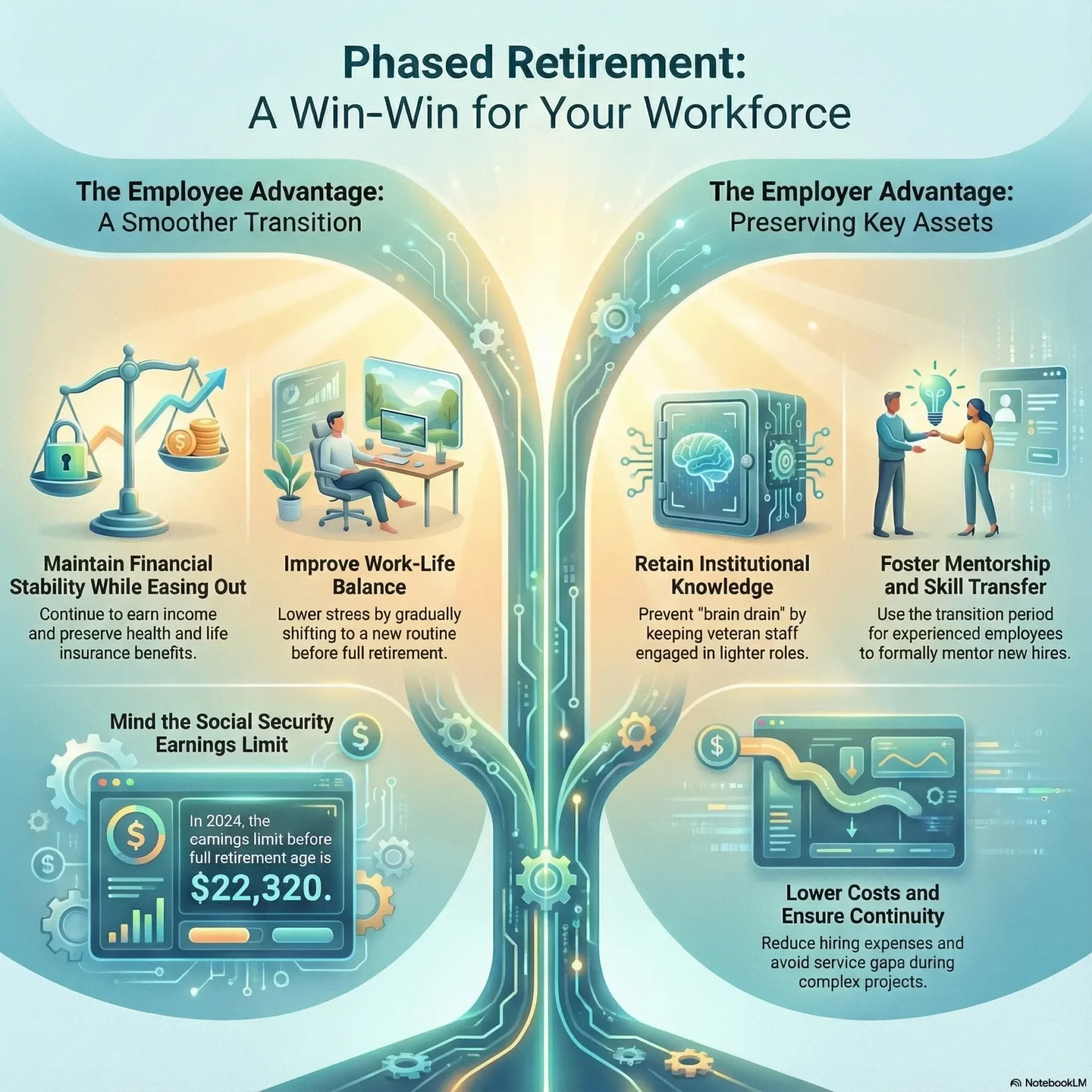
Cutting hours, not ties, keeps a reliable income and usually keeps benefits. A person who retires fully at 63 and discovers at 64 that they miss the work has few good options; a person on three days a week has a conversation instead of a crisis. Concretely: a payroll manager on three days keeps employer health coverage, keeps contributing to their pension on the hours worked, and can take a Wednesday for an appointment without spending leave.
What the employer gets
Two things, and the second is larger. The first is coverage during a transition, so a busy season or a system migration does not lose its most experienced person mid-project. The second is documented knowledge: procedures that lived in one person’s memory get written down, because writing them down is now part of the job. That is what our guide to standard operating procedures covers, and a phased schedule is a rare case where someone has time to do it properly.
Mentoring as a deliverable
Designing mentoring into the plan turns a departing expert into an active teacher. They shadow a successor, update the playbook, and coach new hires, which shortens ramp-up and connects directly to how you run onboarding and training. There is a wider effect: if experienced staff can see a way to wind down instead of leaving outright, they tend to stay longer, one of the quieter levers in most talent retention strategies.
Eligibility and program models you can adapt
Two published programs show how the rules usually work. Both are worth reading even in the private sector, because they solve the three problems any employer faces: who qualifies, how pay is set, and what happens to benefits.
The federal model: half-time work, half the annuity
US federal phased retirement has been running since 6 November 2014. Under OPM rules, an eligible employee moves to a half-time schedule, is paid 50% of their regular salary, and draws roughly half the annuity they would have received by fully retiring. Eligibility requires full-time work for the preceding three years, plus either 30 years of service at your minimum retirement age (or 55 under CSRS) or 20 years at 60. Elections go on form SF 3116.
Two features are worth copying. Phased retirees must spend at least a fifth of their working time mentoring colleagues, which makes knowledge transfer contractual rather than hoped for. And participation is voluntary on both sides: agencies need not offer it and employees have no right to it.
Benefits continue as employee benefits, not retiree benefits: the employer contribution to federal health insurance stays at the full-time level and basic life cover continues. Time in phased status counts as part-time service when the annuity is recalculated at full retirement, so the eventual pension exceeds the phased one.
The CUNY model: two ways to reduce workload
At the City University of New York, staff aged 65 or over with 15 years of pensionable service in the Optional Retirement Program, mainly TIAA, can phase for up to three years. Teachers Retirement System members are not eligible, because that scheme calculates benefits from final salary and a reduced salary would cut the pension.
Two tracks exist. Tenured faculty typically work a 50% workload for 50% of salary. Professional staff in HEO and CLT titles usually cut their workload by 20% while keeping 80% of salary, which in practice means a four-day week. Full health coverage continues, pension contributions and sick leave accrue pro rata, and participants commit irrevocably to retiring at the end.
Private-sector variations
Most private employers have no scheme document at all. That gives you freedom and puts the design burden on you.
- A straight reduction in days per week, the simplest option to administer.
- Seasonal or on-call work tied to peak periods, useful in retail, tax and audit.
- Job-sharing, where two part-timers cover one post and hand over in writing.
- A fixed-term consulting or contract arrangement after employment ends.
The last option deserves a warning. Moving someone from payroll to a contract changes their employment status, benefits and often their tax position, and misclassification is a real risk. Across borders the rules multiply quickly, as our guide to global payroll solutions sets out.
If the reduced schedule is really about hours rather than exit, compare it with flexible work schedules and the evidence on the four-day workweek first.
How to design and roll out a program
Decide what success looks like before you write any rules. A program aimed at knowledge transfer looks different from one aimed at cutting headcount cost, and confusing the two is the commonest design failure.
Set objectives, roles and a timeline
Name the outcome and assign owners: the manager approves the schedule, HR owns eligibility and paperwork, payroll owns pay and deductions, and the employee owns the handover plan. Map the timeline across budget cycles, because a phase starting mid-year without a budget line creates arguments later.
Tie workload and pay to a clear formula
Set pay against hours with a rule anyone can check. Straight pro rata (50% of hours for 50% of pay) is easiest to defend. A more generous ratio, such as CUNY’s 80% pay for an 80% workload, is a retention incentive and should be described as one. Then decide who covers the gap, because “the team will absorb it” is not a plan.
Put every agreement on one form
Use one document recording the reduced hours, the pay percentage, start and end dates, benefit elections, mentoring deliverables, and signatures from the employee, the manager and HR. Federal agencies use SF 3116 for this reason: one form prevents three departments holding three versions of the deal.
Align HR, payroll and managers
Build a short intake and approval runbook, then brief all three groups. Payroll needs the effective date and the new deduction basis, managers need to know what they may approve, and HR needs one place to record it. This is ordinary process design, and where most day-to-day friction in HR management comes from.
- Review the program annually against its stated objective and budget.
- Publish the eligibility rules so refusals can be explained.
Pay, benefits and compliance
Three details decide whether the arrangement works financially: insurance, pension credit, and the Social Security earnings test.
Health and life insurance
Coverage is the deal-breaker for most employees. Federal participants keep employee coverage rather than retiree coverage, the government share of health premiums stays at the full-time level, and basic life insurance continues. CUNY likewise maintains full health coverage during the phasing period.
Private employers must check their own plan documents, because most group health plans set a minimum weekly hours threshold for eligibility. Dropping someone from 40 hours to 16 can silently end coverage. Confirm the threshold before agreeing a schedule.
Pension contributions and service credit
Contributions normally continue on the hours actually worked, and service credit accrues pro rata. In the federal system the phased period is later treated as part-time service, so the final annuity is recalculated upward at full retirement. The exception to watch is any final-salary scheme: if your pension is calculated from your last few years of pay, a reduced salary in those years can permanently cut the benefit. That is why CUNY excludes TRS members. Anyone in such a scheme should get a written projection before signing.
Social Security earnings limits and tax basics
If you claim Social Security before your full retirement age and keep earning, the retirement earnings test applies. For 2026 the annual exempt amount is $24,480 if you reach full retirement age after 2026, and $65,160 in the year you reach it (Social Security Administration). Above those thresholds, benefits are withheld at $1 for every $2 of excess earnings, or $1 for every $3 in the year you reach full retirement age.
Two points people miss. The withheld amount is not lost: your benefit is recalculated upward at full retirement age. And the test stops applying from the month you reach that age, however much you then earn.
Tax treatment depends on your pension type and is worth professional advice. Federal phased retirees should note that the taxable and tax-free split of the annuity is finalised at full retirement, not at the start.
- Confirm the health plan’s minimum hours threshold in writing.
- Ask for a pension projection under the reduced salary before agreeing.
Scheduling and knowledge transfer
A clear weekly rhythm is what stops a reduced schedule turning into full-time work for part-time pay. That drift is the most common complaint from phased retirees, and it is a scheduling problem.
Structuring days, weeks and semesters
Pick a shape that matches how the work arrives. Fixed days (Monday, Tuesday, Wednesday) suit roles with client or student contact, because everyone learns when the person is around. Split weeks suit project work, and semester or seasonal loading suits teaching and audit cycles, where a 50% annual workload can be one full semester on and one off. One practical rule: protect the last working day of each week for documentation and handoffs, or that time disappears.
Building mentoring into the schedule
Make mentoring a listed deliverable with hours attached, not a good intention. The federal 20% requirement is a reasonable benchmark, and in practice it means shadowing sessions, documentation sprints, and a written checklist of what has been transferred.
Recorded walkthroughs and structured internal courses make this durable, and AI-powered learning platforms can turn one person’s explanation into training material that survives their departure. The wider skills question runs through our guides to upskilling and reskilling and preparing for future jobs.
- Define success measures such as ramp-up time, error rates and turnaround.
- Track what has been documented, so the gap is visible before the last day.
Applications, approvals and ending the phase
Start the paperwork earlier than feels necessary. Approvals, signatures and pension elections all take time, and a phase that begins before the elections are processed creates payroll corrections nobody enjoys. Where a formal program exists the deadlines are fixed: CUNY applicants apply by 15 November each year, while federal applicants file SF 3116 through an agency that is free to say no.
- Raise it with your manager informally before anything is filed.
- Collect signatures from the employee, the manager and HR on one document.
- Confirm receipt with HR and keep a copy with your service record.
Plan the ending too. Fix the final date, run a handover checklist, close system access, and confirm the benefit changes that take effect at full retirement. A clean ending separates a program people recommend from one they warn colleagues about.
Conclusion
Phased retirement is a scheduling and benefits question before it is a philosophical one. Get three things right and the rest is administration: confirm health coverage at the reduced hours, get a written pension projection, and check the current Social Security earnings limits if you claim early.
For employers, the return comes from what gets written down: make mentoring a deliverable with hours attached, use one form for every agreement, and review the program against the outcome you wanted.
For the wider picture, see our coverage of future work trends, how workers adapt to automation and employee engagement. If the goal is simply more time rather than an exit, the future of work-life balance is the better starting point.
Found this useful?
Make SmartKeys a preferred source on Google, and our articles will surface more often in your Top Stories, AI Overviews, and AI Mode.
Add as Preferred Source