Work-life balance used to mean drawing a hard line between the office and everything else. That line is harder to draw when the office fits in your pocket. Most knowledge workers now finish the day with a laptop still open on the kitchen table, and the question has shifted from “how do I keep work out of my evening” to “how do I decide what belongs where”.
This article looks at what has actually changed, what the evidence supports, and which habits hold up in a normal week.
Key Takeaways
- Global employee engagement fell to 20% in 2025, its lowest level since 2020, and only 34% of employees are thriving in overall wellbeing (Gallup).
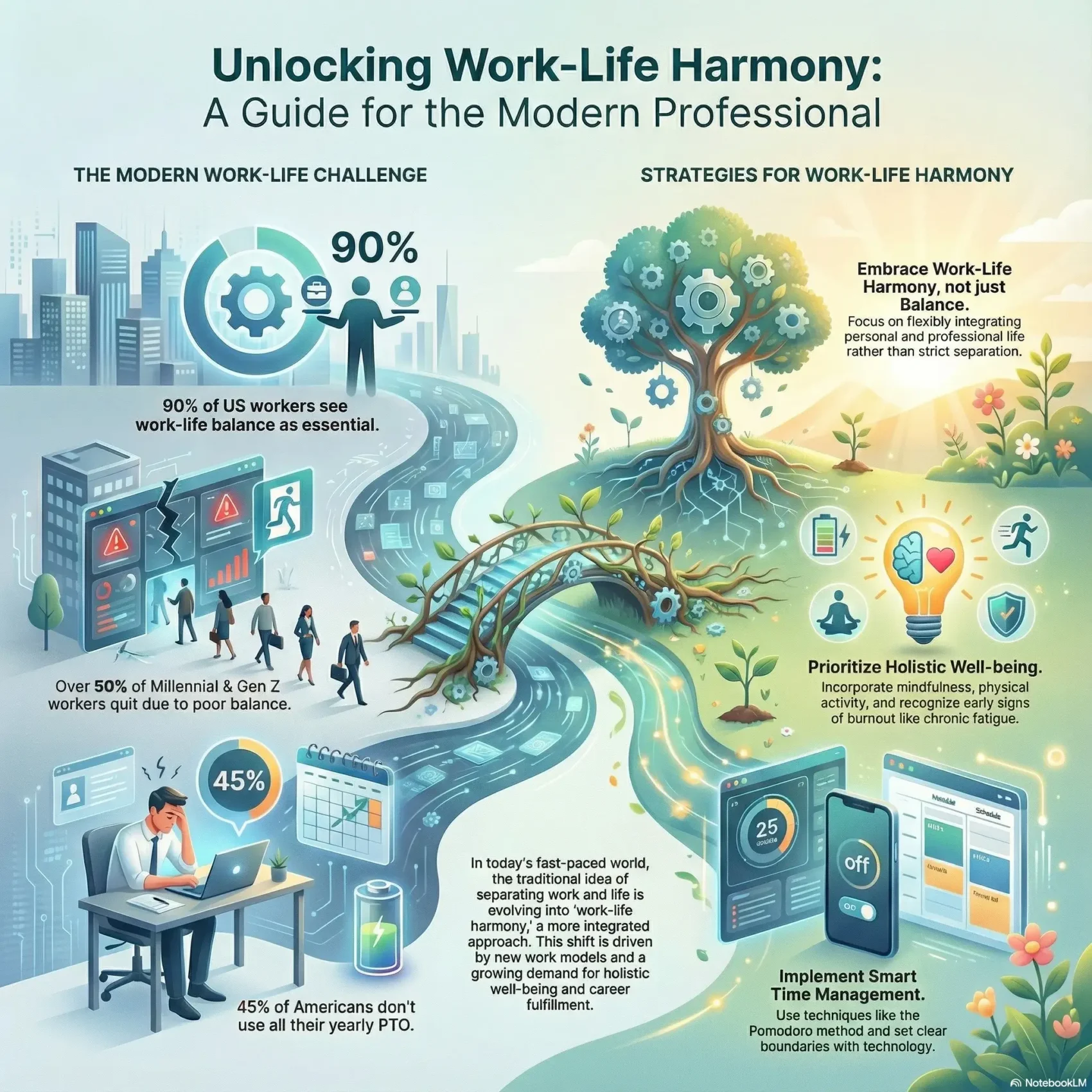
- 46% of US workers with paid time off take less than they are offered, most often because they fear falling behind (Pew Research Center).
- Working 55 hours or more a week is linked to a 35% higher risk of stroke than working 35 to 40 hours (WHO and ILO).
- A six-month four-day-week trial across 141 organisations cut burnout and improved sleep, job satisfaction and health.
- Boundaries are now partly a legal matter: Australia’s right to disconnect covers every employer since August 2025.
Why Work-Life Balance Matters More in 2026
The case for balance is no longer just a wellbeing argument. It shows up in the numbers companies watch.
Gallup’s State of the Global Workplace report found that global employee engagement fell to 20% in 2025, the lowest level since 2020. Engagement here means employees who are involved in and enthusiastic about their work, as measured by Gallup’s twelve-item survey. Only 34% of employees said they were thriving in their overall lives. Managers were hit hardest: their engagement dropped to 22%.
That matters because disengaged employees leave. Median job tenure in the United States was 3.9 years in January 2024, the lowest since 2002, according to the Bureau of Labor Statistics. Replacing people is expensive, and the reasons they give for leaving are often about workload and flexibility rather than pay.
Deloitte’s 2026 Gen Z and Millennial Survey, which polled 22,595 people across 44 countries, found something related. Work-life balance concerns were named as a barrier to seeking a leadership role by 41% of Gen Z and 46% of millennials. Stress and burnout scored even higher, at 50% and 49%. Only a quarter of Gen Z respondents wanted fast-paced promotion. Most preferred steady progress they could sustain.
Read together, those findings say the same thing: when a job costs more than people are willing to pay, they either disengage, step sideways, or leave. Companies that work seriously on retention tend to start here.
Balance or Harmony: What the Words Actually Mean
You will see two terms used almost interchangeably. They describe different things, and the difference is practical.
Work-Life Balance
Balance treats work and personal life as separate containers that need roughly equal weight. The classic version is a fixed end to the working day, no work email at home, and holiday that stays holiday. It is easy to check: either you stopped at six or you did not.
Work-Life Harmony
Harmony treats the two as overlapping and asks you to manage the overlap deliberately. A parent who leaves at three for the school run and answers two messages at nine in the evening is not failing at balance. They have traded a rigid boundary for a flexible one, on purpose.
Harmony works when the flexibility runs both ways. It fails when it becomes a polite word for permanent availability. The test is simple: if you can move work into your evening but cannot move personal time into your working day, that is not harmony. That is just a longer day. This is why clear personal boundaries matter more under a flexible model, not less.
Four Forces Reshaping the Balance Question
Four changes explain why the conversation looks different from a few years ago.
Hybrid Work Settled Into a Pattern
The argument about whether remote work would survive is over. It settled somewhere in the middle, and the practical effect is a recovered commute. For many people that is an hour a day back, which is the single largest block of time most workers have gained in a decade.
The gain is fragile. The same setup that saves the commute removes the physical signal that the day has ended. Teams that manage hybrid schedules deliberately keep the benefit. Teams that improvise get the longer day without the flexibility.
The Right to Disconnect Became Law
Boundaries used to be a matter of company culture. In a growing number of countries they are now a matter of employment law.
Australia is the clearest example. Since August 2024, employees at larger organisations have had a legal right to refuse to monitor, read or respond to work contact outside their working hours, unless that refusal is unreasonable. From 26 August 2025 the same right applies at small businesses. France has required companies above a certain size to negotiate terms for disconnecting since 2017, and Belgium, Italy, Spain, Portugal and Ireland have their own versions.
The laws do not ban after-hours contact. They shift who carries the cost of ignoring it. If you have ever felt obliged to answer a message at ten at night, that is the obligation these rules target. Our guide to the right to disconnect covers how the rules differ by country.
Shorter Weeks Moved From Slogan to Evidence
The four-day week has been argued about for years, mostly with survey data from companies that chose to try it. In July 2025 a study in Nature Human Behaviour raised the standard of proof.
Researchers followed 2,896 employees at 141 organisations across Australia, Canada, Ireland, New Zealand, the UK and the US through a six-month trial of a four-day week with no cut in pay, and compared them with control companies. The intervention group showed lower burnout, higher job satisfaction and better mental and physical health. The researchers traced those gains to three specific things: people felt more able to do their work, slept better and were less tired.
This is not proof that every company should switch. Participating organisations volunteered, and most spent weeks trimming meetings and rework before the trial started. But it is reasonable evidence that reducing hours without reducing pay improves wellbeing rather than just moving the same work into fewer days.
Always-On Tools Created a New Kind of Tiredness
Deloitte’s 2026 survey found that 58% of Gen Z and 54% of millennials report digital fatigue: exhaustion from constant alerts, switching between tools and juggling multiple platforms.
This is worth separating from ordinary overwork. You can have a reasonable workload and still end the day drained, because your attention was cut into pieces. The fix is not working less. It is reducing interruptions and cutting the number of places a message can arrive from.
What Long Hours Actually Cost
Overwork has a measurable health cost, and the best evidence comes from a joint WHO and International Labour Organization analysis published in 2021.
Comparing people who work 55 hours or more a week with those working 35 to 40 hours, the study found a 35% higher risk of stroke and a 17% higher risk of dying from ischaemic heart disease. Using 2016 data, it attributed roughly 745,000 deaths in a single year to long working hours.
Two caveats matter. These are associations across large populations, not a prediction about one person, and the risk sits at genuinely long weeks rather than the occasional busy fortnight. But the threshold is lower than many people assume. A standing 55-hour week is not a sprint. It is a health decision.
Practical Strategies That Hold Up
Most advice here assumes you control your calendar. These four work even when you do not.
Set Boundaries You Can Actually Defend
A boundary that depends on willpower every evening will not last. A boundary built into your setup will.
Practical versions: remove work email from your personal phone, or move it to a separate profile you have to switch into. Set your messaging app’s working hours so colleagues see when you are offline. Decide in advance what counts as a genuine emergency and tell your team, so everything else can wait until morning without a negotiation each time.
Then say it out loud. A boundary nobody knows about just looks like inconsistency.
Protect Focus Instead of Chasing It
If your day is fully reactive, balance is impossible, because work expands to fill whatever is left. Two well-tested methods help.
Time blocking means putting your actual work in the calendar as appointments, not just your meetings. It forces you to confront how many hours you really have before you promise them away. The Pomodoro Technique works at a smaller scale: 25 minutes of single-task work, then a short break. It suits tasks you keep avoiding, because 25 minutes is easy to start.
Neither creates time. Both make the shortage visible early enough to act on it. If your calendar is the problem, better task management habits are usually the first fix.
Take the Time Off You Have Already Earned
Unused holiday is the cheapest balance improvement available, and most people leave it on the table.
Pew Research Center surveyed 5,188 US workers in 2023 and found that 46% of those with paid time off take less than they are offered. The reasons are revealing. Around half said they did not feel they needed more. But 49% worried about falling behind at work, and 43% felt bad about the extra load on colleagues.
Those last two are workload problems wearing a personal-choice costume. If nobody can cover your work for a week, that is a staffing and documentation issue, not a character flaw. Booking the days early, before the quarter fills up, removes most of the negotiation. Some employers now formalise this through clearer time-off policies or longer sabbatical programmes.
Look After the Physical Basics
Sleep, movement and food are not a wellness add-on. They set the ceiling on how much your working hours are actually worth.
Short, regular movement breaks break up long sitting and reset attention better than pushing through. Walking meetings work well for one-to-one conversations that do not need a screen. Consistent sleep does more for next-day performance than any productivity system, which is why sleep habits belong in this conversation. And what you eat during the workday shapes the afternoon far more than most people credit.
Mindfulness practice, meaning short periods of deliberate attention to your breathing or surroundings, has decent evidence for reducing stress. A few minutes is enough to be useful. You can build on that with a short daily meditation habit if it suits you.
Career Fulfilment Without the Burnout
A lot of career advice tells you to find your purpose. That framing sets a high bar and often produces disappointment, because few jobs deliver a single obvious calling.
A more usable approach is to build meaning from the parts of the job you can influence. Notice which tasks leave you with energy rather than draining it, and do more of them. Get better at something you are already good at: visible competence tends to bring more autonomy, and autonomy is what makes a job bearable during busy stretches.
This connects directly to balance. People rarely burn out purely from hours. They burn out from long hours spent on work that feels pointless or unrecognised. The Deloitte data supports that reading: younger workers are not avoiding hard work, they are avoiding roles where the cost is obvious and the payoff is not. A workplace that explains how work connects to outcomes makes the same hours easier to carry.
Spotting Burnout Before It Lands
Burnout is a work-related syndrome, not a formal medical diagnosis, and it develops slowly enough that people usually miss it in themselves. The signs worth watching for are:
- Tiredness that a normal weekend no longer fixes
- Growing cynicism about work that used to interest you
- Irritability that spills into your personal relationships
- Trouble concentrating on tasks you used to find routine
- Dreading the working day well before it starts
One difficult stretch is not burnout. A pattern that persists for weeks after the deadline has passed is a signal worth taking seriously.
If it continues, talk to someone qualified. A doctor or therapist can tell burnout apart from depression, anxiety or a physical cause, and that distinction changes what helps. Many employers offer confidential support through an employee assistance programme. Our guide to burnout at work covers the organisational side, and mental health in remote work the risks specific to distributed teams.
What Employers Can Actually Change
Individual habits only stretch so far. If the workload is impossible, no amount of time blocking will fix it. Three employer-side changes carry most of the weight.
First, workload. Balance policies sitting on top of unrealistic targets read as hypocrisy, and employees notice quickly.
Second, managers. Gallup’s finding that manager engagement fell to 22% matters because managers set the local norm on hours and availability. A burnt-out manager sends messages at midnight and, without meaning to, teaches the team that this is expected.
Third, benefits people can actually use. Flexible hours, real support for a decent home working setup and wellbeing budgets beat a wellness app nobody opens. Deloitte’s digital fatigue finding also points at tooling: cutting the number of platforms a team must monitor is a wellbeing measure, even though it never appears in a wellbeing budget.
Where This Leaves You
Work-life balance in 2026 is less about splitting the day evenly and more about deciding, deliberately, where the overlap sits and who gets to move it.
Within your control: boundaries built into your tools rather than your willpower, holiday you actually take, focus you protect early in the day, and sleep and movement you do not treat as optional. Outside it: workload, management culture and, increasingly, the law, which in several countries now sides with switching off.
The measure of success is not a perfect split. It is whether you can finish a normal week without borrowing from the next one.
Found this useful?
Make SmartKeys a preferred source on Google, and our articles will surface more often in your Top Stories, AI Overviews, and AI Mode.
Add as Preferred Source