Tools
Tools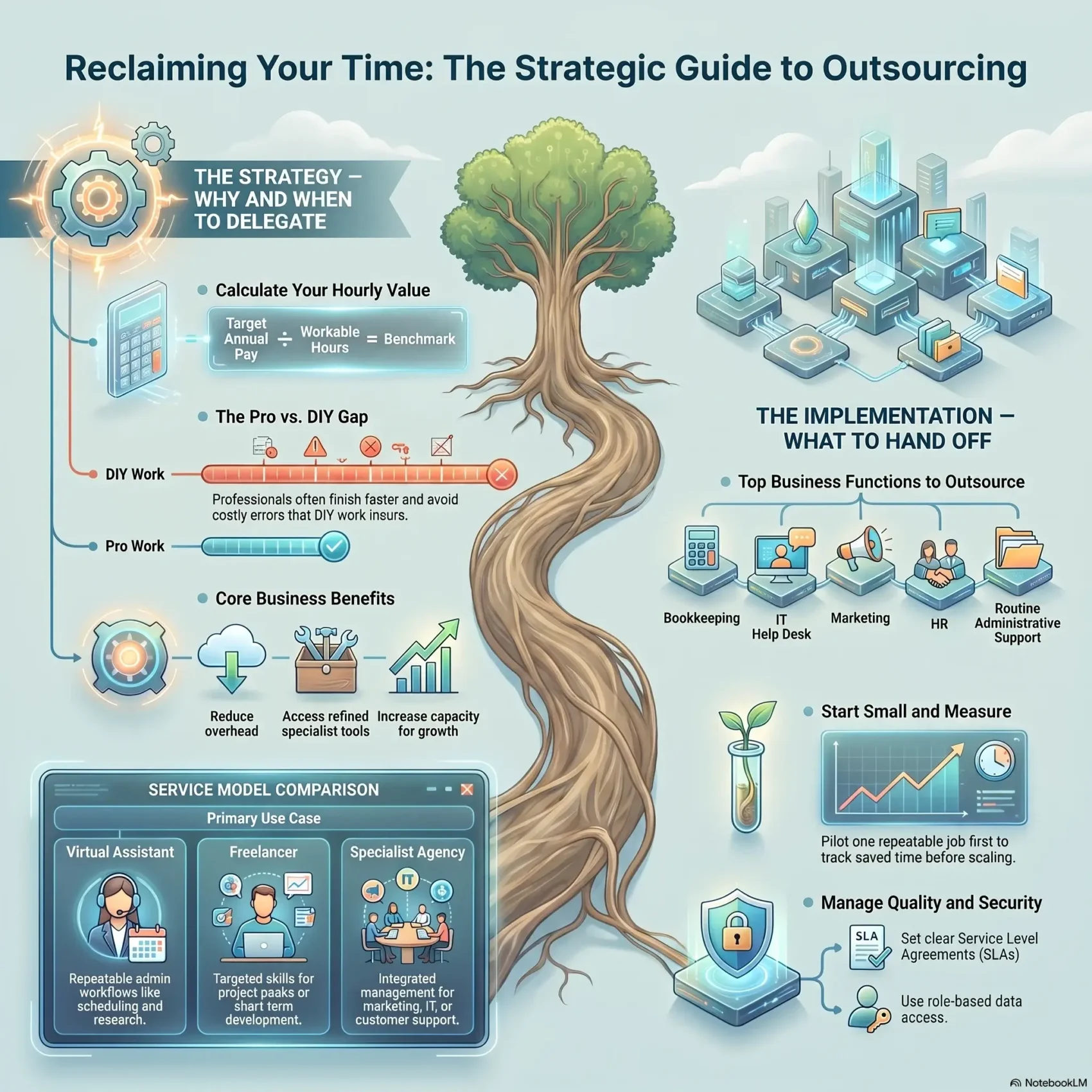
You can realistically win back five to ten hours a week by moving low-value work off your plate. Outsourcing means paying a third party to handle a function under contract — nothing more exotic than that.
It is not the same as offshoring (moving work to another country), and it is not the same as automation (removing the work entirely). In 2026 you will usually combine all three, and the order matters: delete first, automate second, delegate third.
The practice is firmly mainstream. The global business process outsourcing market was worth roughly $328 billion in 2025 and is tracking toward about $359 billion in 2026, growing near 10% a year, with North America accounting for the largest share of spend at about 37%.
This guide shows you what to hand off, what it actually costs at 2026 rates, and how to run a first pilot without losing quality or control.
Key Takeaways
- Delegate work that is essential but not core: admin, bookkeeping, tier-one support, IT maintenance, content production, fulfillment.
- Run the hourly-value test. If a professional charges less than your effective hourly rate and finishes faster, delegate.
- Automate before you delegate. Paying a human to run a broken manual process only makes the process more expensive.
- 2026 benchmarks: offshore VAs run about $4–$15/hour, US-based VAs about $25–$50/hour, standard house cleaning $120–$280 per visit.
- Vet current names and prices. Ceridian is now Dayforce, and MarketerHire now starts near $5,000/month — several older guides still get this wrong.
- Start with one task, one 30-day pilot, one success metric. Then scale only what proves out.
What Outsourcing Actually Means in 2026
Outsourcing is a contract, not a location. You hire an outside party to own a defined function so your own hours go to the work only you can do.
Three terms get mixed up constantly, so it helps to separate them:
- Outsourcing: an external party performs the work under contract. They may sit down the street or across the world.
- Offshoring: the work moves to another country, either to a vendor or to your own offshore team.
- Automation: software performs the work and nobody does it manually. Cheapest per unit, but only for rules-based tasks.
The models you will actually be choosing between
Virtual assistants for recurring admin. Freelancers for specialist projects. Agencies for cross-functional programs. BPO providers for high-volume operations like support, payroll, and accounting. Employer-of-record firms for compliant international hiring. Fractional executives — a part-time CFO, CMO, or CISO — for leadership without a full-time salary.
What changed recently
AI is now baked into most outsourcing contracts rather than sitting beside them. Industry surveys for 2026 report that a large majority of organizations expect their outsourcing partners to bring generative-AI capability, and roughly half of BPO contracts now include automation components.
The practical consequence: providers should be quoting you on outcomes — tickets resolved, invoices processed, first-response time — rather than on headcount. If a vendor still prices purely by seats, ask what happens to your bill when their AI halves the handling time.
Automate Before You Delegate
The cheapest hour is the one nobody has to work. Before you pay anyone to take a task, check whether the task should exist at all.
Work through it in this order:
- Delete. Reports nobody reads, meetings without decisions, approvals that never get rejected.
- Simplify. Cut the steps that only exist because of an old tool or an old client.
- Automate. Scheduling, data entry, invoice routing, reminders, and reporting are rules-based and cheap to automate. Our task automation playbook walks through picking the highest-leverage candidates.
- Delegate. Whatever survives all three steps is worth handing to a person.
This order also makes the handover cheaper. A documented, simplified process needs a fraction of the onboarding time — and onboarding is where most delegation attempts quietly fail.
For the judgment call itself, the four Ds of time management — do, defer, delegate, delete — give you a fast way to sort a full task list in one sitting.
How to Decide What to Outsource: The Hourly-Value Test
Deciding what to hand off starts with knowing what one hour of your time is actually worth. That single number becomes the benchmark for every delegation decision you make afterward.
Step 1: Calculate your effective hourly rate
Divide your target annual income by your realistic workable hours. At $150,000 across 2,000 hours, your effective rate is $75 an hour. Any task a competent professional handles for materially less than that is a candidate.
Step 2: Compare against real 2026 rates
Use current market ranges rather than a number you remember from a few years ago:
| What you delegate | Typical 2026 cost | Best for |
|---|---|---|
| Offshore virtual assistant | $4–$15 / hour | Documented, repeatable admin |
| US-based virtual assistant | $25–$50 / hour | Client-facing work, real-time overlap |
| Specialist freelancer | $40–$150+ / hour | Design, development, analytics, copy |
| Managed VA agency (part-time) | $1,200–$3,000 / month | Continuity and cover when someone leaves |
| Bookkeeping service | $300–$1,000+ / month | Clean books, lower audit risk |
| House cleaning | $120–$280 / visit | Reclaiming evenings and weekends |
These are US market ranges and they move. Get two or three live quotes before you budget.
Step 3: Score the task, not just the rate
- Speed: a professional often finishes in a third of the time, so compare total cost, not hourly cost.
- Quality: a bookkeeper who prevents one filing error can pay for a year of service.
- Hidden costs: count context switching and the opportunity cost of the work you did not do.
- Risk: anything touching customer data, money movement, or brand voice needs tighter controls.
“If a professional can do it for less than your hourly rate — and do it better — delegating is usually the obvious call.”
If you are not sure where your hours currently go, run a time audit for one week first. Most people discover a surprising share of the week sitting in low-value activity, and the audit tells you exactly what to hand off.
Business Tasks Worth Outsourcing First
Predictable, documented, non-strategic work gives you the fastest return. Here is where to look, and what to watch for in each area.
Administrative support
Scheduling, travel booking, inbox triage, CRM hygiene, and data entry are the classic first handover. Platforms such as Upwork, Fiverr, Belay, Time Etc, and Wishup cover the range from hourly freelancer to fully managed assistant.
Inbox triage in particular repays a bit of preparation — set your own email batching rules before you hand the inbox over, so your assistant inherits a system rather than a backlog.
Bookkeeping, payroll, and tax
Hand over reconciliation, AP/AR, payroll runs, and tax prep to credentialed professionals. Look for AIPB or AICPA credentials, and confirm who signs off on filings. Gusto, Bench-style bookkeeping services, and local CPA firms all serve this segment.
IT, security, and development
Managed service providers cover help desk, patching, backups, cloud, and monitoring. For project work, vetted marketplaces like Toptal shorten the search. Where rankings help, Everest Group, ISG, and HFS Research publish independent provider assessments.
Marketing and content
SEO, paid media, email, copywriting, and design scale well externally. Upwork and Fiverr suit project scopes and tighter budgets; MarketerHire matches senior fractional marketers but now sits at a subscription floor of roughly $5,000 a month, so treat it as a growth-stage option rather than a first step.
Customer service
BPO partners give you evening, weekend, and multilingual coverage without hiring a shift team. Ask specifically how AI deflection is priced, and insist on a clear escalation path to a named human.
HR and international hiring
Dayforce (the company formerly known as Ceridian), TriNet, Insperity, and Bambee handle payroll, benefits administration, and compliance. For hiring abroad, employer-of-record providers such as Deel and Remote let you add staff in a new country without setting up an entity.
Fulfillment and logistics
Third-party logistics partners cover pick, pack, ship, returns, and inventory. You trade some margin for the ability to grow without signing a warehouse lease.
Pricing models to mix
- Retainer: predictable monthly spend for steady volume.
- Per-ticket or per-unit: costs track demand, which protects you in slow months.
- Project scope: best for one-off builds with a clear finish line.
If external talent is becoming a permanent part of how you operate, it is worth building a deliberate on-demand workforce strategy rather than hiring vendor by vendor.
Personal-Life Delegation That Wins Back Hours
Household delegation is often the fastest win, because the tasks are simple to specify and easy to price. Start with one or two changes and measure the difference.
Cleaning, laundry, and meal prep
A standard house cleaning runs about $120–$280 per visit in 2026, or roughly $35–$75 per hour per cleaner through a professional company. Weekly or biweekly service typically costs 20–25% less per visit than one-off bookings. Two to three hours back every week, for the price of a few restaurant meals, is a straightforward trade.
Groceries, errands, and appointments
Grocery delivery removes the drive, the aisles, and the queue — usually an hour or more each week once you build a repeat list. A local runner or task platform can absorb pharmacy pickups, post office trips, and returns.
Dog walking, maintenance, and yard work
A 30-minute dog walk averages roughly $24–$34 in the US, with big-city rates higher. Handyperson and lawn work booked through TaskRabbit, Thumbtack, or Angi usually beats a DIY weekend once you count tools, trips, and the rework.
- Start small: one service, tracked for a month.
- Measure: note the hours returned and what you actually did with them.
- Protect the gain: if the reclaimed time refills with more email, you have bought nothing.
That last point matters more than the money. The case for focusing on fewer priorities is that recovered hours only pay off when you defend them.
Choosing Between Service Models
Match the model to the shape of the work, not to the lowest headline rate.
- Virtual assistant: steady, recurring, documented admin. Low cost, but you own the training.
- Freelancer: a specific skill for a defined project. Fast to start, no continuity guarantee.
- Managed agency: a team with process and backup coverage. Costs 20–40% more than a direct freelancer and removes most of your management overhead.
- BPO provider: high-volume operational work with SLAs and reporting. Built for scale, less flexible on scope.
- Employer of record: a real employee in another country, compliantly, without your own legal entity.
- Fractional executive: senior judgment a few days a month, typically for finance, marketing, or security leadership.
Most operators end up blending several: a VA for admin, a freelancer for landing pages, an agency for campaigns. If you want the wider context on how this talent market is developing, our overview of the gig economy through 2030 covers rates, regulation, and the AI effect on freelance work.
Running everything solo? The solopreneur productivity playbook pairs well with this section — it covers what to keep in-house when you are the whole company.
Cost, Quality, and Risk: Running It Properly
Budget for total cost, not the invoice
Your real cost includes the vendor fee plus onboarding time, your management time, tooling, and rework. Model it against the value of the hours you recover. A $2,000 monthly engagement that returns 30 of your hours is cheap at a $75 effective rate; the same engagement returning six hours is not.
Set SLAs and onboard properly
Define response time, resolution time, accuracy, and escalation in writing. Vague expectations are the single most common cause of a failed engagement.
Supply playbooks, sample outputs, and a short recorded walkthrough in week one. Then use a fixed rhythm: a weekly written update, a monthly review against the SLA, a quarterly conversation about scope.
Protect your data — and your AI exposure
Use role-based access and give the minimum permissions the job requires. Require encryption in transit and at rest, signed NDAs, and a documented incident response plan. Ask for compliance evidence — SOC 2, ISO 27001, GDPR posture — rather than assurances.
Add one clause older templates miss: whether your data may be used to train the provider’s AI models, and which subprocessors handle it. In 2026 that is a standard question, and a vendor who cannot answer it clearly is telling you something.
“Favor mature partners who can show a track record with clients that look like you.”
Where your team stays in the loop on AI-assisted output, the framing in our piece on AI augmentation versus automation is a useful way to decide what still needs a human reviewer.
How to Choose the Right Provider
Start by writing down the outcome you want. A one-page brief — scope, volume, deadline, definition of done — saves weeks and lets you compare vendors on equal footing.
Vetting checklist
- Relevant experience in your industry, with two or three reachable references.
- Transparent pricing: what is included, what is excluded, how overages are billed.
- Named point of contact, stated escalation path, and who owns quality control.
- Staff turnover and continuity plan — what happens when your assigned person leaves.
- Independent reviews or analyst coverage where the category has it.
Then run a real pilot
- Pick one task and a 30-day window.
- Define a single success metric before you start — hours returned, tickets closed, error rate.
- Document the process as you hand it over. The document is the asset, not the vendor.
- Review at day 30 against the metric, not against your gut feel.
- Scale, adjust, or stop. All three are acceptable outcomes.
“Choose a partner who understands your business, shows measurable results, and communicates without being chased.”
Conclusion
Pick one repeatable job this week and hand it off. One task, properly documented, teaches you more than three months of planning.
Run the hourly-value test, check the work against delete-simplify-automate first, and choose the service model that fits the shape of the work. Admin, bookkeeping, tier-one support, and IT maintenance are the reliable starting points.
Keep the first engagement low risk: narrow scope, written SLA, 30-day review. Then reinvest the recovered hours into sales, product, and customer relationships — the work that actually compounds.
Standardize as you go. Handover checklists, process docs, and SLA templates are what let the second and third delegation take a fraction of the effort of the first. That is how a small experiment turns into a genuinely lighter week.
FAQ
What should I outsource first?
How do I know whether outsourcing is worth the money?
What does a virtual assistant cost in 2026?
FAQ
What should I outsource first?
Start with repeatable, non-strategic work that eats hours without driving decisions: administrative support, bookkeeping, routine IT maintenance, content production, and tier-one customer support. These have clear inputs and outputs, which makes them easy to document, easy to price, and easy to measure.
How do I know whether outsourcing is worth the money?
Calculate your effective hourly rate by dividing your target annual income by realistic workable hours. Compare that to the provider’s total cost, including onboarding and your management time. If a professional delivers the same outcome faster for less than your rate, it usually pays off — but only if you actually redirect the freed hours to higher-value work.
What does a virtual assistant cost in 2026?
Rates vary widely by location and model. Offshore assistants through managed providers typically run about $4–$15 per hour, US-based assistants roughly $25–$50 per hour, and part-time managed agency packages around $1,200–$3,000 per month. Specialized work such as bookkeeping or executive support sits at the top of each band.
Should I automate a task instead of delegating it?
If the task is rules-based and high-volume — data entry, invoice routing, scheduling, reminders, standard reporting — automate it first. Automation has no hourly cost and no onboarding curve. Delegate the work that needs judgment, relationships, or exception handling, and delegate it only after the process has been simplified.
Offshore, nearshore, or local — how do I choose?
Weigh rate against time-zone overlap, language fluency, and regulatory requirements. Offshore delivers the lowest cost, nearshore buys you working-hours overlap and easier collaboration, and local providers offer the fastest turnaround and simplest compliance. For anything touching regulated or sensitive data, prioritize the compliance posture over the rate.
How do I keep quality from slipping?
Write down the deliverables and the SLA — response time, accuracy, escalation — before work starts. Supply playbooks and sample outputs during onboarding, sample the output for quality in the first weeks, and hold a fixed weekly check-in. Short feedback loops catch drift while it is still cheap to correct.
How do I protect my data when outsourcing?
Apply least-privilege access, require encryption in transit and at rest, sign an NDA, and ask for compliance evidence such as SOC 2 or ISO 27001 rather than verbal assurance. Since 2026 contracts increasingly involve AI tooling, also confirm in writing whether your data can be used to train the provider’s models and which subprocessors touch it.
Which personal tasks give back the most time?
Cleaning, laundry, grocery delivery, and yard work are the usual winners because they are recurring and easy to specify. A standard house cleaning costs roughly $120–$280 per visit in 2026 and typically returns two to three hours a week. Use platforms that run background checks and carry insurance, and start with a narrow, well-defined scope.
What metrics should I track?
Track hours returned, cost per unit of output, error or rework rate, response time, and the downstream effect on revenue or customer satisfaction. Pair the numbers with brief qualitative feedback from anyone who works with the provider — the metrics tell you whether it works, the feedback tells you why.
When should I bring outsourced work back in-house?
Reconsider when costs rise without a matching gain, when quality drops despite clear SLAs, when communication requires constant chasing, or when the work becomes genuinely core to your strategy. Tight iteration speed and direct control are legitimate reasons to insource, even at a higher cost.