
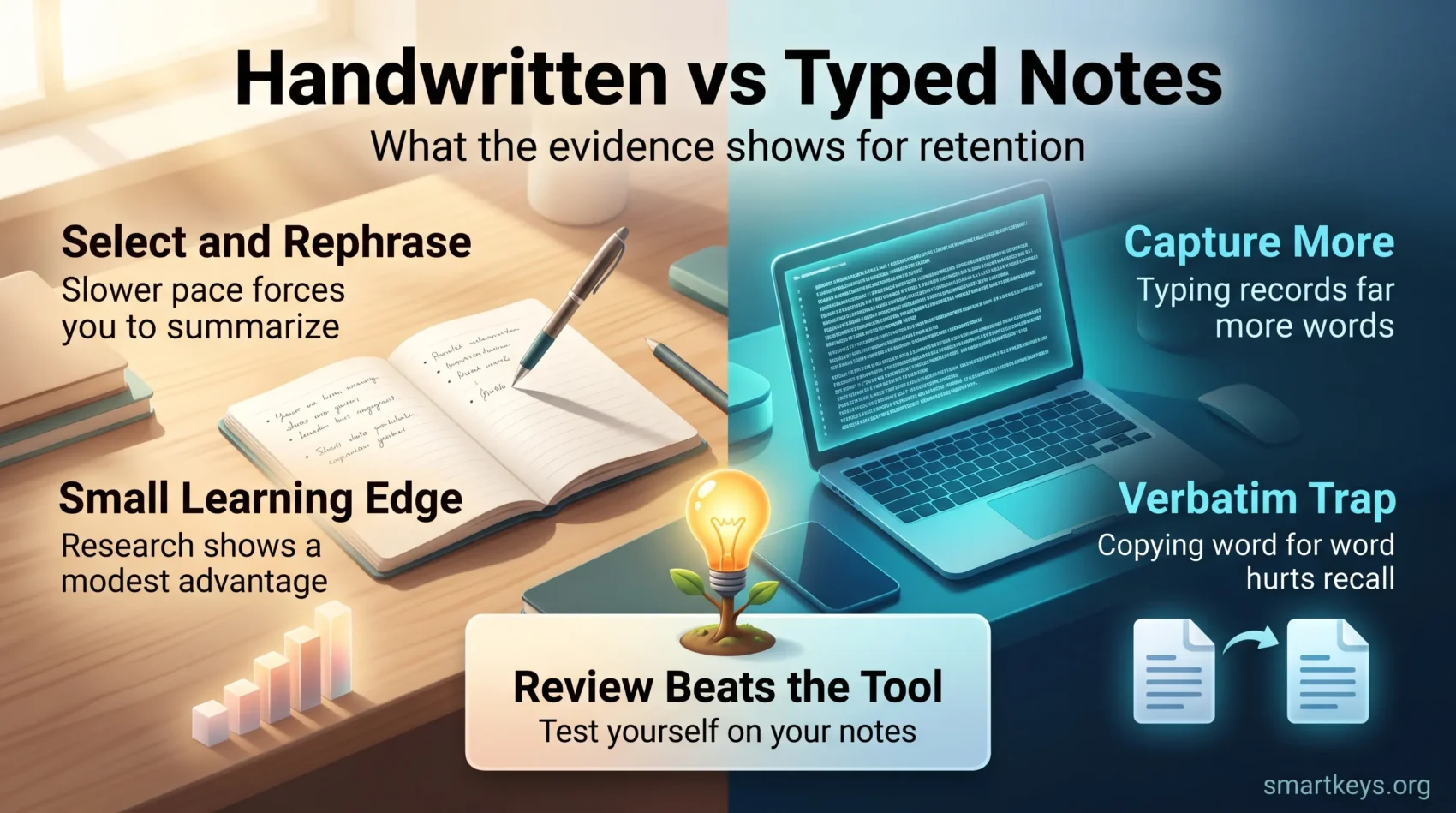
Should you take notes with a pen or a keyboard? The question sounds small, but it shapes how much you remember from lectures, training sessions and meetings. The short answer from the research: handwriting has a small edge for learning, typing captures far more information, and how you review your notes matters more than either tool.
Below you will find what the key studies found and how to test which method works for you. For help picking an app or device, see our guide to digital note-taking tools and setups.
Key Takeaways
- Typing lets you record much more, but it also tempts you to copy lectures word for word.
- Handwriting forces you to choose and rephrase, which helps understanding.
- A 2024 meta-analysis found a small achievement advantage for handwritten notes.
- A large 2021 replication found no clear difference on an immediate quiz.
- Reviewing and testing yourself on your notes has a bigger effect than the tool you use.
Handwriting vs Typing Notes: What Research Shows About Retention
Retention means how much information you can still recall later. Most of the debate started with one paper.
The study that started the debate
In 2014, psychologists Pam Mueller and Daniel Oppenheimer published “The Pen Is Mightier Than the Keyboard” in Psychological Science. Students watched lecture videos and took notes either by hand or on a laptop. The laptop group wrote more words and copied more of the lecture verbatim, meaning word for word. The handwriting group did better on some conceptual questions, the ones that ask you to apply or explain an idea rather than repeat a fact.
Their explanation: handwriting is slower, so you must decide what matters and put it in your own words. That extra thinking may help the material stick.
The replication that cooled things down
Big claims need to be repeated by other teams. In 2021, a group led by Heather Urry ran a direct replication of the original first study with more than twice as many students. Their result, published as “Don’t Ditch the Laptop Just Yet”, found only small, statistically non-significant differences in quiz scores between the two groups.
Some findings did hold up. Typists again wrote more and copied more verbatim. More words went with better scores; more verbatim copying went with worse ones. A small meta-analysis of similar studies, which pools results to get a clearer picture, also found no significant overall effect of the note-taking medium.
One limit: students took the quiz right after the lecture without reviewing their notes, which is not how most people study.
The broader picture from 2024
A 2024 meta-analysis by Flanigan and colleagues in Educational Psychology Review combined 24 studies with college students. It found that taking and reviewing handwritten notes was linked to higher achievement, but the effect was small. Typing strongly increased how much students wrote.
In short, handwriting may give you a modest learning advantage. It will not turn a weak study routine into a strong one.
How Handwriting and Typing Shape the Note-Taking Task
The real difference is what each tool makes you do while you listen.
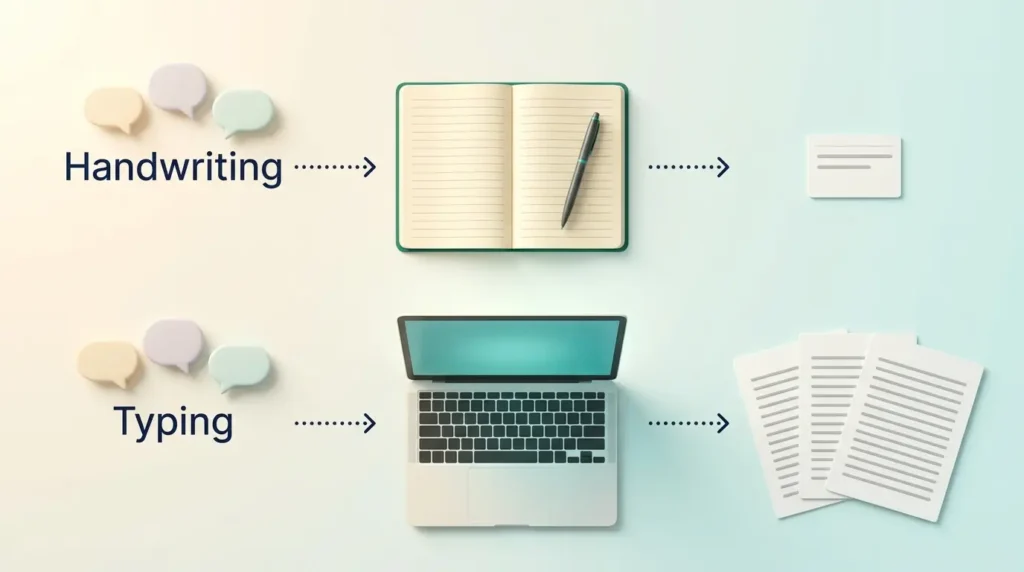
Handwriting encourages selection and paraphrasing
Writing by hand is slower than speech, which pushes you to summarize. You hear three sentences, pick the core idea and write it down in fewer words. This paraphrasing makes you process the meaning on the spot. Visual methods push this even further, which is why some people combine handwriting with mind mapping to connect ideas.
Typing makes it easier to capture more information
Typing can follow most speakers almost word for word. That helps when details matter, such as numbers or names. The risk is that you become a transcriber whose fingers work while the mind stops deciding what matters.
On the plus side, typed notes are searchable, easy to organize with headings and simple to share with a team.
To get some of the handwriting benefit while typing, use short bullets in your own words.
What Brain Engagement Can and Can’t Tell You About Learning
Headlines often say handwriting “lights up” more of the brain. These claims come from EEG studies, which measure electrical brain activity through scalp sensors.
A 2024 EEG study by Van der Weel and Van der Meer in Frontiers in Psychology found more widespread connectivity between brain regions when students wrote by hand than when they typed. However, it did not test whether students remembered more afterward.
A 2026 EEG study by Shin and colleagues in Frontiers in Education went one step further. It compared ink pens, digital pens and keyboards and then tested students right after each lecture. Both pen types produced stronger brain signals than the keyboard, yet test scores showed no significant difference. More brain activity is not the same as better memory.
Brain activity shows that two tasks differ. Only memory tests show which one helps you learn more.
When Typed Notes May Work Better for You
Handwriting is not automatically the right choice. Typed notes often win in these situations:
- Fast, detail-heavy content. Technical training, legal points or figures you need exactly.
- Work meetings. Decisions and action items need to be shared quickly. A meeting notes template keeps typed notes focused on outcomes, and an AI meeting notes workflow can handle the transcript.
- Long-term reference. If you will search the notes months later, digital text is easier to find. Store them in a second brain system or in apps compared in Evernote vs OneNote and Evernote vs Google Keep.
- Accessibility. If handwriting is slow, tiring or painful for you, typing or voice capture may let you take part fully. Our guide to organizing audio notes shows how to turn voice memos into usable notes.
Text expansion snippets and keyboard shortcuts cut formatting effort, which leaves more attention for the content.
How to Choose and Use a Note-Taking Method That Supports Recall
Since average differences are small, your own results matter most.
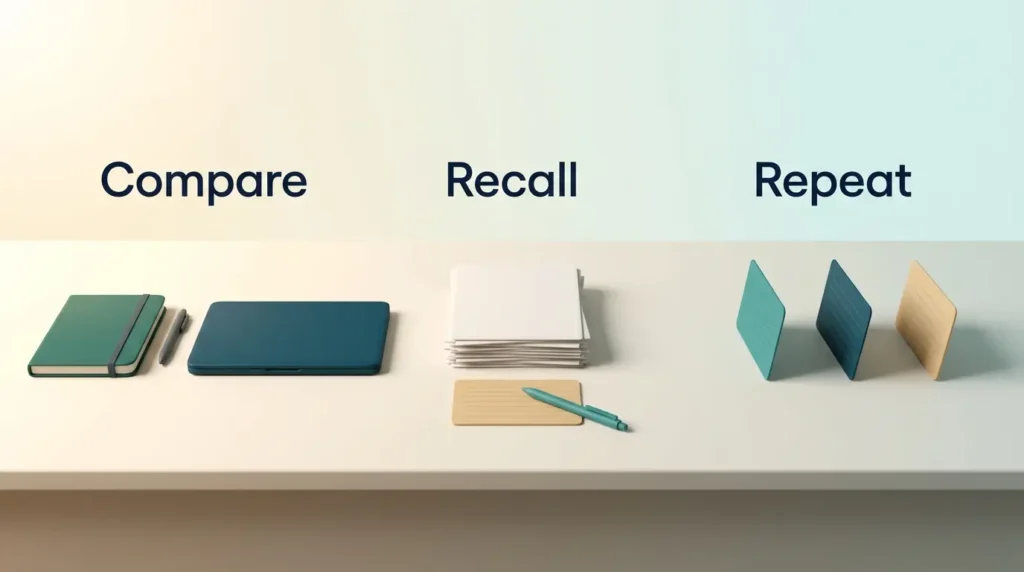
Run a simple personal test
- Take notes by hand in one session and by keyboard in a similar one.
- A day later, close your notes and write down everything you remember. Then answer a few “why” and “how” questions.
- Compare what you recalled after each session. Repeat the test once or twice before you decide, since one session can be a fluke.
Review with active recall
Whatever tool you choose, the biggest gains come after the lecture. Cover your notes and try to explain the main points from memory. This is called retrieval practice, and it is one of the best-supported learning methods in psychology. Short, repeated reviews spread over days work better than one long session, which is also the idea behind microlearning.
Combine both methods
A practical hybrid:
- Type during fast sessions to capture details.
- Afterward, write a short handwritten summary of the five most important points.
- Connect the ideas to your work in a bullet journal or a quick brain dump.
This gives you searchable records plus the deeper processing of handwriting. If long sessions drain your focus, see our ADHD-friendly productivity systems and the focus framework for knowledge workers.
Conclusion
Neither method guarantees better recall. Handwriting has a small learning edge because it forces you to select and rephrase. Typing wins on speed, volume and searchability.
The habits around your notes matter more than the tool. Capture key ideas in your own words, review them within a day and test yourself instead of rereading. Choose the tool that helps you think, then check what you can actually recall.
Found this useful?
Make SmartKeys a preferred source on Google, and our articles will surface more often in your Top Stories, AI Overviews, and AI Mode.
Add as Preferred SourceFAQ
What are the main differences between handwritten and typed notes?
The main difference is speed and what that speed does to your thinking. Typing lets you capture much more information, often close to word for word, and your notes are easy to search, edit and share. Handwriting is slower, so you have to pick the key ideas and rephrase them in your own words. On average, research shows a small learning advantage for handwriting.
Does the Mueller and Oppenheimer study prove handwriting is better?
No, it does not prove it on its own. The 2014 study found that students who wrote by hand did better on some conceptual questions, while laptop users copied more verbatim. A larger replication in 2021 found no significant difference in quiz scores. A 2024 meta-analysis of 24 studies found a small advantage for handwritten notes. So handwriting may help a little, but the effect is modest.
What factors should I consider when choosing between handwriting and typing?
Consider the pace of the content, how much detail you need and how you will use the notes later. Fast, detail-heavy sessions favor typing. Conceptual topics where understanding matters more than exact wording favor handwriting. Comfort matters too: if writing by hand is slow or tiring, typing may let you participate better.
How can I test which note-taking method works best for me?
Run a small personal experiment. Take notes by hand in one session and by keyboard in a similar session. A day later, close your notes and write down everything you remember, then answer a few questions that ask you to explain or apply the ideas. Your own results are more useful than average research findings, since the differences between methods are small.
Does handwriting activate the brain more than typing?
EEG studies suggest it does, but that does not automatically mean better learning. A 2024 study found more widespread connectivity between brain regions during handwriting than during typing, but it did not measure memory. A 2026 study found stronger brain signals for pens than keyboards, yet no significant difference in immediate test results. Memory tests, not brain scans, show which method helps you remember more.
Are there situations where typed notes are more beneficial?
Yes. Typed notes are usually better when you need to capture a lot of detail quickly, such as figures, names or technical steps. They also suit shared meeting notes and reference material you will search later. To keep the learning benefit, type in short bullets using your own words instead of transcribing everything, and review the notes with self-testing afterward.
Does writing on a tablet with a stylus count as handwriting?
Mostly, yes, in the way that matters for learning. A stylus keeps the slower pace of handwriting, so you still have to select and rephrase ideas rather than copy them. Most classic studies compared paper with laptops, so evidence on tablets is more limited. A 2026 EEG study that included digital pens found no significant performance difference between devices on immediate tests. The practical bonus is that tablet notes can be searched and backed up.