For years, companies chased the lowest landed cost, meaning price plus shipping, duties and handling, wherever the factory sat. Many are now moving production closer to American customers and suppliers. That shift, known as reshoring manufacturing, runs alongside nearshoring, and the 2026 data shows both its momentum and its limits.
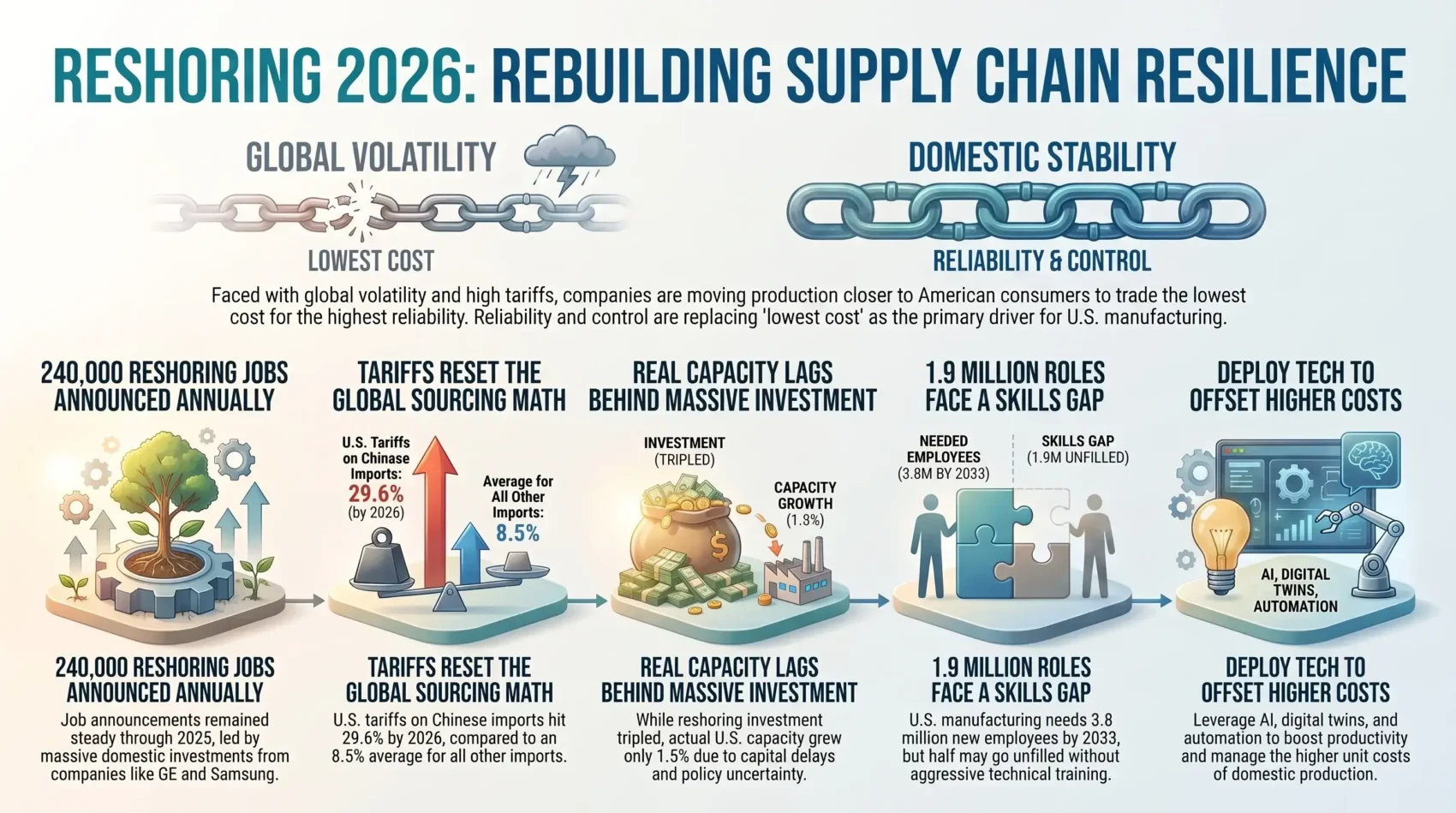
The Reshoring Initiative counts announced jobs. It recorded about 244,000 reshoring and foreign direct investment jobs in 2024, and its 2025 annual report, published in April 2026, put the pace at a similar level. Foreign direct investment, or FDI, means a foreign company building capacity on U.S. soil instead of exporting into it. GE Appliances put a face on it in June 2025: a $490 million investment moved washing machine production from China to Louisville, Kentucky, creating about 800 jobs.
COVID-19 exposed weak points in global supply chains, and the pressure never lifted. Shipping delays, port congestion, tariffs and geopolitical risk still make distant networks hard to manage.
This guide covers what has actually changed by 2026: the benefits, the costs, the skills, the technology, and the gap between what companies announce and what they build.
Key Takeaways
- Reshoring and nearshoring move production closer to customers, not always home.
- Announcements held near 244,000 jobs a year, but built capacity lags badly.
- GE Appliances and Apple show what committed domestic investment looks like.
- Tariffs changed the math, though not in every product category.
- Skills and automation, not patriotism, decide whether a domestic plant works.
What Reshoring Manufacturing and Nearshoring Mean for U.S. Companies
Your sourcing strategy shapes prices, delivery times and customer trust. Reshoring returns operations American companies once moved overseas, while offshoring sends production abroad. Nearshoring takes the middle path, placing work in closer regions such as Mexico or Canada. Friend-shoring adds a political filter, favoring allied countries over the cheapest.
How Reshoring Differs From Offshoring
Consider a smartphone: minerals from one country, components assembled in another, software loaded elsewhere. Logistics providers move it to stores or homes, and blockchain-based logistics platforms now record each handoff in a form every partner can verify.
Tariffs reset part of that calculation. A tariff is a tax on imported goods, paid by the importer. USAFacts puts the average effective U.S. tariff rate on Chinese imports at 29.6 percent in February 2026, against 8.5 percent across all imports. Duties at that level change landed cost and the case for distant sourcing. They also push companies to re-examine supplier networks with digital procurement and analytics tools.

How Reshoring Builds More Resilient Supply Chains
A strong network absorbs shocks and keeps goods moving when transport or suppliers fail. Reshoring supports shorter paths, cleaner inventory data and more direct control. It pairs well with geospatial analytics for routing and site selection, and with data lakes for business intelligence that pull plant, supplier and logistics data into one view. Location alone does not create resilience. That takes a wider set of resilience practices, from dual sourcing to buffer stock.
Resilience matters most where public safety and the economy meet. Healthcare, semiconductors, food and energy need dependable domestic supply, because a delay reaches national security and daily life.
Critical Industries Driving Domestic Production
The CHIPS and Science Act, the 2022 law that funds domestic chip plants, put federal money behind U.S. semiconductor capacity. Samsung’s Taylor, Texas project closed a finalized award of $4.745 billion in December 2024. Samsung is investing more than $37 billion in the region, with over 3,500 manufacturing jobs and about 12,000 construction jobs projected.
Technology carries the rest. Automation, AI in business operations and connected sensors catch defects early. IoT platforms stream machine data in real time, and private 5G networks carry it across the plant floor. A digital twin, a live software model of a real production line, lets engineers test a change before touching the machines. Predictive maintenance replaces parts before they fail, and 3D printing across the supply chain shortens the wait for a spare part when a supplier goes dark.
The Business Benefits of Bringing Manufacturing Home
Local production offers more than a shorter route to market. Reshoring cuts shipping delays, improves operational control and speeds up response to changing demand, usually at a higher unit cost. It also limits exposure to tariffs and overseas disruption.
Domestic plants are getting more productive. The Bureau of Labor Statistics reported manufacturing labor productivity up 1.9 percent in the second quarter of 2026, with output up 4.6 percent and hours worked up 2.6 percent. Factories added hours and still produced more per hour worked. The gain came from making more, not cutting staff.
“The best cost is not always the lowest price; it is the cost your business can manage with confidence.”
Automation offsets part of the higher labor cost, and the same machine data feeds sustainability reporting. Carbon accounting software turns plant energy use into reportable numbers once you commit to carbon neutrality targets, and shorter routes make greener logistics easier to evidence.
Apple opened its Advanced Manufacturing Center in Houston on 13 August 2026. The 20,000-square-foot site builds AI servers previously made overseas, with Mac mini production due later in the year. Apple says it went from picking the site to shipping product in under nine months, part of its $600 billion American Manufacturing Program.
Challenges and Strategic Considerations for Reshoring Efforts
Moving work closer to U.S. customers sounds simple. Execution is where plans stall.
Announced Versus Built: What the 2026 Data Shows
Kearney’s Reshoring Index compares U.S. imports of manufactured goods from low-cost Asian countries against domestic factory output. A negative reading means imports grew faster. The 2026 index improved from minus 115 to minus 91 but stayed negative. Imports rose 4.6 percent to a four-year high. China’s share fell below 10 percent, down from roughly 20 percent four years earlier, while 13 other Asian exporters picked up $193 billion and imports from Mexico rose 8 percent. Most telling: investment tripled over those four years, yet U.S. manufacturing capacity grew only 1.5 percent, as uncertainty delayed or canceled projects.
Computers, electronics and apparel together account for 44 percent of Asian imports. Even after tariffs, they still cost less to import than to produce at home, which drags the index negative while other categories do move. Read your own category, not the headline, and use a formal risk management framework to decide what can realistically shift.
Labor, Skills, and Workforce Gaps
Domestic factories need trained operators, tooling engineers and technical schools within commuting distance. Deloitte and The Manufacturing Institute project that U.S. manufacturing may need as many as 3.8 million new employees by 2033, with roughly 1.9 million roles unfilled if the skills gap persists. Overseas hubs hold denser pools of experienced production engineers, and that density is harder to replicate than a building. Closing the gap means apprenticeships, training budgets and a cross-training strategy that keeps a smaller team flexible.
Higher Costs, Capital Needs, and Policy Uncertainty
Domestic capacity is capital-heavy. Land, buildings, equipment, financing and higher wages all arrive before the first unit ships, and incentives change with an administration. Treat policy support as an accelerator, not the foundation of the business case.
Bringing final assembly home while raw materials, sub-assemblies and tooling still come from one distant region leaves the original exposure untouched. Map suppliers, demand, quality requirements and technology together. Then work tier by tier, from your direct suppliers to theirs, to find the single points of failure a new plant would not fix.
Why Nearshoring and Friend-Shoring Can Strengthen U.S. Operations
Nearshoring and friend-shoring connect you with trusted partners instead of forcing every product into a U.S. factory. Mexico’s 8 percent import growth in 2026, including a $47 billion jump in computers and electronics, shows where that capacity is landing. They balance cost, speed and resilience without a single distant dependency. Blockchain adoption in business and shared tracking help most when parts cross a border rather than an ocean.
Conclusion
Reshoring manufacturing can strengthen United States resilience when leaders balance supply security, cost, skills, technology and demand. The benefits are real, and so is the execution risk. The 2026 data shows the two moving at different speeds.
Critical sectors such as semiconductors, healthcare, energy and food may deserve focused investment rather than a blanket return of production. CHIPS funding helps factories expand, but a plan that only works with a grant is not a plan. Build the case on demand, unit economics and the skills you can recruit. Watch too how circular production models and additive manufacturing change what a plant needs to be.
Review your supply chain, partner countries and production goals. A balanced plan builds a stronger operation without pretending change is free.
Found this useful?
Make SmartKeys a preferred source on Google, and our articles will surface more often in your Top Stories, AI Overviews, and AI Mode.
Add as Preferred Source