Participatory management invites employees into decisions that affect their work — without turning every choice into a committee. Done well, it raises commitment and surfaces knowledge that never reaches the org chart. Done badly, it stalls delivery and burns manager time.
The case for it got stronger in 2026. Gallup’s State of the Global Workplace report puts global engagement at 20%, its lowest level since 2020, with 64% of employees not engaged and 16% actively disengaged. The estimated cost to the world economy: around $10 trillion in lost productivity. In the US, engagement sits at 31% — an 11-year low.
At the same time, AI is landing on desks faster than anyone is consulted about it. That combination is why involvement stopped being a culture perk and became an operating question.
This guide gives you the four levels of involvement, a way to map decision rights so nothing gets stuck, the guardrails that keep managers sane, what the EU AI Act now requires before you deploy workplace AI, and a 90-day pilot you can start this quarter.
Key Takeaways
- Involvement is a dial, not a switch — informational, consultative, democratic and collective each fit different decisions.
- Decision rights must be written down. Ambiguity, not participation, is what slows teams.
- Managers explain roughly 70% of the variance in team engagement, so start with them.
- AI rollouts are the highest-value place to apply participation right now — and in the EU, informing workers is a legal duty.
- Time-box discussions and publish the rationale, or people stop contributing.
- Measure time-to-decision alongside engagement, or you will only see half the picture.
Why employee voice matters more in 2026
Two numbers frame the problem. Engagement is at a multi-year low, and the people who could fix it are struggling themselves.
The engagement picture behind the case
Gallup’s long-running research finds that managers account for about 70% of the variance in team-level engagement. That would be encouraging if manager engagement were healthy — but global manager engagement fell to roughly 22% in the latest reading, down about five points year over year, with the sharpest declines among managers under 35.
You cannot cascade motivation from a layer that is running on empty. Participatory approaches help here in a specific way: they redistribute some of the cognitive load of decision-making instead of concentrating it in one exhausted role. For the wider context on what is moving these numbers, see our breakdown of employee engagement trends.
AI made participation an operational and legal question
AI adoption at work crossed a threshold in 2026. Gallup’s quarterly workforce study found 52% of US employees now use AI in their role, up from 21% in mid-2023, with 30% using it at least a few times a week.
But adoption is not the same as usefulness. In late 2025, only 16% of employees strongly agreed that the AI tools their organization provides are actually useful for their work. And Gallup’s February 2026 survey of 23,717 US employees found 27% of people at AI-adopting organizations reported large or very large disruptive change in the past year, against 17% elsewhere.
That gap has an obvious cause: tools get selected far away from the people who have to use them. Research from Protiviti’s AI readiness work names employee involvement — alongside learning programs and clear communication — as one of the three approaches leaders most often identify as effective for driving adoption. SHRM’s 2026 research points the same direction from the other end: 52% of organizations do not involve HR directly or cross-functionally in AI strategy and vision at all.
In the EU, this is no longer optional. Article 26(7) of the EU AI Act requires employers deploying a high-risk AI system in the workplace to inform workers’ representatives and affected workers before the system goes live. In June 2026, the European Parliament approved a provisional agreement shifting the core Annex III high-risk deadline to December 2027, pending Council adoption — but the obligation itself is unchanged, only its enforcement date. If you are mapping your exposure, start with our guide to EU AI Act compliance and the practical side of algorithmic management.
What participatory management actually is
At its simplest: employees influence decisions that shape their work, through a defined process rather than an open door.
Participative leadership vs. participatory management
Participative leadership is a personal style — a manager asks for input, delegates some authority, and often keeps the final call. Participatory management is the systemic version: the involvement is written into policies, meeting formats and decision rights, so it survives a manager changing jobs.
The distinction matters because the first is fragile and the second is durable. One good listener does not make a participative organization.
A short history, and why it resurfaced
Rensis Likert’s principles — mutual support, group decision-making, high performance goals — gave the field its first blueprint in the 1960s. Later work by Kahai and colleagues sharpened the question of when leaders should consult, delegate or decide alone.
What changed recently is the cost of being wrong. Complex, fast-moving work rewards local knowledge, and the people closest to a customer or a codebase often see problems weeks before a dashboard does.
If you want the more radical end of this spectrum, look at self-managing teams and holacracy adoption. Most organizations land somewhere in the middle, which is the trade-off explored in flat vs. hierarchical structures.
The benefits — and the trade-offs you should plan for
What you gain
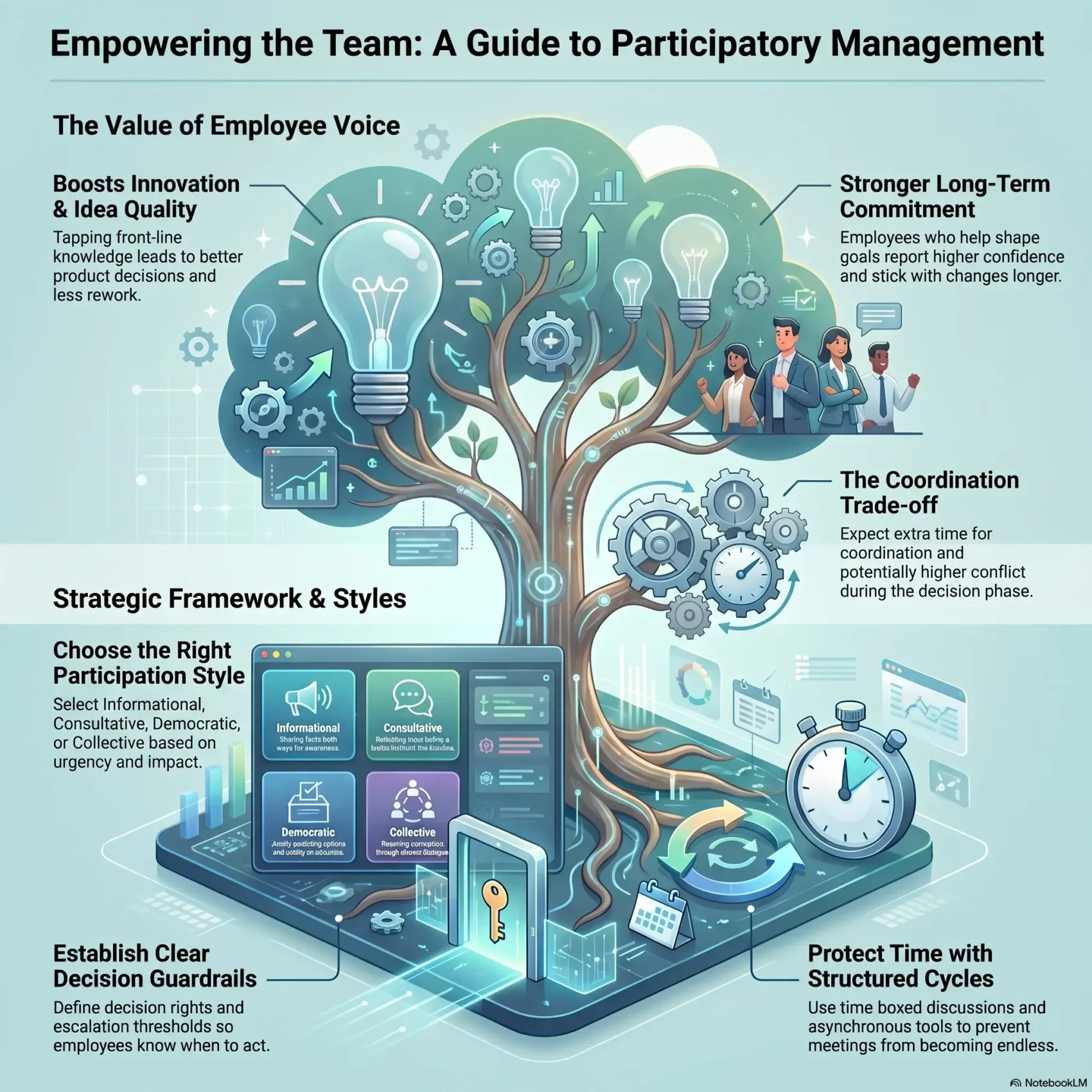
Involve people early and you generally get better decisions, less rework, and far less resistance at implementation. Employees who help shape a goal report higher confidence and stay with the change longer. Research linking participative leadership to well-being, trust in leaders and self-efficacy has been consistent across contexts.
“When people make meaningful contributions, resistance drops and learning accelerates.”
What it costs
Time, mostly. Leaders have to explain options, collect input and review it — which is a poor fit for urgent calls. Group discussion also raises the odds of conflict during the decision phase, not after it.
There is a second, quieter cost: consultation theatre. Asking for input and then ignoring it does more damage than never asking. If you cannot act on the answer, do not run the process.
How to make it work in your company
Turn voice into action with explicit decision rights and fast feedback loops.
Four foundations
Start with transparency, trust, delegation and ownership. Give employees real visibility into performance data, customer signals and constraints — people cannot contribute usefully to a decision they can only see half of. Our guide to building a transparency culture covers how far to open the books and where to stop.
Then delegate to the people closest to the work, with agreed guardrails. The mechanics of doing that without losing control are covered in effective delegation.
Map decision rights by domain
Split decisions into four buckets and assign a default owner to each:
- Technical — expert teams and customer-facing staff usually hold the best information.
- Social — working agreements, meeting norms and safety benefit most from group input.
- Financial — leadership decides, but trade-offs should be visible to those affected.
- Personnel — managers lead, with narrow and well-defined consultation.
Then set explicit escalation thresholds so a front-line employee knows exactly when to act and when to loop someone in. If you need a framework to structure this, our overview of decision-making models compares the common options, including RACI and DACI.
Choose the right level of involvement
- Informational: facts flow both ways for awareness. No authority shared. Fastest.
- Consultative: you collect input, then decide and explain. The right default for most work.
- Democratic: the group analyzes options and votes. Use where buy-in matters more than speed.
- Collective: shared authority for outcomes affecting the whole group. Slowest, strongest ownership.
Match the level to the decision, not to your personality. Reserve directive calls for genuinely time-critical or high-risk choices — and say so out loud when you make one.
Guardrails that protect managers
Time-box every discussion. Publish an agenda and a decision deadline. Collect input asynchronously before anyone books a room — asynchronous communication tools do most of this work, and a serious meeting reduction effort usually pays for the participation overhead several times over.
In hybrid setups, watch who actually gets heard. Remote participants lose airtime by default, which is exactly what hybrid meeting etiquette is designed to correct. The same logic applies to whose perspectives are in the room at all — see diversity and inclusion at work.
Close the loop every time. Communicate the decision, the rationale, and which input changed it. This single habit is what separates participation from theatre.
Where AI changes the equation
AI deployment is currently the highest-leverage place to apply participatory management, for three reasons.
First, the usefulness gap is a selection problem. When only 16% of employees strongly agree their organization’s AI tools are useful, the fix is not more licenses — it is asking the people doing the work which tasks are actually worth automating.
Second, disclosure builds trust faster than reassurance. Publishing what a system does, what data it uses and who reviews its output removes most of the fear. A clear set of generative AI usage guidelines, written with employee input rather than delivered to them, does more for adoption than a mandate.
Third, in Europe it is now a compliance step with a paper trail. Informing workers and their representatives before a high-risk system goes live is a pre-deployment duty, not a launch announcement.
Measuring whether it actually works
Track a small set of indicators on both sides of the trade-off:
- Speed: time-to-decision, and the share of decisions that get reopened.
- Quality: ideas implemented, rework rate, escaped defects.
- Sentiment: whether people believe their input matters — employee NPS and pulse surveys catch this early.
- Retention: voluntary turnover in participating teams versus comparable ones.
Feed the results into regular coaching conversations rather than an annual cycle. The rhythm described in continuous performance management fits this well, because participation produces feedback continuously and an annual review has nowhere to put it.
A 90-day pilot you can run
Days 1–30. Pick one decision area with real stakes but contained blast radius — tool selection, shift patterns, or a process redesign. Write down who decides, who is consulted, and the deadline. Choose your involvement level and say which one you picked.
Days 31–60. Run it. Collect input asynchronously first, hold one time-boxed session, then decide. Publish the rationale within 48 hours, naming which input changed the outcome.
Days 61–90. Measure time-to-decision against your previous baseline, survey the participants, and document what you would change. Then either widen the scope or pick a second area.
Conclusion
Participatory management is not a softer way to manage — it is a more explicit one. The organizations that get value from it are the ones that write decision rights down, match the level of involvement to the decision, time-box the process, and always explain the outcome.
With engagement at a multi-year low and AI reshaping work faster than most consultation processes can keep up, the cost of deciding in a vacuum has gone up. Start with one decision, run it properly, and let the result make the argument for the next one.
Found this useful?
Make SmartKeys a preferred source on Google, and our articles will surface more often in your Top Stories, AI Overviews, and AI Mode.
Add as Preferred Source