Carbon neutrality has quietly stopped being a pledge and become paperwork. In 2026, nobody asks whether you have a target. They ask whether you can show the data behind it, increasingly under a legal deadline.
Three things changed in the last twelve months. The EU’s carbon border levy started charging real money. California’s first mandatory emissions reports came due. And the Science Based Targets initiative rewrote the rulebook companies use to define “net zero”.
This guide turns that pressure into a plan: what the terms commit you to, which rules now apply to a U.S. business, and a five-step roadmap that puts reductions first and treats removals as the last resort they should be.
Key Takeaways
- Carbon neutrality means balancing what you emit with verified removals, but reductions have to carry almost all of the weight.
- Global removal capacity is roughly 2.2 billion tonnes a year against about 42 billion tonnes of emissions. The math does not allow an offset-first strategy.
- Four 2026 rule changes (CBAM, California SB 253, the EU’s Omnibus I directive and SBTi’s V2.0 standard) reshape who has to report what.
- Measure first, cut second, buy clean electricity third, and reserve removals for the residual 5-10% you genuinely cannot eliminate.
- Microsoft paused carbon removal purchases in April 2026, then resumed weeks later. The episode showed how thin the market is when one buyer moves.
What carbon neutrality actually commits you to
Pin down what balance between emissions and removals looks like for your organization. That clarity turns a vague pledge into something you can audit, report and defend.
First, the three scopes
Every rule below sorts your emissions into three buckets.
Scope 1 is what you burn directly: company vehicles, gas boilers, refrigerant leaks. Scope 2 is the electricity, heat and steam you buy. Scope 3 is everything else in your value chain: purchased goods, business travel, shipping, and what happens to your product after a customer buys it.
For most companies Scope 3 is by far the largest bucket and the hardest to measure, because the data sits with suppliers. The counting rules come from the GHG Protocol, the accounting standard regulators and voluntary programs alike treat as the default.
Balancing what you emit against what you remove
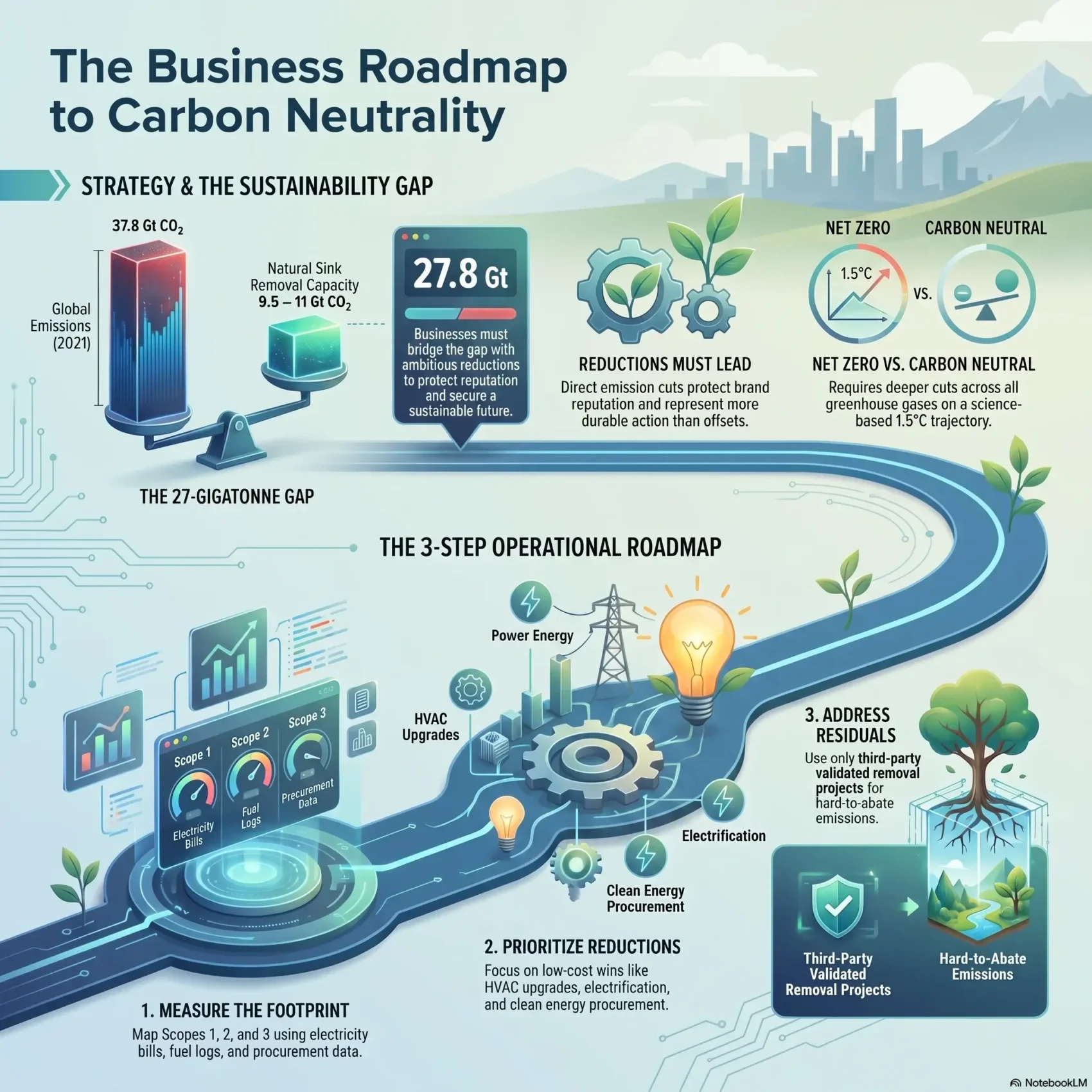
Carbon neutrality means you measure your emissions, reduce them first, and use verified removals to address what is left. The sequence matters more than the label.
The scale gap explains why. Fossil CO2 emissions reached a record 38.1 billion tonnes in 2025, with roughly 4.1 billion tonnes more from deforestation and land-use change, according to the Global Carbon Budget 2025. Against that, deliberate human-directed carbon removal runs at about 2.2 billion tonnes annually, and almost all of it is trees and soil rather than technology.
The 2026 State of Carbon Dioxide Removal report sizes the engineered share: novel methods such as direct air capture and biochar removed roughly 2 million tonnes in 2025, against the 70 million a net-zero path needs by 2030. Projects actually under contract add up to about 8.4 million tonnes by that date.
Atmospheric CO2 averaged 425.7 parts per million in 2025, roughly 52% above pre-industrial levels. There is no version of this arithmetic where offsets substitute for cutting emissions.
Carbon neutral, net zero, climate neutral: the words are not interchangeable
Carbon neutral typically means you balance CO2 released with removals or offsets, usually measured under the GHG Protocol.
Net zero sets a stricter bar. It expects deep reductions across all greenhouse gases on a science-based trajectory aligned to 1.5°C, and it limits how much residual emission removals are allowed to cover.
Climate neutral goes wider still, aiming to cut greenhouse gases and minimize other environmental harms rather than balancing a subset.
Climate positive and carbon negative both mean removing more than you emit. “Carbon positive” is a marketing phrase that means nothing technical, so avoid it in any document a regulator might read.
Why the timeline pressure is real
The remaining carbon budget for a 50% chance of holding warming to 1.5°C is about 170 billion tonnes of CO2, roughly four years at 2025 emission levels. Whatever your view of the political timeline, the physical one is short, and it drives the regulatory wave described below.
“Reductions first, transparent removals second. That sequence protects your reputation and it is the only version the numbers support.”
Four 2026 rule changes that reshape your plan
The compliance landscape shifted more in the past year than in the previous five. Here is what applies, and when.
CBAM entered its definitive phase on 1 January 2026
The EU’s Carbon Border Adjustment Mechanism, or CBAM, is a carbon price on imports. It exists so that goods made outside the EU do not undercut EU producers who already pay for their emissions. On 1 January 2026 it moved from reporting-only to financially binding, covering cement, iron and steel, aluminium, fertilizers, electricity and hydrogen.
The Omnibus revision replaced the old exemption for small consignments with a single threshold: importers bringing in fewer than 50 tonnes of covered goods a year fall outside the regime. The Commission estimates this removes roughly 90% of importers from scope while still capturing about 99% of embedded emissions. Electricity and hydrogen have no threshold at all.
What it means for a U.S. exporter: your EU customers now need product-level emissions data from you. No certificates are bought during 2026; sales open in February 2027 for 2026 imports, with the first annual declaration due later that year. That gives you a year to get supplier data in order, not a year to ignore it. Manufacturers already mapping their upstream footprint for supply chain resilience find the same data serves both purposes.
California SB 253 brings the first mandatory U.S. emissions reports
SB 253 requires U.S. companies with over $1 billion in annual revenue doing business in California to publicly report Scope 1 and Scope 2 emissions under the GHG Protocol. The California Air Resources Board deferred the first deadline from 10 August to 10 November 2026 while it clarified the regulation.
Two details make the first filing less daunting than it sounds. CARB is asking companies to report the data they were already collecting as of December 2024, rather than a perfect inventory built from scratch. And no third-party assurance is required for that first submission, though you may provide it voluntarily. Assurance means an outside auditor signs off that your numbers are defensible, and it is scheduled to arrive with Scope 3 reporting in 2027.
The companion law SB 261, covering climate-risk disclosure for companies above $500 million in revenue, remains stayed under a Ninth Circuit injunction while litigation continues.
With the deadline now weeks away, in-scope companies that have not reconciled their fiscal-year data are running short of room. Purpose-built carbon accounting software is what most use to close the gap, and the underlying problem is usually a data governance one rather than a climate one.
The EU narrowed CSRD dramatically with Omnibus I
The Corporate Sustainability Reporting Directive, or CSRD, is the EU rule that obliges large companies to publish audited sustainability information alongside their financial accounts. Directive (EU) 2026/470 entered into force on 18 March 2026 and raised its thresholds sharply: reporting now applies to companies with more than 1,000 employees and more than €450 million in net turnover. Estimates suggest this pushes around 80% of previously in-scope companies out of the regime. Listed small and medium enterprises are fully exempt.
The amendments apply to financial years starting from 1 January 2027, with first reports due in 2028. If you were building a CSRD program, re-check whether you are still in scope before spending another dollar on it. If you are not, decide deliberately what to keep reporting voluntarily, because customers and lenders will still ask. Our guide to building an ESG reporting framework covers that call, and the compliance-automation tools used in regulatory technology projects tend to carry the reporting load.
SBTi rewrote the net-zero rulebook
The Science Based Targets initiative, the body most companies use to validate their climate targets, published Corporate Net-Zero Standard Version 2.0 on 11 June 2026. It is the most substantial revision since 2021.
The headline changes: companies are now sorted into Category A (large, facing mandatory assurance, climate transition plans and tighter Scope 3 requirements) and Category B (smaller, with proportionate obligations). Scope 1 and Scope 2 get separate targets rather than a combined one. And the standard formally recognizes “best efforts”, so companies that miss targets while demonstrating genuine action can stay on the trajectory rather than being marked as failures.
Timing matters here. Companies can submit targets under Version 2.0 from February 2027, and Version 1.3.1 remains usable until 31 January 2028. If your commitment or renewal falls in 2026, most guidance points to staying on the current version and moving over at your next target cycle.
The five-step roadmap
Gather activity data first. That baseline drives every decision that follows: where to cut, what to buy, and how little you actually need to offset.
Step 1: Measure your footprint honestly
Collect electricity bills, fuel logs, travel records, refrigerant leakage and procurement totals. Assign them to Scopes 1, 2 and 3 under the GHG Protocol and convert them to CO2e, the common unit that expresses methane and other gases as their carbon dioxide equivalent.
Confirm your boundaries before you publish anything. Boundaries define what you are counting, for instance whether a leased warehouse or a joint venture sits inside your inventory. A baseline with an undocumented boundary is the most common reason a target gets challenged later.
Step 2: Cut the cheap tonnes first
Reductions before anything else. Start with low-cost wins that pay back inside three years: lighting and HVAC upgrades, controls and scheduling, process efficiency, fleet electrification.
Then move to structural changes: supplier engagement, product redesign, material substitution. Most technologies that make deeper cuts viable are now commercially available rather than experimental, a shift visible across current climate tech trends and the wider market for green technology.
Step 3: Fix your electricity
Scope 2 is usually the fastest large reduction available and the easiest to document. Options range from utility green tariffs and on-site solar through to power purchase agreements with matched generation.
Be precise about what you claim. Annual matching means your yearly clean-energy purchases equal your yearly consumption. Hourly matching means they line up hour by hour, a far stronger claim, and disclosure standards increasingly ask which one you mean. If your footprint is growing because of cloud and AI workloads, the economics behind AI data center energy are worth understanding before you sign a long contract.
Step 4: Attack Scope 3 through your suppliers
For most companies, the value chain dwarfs direct operations. That makes procurement your biggest lever and your slowest one, because it depends on data you do not own.
Start with your top 20 suppliers by spend, ask for primary emissions data rather than industry averages, and write reporting expectations into contracts at renewal. Designing for durability and reuse at the same time compounds the effect, which is why circular economy models and greener supply chains tend to show up together in credible plans. In the EU, the new digital product passport rules will force much of this product-level data into the open anyway.
Step 5: Reserve removals for genuine residuals
Use offsetting only for the hard-to-abate remainder, typically 5-10% of your baseline. Distinguish between avoidance credits, which pay for emissions that never happen, and removals, which take carbon back out of the air. They are not the same product and should not share a line in a report.
Demand third-party validation, demonstrable additionality and ongoing monitoring. Additionality means the project would not have gone ahead without your money; without it you are paying for something that was happening anyway. Nature-based sinks are valuable but reversible, since fire, drought and land-use change can undo them. Engineered removal is durable but expensive.
What the Microsoft pause revealed about the removal market
In April 2026, reports emerged that Microsoft had paused new carbon removal purchases, and the durable removal market wobbled. One buyer accounted for the large majority of global purchases, so a single procurement decision moved the whole sector.
The pause turned out to be short. By late May, Microsoft had signed a seven-year agreement with Danish biogas producer BioCirc for 650,000 tonnes of removals, and its chief sustainability officer said the program had not ended. The lesson is not that Microsoft withdrew. It is that a market this concentrated cannot be treated as reliable supply.
Microsoft had contracted roughly 45 million tonnes of removal by early 2026 while its own emissions climbed sharply, driven by AI data center expansion. That is the cautionary tale: even the best-resourced buyer in the world found that growth outran its offsets.
The price gap tells the rest of the story. Sylvera’s 2026 pricing analysis puts average direct air capture credits above $500 per tonne, against roughly $6 for REDD+ forest protection credits and $22 for reforestation removals. If your plan quietly assumes you can offset a large residual at the low end of that spread, stress-test it now and put the real cost into capital planning. How capital prices this risk is worth watching in current green finance trends.
Your next twelve months
Close the loop with a simple sequence. Set annual milestones, lock in the data systems that produce your numbers, and make reductions rather than purchases the headline of every update.
Check your scope under each of the four rule changes above: at least one probably applies to you and at least one probably no longer does. Build a quarterly policy-watch routine so the next revision does not surprise you. Fold likely certificate and assurance costs into budgets rather than treating them as an exception.
Then report plainly. Publish your methodology, your boundaries, your reductions and your removals as separate figures. Customers read these documents, and sustainability has become a buying criterion rather than a brand exercise, which is why corporate responsibility reporting has shifted from pledges to filings. Software vendors face the same pressure through ESG reporting rules in SaaS.
The companies that come out ahead are the ones whose numbers hold up under scrutiny. That is a question of strategy rather than communications, and the strongest plans treat emissions cuts as a source of product and process innovation, not a compliance tax.
Found this useful?
Make SmartKeys a preferred source on Google, and our articles will surface more often in your Top Stories, AI Overviews, and AI Mode.
Add as Preferred Source