

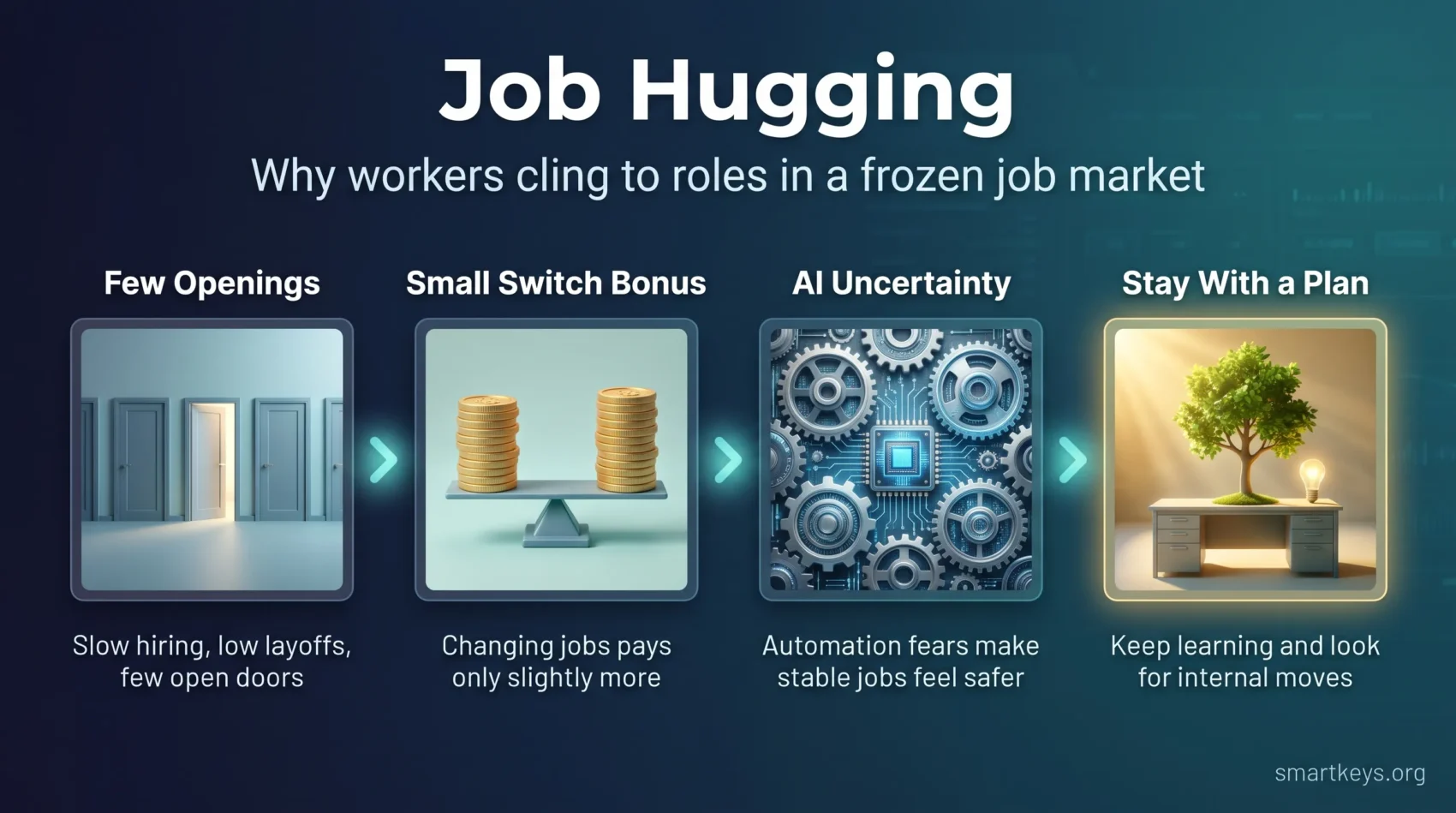
Job hugging means staying in your current job mainly because leaving feels too risky, even when you feel stuck, bored or underpaid. The term took off in 2025, and in 2026 it still describes how many people behave at work. Hiring is slow, layoffs are low, and few workers want to gamble on a new role.
That is a sharp turn from the Great Resignation of 2021 and 2022, when record numbers of people quit for better pay and more flexibility.
This guide explains why job hugging is happening and helps you judge whether staying is a smart move, a short pause or a warning sign. Managers will find practical steps too.
Key Takeaways
- Job hugging means staying in a role out of caution, not because you love it.
- The U.S. quits rate has hovered around 2% since mid-2025, down from a 3% peak in 2022.
- Switching jobs still pays a bit more than staying, but the gap is much smaller than in 2022.
- Staying can be a sound plan if you keep learning. It turns into stagnation if you stop growing.
- For employers, low turnover can hide low engagement. Track engagement, not only retention.
What Is Job Hugging?
The consulting firm Korn Ferry put the phrase into circulation in an August 2025 article. It described employees “holding onto their jobs for dear life.” Business media quickly picked it up, and the label stuck.
In plain terms, a job hugger stays put even when the job is not a great fit. The main reason is security: a steady paycheck, health benefits and a known routine feel safer than an uncertain search. Picture a marketing manager who has outgrown her role but skips two interesting job ads because a new employer could lay her off first.
Three related terms are easy to confuse:
- Job hopping is the opposite. People switch roles often to gain pay, titles or new skills.
- Quiet quitting describes effort, not tenure. It means doing only what the job description demands.
- Job hugging describes the decision to stay. A job hugger can still work hard, or can drift into quiet quitting over time.
Not every long tenure is job hugging. If you stay because you enjoy the work and see a future, that is commitment. The difference lies in the motive.
Why Is Job Hugging Rising in Today’s Frozen Job Market?
Economists often call the current U.S. situation a “low-hire, low-fire” labor market. Companies are not cutting many jobs, but they are not hiring much either. For someone thinking about leaving, that means few open doors outside.
Fewer people quit, and fewer jobs open up
The Bureau of Labor Statistics tracks quits in its monthly JOLTS survey (Job Openings and Labor Turnover Survey). In 2022 the quits rate peaked near 3% of all workers per month. By January 2026, according to Indeed Hiring Lab, it had been at or below 2.0% for seven months in a row.
The trend continued through the year. KPMG’s analysis of the August 2026 JOLTS data shows the quits rate slipping to 1.9% on a three-month average. There was about one job opening per unemployed person, down from two per person in 2022. The layoff rate stayed historically low at 1.1%.
Switching pays less extra than it used to
The Atlanta Fed’s Wage Growth Tracker compares pay raises for people who change jobs with those who stay. On a 12-month average, job switchers saw median wage growth of 4.4% in September 2026, while job stayers saw 3.5%.
So moving still pays a little more, but under one percentage point is modest. For many people it does not outweigh the risk of a new probation period or a worse manager.
AI adds a layer of worry
Fear of automation also plays a part. In an August 2025 Reuters/Ipsos poll, 71% of Americans said they were concerned that AI will put too many people out of work permanently. When you are unsure which roles will exist in three years, a stable job looks more valuable. Our guide on how work splits between people and AI helps you judge your own role. For younger workers, our piece on AI and entry-level jobs is also worth a look.
How Job Hugging Can Affect Your Career
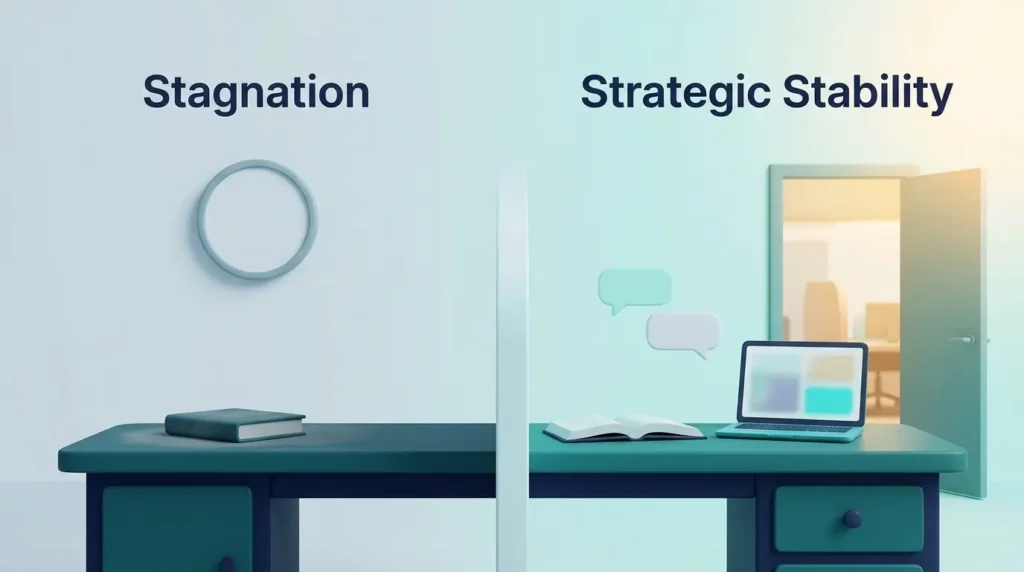
Staying put is not automatically a mistake. In a weak market it can protect your income and give you time to plan. The risk comes when staying replaces growing.
Watch for these warning signs:
- You have not learned a meaningful new skill in the past year.
- You avoid new projects because they feel like extra risk.
- You do the minimum and count the hours.
- You could not name one thing you want to achieve in your role next year.
If several of these apply, you may be sliding from stability into stagnation, and disengagement is common. Gallup’s State of the Global Workplace 2026 report puts global employee engagement at 20%, a five-year low. Long stretches of disengagement can also feed into burnout.
A simple test helps you tell the two apart. Ask yourself three questions:
- Am I still learning? New tasks, tools or responsibilities count.
- Am I getting useful feedback? Regular, honest input from your manager is a good sign.
- Can I move inside the company? Lateral moves, projects in other teams or a career lattice approach keep you growing without leaving.
Two or three “yes” answers suggest strategic stability. Mostly “no” answers suggest it is time to act, even if you do not quit yet.
Why Job Hugging Matters for Employers and the Workforce
For companies, low turnover looks like good news. Recruiting costs drop and teams stay intact. But a stable headcount can hide a problem: people who stay out of fear rather than commitment.

This creates what some HR observers call a “talent jam.” When few people leave, fewer positions open up for others to move into. Promotions slow down and ambitious employees feel blocked. Over time, a company can end up with a workforce that is present but not fully engaged.
Retention numbers alone will not reveal this. Imagine a team where 95% of people stay but most only do the minimum. The retention figure looks great, yet the team is in worse shape than it suggests. That is why employee engagement deserves as much attention as turnover in any talent retention strategy.
How You Can Respond to Job Hugging as an Employee
If you have decided to stay for now, make that time count. Treat it as a deliberate phase with goals, not a waiting room.
- Build skills on purpose. Pick one or two skills that matter for your next step. Short courses, upskilling programs or stretch assignments all work.
- Shape your current role. Job crafting, adjusting your tasks and relationships within your role, can restore some energy without a job change.
- Look inside first. Many employers now run an internal talent marketplace that lists projects and open roles across teams.
- Find a mentor. A mentor outside your direct reporting line can give honest advice on your options. Mentorship platforms make this easier in larger companies.
- Keep an eye on the market. Update your profile and note which skills job ads ask for.
Then raise it with your manager. A one-on-one meeting is a good place to say where you want to go and ask what support is possible.
What Employers Can Do About Job Hugging
Managers cannot change the labor market, but they can change why people stay.
- Measure engagement regularly. Short pulse surveys or AI-supported engagement surveys show where motivation is dropping before it shows up in results.
- Be open about business conditions. Uncertainty feeds fear. Clear updates on strategy and job security help people plan instead of freeze.
- Open internal paths. Make lateral moves, project rotations and promotions visible. A clear internal mobility policy helps unclog the talent jam.
- Talk about pay honestly. If switchers earn more than stayers, explain how raises work. Pay transparency rules in the U.S. and EU push in this direction anyway.
Conclusion
Job hugging is a rational response to a slow labor market. Quits are low, openings are scarce, and switching pays only a little more than staying.
But staying employed is not the same as moving forward. Workers should treat stability as a pause with a plan: keep learning and look for internal moves. Employers should look past retention numbers and ask whether people stay out of commitment or fear. That distinction decides whether a stable workforce is an asset or a hidden cost.
Found this useful?
Make SmartKeys a preferred source on Google, and our articles will surface more often in your Top Stories, AI Overviews, and AI Mode.
Add as Preferred SourceFAQ
What is job hugging?
Job hugging means staying in your current job mainly for security, even when you feel stuck, bored or underpaid. The term was popularized by Korn Ferry in August 2025, when a slow hiring market made many workers unwilling to risk a move. It is different from loyalty: someone who stays because they enjoy the work and see a future is committed, not hugging. The key question is whether you stay by choice or out of fear.
How does job hugging differ from job hopping and quiet quitting?
Job hugging is about staying, job hopping is about leaving, and quiet quitting is about effort. Job hoppers change roles often to gain pay, titles or new skills. Quiet quitters stay but do only what their job description requires. A job hugger stays mainly for security and may still work hard. Over time, though, a job hugger who feels stuck can slide into quiet quitting.
Why is job hugging common in 2026?
Job hugging is common because the U.S. labor market in 2026 offers few openings and little reward for switching. The quits rate has hovered around 2% since mid-2025, and in August 2026 there was roughly one job opening per unemployed person, half the 2022 level. According to the Atlanta Fed, job switchers earned only about one percentage point more in wage growth than stayers. Worries about AI replacing jobs add to the caution.
Is job hugging bad for my career?
Job hugging is not bad in itself, but it becomes a problem if you stop learning. Staying in a weak market can protect your income and give you time to plan your next step. The risk is stagnation: no new skills, no feedback and no path forward. If you are no longer learning or getting honest feedback, start building skills and exploring options now, even if you do not plan to quit soon.
What should employers know about job hugging?
Employers should know that high retention can hide low engagement. When people stay mainly because the job market is tough, they may be present but not motivated. Fewer departures also mean fewer openings for others, which slows promotions and internal moves. Managers should track engagement alongside turnover, be open about business conditions and create clear internal career paths. The goal is a team that stays by choice.