Tools
Tools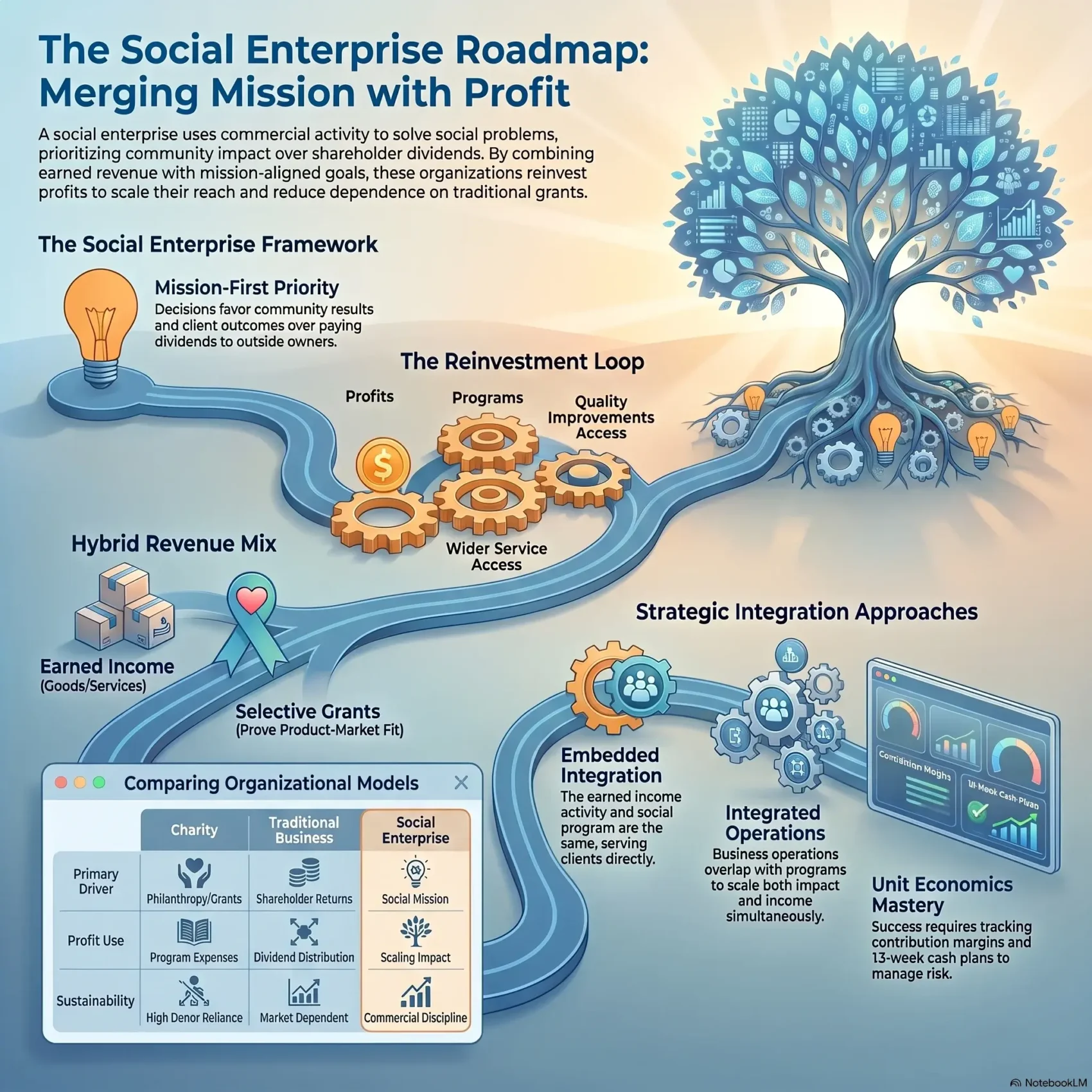
Last Updated on August 17, 2026
A social enterprise model uses commercial revenue to pay for a social mission. Not grants first and trading second — trading first, with grants as a deliberate supplement. This guide gives you the structure, funding paths, unit economics and impact metrics to build one that lasts.
Two strategies do the work. Your operating strategy sets structure, partnerships and delivery. Your resource strategy sets where money and talent come from. Together they let you tie impact directly to the bottom line — which is what boards, funders and institutional buyers now ask for.
What changed heading into 2026: the bar for proving impact rose sharply. B Lab retired the old 80-point B Corp scorecard in favour of mandatory requirements across seven impact topics, verified by third parties. TOMS abandoned one-for-one years ago for a profit-share model. Warby Parker crossed 20 million pairs distributed. The pattern is consistent: pledges are out, audited performance is in.
Key Takeaways
- Earned revenue — not donations — is what makes a mission-driven organization resilient.
- Eight proven business models exist; pick one or two and pilot before you scale.
- Legal form (nonprofit, benefit corporation, mission-locked LLC) determines how you raise money.
- B Corp certification changed fundamentally in 2026 — no more points, no more cherry-picking.
- Unit economics per service line matter more than total revenue.
- Impact metrics need to connect to cost and revenue drivers, or leadership will ignore them.
Why the social enterprise model matters right now
Donor behaviour and public funding have both become less predictable. That makes a single-source revenue base a real risk. Organizations that sell something — goods, services, contracts — keep operating when a grant cycle slips.
Earned income also does something grants cannot: it proves demand. If customers pay, you have evidence your offer works. That evidence is what unlocks institutional contracts and patient capital.
Buyers have shifted too. Procurement teams increasingly ask suppliers for verifiable social and environmental performance, which is the same shift driving corporate social responsibility programs from marketing budgets into operations. A credible mission-driven supplier is now commercially advantageous, not just ethically appealing.
“Connect mission outcomes to the bottom line, and leadership stops treating impact as a cost centre.”
Three decisions shape everything that follows:
- Validate demand first. Customer need and unit economics beat a compelling story.
- Choose control or speed. Partner with an existing company, or build your own revenue engine.
- Start small. Pilot operations, test staffing assumptions, set exit triggers.
If you are building this alongside an environmental commitment, a documented sustainability strategy gives you a second set of measurable targets that funders already recognise.
What a social enterprise model actually is
A social enterprise is a company built to advance a defined mission that reinvests its profit to widen access and improve outcomes. The commercial activity is the engine, not a side project.
Mission first, profit as fuel
Decisions favour clients and community results over distributions to outside owners. Surplus goes back into programs, service quality and reach. That single rule is what separates this from conventional business — and it needs to live in your bylaws, not just your website.
Where the money comes from
The practical mix is earned income plus selective grants:
- Earned income is the core. It proves product-market fit and reduces donor dependency.
- Grants fund pilots, subsidise access for people who cannot pay, or cover R&D.
- Reinvested profit funds hiring, scaling and service upgrades without diluting the mission.
Social enterprise vs. charity vs. traditional company
| Dimension | Charity | Social enterprise | Traditional company |
|---|---|---|---|
| Primary income | Donations and grants | Sales, contracts and fees | Sales |
| Profit destination | No profit motive | Reinvested into mission | Distributed to shareholders |
| Success measure | Outcomes delivered | Outcomes plus financial viability | Financial return |
| Main risk | Funding cycles | Mission drift or thin margins | Market competition |
Choose a business model that fits your mission and market
Start by matching what clients need to what your team can reliably deliver. The right choice makes hiring, pricing and fundraising simpler. The wrong one creates permanent tension between program staff and commercial staff.
Three integration levels
Embedded: the earned activity and the program are the same thing. Clients are customers.
Integrated: business operations overlap with programs, sharing staff, assets or channels.
External: a separate trading arm funds mission activities without mixing delivery.
Eight proven social enterprise business models
| Model | How it earns | Best when |
|---|---|---|
| Employment | Sells output made by trained participants | Barriers to work are the core problem |
| Market intermediary | Takes a margin connecting producers to buyers | Producers lack market access |
| Fee-for-service | Charges for programs, training or counselling | Some clients can pay full price |
| Low-income client | Affordable products at volume | Unit costs fall sharply with scale |
| Cooperative | Member-owned sales and shared surplus | Beneficiaries can own the enterprise |
| Service subsidization | Sells externally to fund subsidised access | You have a commercially valuable capability |
| Organizational support | Sells back-office or advisory services to other organizations | Your internal expertise is in demand |
| Entrepreneur support | Sells training, tools and finance to founders | Beneficiaries are themselves business owners |
Designing for sustainability
Map client jobs-to-be-done to products you can deliver at quality. Check market size, pricing power and startup cost before committing. Align staffing so commercial targets and client advancement move in the same direction rather than competing for the same hours.
This is ordinary business model innovation work — the mission constraint changes the inputs, not the method.
“Pilot one or two models, set success criteria in advance, and define your exit triggers before you scale.”
Legal structures, compliance and funding in the United States
Your legal form determines what money you can raise and how accountability is enforced. Choose it before you take capital, not after.
Comparing the main forms
- 501(c)(3) nonprofit: access to grants and tax-deductible gifts; surpluses must be reinvested. Watch unrelated business income rules if trading grows.
- Benefit corporation: a for-profit form that legally requires directors to weigh stakeholders alongside shareholders. More than 35 states plus the District of Columbia now recognise some version of the form.
- LLC with mission clauses: flexible and cheap to run, but the mission lock is only as strong as your operating agreement.
- Hybrid: a nonprofit parent with a trading subsidiary — common, effective, and more administratively demanding than founders expect.
What changed with B Corp certification
If you plan to certify, the rules are new. B Lab published its revised standards in April 2025 and rolled them out through 2026, replacing the old B Impact Assessment scoring model entirely.
- The 80-point threshold is gone. Companies must now meet Foundation Requirements plus mandatory sub-requirements across seven impact topics, including climate action, fair work and human rights.
- Strength in one area no longer offsets weakness in another.
- Third-party verification replaces self-assessment, and companies must show continued progress at year three and year five.
- New applicants certify under the new standards only — the previous version closed to new submissions during 2026.
Plan for a gap assessment and a multi-year roadmap rather than a one-off application. Certification is now a governance programme, not a badge.
Building a resilient revenue mix
Favour earned income and stable contracts with public or private buyers. Then layer other sources deliberately:
- Use grants for pilots, subsidised access or R&D — not for core operating cost.
- Explore impact investment and blended finance; the same investor appetite driving green finance extends to social outcomes.
- Track cash runway and your earned-income ratio monthly. Both are early warning signals.
- Diversify customers and channels so no single buyer is existential.
Workforce strategies
Inclusive hiring, paid training and living wage commitments only work when staff advancement is tied to service quality. Otherwise you get two workforces with different standards inside one organization.
Write your ethical commitments down. A documented business ethics framework gives managers a consistent way to resolve the tradeoffs that come up weekly.
“Hardwiring mission into bylaws and charters makes governance defensible — and makes funders confident in your controls.”
Start with legal counsel, clear bylaws, and basic policies on reporting, contracts, data privacy and conflicts of interest.
Due diligence: readiness, unit economics and impact measurement
Treat the pilot like a small business. Validate demand, cost and team capability before scaling. Most failed social enterprises were never tested at small scale first.
Readiness checklist
- Do you have real industry knowledge, or only mission conviction?
- Can your team read a P&L and a cash forecast?
- Who owns commercial delivery when program work gets busy?
- What few things must be true for this to work — and how will you test them?
Compare your assumptions against wider market signals before you commit; broader small business trends around cost pressure and access to capital apply to mission-driven ventures too.
Pricing and unit economics
Build the numbers per service line, not for the organization as a whole:
- Acquisition cost, delivery cost, gross margin and contribution margin per unit or client.
- Pricing that matches willingness to pay, with any subsidy funded explicitly rather than absorbed silently.
- A 13-week cash plan plus break-even scenarios for price and volume shocks.
If you are subsidising some customers from others, a deliberate pricing strategy framework keeps that cross-subsidy visible on the books instead of quietly eroding margin.
Measuring social returns
Pick metrics that connect to revenue and cost drivers, so financial and social performance reinforce each other rather than competing for attention.
- Choose a few quantitative indicators you can track today; use proxies while data collection improves.
- Build a dashboard leadership reviews weekly, not an annual report nobody reads.
- Use a theory of change to connect outputs to outcomes, and validate with surveys or third-party evaluation.
If you sell to enterprise or public sector buyers, aligning your reporting to a recognised ESG framework saves considerable effort later — their procurement teams already use one.
Social enterprise examples worth studying
Three well-documented cases, including what each one got wrong.
Warby Parker: giving built into cost of goods
For every pair sold, a pair is distributed through nonprofit partners — principally VisionSpring, which trains local sellers rather than dumping free product into markets. By mid-2025 the program had passed 20 million pairs distributed across more than 80 countries.
The design lesson: the giving is priced into COGS from day one, so margins stay predictable. It also depends on the company’s direct-to-consumer strategy — cutting out intermediaries created the margin that funds the giving.
TOMS: the model that had to change
TOMS pioneered one-for-one in 2006 and retired it in 2021. Two problems drove the shift: donated shoes could undercut local sellers, and giving away product scaled costs with volume rather than with profit.
It now commits at least one-third of net profits to grassroots organizations. The lesson is not that one-for-one is wrong — it is that a giving mechanism tied to units, rather than profit, breaks in a bad year.
Grameen Bank: distribution as the innovation
Grameen unlocked credit through group lending and doorstep service rather than collateral. As of mid-2026 it operates roughly 2,568 branches, reaches about 94% of villages in Bangladesh and serves close to 45 million people, with over 97% of lending going to women.
Founder Muhammad Yunus led Bangladesh’s interim government from August 2024 until February 2026, then returned to social business work at the Yunus Centre. The model has since influenced everything from microfinance funds to peer-to-peer lending platforms.
What the sector teaches
- Clear product value tied to measurable outcomes wins institutional buyers.
- Employment models create paid training and direct placements, but carry higher supervision cost.
- Storytelling plus data wins contracts; storytelling alone does not.
- Partnerships and existing distribution reduce risk and speed market entry.
Your first 90 days
Days 1–30: Interview 15 potential customers and 10 beneficiaries. Pick two candidate models from the table above. Draft unit economics for each.
Days 31–60: Run a paid pilot with real customers, however small. Set explicit success criteria and a kill date. Confirm your legal form with counsel.
Days 61–90: Review pilot data against your criteria. Decide to continue, adjust or stop. If continuing, build the 13-week cash plan and the impact dashboard before adding headcount — the usual scaling mistakes apply here as much as in any startup.
Conclusion
The social enterprise model works when commercial discipline and mission commitment are designed together rather than balanced against each other. Pick one or two business models, pilot them with clear metrics and decision gates, and choose a legal form that locks the mission in.
Set pricing, program scope and staffing that protect long-term viability. Then measure outcomes with the same rigour you apply to cash. Start small, prove it, and scale what holds up.