Design thinking has been in the business vocabulary for two decades. What changed in 2026 is the economics behind it. When AI can turn a rough idea into a working prototype in an afternoon, building slowly is no longer the expensive mistake. Building the wrong thing quickly is.
That shift makes this method more useful, not less. Design thinking is a human-centered, non-linear way to frame the right problem, test ideas early, and reduce risk with real user evidence instead of internal opinion.
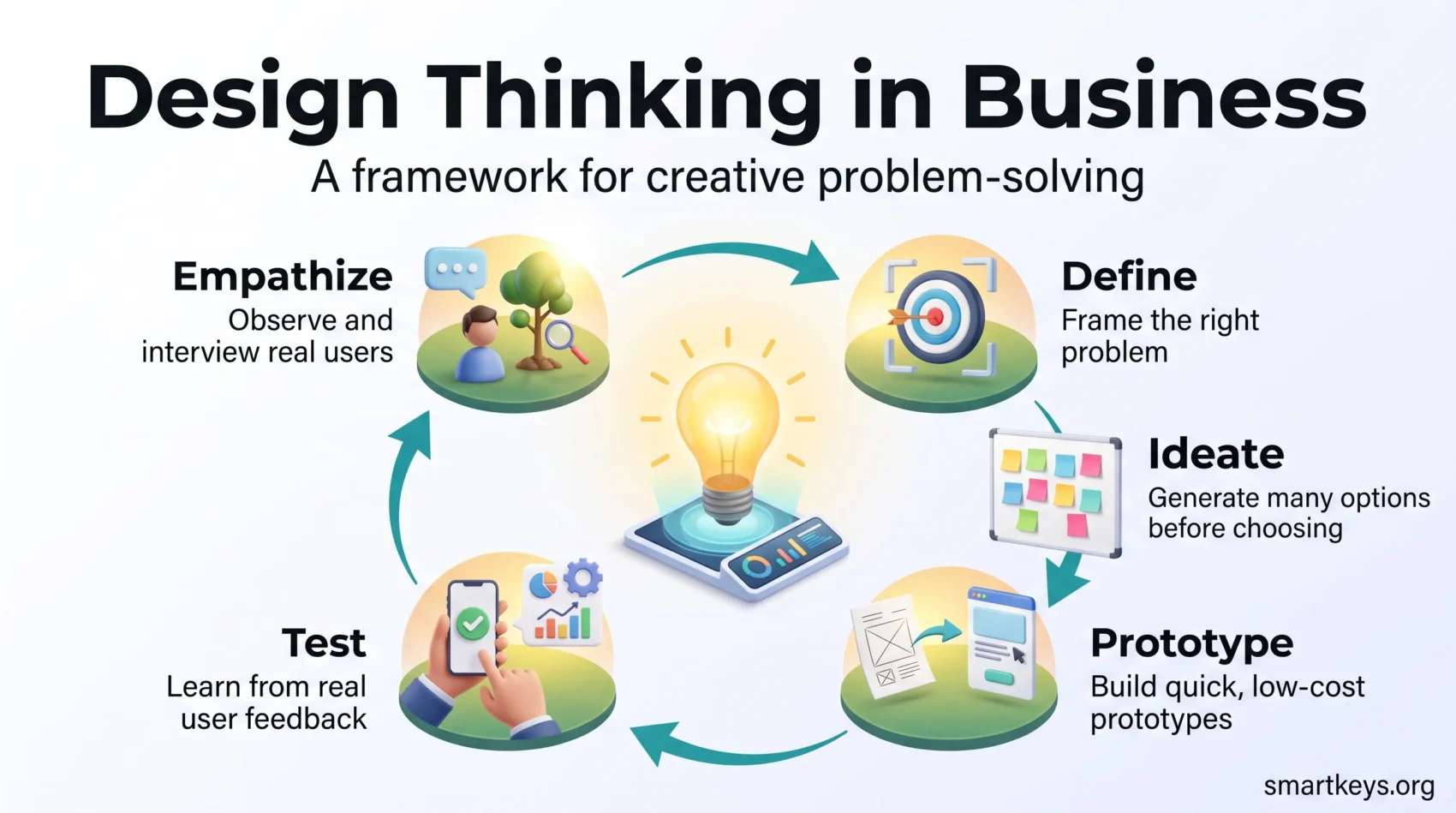
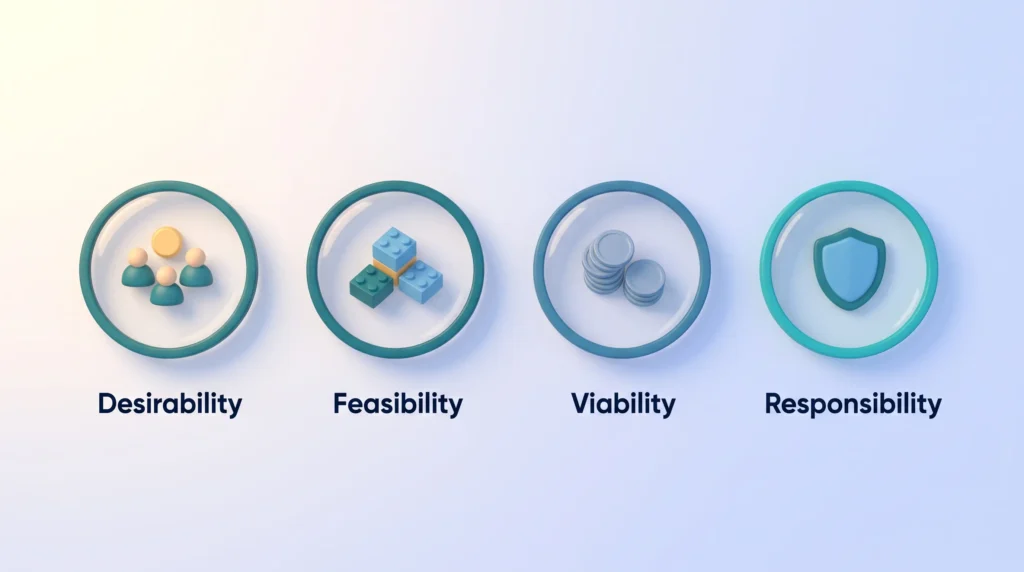
Start with empathy. Then move through define, ideate, prototype and test to reach solutions that balance desirability, feasibility and viability — with responsibility now widely treated as a fourth lens.
The demand signal is measurable. The World Economic Forum’s Future of Jobs research ranks creative thinking among the top core skills for 2030, expects 39% of workers’ core skills to change by then, and finds 63% of employers naming the skills gap as their single biggest barrier to transformation. Structured creativity has moved from nice-to-have to core capability.
Key Takeaways
- Apply a human-centered process so the solutions you ship are ones people actually value.
- Use rapid experiments to test assumptions before you commit budget.
- Balance desirability, feasibility and viability — and add responsibility as a fourth check.
- Treat AI output as a hypothesis, not evidence: real users still decide.
- Pair discovery with agile delivery instead of arguing about which one wins.
What You’ll Learn in This Guide
This is a practical walkthrough, not a theory lecture. The methods here are designed for non-specialists who need to solve messy, ambiguous problems with a team.
Your outcomes:
- Spot unmet needs and turn them into human-centered solutions that matter to people and to your business.
- Work through each phase — from framing questions to prototyping and testing.
- Build cross-functional momentum and align stakeholders across teams and levels.
- Use lightweight research and experiments to de-risk decisions before they get expensive.
- Generate many options fast and turn the promising ones into something users can react to.
Who this guide is for:
- Business leaders and product managers who need to steer innovation.
- UX professionals, strategists, and team leads scaling practical methods.
- Anyone facing complex problems who wants user-centered answers.
“A repeatable, action-oriented process helps teams move from insight to tested solutions.”
What Is Design Thinking?
Design thinking is a human-centered approach to innovation that anyone can learn. You use observation and interviews to surface real needs, then turn those needs into testable ideas and quick prototypes.
The Stanford d.school frames five phases: Empathize, Define, Ideate, Prototype, Test. These form a cycle, not a straight line. IDEO founder David Kelley has long described the reality as a big mass of looping back — you revisit earlier phases whenever new evidence appears.
Action beats analysis paralysis. Rapid prototyping and user feedback speed up learning, which reduces the risk of solving the wrong problem beautifully.
Use tangible artifacts — sketches, mockups, role plays — to align teams and move from talk to trial. The process scales from a single touchpoint to an entire service experience. If you want a structured way to compare options once evidence is in, our guide to decision-making models pairs well with this method.
“Quick experiments with real users reveal what works and what needs to change.”
- Learn by building, not just planning.
- Research helps you reframe assumptions instead of defending them.
- Messy, iterative work is normal — and often where breakthroughs come from.
What Changed by 2026: Speed, AI, and a Higher Evidence Bar
The bottleneck moved. Tooling surveys published in 2026 put the average reduction in prototyping time from AI assistance at roughly 60%. Concepts that once needed weeks of design work now arrive as clickable artifacts within a day.
That creates a new failure mode. Teams can now generate convincing prototypes for problems nobody validated. As Design Sprint Academy put it when they added an explicit problem-framing stage to their sprint format: you don’t want to move fast on the wrong problem.
Synthetic users: a sanity check, not a verdict
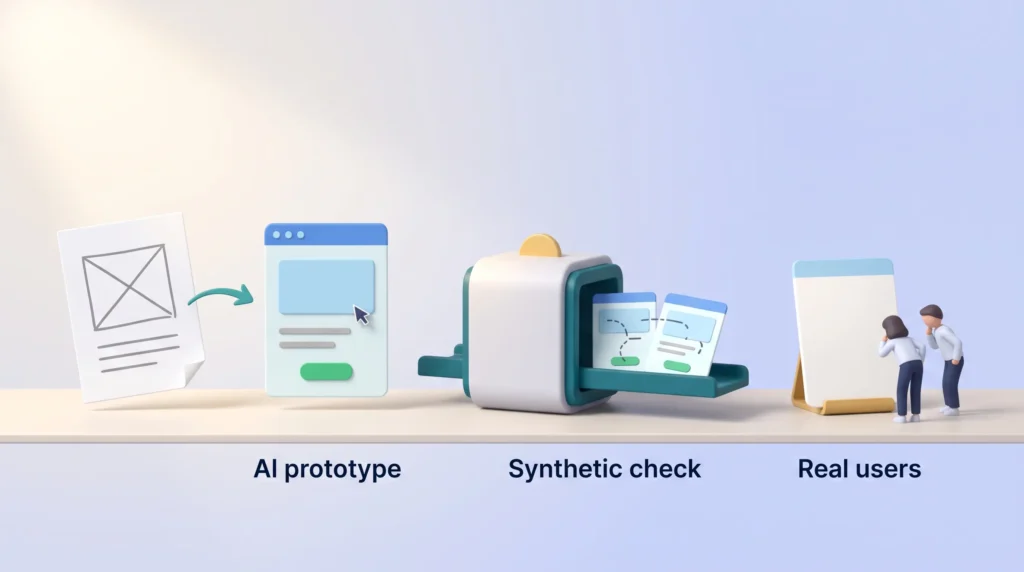
Many teams now run early concepts past AI personas conditioned on support logs, past interview transcripts and behavioral data. That catches dead ends, broken flows and obvious usability friction at almost no marginal cost.
But the Nielsen Norman Group has been blunt about the limits: synthetic users are hyper-logical and biased toward agreeable feedback. They cannot give you hesitation, confusion, or the moment somebody quietly gives up.
The pattern that works in 2026 is hybrid, sometimes called the sandwich model: run cheap synthetic passes to clear out structural problems, then put the refined prototype in front of real people for the things only humans reveal.
Label your evidence
A discipline worth borrowing from research teams: tag every artifact as evidence, inference, hypothesis, or generated draft. An AI-written persona is a hypothesis. A recorded user session is evidence. Confusing the two is how confident-looking, ungrounded work reaches a roadmap.
If your organization is formalizing this, our generative AI usage guidelines cover the governance side, and the AI ethics framework guide covers review gates for higher-stakes decisions.
- Use AI for volume: transcript synthesis, option generation, first-draft flows.
- Use humans for judgment: which problem matters, what the tradeoff costs, when to stop.
- Never skip the last mile: real participants, consent, and a named reviewer at each gate.
The Origins: From Designers’ Mindset to Business Strategy
IDEO’s shift from crafted products to whole experiences rewired how businesses pursue new opportunities. By the 1990s the firm focused on product excellence; by 2001 it had broadened into organizational and experience work that leaders could adopt.
From IDEO to the d.school
David Kelley helped move these methods out of the studio and into classrooms at Stanford’s Hasso Plattner Institute of Design. That made practical tools available to people in every role, not just designers.
Tim Brown framed the approach as the intersection of people’s needs, technical possibility, and business requirements. His definition turned creative work into a repeatable process organizations could fund and manage.
Why the term spread beyond designers
Leaders embraced it because it demystified creativity and made problem solving a team sport. Describing the work as overlapping spaces — inspiration, ideation, implementation — helped teams accept looping rather than linear progress. That same collaborative logic underpins open innovation models, where the useful ideas often come from outside your walls.
“Framing innovation around people, technology, and business changed how leaders invest and build.”
Why Design Thinking Matters for Business Today
When markets move quickly, your ability to explore and iterate becomes a competitive edge.
Drive innovation by testing ideas fast. Companies across industries use design thinking to tackle vague, wicked problems and find workable paths forward — including the kind of structural rethinking covered in business model innovation.
Learn faster than the competition
Teams that run quick experiments accumulate evidence while others accumulate opinions. That speed uncovers opportunities and shapes better products.
Reduce risk by testing early
Get real feedback on rough prototypes instead of betting on internal consensus. Early tests cut costly rework and surface the objections you’d otherwise meet at launch.
Differentiate through human-centered solutions
Focus on actual needs to build things people value. That alignment reduces feature bloat and gives you something specific to say in a crowded market — a theme running through current customer experience trends.
- Explore, test, and learn faster to win in volatile markets.
- Use research and prototypes to align teams and shorten decisions.
- Make small bets, scale what works, and avoid waiting for perfect data.
For hands-on methods, see our guide to AR and VR product prototyping and adapt those techniques to your next project.
Core Principles: Desirability, Feasibility, Viability — and Responsibility
Begin by weighing what people actually want before you consider how to build it. That focus keeps your team from solving the wrong problem well.
Start with desirability
Desirability asks who benefits and why. You interview users, map unmet needs, and surface emotional value. This steers ideas toward real demand rather than internal enthusiasm.
Evaluate feasibility without killing ideas early
Feasibility checks technical and operational fit after promising concepts appear. Bring engineers in to adapt scope, not to veto concepts before they’re understood.
Ensure viability for sustainable impact
Viability verifies whether a solution can sustain itself through revenue, cost savings, or mission-aligned funding in nonprofit contexts.
Add responsibility as a fourth lens
IDEO U now explicitly adds responsibility alongside the classic triad. The question is simple and uncomfortable: who could this harm, and who is excluded by design? In 2026, with AI in the loop across research and delivery, that lens stops being optional.
“Balance these lenses to choose where to invest and how far to scale.”
- Start with desirability to understand real needs.
- Introduce feasibility to refine ideas, not constrain them.
- Assess viability so the solution survives past the pilot.
- Apply responsibility before launch, not after the first complaint.
The Design Thinking Process: Five Phases, Continuous Iteration
Use a five-step loop to turn user insight into rapid, learnable prototypes. Each phase feeds the next, and you loop back whenever tests reveal something new.
Empathize: research users’ needs
Observe and interview to learn real context and constraints. Collect facts, emotions, and behaviors — especially the gap between what people say and what they do.
Define: frame the right problem
Synthesize research into a sharp problem statement. A clear brief guides focused exploration and avoids wasted effort. This is the phase AI speed has made more valuable, not less.
Ideate: generate options before choosing
Push for many alternatives. Quantity frees creativity and surfaces unexpected options. Visual methods help here: mind mapping for problem solving and digital whiteboards keep distributed teams diverging together rather than talking in circles.
Prototype and test: make ideas tangible
Build quick, low-cost prototypes and put them in front of real users. Learn what works, then iterate or reframe the problem entirely.
- Embrace iteration: jump between phases as new insights appear.
- Document decisions: capture what you learned so the next team starts further ahead.
“Rapid cycles of prototype and user feedback reduce risk and sharpen solutions.”
Mindsets That Power the Process
The mindsets you bring shape how quickly your team turns questions into tested answers.
Empathy, curiosity, and optimism
Cultivate empathy so you design with users, not for them. Curiosity keeps you asking better questions. Optimism helps you try things when resources are tight.
Embrace ambiguity and reframe assumptions
When a problem feels unclear, resist the quick fix. Reframe the assumption and test multiple framings. This habit prevents early anchoring — the most common reason good teams solve the wrong problem.
Make it tangible and take action
Sketches, storyboards, and role-play turn fuzzy notions into things you can test. Then run small experiments. Fast evidence beats long debates.
Collaborate across diverse teams
Bring varied backgrounds together to blend perspectives. Cross-functional work sparks unexpected solutions and builds the buy-in you’ll need later. For distributed teams, our guide on fostering creativity in remote work covers what actually survives the move to video.
“Start small, learn fast, and let empathy guide the choices you make.”
Popular Frameworks You Can Use
Pick the pattern that clarifies when to diverge, converge, and validate. Choose the model that fits your team’s tempo.
IDEO’s Inspire-Ideate-Implement
Inspire focuses on observing and empathizing. Ideate runs wide to surface options. Implement prototypes and tests quickly so you learn fast.
The Double Diamond
This model alternates divergence and convergence. Use Discover and Define to frame the right problem, then Develop and Deliver to build and ship. It helps you manage the problem space and solution space separately.
AIGA’s Head, Heart, Hand
Balance strategy (Head), empathy (Heart), and craft (Hand). This trio keeps work smart, humane, and practical.
- Use Inspire-Ideate-Implement for a tight loop from research to action.
- Apply the Double Diamond when you need explicit moments to diverge and converge.
- Lean on Head-Heart-Hand to balance strategy, emotion, and execution.
“Shared DNA across frameworks: people-centered work, collaboration, clear communication, and rapid iteration.”
Design Thinking vs. Agile: Complementary, Not Conflicting
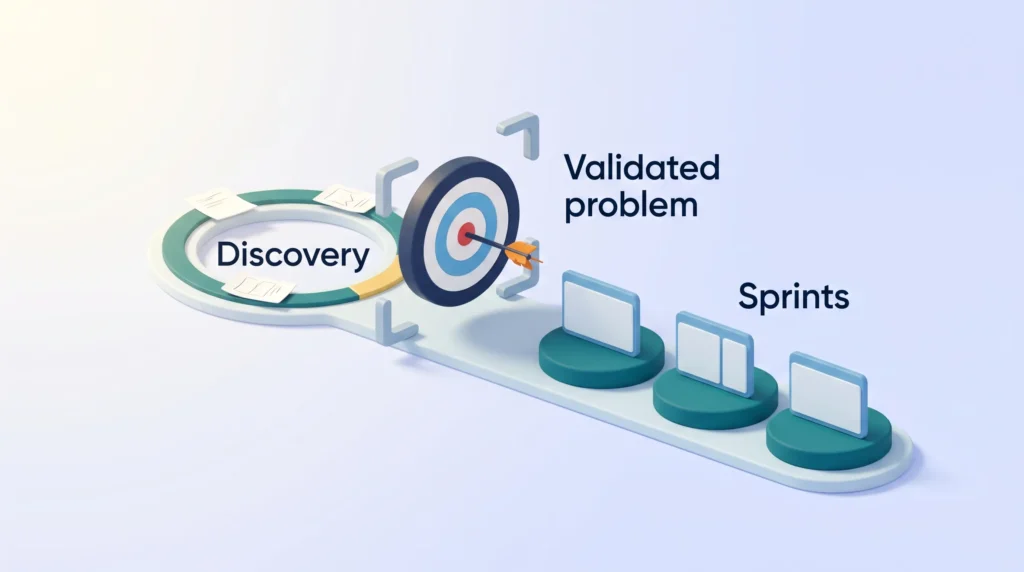
Effective teams run separate but linked rhythms for learning and delivery. Explore the right problem with one approach, then use delivery-led methods to ship.
Shared values
Both favor iteration, user focus, and collaboration. Both run short cycles to gather feedback, which keeps the user at the center and reduces choices made in isolation.
Key differences
Design thinking helps you frame problems and test options. Agile takes a chosen solution and iterates through sprints to deliver working software. Non-technical teams increasingly borrow the same cadence — see agile beyond IT for how marketing and HR teams adapted it.
“Validate the problem space before you commit sprint capacity — it saves time and alignment.”
- Explore with discovery; deliver with sprint-based execution.
- Use design sprints to compress discovery when urgency is high.
- Translate insights into backlog items so teams ship with confidence.
- Skip the either/or debate and adopt a both/and rhythm.
Systems Thinking and Design: Seeing the Bigger Picture
Look beyond single events to map the loops and forces that keep problems alive. A systems view moves you from quick fixes to lasting change.
The Iceberg Model pushes you under visible events to spot patterns, structures, and mental models. Burnout, for example, may show up as absenteeism but trace back to workload policy and culture.
Mapping stakeholders, patterns, and hidden dynamics
Build systems maps to visualize stakeholders, influence flows, and gaps. Maps reveal bottlenecks and the small shifts that unlock disproportionate impact.
Combining system insight with prototypes
Test small changes with the people who feel the impact. That raises the odds your solution sticks instead of being reversed six months later.
“Zooming out lets you choose leverage points that stop problems from returning.”
- See the connections that make stubborn problems recur.
- Uncover root causes with the Iceberg Model.
- Design interventions with stakeholders who hold power and live the impact.
Design Thinking in Action: Real-World Examples
Real projects reveal how small mismatches in delivery, timing, or use can stop a good idea cold.
Shanti and safe water: when solutions miss people’s needs
Shanti avoided the safer water option because the required five-gallon jerrycan was too heavy for her daily routine. The plant’s opening hours and purchase minimums clashed with her schedule.
The product was well made. The service rules ignored real life — and that was enough to make it fail.
Positive deviance in Vietnam: local insights, lasting impact
Local families added small shrimp and greens to meals and shifted to smaller, more frequent portions. Those simple changes helped 80% of 1,000 children improve within a year.
The lesson: local insight often beats outsider assumptions when you test with the people who live the problem. That principle is also what makes crowdsourced innovation work when it works.
Mosquito nets in Africa: distribution as part of the solution
Mass distribution reduced malaria but sometimes left other groups without access. Products alone aren’t enough — channels, incentives, and systems have to align so the right people get what they need.
“Involve users early, prototype services, and test logistics — not just the artifact.”
How to Use Design Thinking in Your Organization
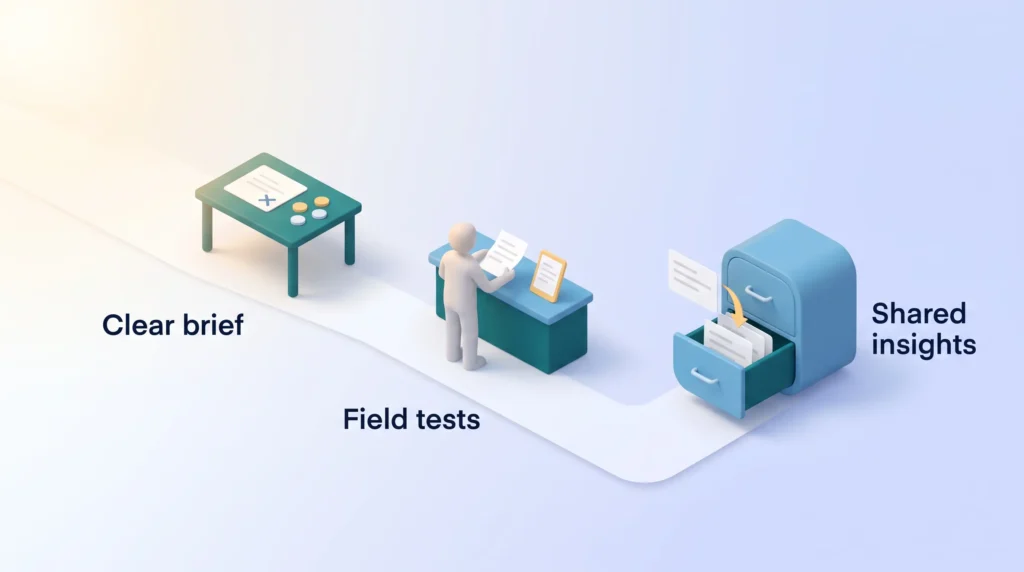
Make change practical by giving small teams clear goals and permission to experiment. Start with a brief that limits scope but leaves room for multiple solutions.
Form cross-functional teams and set a clear brief
Assemble a compact team with varied skills. Write a brief that sets objectives, constraints, and success metrics without prescribing the answer. Increasingly this means designing the human-AI split deliberately, a topic covered in collaborative intelligence.
Run lightweight experiments and prototypes
Skip the long focus groups and go into the field. Observe behavior, not only stated preference, then build scrappy prototypes to test ideas fast and cheaply.
Capture insights and build a learning culture
Record findings in a shared repository so learning compounds across projects. Establish rituals — demos, short retros, decision checkpoints — to make it repeatable. At scale, voice of customer AI can surface themes across feedback volumes no team could read manually.
- Assemble cross-functional teams with clear roles.
- Observe in context and test with quick prototypes.
- Store insights centrally so evidence is findable later.
- Define decision criteria before experiments begin, not after results arrive.
“Run small bets early: fast evidence beats long debates.”
Four Practical Ways to Start This Week
You can start with simple actions that surface real user needs fast.
Practice empathy: observe and interview users
Schedule two or three short interviews this week. Watch people where they work or shop. Note what they do, not just what they say.
Build scrappy prototypes to surface unmet needs
Sketch a paper mock or a quick clickable draft. Low-fidelity prototypes reveal hidden assumptions and invite honest feedback — polished ones invite politeness.
Turn problems into “How might we…?” questions
Reframe a pain point as a single open question. A good How might we invites ideas and focuses the team on one clear issue.
Balance generative, evaluative, and validating research
Use generative work to find opportunities, evaluative tests to improve concepts, and validating checks to confirm fit. Pick one small test and run it now. When it’s time to present what you found, data storytelling is what turns findings into decisions.
- This week: three user conversations and one scrappy prototype.
- Set a timer: run a 15-minute idea sprint to push past the obvious options.
- Commit to action: one quick test beats one long slide deck.
Design Thinking and Your Career Growth
Advancing often means adding breadth to deep skills so you can work across teams and roles.
Becoming a T-shaped professional
T-shaped people combine real depth in one area with a broad base across others. That mix helps you collaborate with engineers, product managers, and users — and it maps directly onto the hybrid profiles dominating future job markets.
Building creative confidence through action
Create small, testable artifacts and learn from real feedback. Prototyping teaches you faster than perfect planning.
Practice running short workshops, guide teams through divergence and convergence, and tell concise stories about your process. Those habits align stakeholders and make your impact visible.
- Show evidence in your portfolio: prototypes, tests, and measurable outcomes.
- Practice facilitation and clear storytelling to move ideas into action.
- Grow creative confidence by iterating instead of waiting for the ideal answer.
“Turn small experiments into proof that you learned and improved the experience.”
Aligning Your Team on the Process and Outcomes
Name the shared steps and expected outcomes before you start building. Teaching the phases in a simple, repeatable way helps teams move from questions to tests without confusion.
Agree on language first
Use the same names for phases, deliverables, and success metrics. The method works iteratively, but you can teach it linearly to make onboarding easier — new team members then follow a clear path from framing to testing.
- Define outcomes for each phase so everyone knows what good looks like.
- Use lightweight templates and checklists to move from research to action.
- Decide with evidence from prototypes and user tests, not seniority.
- Keep the work grounded in real needs, especially when AI makes output cheap.
“Align language, set clear outcomes, and let user evidence guide choices.”
Conclusion
Close the loop by turning insight into a short, measurable experiment.
Design thinking blends desirability, feasibility, viability and responsibility through a tight process: empathize, frame the problem, ideate, prototype, test. The case studies show how context, systems, and distribution shape whether a good idea survives contact with reality.
In 2026 the method’s value has shifted. Execution is cheap and getting cheaper. Judgment about which problem deserves the effort is the scarce resource — and that is exactly what this process protects.
Take one small action today: talk to a user, sketch an idea, or run a quick test. Then let what you learn decide your next move.
Found this useful?
Make SmartKeys a preferred source on Google, and our articles will surface more often in your Top Stories, AI Overviews, and AI Mode.
Add as Preferred Source