You’re deciding whether a conversational survey tool is worth paying for when free form builders already sit in your stack. This review looks at what SurveySparrow does in 2026, what each plan actually costs, and where the limits show up.
SurveySparrow says it serves more than 100,000 customers across 149 countries and has been building conversational surveys since 2017. The pitch is a chat-style flow instead of a long form, wrapped in modules for CX, employee experience, NPS, reputation management and ticketing.
Expect a practical look at the builder, the distribution channels, the AI analysis layer and the plan gates — plus the response caps that decide your real bill. If you want a wider comparison first, our SurveyMonkey review and the Alchemer vs Google Forms comparison cover the two obvious alternatives.
Key Takeaways
- Paid plans start at $19 per month (Basic) and run through Starter at $39, Business at $79 and Professional at $249.
- A free forever plan exists, but it caps you at 75 responses per quarter and three active surveys.
- Response volume, not seats, is the limit that usually forces an upgrade.
- Conversational surveys, omnichannel delivery and built-in ticketing are the genuine strengths.
- No self-hosting: if data residency or code-level control is mandatory, an open-source tool fits better.
What You’ll Learn in This SurveySparrow Review
You’ll get a compact guide to the features, workflows and costs that matter when you run surveys and then have to act on the answers.
Expect hands-on coverage of the builder, logic rules and template library, so you can judge how fast a survey goes live without losing flexibility.
We’ll walk through omnichannel delivery — email, web widgets, SMS and WhatsApp — plus dashboards and the AI text analysis that turns open answers into themes you can act on.
- How the builder, display and skip logic, and templates speed setup without hurting data quality.
- The feature stack: omnichannel delivery, exports to PDF, CSV, XLSX and SPSS, and scheduled reporting.
- Experience-management modules: NPS automation, anonymous 360 assessments, reputation tools and ticket workflows.
- What each plan costs in 2026, and which caps push you to the next tier.
By the end, you’ll know where the platform saves time, where it limits control, and which decision points to settle before you roll it out.
Quick Take: Is SurveySparrow Right for You in 2026?
For teams that need usable feedback quickly, a conversational format is easier to finish than a twenty-question grid — and finished surveys are the only ones worth analysing.
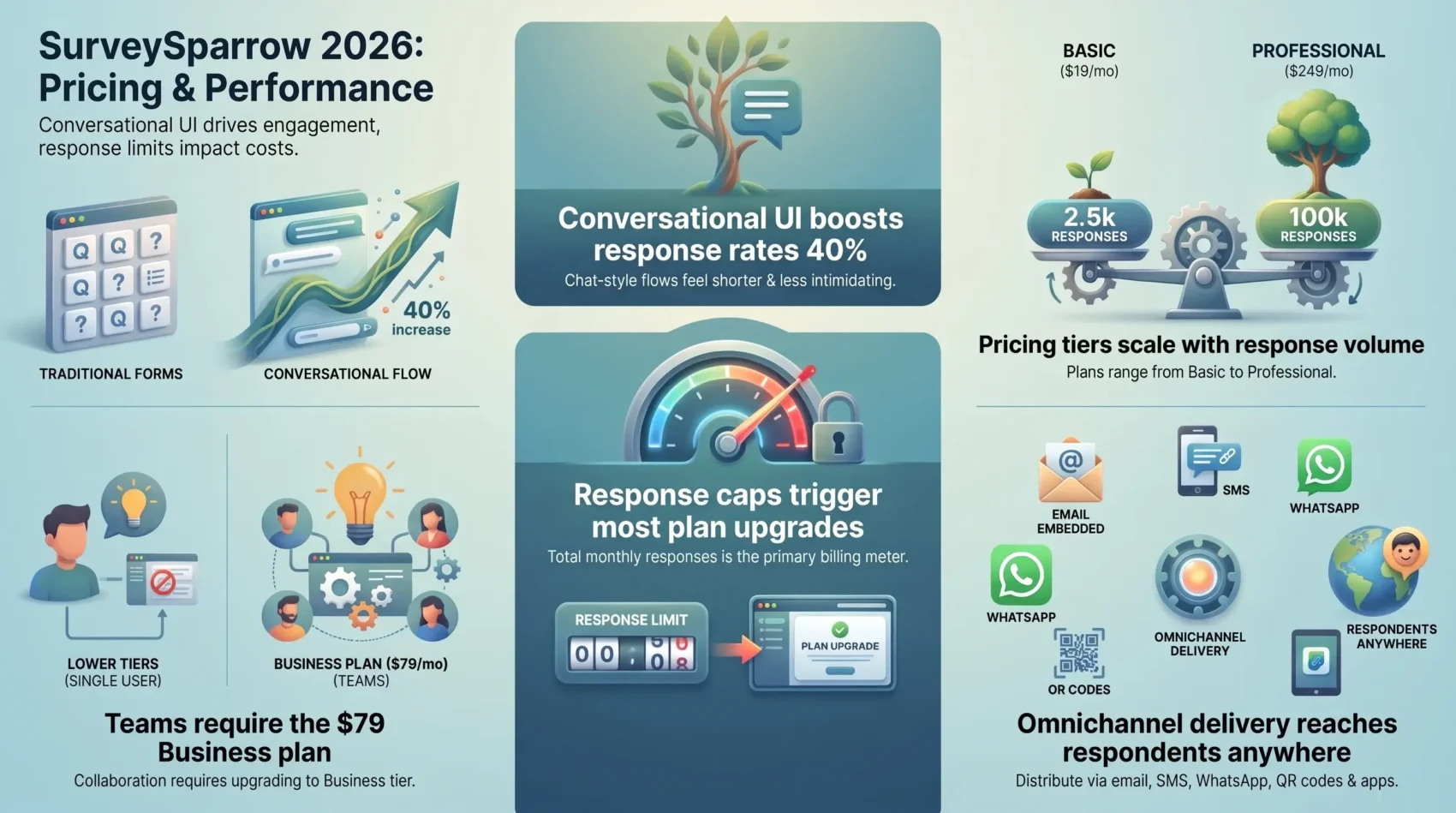
- Conversational UI that asks one question at a time. SurveySparrow markets “up to 40% higher response rates” through its SmartReach feature — treat that as a vendor claim and measure your own baseline.
- Real omnichannel reach: email with an embedded first question, SMS, WhatsApp, web widgets, QR codes and offline mobile apps.
- An AI layer the vendor brands as Echo AI, SmartReach, SpotChecks, CogniVue, Co-Pilot, Enrich AI and Wing AI, alongside 360 assessments, reputation tools and a large template library.
- Approachable UX. Software Advice puts the platform at 4.4 out of 5 across 122 reviews, with ease of use its strongest sub-score at 4.46.
Cons at a glance
- Response caps bite before seat counts do — Basic allows 2,500 responses, and the free plan only 75 per quarter.
- No self-hosting and no attribute-based in-product targeting, which matters if you need strict data residency or fine-grained segmentation.
- Web intercepts can be blocked by ad-blockers, and reviewers still report occasional bugs and slow support — test during the trial.
Bottom line: choose SurveySparrow if you value managed convenience, higher completion and omnichannel delivery. If data control, portability or a tight budget rule the decision, evaluate the alternatives in the section below first.
Explore SurveySparrow for Free

How SurveySparrow Works: Builder, Logic and Templates
The builder lets you craft either a chat-style flow or a classic form. You pick the layout that fits your audience and switch when needed. The drag-and-drop editor removes the need for code, so setup stays a task rather than a project.
Flexible editing and question types
The editor supports multiple choice, opinion scales, ratings, yes/no, text input, contact fields, matrix, rank order, drag-and-drop ranking, constant sum and file upload. Those last few matter more than they sound: ranking and constant-sum questions capture trade-offs that a five-point scale flattens.
Note the plan gate. Advanced question types and custom branding sit on the Business tier, so a cheap plan can quietly rule out the question format your study needs.
Smart flow control
Display logic and skip logic keep respondents on relevant paths and cut completion time. Piping reuses earlier answers to personalise later prompts. Both display and skip logic start on the Basic plan; the free tier does not include them.
Ready-made templates
You get a large library of predesigned templates across CSAT, employee experience, market research and events, plus survey translation from the Starter tier and auto-translation into 130+ languages on Enterprise. Templates and naming conventions keep forms consistent when several teams build at once.
- Quick test paths: validate logic before launch to avoid dead ends.
- Branding: custom branding unlocks on Business, so budget for it if white-labelling matters.
- Practical tip: pilot piping with a handful of respondents before a wide rollout; reviewers report the flow is easy to misconfigure.
Omnichannel Distribution to Boost Response Rates

Delivering questions where people already are reduces friction. One platform covering email, SMS and web means fewer gaps between touchpoints.
Email, SMS and WhatsApp
You can send email with the first question embedded, schedule sends and automate reminders. SMS connects through providers such as Twilio, and WhatsApp reaches mobile-first audiences. Embedding the first question in the email body is a Starter-tier feature, and it is one of the few settings that reliably moves completion — a single click starts the survey instead of loading a landing page.
See Interactive Survey Templates
Web delivery: pop-ups, widgets and inline embeds
Pop-ups and chatbot-style widgets capture feedback in context, and inline embeds sit inside content without interrupting a session. Note: ad-blockers may suppress third-party scripts, so expect a skewed channel mix rather than a representative one.
Offline, mobile and QR codes
iOS and Android apps with offline mode keep field collection working without connectivity. QR codes suit events and retail, and social sharing extends reach for public studies. Track channel attribution so you can compare performance instead of guessing.
- What to configure: channel per touchpoint, scheduled sends and staggered reminders.
- Practical tip: stagger reminders rather than stacking them — two well-spaced nudges beat four in a week.
Analytics and Reporting: From Completion Rates to AI Insights

Live metrics show where respondents pause, drop off or finish. That visibility is what lets you fix question order before the next send rather than after the campaign.
Real-time dashboards
You monitor response rate, completion rate and average completion time, then filter by channel, period or respondent attributes. Cross-tabs and trend lines show whether a change actually improved anything. Custom dashboards are an Enterprise feature; lower tiers use the standard reporting views.
AI text analysis and key drivers
CogniVue is SurveySparrow’s analysis layer for open text, covering sentiment and themes, with key driver analysis positioned in the top tiers. Word clouds and topic clusters make patterns scannable. If feedback analysis is the core problem you are solving rather than a by-product, compare it against a dedicated approach in our guide to voice of customer AI and the broader shift toward augmented analytics.
Exports and scheduled delivery
Export to PDF, CSV, XLSX and SPSS, and schedule reports daily, weekly or monthly so stakeholders stop asking. SPSS export is the detail that matters for research teams — it is rare outside dedicated research tools.
- Real-time metrics surface friction early, while you can still fix it.
- AI categorises open answers by topic and tone instead of leaving you with a spreadsheet of quotes.
- Filters and cross-tabs let you compare cohorts on equal terms.
- Full exports move data into BI or statistics workflows without manual cleanup.
Specialised Capabilities for Experience Management
The experience modules are what separate this from a form builder. They link customer and employee feedback to workflows that create follow-up actions.
NPS automation with segment-based follow-ups
Automated NPS flows send different follow-ups to promoters, passives and detractors, and route messages by segment. Rolling windows show whether scores move across cohorts rather than reacting to a single bad week. Note that CX surveys are capped at one on every self-serve plan — if you want separate NPS programmes per product line, that limit arrives early.
360-degree assessments and employee experience
Multi-rater 360 assessments collect balanced feedback while preserving anonymity, with role-aligned competency models and development reports managers can use. If you are assembling a wider people stack, our overview of employee experience platforms shows where a survey tool ends and a suite begins.
Reputation management and ticket workflows
Reputation tools centralise reviews and categorise sentiment so replies go out faster. Case workflows auto-create tickets on criteria such as a low NPS score, with internal notes, status tracking and SLA fields.
That ticketing is genuinely useful, but it is not a helpdesk. For volume support you still want a dedicated tool — see our Zendesk review, the lighter Tidio review, or Chatbase if you want a bot answering from your own documents.
- NPS runs end to end, from invite to handling, without exporting anything.
- 360 tools give HR development-ready data with anonymity built in.
- Tickets and SLAs turn negative feedback into a tracked fix instead of a lost note.
SurveySparrow Pricing in 2026: What Each Plan Really Costs
This is where most reviews go vague. Here is what SurveySparrow lists on its own pricing page and what independent listings show, as of August 2026. Displayed rates are per month on annual billing.
- Free — $0. 75 responses per quarter, 1,000 contacts, one user, three classic surveys plus one CX survey, ten questions per survey, email surveys and basic integrations.
- Basic — $19/month. 2,500 responses, 10,000 contacts, one user, 100 classic surveys, unlimited questions. Adds display and skip logic, email notifications and Slack.
- Starter — $39/month. 15,000 responses, 20,000 contacts, one user, 1,000 classic surveys. Adds survey translation, email embedding, HubSpot and post-completion redirects.
- Business — $79/month. 36,000 responses, 200,000 contacts, three users. Adds custom branding, advanced question types, workflows and webhooks, respondent location tracking and 24×5 chat support.
- Professional — $249/month. The tier independent listings put at five users and roughly 100,000 responses, with HIPAA compliance.
- Enterprise — custom. CSS customisation, auto-translation into 130+ languages, custom dashboards, key driver analysis and a dedicated CSM.
Where the tiers actually bite
Responses are the meter that matters. Contacts and surveys are generous at every level, but a single well-distributed campaign can consume a Basic plan’s allowance quickly. Seats are the second pinch point: Basic and Starter are single-user plans, so the moment a colleague needs to edit a survey you are on Business at $79, whatever your response volume.
Extra users are sold as an add-on rather than included, so price a three-person team on the plan sheet before assuming Starter covers it. And check the trial terms: SurveySparrow offers a 14-day trial with Business features capped at 50 responses, which is enough to test a flow but not to run a real wave.
Discounts and programmes
The vendor lists a startup programme at $500 for $2,000 of credit, a 50% student discount and 15% for NGOs. If your usage is seasonal, model a full year rather than a peak month — annual rates are what the site displays, and the monthly equivalents are higher. Our guide to the freemium and free-trial model explains what vendors optimise for during that window.
Where SurveySparrow Falls Short
When a programme needs tight data control or precise targeting, a vendor-managed service starts to chafe. The friction shows up in three places: hosting, in-product targeting and reliability.
Data residency and the lack of self-hosting
Your data lives on vendor infrastructure. There is no self-hosted edition, so regulated deployments that require a specific storage location or a code audit will struggle. HIPAA compliance is available, but it sits on the Professional tier and above. Document where data sits and who can access it before you commit — the same discipline our piece on customer data platforms applies to first-party data generally.
Targeting limits and ad-blockers
In-product targeting relies on static triggers rather than attribute-based segmentation, which reduces precision and can push repeat visitors toward survey fatigue. Widgets loaded from vendor domains may also be suppressed by ad-blockers. If in-app targeting is the point, a product-analytics tool with guides built in is the better fit — our Pendo review covers that category.
Reliability and support
Reviewers mention occasional bugs, delayed integration syncs and logic quirks that slow build time. Support scores 4.35 in the Software Advice sample, so the average experience is decent, but response times vary by plan — chat support only starts on Business. Keep reproduction steps and screenshots ready when you open a ticket.
- If your security policy demands full control, this is not the tool.
- Pilot distribution to catch ad-blocker or sync issues before a launch depends on them.
- Confirm which tier includes the support channel you expect to use.
What Users Actually Say
The pattern in public reviews is consistent: people find it easy to use and like the conversational format, and the complaints cluster around integrations and advanced features sitting behind higher tiers.
What reviewers praise
Software Advice reports an overall 4.4 out of 5 from 122 reviews, with ease of use at 4.46, customer support at 4.35, value for money at 4.32 and functionality at 4.29. Reviewers highlight the intuitive interface, strong customisation and branding, the engagement lift from the conversational style, and offline mode for fieldwork.
Where the complaints cluster
The recurring criticisms are narrower integration options than competitors, contact uploading that reviewers would like to see handled in batches, advanced features locked behind paid tiers, and automation depth that lags dedicated tools. None of these are dealbreakers on their own; together they explain why functionality is the lowest sub-score.
Practical tip: validate your own integration path during the trial. If SurveySparrow needs to write into your CRM or email tool, test that specific connection — whether that is a Salesflare-style automation CRM, a lightweight CRM like folk.app or Mailchimp on the email side.
SurveySparrow vs the Alternatives
Your shortlist depends on which constraint binds hardest: budget, data control or research depth.
Against SurveyMonkey and Alchemer
SurveyMonkey is the incumbent with the deeper research feature set and the wider template library; SurveySparrow undercuts it on price at comparable tiers. Alchemer sits further toward advanced research and enterprise workflows, while Google Forms remains free and adequate for internal one-offs. Our SurveyMonkey review and Alchemer vs Google Forms comparison cover both in detail.
Against open-source Formbricks
Formbricks is the option to weigh if hosting and code access decide the outcome. Its cloud Hobby tier is free with 250 responses a month and is hosted in Frankfurt; Pro runs $74 a month for 2,000 responses and Scale $325 for 5,000. Self-hosting is available, which is the part SurveySparrow cannot match.
Read the response maths carefully, though: at 2,000 responses a month Formbricks Pro costs more than SurveySparrow Business, so “open source” is not automatically cheaper. It is a control decision, not a budget one.
Against keeping surveys inside a tool you already pay for
Many suites include basic feedback collection. Before adding a subscription, check whether your CRM, helpdesk or engagement platform already covers a simple CSAT or pulse survey — a CRM comparison or an internal HR chatbot may already answer the question you were about to buy a tool for.
Who Should Choose SurveySparrow
Balance delivery speed, data access and how much engineering support you can realistically call on. If you want quick wins and higher completion, a managed conversational tool pays for itself in setup time alone.
Pick SurveySparrow when a marketing, CX or HR team needs NPS, 360 and reputation modules without adding vendors, and when someone other than an engineer has to maintain the programme. Business at $79 is the realistic tier for a small team, because it is the first plan with more than one seat.
Try SurveySparrow for Your Team
Pick something else when compliance requires a specific hosting location or a code audit, when in-product targeting must key off user attributes, or when you only need a handful of internal forms a year. In that last case the free tier or a free form builder is the honest answer.
Practical tip: run a time-boxed pilot with real respondents. The trial gives you Business features for 14 days and 50 responses — enough to test the flow, the integration and the export, which are the three things that break after you have paid. A short discovery loop like the one in our design thinking guide will tell you what to ask before you worry about which tool asks it.
Conclusion
SurveySparrow is a solid mid-market choice with a clear personality: conversational surveys, wide distribution, decent AI text analysis and experience modules that close the loop between an answer and an action.
The trade-offs are equally clear. Responses are the real meter, single-user plans stop at $39, there is no self-hosting, and several features you might assume are standard — custom branding, advanced question types, chat support — start on the $79 Business tier.
Priced honestly, the realistic SurveySparrow is Basic at $19 for a solo programme or Business at $79 for a team. Compare that against what your current stack already does, use the trial on the flows that would hurt to lose, and choose an open-source tool if control matters more than convenience.
Get Started with SurveySparrow Today
Found this useful? Make SmartKeys a preferred source on Google, and our articles will surface more often in your Top Stories, AI Overviews, and AI Mode.FAQ
How much does SurveySparrow cost in 2026?
Is there a free SurveySparrow plan or free trial?
Do conversational surveys really improve completion rates?
Which distribution channels does SurveySparrow support?
What logic and personalisation can you apply?
What analytics and export options are available?
Can you automate NPS follow-ups and close the feedback loop?
Does SurveySparrow handle employee experience and 360 assessments?
What are the most common SurveySparrow limitations?
How does SurveySparrow compare to SurveyMonkey and Formbricks?