Companies keep removing layers of management, and the trend now has a name: the great flattening. Fewer managers sit between the top of a company and the people doing the work.
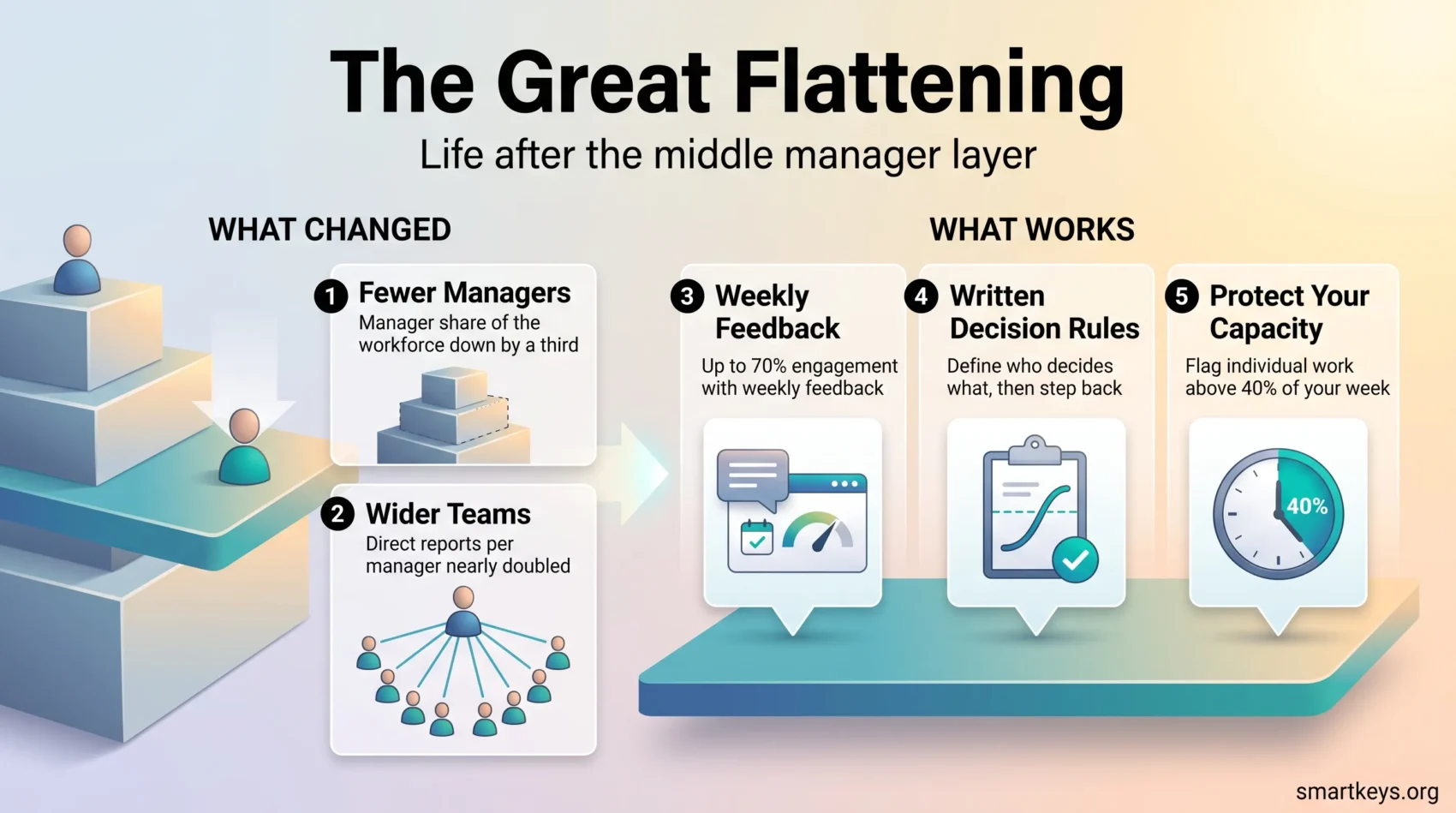
If you lead a team, you now look after more people with less cover from above. The shift is measurable. Payroll data from Gusto, covering 8,500 US businesses with 2 to 500 employees, shows managers fell from roughly 25% of the workforce in 2019 to about 15% by the third quarter of 2024. Over the same period the span of control, meaning the number of people reporting to one manager, went from about three to almost six.
Management itself is not disappearing. The US Bureau of Labor Statistics puts the median wage for management occupations at $126,520 as of May 2025 and projects about 1.1 million openings a year between 2025 and 2035. The role is not vanishing. It is getting wider.
Key Takeaways
- The manager share of the workforce fell by roughly a third between 2019 and 2024 (Gusto).
- Spans of control are widening, so each manager carries more people and more coordination.
- Manager engagement dropped to 22% in 2025, faster than for non-managers (Gallup).
- Demand stays high: about 1.1 million openings a year through 2035 (BLS).
- The managers who cope delegate real decisions and give feedback weekly.
What Middle Management Actually Does
A middle manager manages employees but still reports to someone above them. Typical titles are Department Head, Regional Manager and Team Lead.
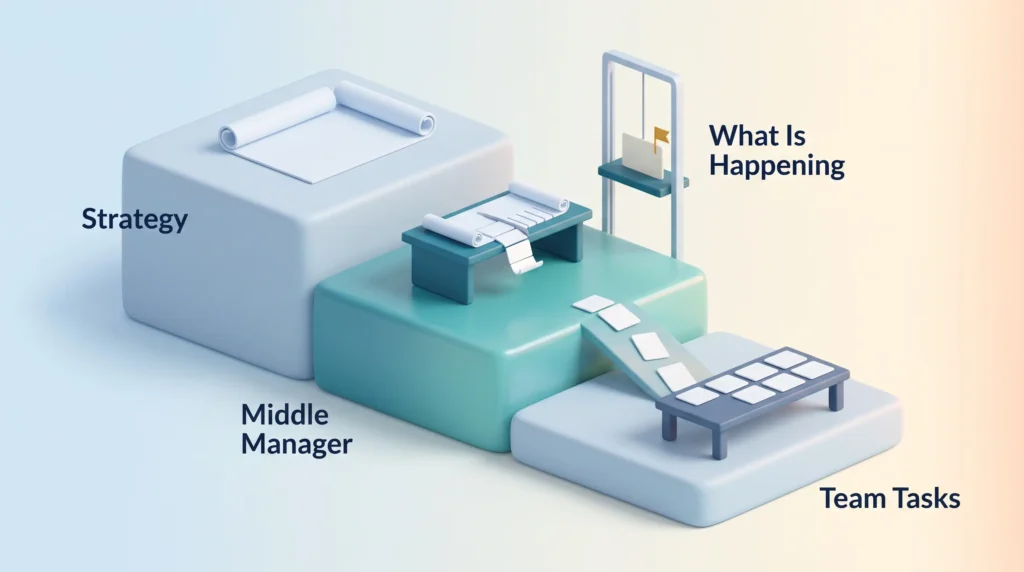
The job runs in two directions. Downward, you turn company strategy into work your team can start on Monday. Upward, you tell senior leaders what is really happening, including the parts that do not fit the plan.
An example makes it concrete. A leadership team decides to cut order processing time by 20%. That means nothing to a warehouse team until someone decides which steps get dropped and who covers the gap.
In a flatter structure, more of it lands on fewer people. Companies redesigning their org charts around AI-driven organizational design often assume the coordination work disappears with the layer. It does not. It moves. Even holacracy adoption, which removes managers entirely, has to put that coordination somewhere.
How Far the Flattening Has Gone: The 2026 Numbers
Gusto’s payroll analysis found manager hiring was about 40% below its January 2022 level by late 2024, while layoffs hit managerial roles roughly three times harder than individual contributor roles. Firms with 100 to 499 employees saw spans rise 44% between 2022 and 2024.
Gallup, in research published in January 2026, put the average span of control at 12.1 direct reports in 2025, up from 10.9 in 2024. That average is pulled up by a small group of very large teams. The median manager still has five or six reports, 37% have fewer than five, and 13% oversee 25 or more people.
Most managers have not seen their team double. A minority now carry a team size that no technique makes comfortable.
The pressure shows in engagement figures. Gallup’s State of the Global Workplace 2026 report puts global engagement at 20% in 2025, down from a 2022 peak of 23%. Manager engagement fell further: 22% in 2025, down from 27% in 2024 and 31% in 2022. Non-managers sat at 19%. The gap has almost closed, and not because teams got happier. Our overview of current leadership trends covers what that decline does to trust.
Core Responsibilities and the Skills That Now Matter Most
The core duties have not changed. What changed is how often you have to do them.
- Setting priorities and assigning work so projects actually finish.
- Giving feedback often enough that performance problems stay small.
- Allocating budget and people against deadlines that keep moving.
- Handling conflict and applying company policy consistently.
Four skills carry more weight in a wide team than in a small one:
- Written clarity. With 12 reports you cannot explain everything twice. Our guide on choosing between email, chat or a meeting is a useful filter, and asynchronous work habits cut the meeting load.
- Structured check-ins. A repeatable format keeps the conversation about growth rather than status. A one-on-one meeting template makes this survivable at scale.
- Continuous feedback. Annual reviews cannot carry a large team. Continuous performance management spreads the load across the year.
- Delegation with real decision rights. Handing over a task while keeping every decision is not delegation. Giving people a defined say, as in participatory management, frees your calendar.
One Gallup finding is worth sitting with: 97% of managers also carry individual contributor work, and the median manager spends 40% of their time on it. Above that mark, engagement drops as team size grows.
The Real Problems of the Squeezed Middle
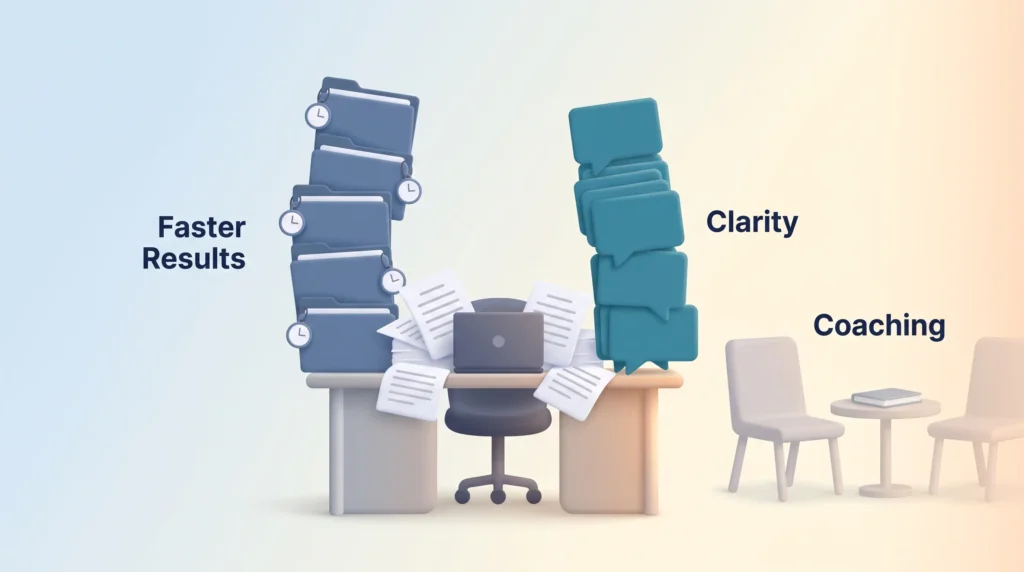
Managers are caught between two sets of expectations. Senior leaders want faster results. Teams want protection and clarity. When headcount is cut, both rise at once.
Preparation is the gap nobody funds. Research from Surface by Paradigm, published in its State of Workforce Transformation 2026 report and covered by HR Executive in August 2026, found that only 6% of leaders believe their middle managers are prepared to lead change across most of the organization. Only 10% of organizations systematically use span of control data when they design teams. Companies are widening spans without checking who can carry them.
Distance makes it harder. In hybrid teams you lose the informal signals that someone is struggling. Building digital trust in remote teams takes deliberate structure, not more monitoring.
The consequences are predictable. Overloaded managers stop coaching first, because coaching has no deadline attached. That feeds employee burnout and weakens talent retention when a company can least afford to lose people. Team resilience training helps, but it does not substitute for a workable team size.
Staying Employable: Where to Put Your Development Time
Fewer manager roles means more competition for each one. The BLS still projects about 1.1 million openings a year through 2035, so the jobs exist.
Four areas repay the effort:
- Coaching at scale, so development happens in short regular conversations instead of one annual event.
- Decision design, meaning you write down who decides what.
- Data literacy, enough to question a dashboard rather than repeat it.
- Project delivery, the unglamorous work of scoping, sequencing and cutting.
Internal routes are often faster than courses. An internal talent marketplace lets you take on a short project outside your team. Mentorship platforms pair you with someone who has run a team your size. A cross-training strategy gives your people cover so you can step back. Our guide to upskilling ROI ties development spend to retention and output.
How to Lead a Bigger Team Without Burning Out
Three practices do most of the work.
Make feedback weekly and cheap. Gallup’s data is blunt here. Employees who get meaningful feedback every week show engagement of 67% to 70%, against 22% to 26% for those who do not, and this holds regardless of team size. Weekly does not mean long. A five minute message naming one specific thing counts.
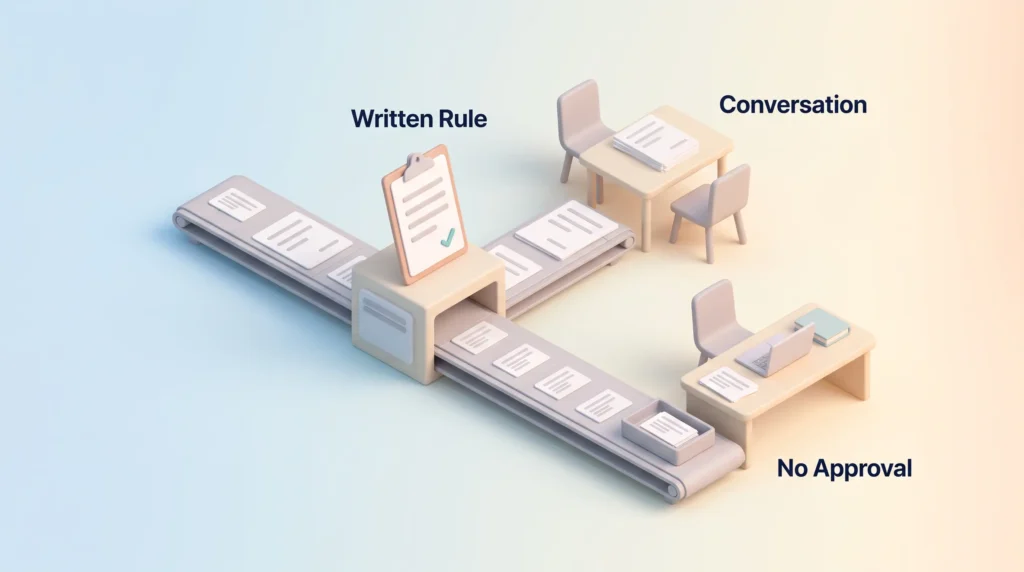
Push decisions down and write the rule. Do not just say “use your judgement”. Write the boundary: refunds under 200 euros need no approval, anything above needs a conversation. Clear limits move work off your desk permanently, and the same applies when managing freelancers and contractors.
Defend your own capacity. If you are past that 40% mark on individual contributor work, that is the first conversation to have with your own manager. Bring the team size and the delivery numbers, not a complaint. Workforce contingency planning gives you the vocabulary, because a single overloaded manager is a continuity risk on paper.
Conclusion
The great flattening changed the org chart. It did not remove the work middle managers were doing. Someone still has to translate strategy into tasks, notice when a person is struggling, and tell senior leaders what the plan is missing.
The practical response is narrow. Keep a weekly feedback rhythm. Write down who decides what. Watch how much of your week goes to work only you can do, and say something before it breaks.
Found this useful?
Make SmartKeys a preferred source on Google, and our articles will surface more often in your Top Stories, AI Overviews, and AI Mode.
Add as Preferred Source