
Most people meet AI through the giants: ChatGPT, Gemini or Claude, running in huge data centers. But a second group of models is quietly doing more and more of the everyday work. Small language models (SLMs) are AI text models compact enough to run on a single server, a laptop or even a phone.
For many business tasks, that smaller size is an advantage rather than a compromise. A small model can sort support tickets, pull names out of contracts or summarize a meeting. It often does this faster and cheaper than a frontier model, the industry term for the largest and most capable systems. It can also do it without sending your data to someone else’s cloud.
This guide explains what small language models are, how they are made, where they beat large models and where they do not. It ends with practical steps for trying one yourself.
Key Takeaways
- Small language models trade broad general knowledge for speed, low cost and the option to run locally.
- They work best on narrow, repeatable tasks such as classification, extraction, routing and short summaries.
- Gartner expects companies to use small, task-specific models at least three times more than general LLMs by 2027.
- Running a model on your own hardware keeps sensitive data in-house, which helps with privacy rules.
- The smartest setup is often a mix: a small model for routine work and a large model for hard reasoning.
What Is a Small Language Model?
A language model is software trained to predict and generate text. Its size is measured in parameters, the internal settings the model learns during training. More parameters usually mean more stored knowledge, but also more memory, more computing power and higher costs.
There is no official cutoff for “small”. In practice, the term covers models from a few hundred million up to roughly 10 billion parameters. Frontier models are far bigger. A more useful definition is practical: a small model is one you can run on a single GPU (the graphics chip that does most AI computing), a normal laptop or a modern smartphone.
If terms like parameter, inference or token are new to you, our AI glossary for tool buyers explains them in plain language.
Three basic designs
Small models come in three main designs, and each suits different jobs:
- Encoder-only: reads text and labels it. Good for classification, such as tagging emails by topic.
- Decoder-only: writes text one word piece at a time. This is the design behind chat assistants.
- Encoder-decoder: reads a full input, then writes a new output. Good for translation and summaries.
A classic example of a small encoder model is DistilBERT. According to its authors, it is 40% smaller and 60% faster than the original BERT model while keeping about 97% of its language understanding.
Popular Small Language Models in 2026
Several large tech companies now publish small models openly, meaning anyone can download and run them. The most relevant families today include:
- Google Gemma 4: released in April 2026 under the Apache 2.0 license, which allows free commercial use. The E2B and E4B versions (about 2 and 4.5 billion effective parameters) are built for phones and laptops.
- Microsoft Phi-4: Phi-4-mini has 3.8 billion parameters. Phi-4-multimodal, with 5.6 billion, also handles images and speech.
- Alibaba Qwen3.5: the small series, released in March 2026, ships in 0.8B, 2B, 4B and 9B sizes (B stands for billion parameters). Tool calling, the ability to trigger other software such as a search or a database query, is built in.
- Meta Llama 3.2: the 1B and 3B versions remain popular for on-device text tasks.
- IBM Granite 4.0 Nano: models from 350 million to roughly 1.5 billion parameters, aimed at enterprise use on laptops and in browsers.
On top of these open models, device makers ship their own. Google’s Gemini Nano runs directly on supported Android phones, for example to summarize recordings without uploading them.
Why Small Language Models Matter for Your Business
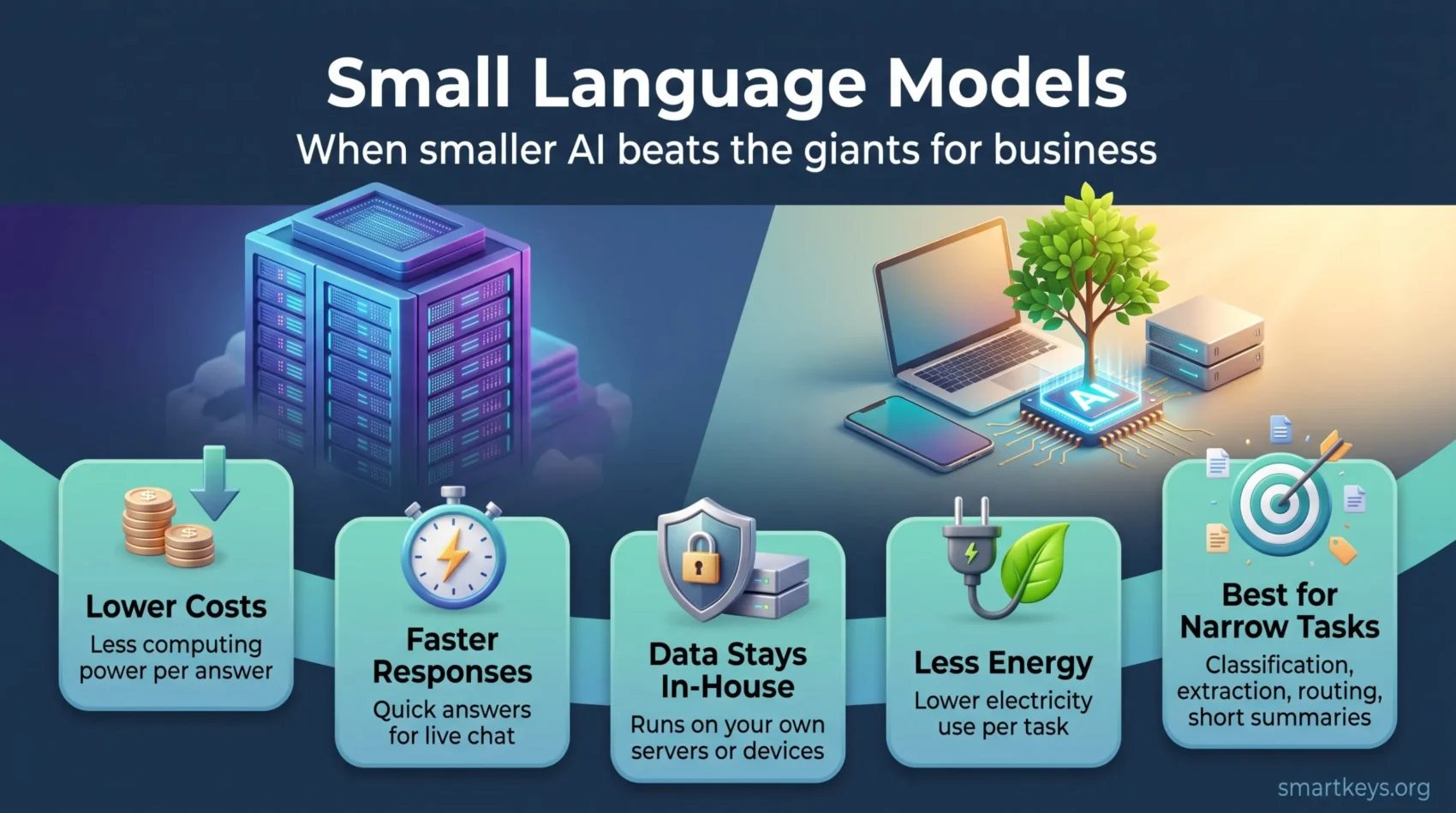
Large models are impressive, but you pay for that power on every request. Small models change the math in four ways.
Lower running costs. A small model needs less computing power per answer. If you process thousands of support tickets a day, that difference adds up quickly. Our guide to cloud cost optimization shows why per-request costs matter at scale.
Faster responses. Fewer parameters mean less work per answer. That matters for live chat, voice assistants and any workflow where a user is waiting.
Privacy and control. You can run a small model on your own servers or devices. Customer data never leaves your environment, which makes it easier to meet the rules covered in our overview of data privacy trends. It also fits companies that care about sovereign cloud and data residency.
Less energy. Smaller models use less electricity per task. With AI data center energy costs rising, that is both a budget and a sustainability point.
Analysts see the same trend. In April 2025, Gartner predicted that by 2027 organizations will use small, task-specific AI models at least three times more than general-purpose large language models. Its reasoning: they respond faster, need less computing power and can be tuned with company data for better accuracy.
How Small Language Models Are Made Small
You do not need to build a model yourself to benefit from SLMs. Still, knowing the main shrinking methods helps you judge vendor claims.
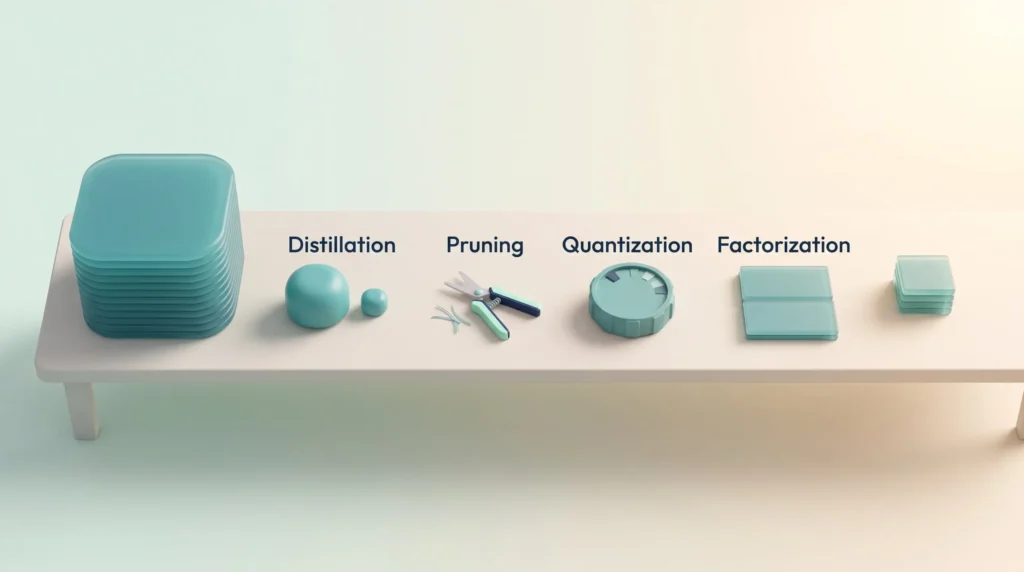
Knowledge distillation trains a small “student” model to copy the answers of a large “teacher” model. The student learns useful behavior without needing the teacher’s size.
Pruning removes parts of a model that contribute little, such as unused connections or layers. Pruning too much hurts accuracy, so it is usually followed by extra training.
Quantization stores the model’s numbers with less precision, for example as 8-bit or 4-bit integers instead of 32-bit decimals. Think of it as compressing a photo: slightly less detail, much smaller file. Meta reported that its quantized Llama 3.2 1B and 3B models are on average 56% smaller and up to two to four times faster than the originals.
Low-rank factorization splits large blocks of numbers inside the model into smaller ones. This cuts both size and computing work.
Real-World Use Cases
Small models shine when the task is clear and repeats often. Here are the areas where they already pay off.
Customer support and internal assistants
A small model can answer routine questions, route tickets to the right team or suggest replies to agents. It can run on a private server, a kiosk or inside an app. For a wider view of what works, see our article on AI chatbots in customer service. The same approach powers HR chatbots for employee questions.
Summaries, notes and translation
Small models handle short summaries well. A local model can turn a meeting transcript into action items without uploading the recording, which pairs well with an AI meeting notes workflow. Multilingual models like Qwen3.5 also support basic translation, a use case explored in our look at real-time translation tools.
Extraction and classification
This is where small models are strongest. Pulling invoice numbers, names or dates out of documents does not need a model that can write poetry. GLiNER2, an extraction model with 205 million parameters, scored an average F1 of 0.590 on the CrossNER benchmark, close to GPT-4o at 0.599, according to its authors. F1 is a standard accuracy score for finding the right items, and CrossNER is a public test set for recognizing names and terms across different subject areas. The same paper reports that GLiNER2 handled a 20-label classification task on a standard processor (CPU) in about 163 milliseconds. GPT-4o, called through its cloud API, took about 425.
Offline and edge use
Because they fit on local hardware, small models also work where the internet is slow or missing: in vehicles, factories, warehouses or field service. Our guide to edge AI in business covers these scenarios in more detail.
Small Language Models vs. LLMs: When to Use Which
The right choice depends on the task. A simple rule helps.
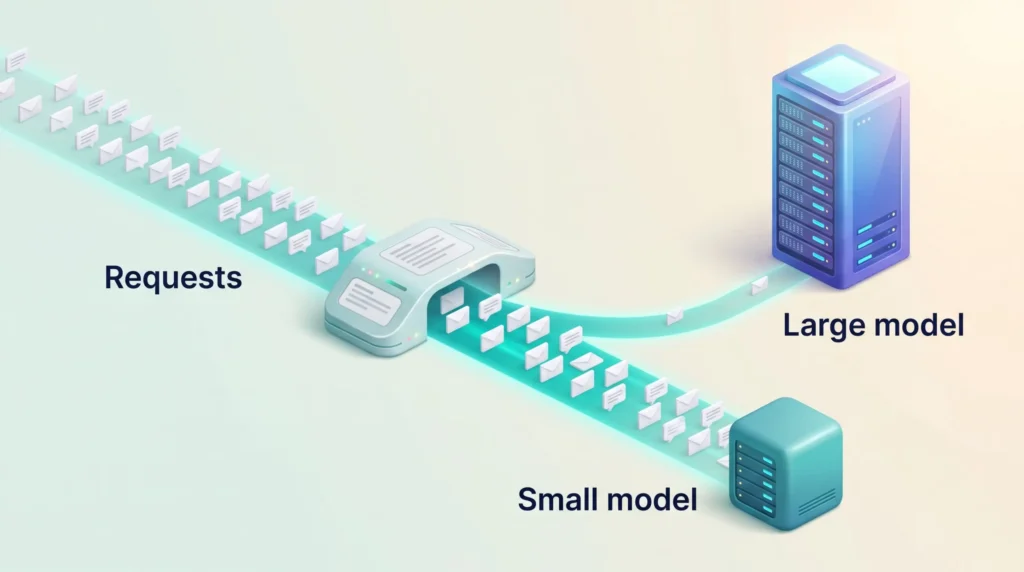
- Choose a small model for narrow, high-volume jobs: classification, extraction, routing, moderation, short summaries and fixed-format answers.
- Choose a large model for open-ended work: complex reasoning, long documents, broad world knowledge and creative writing.
Many teams now combine both. A small model handles the bulk of routine requests, and only the hard cases go to a large model. This setup is often called routing. NVIDIA researchers made a similar argument in a 2025 paper titled “Small Language Models are the Future of Agentic AI”. Their point: most steps inside an AI agent are repetitive and narrow, so a small model is often enough. If you are building AI agents for your business, this split can save real money.
Managing several models side by side takes some process. Our LLM Ops strategy guide explains how to monitor, update and govern them.
Trade-offs and Limitations
Small models are not a free win. Before you switch, keep these limits in mind.
Less general knowledge. A smaller model simply stores fewer facts. Microsoft noted this about its own Phi-3 models, which scored lower on factual knowledge tests because of their size. Ask a small model about a niche topic and it may guess.
Made-up answers. Like large models, small ones can “hallucinate”, meaning they state false things with confidence. The risk grows when you ask outside the model’s comfort zone.
Inherited bias. A small model trained from a larger one, or from web data, can copy that source’s biases.
To reduce these risks, use a few simple safeguards:
- Keep a human review step for anything customer-facing or high-stakes.
- Connect the model to your own documents with retrieval-augmented generation (RAG), a setup where the model looks up relevant files before answering.
- Set confidence thresholds so unsure answers go to a person or a larger model.
- Test tricky and ambiguous prompts before going live.
Clear internal rules also help. Our generative AI usage guidelines and AI governance model give you a starting framework.
How to Try a Small Language Model Yourself
Testing a small model is easier than most people expect. You do not need a data science team.
On a desktop or laptop: install Ollama, a free tool that downloads and runs open models locally. Then type ollama run qwen3.5:2b in a terminal, the text command window on Windows, macOS or Linux. The model downloads once and runs on your machine, with no data sent to the cloud.
On a phone: apps such as PocketPal AI run small models offline on iOS and Android. You can switch between models like Gemma, Phi and Qwen to compare their answers.
Start with one real task, for example tagging 100 past support emails. Compare the results with what your team did by hand. That gives you a fair accuracy check before any wider rollout. Also make sure local tools are approved by IT, or they quickly become shadow AI.
Fine-Tuning a Small Model for Your Task
If a model is close but not good enough, you can train it further on your own examples. This is called fine-tuning.
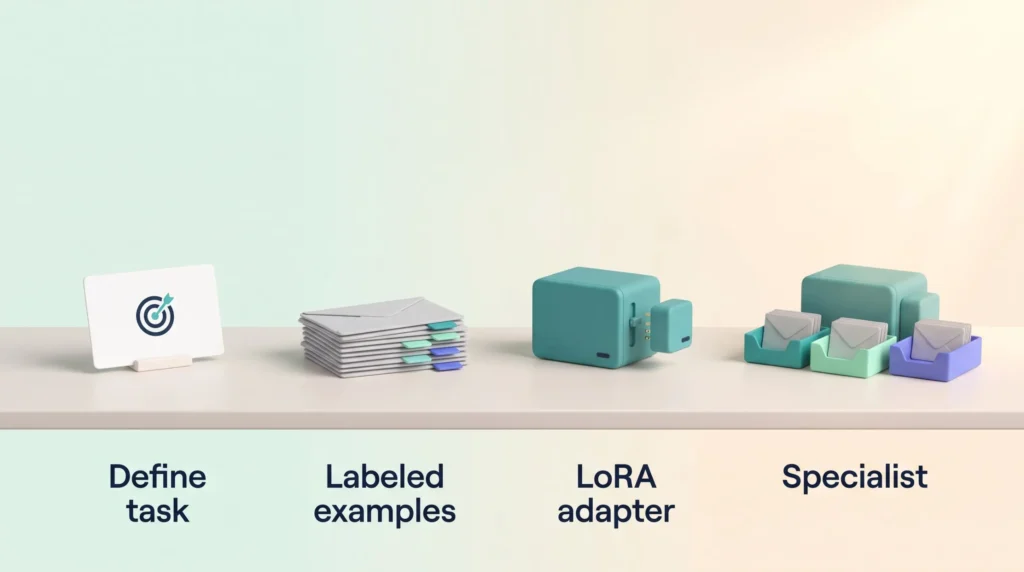
Start by defining one precise task. For instance: sort support emails into Billing, Technical or Feedback. Then collect a few hundred labeled examples.
You rarely need to retrain the whole model. A method called LoRA (low-rank adaptation) adds a small set of extra settings and trains only those. It needs far less computing power and data than full training. Adapters and prompt tuning work in a similar lightweight way. Open-source tools like Hugging Face’s PEFT library support all three.
A fine-tuned small model trained on your contracts, manuals or ticket history can become a specialist. This is the idea behind vertical AI solutions built for one industry.
Conclusion
Small language models are not a lesser version of AI. They are the right tool when a task is narrow, data is sensitive and answers need to be fast and cheap.
The practical path is simple. Keep a large model for complex reasoning. Route routine work to a small model you control. Test on real data, add human review where it matters and measure the return against a clear baseline. Done this way, small models can deliver clear business value today.
Found this useful?
Make SmartKeys a preferred source on Google, and our articles will surface more often in your Top Stories, AI Overviews, and AI Mode.
Add as Preferred SourceFAQ
What defines a small language model?
A small language model is an AI text model with far fewer parameters than frontier systems, usually from a few hundred million up to about 10 billion. There is no official size limit. The practical test is whether it runs on modest hardware such as a single GPU, a laptop or a smartphone. Examples include Google’s Gemma 4 E2B and E4B, Microsoft’s Phi-4-mini, the small Qwen3.5 models and IBM’s Granite 4.0 Nano. Because they are compact, they answer faster, cost less to run and can work offline, but they hold less general knowledge than large models.
How do small models compare in performance to larger models?
Small models can match large ones on narrow tasks, but they fall behind on broad, open-ended work. For classification, data extraction, routing and short summaries, a well-chosen or fine-tuned small model often comes close to a frontier model while responding faster. The extraction model GLiNER2, for example, scored almost the same as GPT-4o on a standard entity-recognition benchmark. For complex reasoning, long documents or questions that need wide world knowledge, large models remain clearly stronger. That is why many teams use both and route each request to the model that fits.
What are the limitations of small models?
The main limitation is less stored knowledge, so small models are more likely to guess when asked about unfamiliar topics. Like all language models, they can also produce confident but false answers and may carry biases from their training data or from the larger model they learned from. They handle long, complex reasoning chains less reliably than frontier models. You can reduce these risks by keeping tasks narrow, connecting the model to your own documents, adding confidence thresholds and keeping a human review step for anything important.
How can I run a small model on my own computer or phone?
The easiest way on a computer is Ollama, a free tool for Windows, macOS and Linux. After installing it, a single command such as “ollama run qwen3.5:2b” downloads a model and starts a local chat. On a phone, apps like PocketPal AI run small models offline on iOS and Android. Both options keep your prompts on your own device. Before using them for work data, check that your IT or security team approves the tool and the model license.
Should I fine-tune a small model or use RAG?
Use RAG when the model needs access to facts that change, and fine-tuning when it needs to learn a stable behavior or format. RAG, short for retrieval-augmented generation, lets the model look up your current documents before answering, so you update the files instead of the model. Fine-tuning, often with the lightweight LoRA method, teaches the model a specific skill such as sorting tickets into your categories or writing in a fixed format. Many business setups combine both: a fine-tuned small model that also retrieves company documents.
Are small language models better for data privacy?
They can be, because a small model can run entirely on your own servers or devices. When nothing is sent to an outside AI provider, customer and employee data stays under your control, which simplifies compliance with rules such as the GDPR. The model size alone does not guarantee privacy, though. You still need secure hardware, access controls and clear rules for what data goes into prompts. A small model called through a third-party cloud API offers no more privacy than a large one.