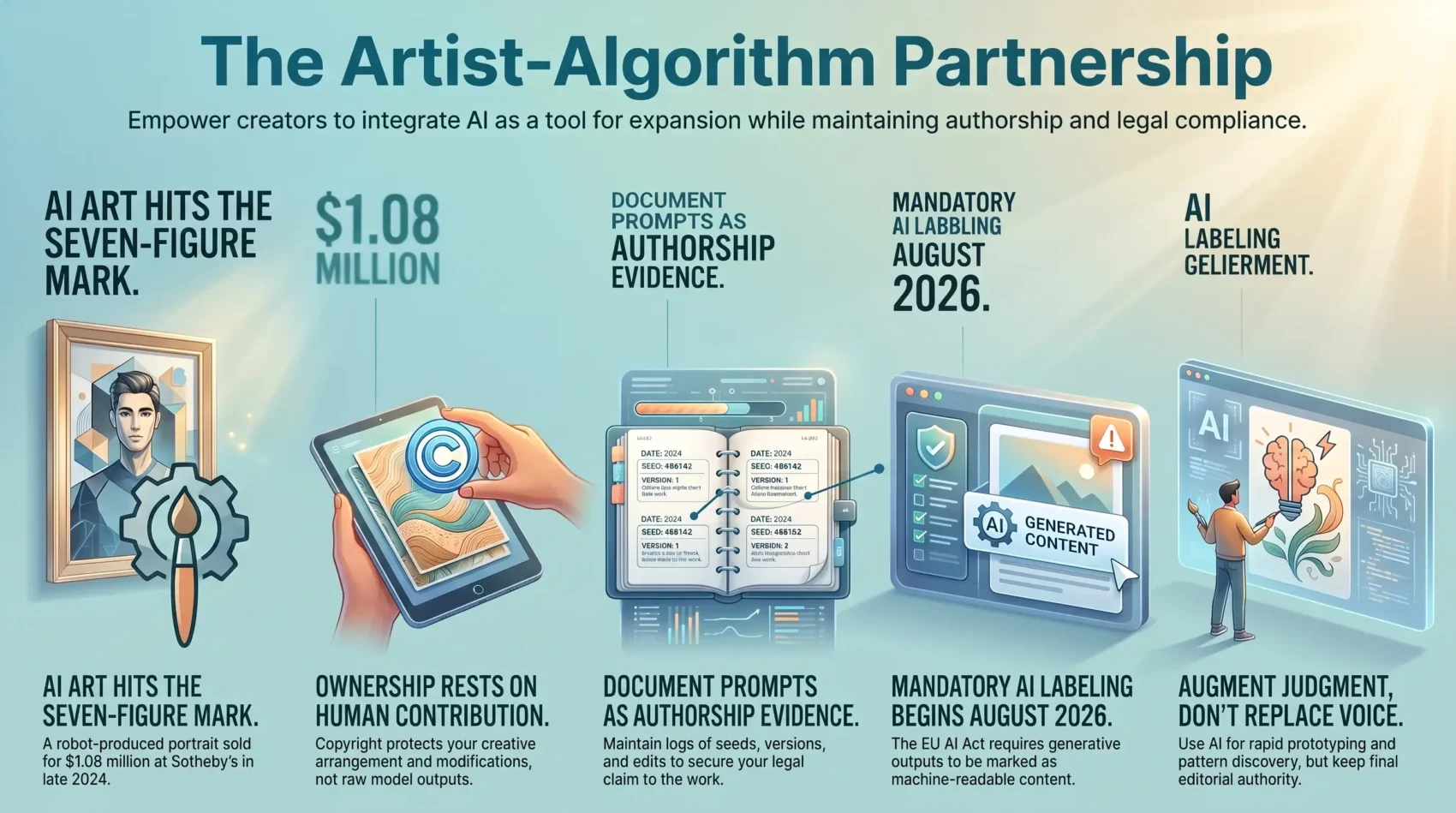
You are working in a market that now prices machine-made art in six figures. In November 2024 a portrait of Alan Turing produced by the humanoid robot Ai-Da sold at Sotheby’s for $1.08 million, far above its high estimate. Four months later Christie’s ran Augmented Intelligence, its first sale devoted to AI-assisted work, and took $728,784. An open letter signed by thousands of artists had demanded that the same auction be cancelled.
Both facts matter to your practice. The money says major institutions have accepted the medium. The letter says the terms of that acceptance are still being argued over, and you get to decide where you stand.
The collaboration itself is simple. You set the intent, the system extends your reach, and the result can beat either one alone. Mathematician Marcus du Sautoy, author of The Creativity Code, makes the point that art has always been built on earlier art, whoever or whatever made it.
Expect practical change. New methods speed up exploration, reshape how work is shared, and now carry legal disclosure duties that did not exist two years ago. Keep your vision clear and your records clean.
Key Takeaways
- Machine-assisted art sells at major auction houses, and it draws organised pushback from working artists.
- You can widen your process without giving up authorship or voice.
- In the United States, copyright protects your human contribution, not the raw model output.
- Since 2 August 2026 the EU AI Act has required generative outputs to be marked as machine-readable AI content.
- Documentation is now part of craft: keep prompts, versions, and edit history.
Where AI-made art stands in 2026
What began as studio tinkering has reached salerooms, museums, and the statute book.
From studios to salerooms
Ai-Da’s exhibitions and the Sotheby’s result moved generated work from a curiosity to a priced asset class. Christie’s followed with a dedicated sale that beat its own estimates. Institutions now treat these methods as a legitimate mode of expression rather than a novelty slot.

What the backlash is actually about
The open letter against the Christie’s sale did not object to software. It objected to models trained on copyrighted work without licence or payment. That distinction is the one to hold onto. The fight is over consent and compensation for training data, not over whether you may use a brush that runs on electricity.
Commentators often call artificial intelligence a general-purpose technology, meaning an invention that reshapes almost every industry rather than one corner of the economy, on the scale of the printing press. That framing is useful because it sets expectations. General-purpose technologies do not settle in a season. They arrive with decades of legal and economic argument attached.
Your role and next steps
You gain faster idea discovery, new formats, and more time for high-level choices. Document your process, ask clear questions about where a tool’s training data came from, and test tools on small projects before you commit a paid commission to them. The same logic that governs AI augmentation in the wider workplace applies to a studio. Augment the judgement you already have.
- Map where tools genuinely save hours.
- Keep authorship clear when you present work.
- Learn practical methods like using AI assistants for iteration.
How AI enhances the creative process without replacing your voice
Tools that mine large datasets surface unexpected patterns that feed fresh ideas. You can translate those signals into rough sketches, composition studies, or story beats that you then refine by hand.
Idea generation and pattern discovery
Turn broad archives into usable prompts. Build a pattern library that captures recurring shapes, palettes, and motifs, then pick the variants that match your intent. A simple version: save fifty reference images from your own archive, note the three colour relationships that keep appearing, and use those as the constraint you feed the tool.
If you struggle to get started, a fast brain dump before you open any tool keeps the machine responding to your ideas rather than seeding them. The same discipline sits at the heart of design thinking: frame the problem before you generate options.
Visuals, music, and text
Practical flows matter more than tool names. Draft story beats with a text model, test harmonic palettes for a melody, run quick composition studies for images. Audio and video have moved fastest. AI podcast production tools now handle scripting and voice, while avatar and localisation platforms and short-form video generators cover presenter footage and ad variants. Choose only the outputs that fit your emotional aim.
Keeping humans and emotion central
Anchor every experiment to a clear emotion or message. Set limits on how much generated material you accept into a piece. Document edits, preserve analogue practice, and state authorship plainly so your artistic expression stays primary.
- Mine data to surface usable patterns.
- Use targeted tools for text, music, or image drafts.
- Define the emotion before you generate, and record the choices you make.
The collaboration spectrum: from human-led control to automated outputs
At one end you steer every decision. At the other, systems deliver finished pieces. How much control you keep depends on intent, audience, and what you intend to ship.
Granular creative control vs. full automation
Granular control means clear authorship, a consistent voice, and tight alignment with your style. Use tools that let you nudge parameters and record each choice.
Full automation speeds delivery and scales output, but it drifts from your concept and overfits to trends. Set checkpoints where a human must approve. This is the same trade-off teams face when they design AI agent workflows. Autonomy is cheap, but so is drift.
Rapid prototyping without losing authenticity
Adopt a rapid prototyping loop to cut the time to a first draft. Test options fast, ask focused questions about intent, then refine only the outputs that meet your standards. Concretely: give yourself twenty minutes and six variants, pick one, and spend the rest of the session on it by hand.
- Map where a tool saves time and where human review is mandatory.
- Define your non-negotiables (motifs, palette, or voice) that the technology must respect.
- Document choices so you can credit contributors and explain your development steps.
What supporters and critics each get right
You need to weigh real gains against real risks before you scale a new method.
Supporters stress that lower barriers let more people publish, design, and score music. Faster prototyping widens range and helps new aesthetics reach an audience.
Democratization and accessibility
Access matters. Cheaper tools mean more voices enter design and art, much as freelance talent platforms and crowdsourced innovation opened commissioning to people outside the usual networks.
Originality, ownership, and income
Critics raise substantive concerns about intellectual property when a model has learned from prior work. Those concerns are now being tested in court rather than in essays. In November 2025 the English High Court rejected Getty Images’ secondary copyright claim against Stability AI, after Getty dropped its main training-data claims mid-trial. Getty won only on a narrow trademark point. The ruling settled less than either side wanted, which is why licensing deals, not verdicts, are doing most of the work.
Displacement of paid commissions worries illustrators, voice actors, and stock photographers with good reason. Engage these questions before you publish or sell, not after a client asks.
The attention economy
Highly optimised output is cheap to produce and easy to distribute, so it can crowd out slower, bespoke work in feeds that reward volume. That is a distribution problem, not an aesthetic one. Brands that win attention still do it through narrative and storytelling rather than volume.
- Take the gains in access, speed, and range, then use them to raise your standards.
- Clarify sources and handle rights so releases avoid conflicts.
- Credit influences and check outputs for factual and reputational risk before publishing.
Bottom line: borrow the best from both camps. Use accessibility to widen your reach while guarding authenticity, ownership, and your long-term income.
Ethics, rights, and policy: what changed
Two court decisions and one regulation now shape how you present AI-assisted work.
Who owns AI-assisted output
Define ownership early. In its January 2025 report on copyrightability, the US Copyright Office confirmed that existing law needs no amendment. Prompts alone do not make you an author. Material you contribute yourself, the way you creatively select and arrange generated elements, and your own modifications to that material all remain protectable. In practice your claim rests on what you demonstrably did, so agree rights and attribution with collaborators and clients in writing before delivery.
Labelling, transparency, and provenance
Be transparent about process. Article 50 of the EU AI Act has applied since 2 August 2026, and the Digital Omnibus package that delayed other parts of the Act left it in force. Providers of generative systems must mark outputs so a machine can detect that they are AI-generated, and deployers must disclose deepfakes. Artistic, satirical, and creative work gets a lighter obligation, because the disclosure must not spoil the display or enjoyment of the piece. Generative systems that were already on the market before that date have until 2 December 2026 to meet the marking requirement.
Provenance standards such as C2PA Content Credentials, an industry format that stores a signed edit history inside the file, give you a way to carry that record with the work instead of in a caption. Similar disclosure norms are spreading through everyday etiquette around AI at work, through internal generative AI usage guidelines, and through wider legislation on AI and work. If you sell into more than one market, track how AI regulation differs by region before you promise a client anything.
Aligning incentives for fair development
Push for norms that reward quality and accountability rather than volume. Licensed training sets, revenue sharing, and clear credit are the levers that work. Both open innovation models and tokenised ownership experiments show that attribution is a design decision, not an afterthought.
- Document rights and credit to reduce friction later.
- Adopt labelling and safety practices that protect your audience.
- Build a checklist for the hard questions: datasets, consent, and credit.
AI in creative work: a practical method for your process
Pinpoint one stage where a tool can save time or spark ideas. Start small. Decide whether you need help with ideation, references, composition, or final polish. That keeps the experiment focused and cheap.
Then match the tool to the job. Use pattern explorers for images, melodic sketchers for music, prompt-driven text for drafts. Set your constraints, such as style, palette, or tempo, before you generate, so outputs arrive inside your intent rather than outside it.
Generate, integrate, and keep your signature
Generate focused material, whether images, passages, or audio stems, that reflects your ideas rather than generic trends. Integrate it with overlays, colour studies, or arrangement edits.
Iterate quickly. Time-box experiments and get feedback from trusted peers. Tag useful patterns and store references so each session builds on the last.
Repeatable checklist
- Identify the single step you want to improve.
- Select a tool and set constraints before you use it.
- Generate targeted material and merge it with traditional technique.
- Iterate, collect feedback, and log what changed.
- Keep prompts, seeds, and version files, because they are your authorship evidence.
- Add your own mark in phrasing, mark-making, or arrangement before release.
Final note: decide what to keep and what to discard so the finished piece reflects your standards. This protects your voice while expanding your range.
From prompt to practice: a worked example
Here is how the loop looks when a painter moves from a generated image to a finished canvas. The steps below are a composite scenario rather than a case study of one named artist, but each step is a choice you will recognise.
Turning generated images into a unique canvas
Start with a clear objective: inject unfamiliar patterns into a traditional painting. Feed a calm forest photograph into an image tool and ask it for dense, unexpected colour and shape.
The output suggests new colour palettes and composition cues. Those motifs become reference points, not the artwork itself, and that difference is the whole method.
In the studio, translate the selected images into acrylics. Brushes, layering, and edges are where your own hand enters, and peer feedback decides which patterns stay and which get refined away.
- Objective, then prompt, then a hard selection from the outputs.
- Translate motifs into material choices and rhythm.
- Time-box iterations and gather peer input.
- Credit influences and present the finished work as your own.
The pattern generalises. The strongest results come where human choices frame every stage. For a practical next step, read a hands-on review of a generative creative tool before you commit to one.
Conclusion
This moment asks you to pair steady craft with fast experimentation, so ideas move from sketch to shelf without losing their point.
Use these tools to expand your range and speed discovery, but keep the final calls yours.
Adopt three habits: set clear intent, keep records of what you used and what you changed, and time-box every experiment. Before release, run a short checklist. What is mine? What was model-assisted? Does the piece do what I meant it to do, and does it need a disclosure?
Favour tools that amplify authorship rather than replace it. Invest in the craft, share your process where it builds trust, and help set the norms you would want to work under.
Found this useful?
Make SmartKeys a preferred source on Google, and our articles will surface more often in your Top Stories, AI Overviews, and AI Mode.
Add as Preferred Source