Booking a meeting should take seconds, not an email thread. A scheduling tool solves that through automated scheduling: you publish your real availability as a link, other people pick a slot, and the meeting lands in both calendars. Calendly and Doodle are the two best known options, and both changed noticeably during 2026. This comparison covers what each one now costs, what its AI features actually do, and which type of user each fits.
The short version: Calendly has grown into a meeting workflow platform that books the meeting and then writes it up. Doodle has stayed close to its original strength, finding a time that suits a group, and is adding automation on top of it. Those are different products at similar prices, so the right pick depends on what happens after the booking.
Key Takeaways
- Calendly’s free plan allows 1 event type and 1 connected calendar. Doodle’s free plan allows 1 Group Poll, 1 Booking Page, 1 one-to-one page and basic Sign-up Sheets.
- Calendly Standard costs $10 per seat per month on annual billing and Teams costs $16. Doodle Pro costs about $11 per month annually and Doodle Team costs $8.95 per user per month with a two-seat minimum.
- On 19 August 2026 Calendly launched two AI products, Notetaker and an assistant called Callie, and put them behind two new tiers: Standard Plus and Teams Plus.
- Those Plus tiers add $8 per seat per month: $18 for Standard Plus and $24 for Teams Plus on annual billing. Free, Standard and Teams users get 5 Notetaker recaps a month after a 14-day trial.
- Doodle still leads on group scheduling with its Group Poll, and adds AI-written meeting descriptions on Team plans.
- Both vendors start Enterprise at $15,000 a year, and both expect roughly 50 seats or more at that level.
What Changed in 2026
Most of the movement came from Calendly. In August 2026 it released Notetaker, an AI assistant that joins your Zoom, Google Meet or Microsoft Teams call and returns a recording, a transcript, a shareable recap and action items. Alongside it came Callie, a beta assistant that arranges meetings inside an email thread: you copy into the conversation and it proposes and books a time.
Both sit on new plan tiers rather than being folded into the existing ones, so they raise the bill. Our guide to an AI meeting notes workflow explains what that automation replaces.
Doodle moved differently. It now markets itself as an operating system for time, built on agentic calendar orchestration: software that reads the calendars involved and proposes a slot without a human comparing them. Its Enterprise tier adds engagement analytics and organisation-wide focus policies. The marketing is ambitious, but the shipped product is still recognisably Doodle: fast, light and built around a poll.
One consequence applies to every AI notetaker, not just Calendly’s. Recording and transcribing a meeting means processing personal data, and in the EU participants generally have to be told. Our overview of EU AI Act compliance covers those disclosure duties.
Understanding Calendly
Calendly launched in 2013 and reports more than 20 million users across over 230 countries and territories. It began as a booking link and is now a set of connected modules around the meeting itself.
How Calendly Works
You connect your calendar, define the meeting types you offer, and set the hours you are willing to be booked. Calendly then publishes a page per meeting type. Invitees pick a slot, and Calendly writes the event to both calendars, adds the video link and sends reminders.
Time zones are handled automatically, which removes a common source of no-shows. If your calls cross regions, see our guides to follow-the-sun scheduling and managing cross-border teams.
Key Features of Calendly in 2026
- One-to-one, group and round-robin meeting types. Round-robin means incoming bookings are shared out across a team rather than always landing on one person.
- Routing forms, which ask a visitor a few questions and then send them to the right calendar based on the answers.
- Workflows for automated reminders and follow-up messages.
- Payment collection through Stripe and PayPal, useful for paid consultations.
- Meeting Polls, for the cases where a fixed booking page is not enough.
- Notetaker and Callie, the AI products described above, on the Plus tiers.
- Analytics on booking volume and team activity.
- More than 100 integrations, including Google Calendar, Outlook, Zoom, Salesforce, HubSpot and Zapier.
That breadth is why Calendly suits sales, recruiting and client-facing teams, and why it slots into the tools they already use, such as the chat platform covered in our Slack collaboration tool review.
Understanding Doodle
Doodle started in 2007 as a poll for finding a common meeting time, and that remains its centre of gravity. Around it sit three other products: a Booking Page, a one-to-one page and a Sign-up Sheet for events where attendees choose a session.
How Doodle Works
For a Group Poll you propose several possible times and send a link. Each participant ticks the slots that work for them, and the result is a grid showing exactly where availability overlaps. Nobody needs an account to respond, which is why Doodle spread through clubs, committees and volunteer groups long before it targeted businesses.
Doodle also connects to your calendar to avoid double bookings, detects time zones automatically, and on Team plans writes the meeting description for you.
Key Features of Doodle in 2026
- Group Poll for finding a shared time across many participants.
- Booking Page and one-to-one page for standard link-based booking.
- Sign-up Sheets, where attendees claim a slot in a session or shift.
- Calendar sync with Google Calendar and Outlook or Microsoft 365.
- Video links for Zoom, Microsoft Teams and Webex on Pro and above.
- AI-generated meeting descriptions and activity reports on Team and Enterprise.
- Engagement analytics and organisation-wide focus policies on Enterprise.
Doodle historically trailed Calendly on business automation. The Team and Enterprise tiers close part of that gap with an admin console, roles and permissions, custom branding and Stripe payments, but the routing and CRM depth is not comparable.
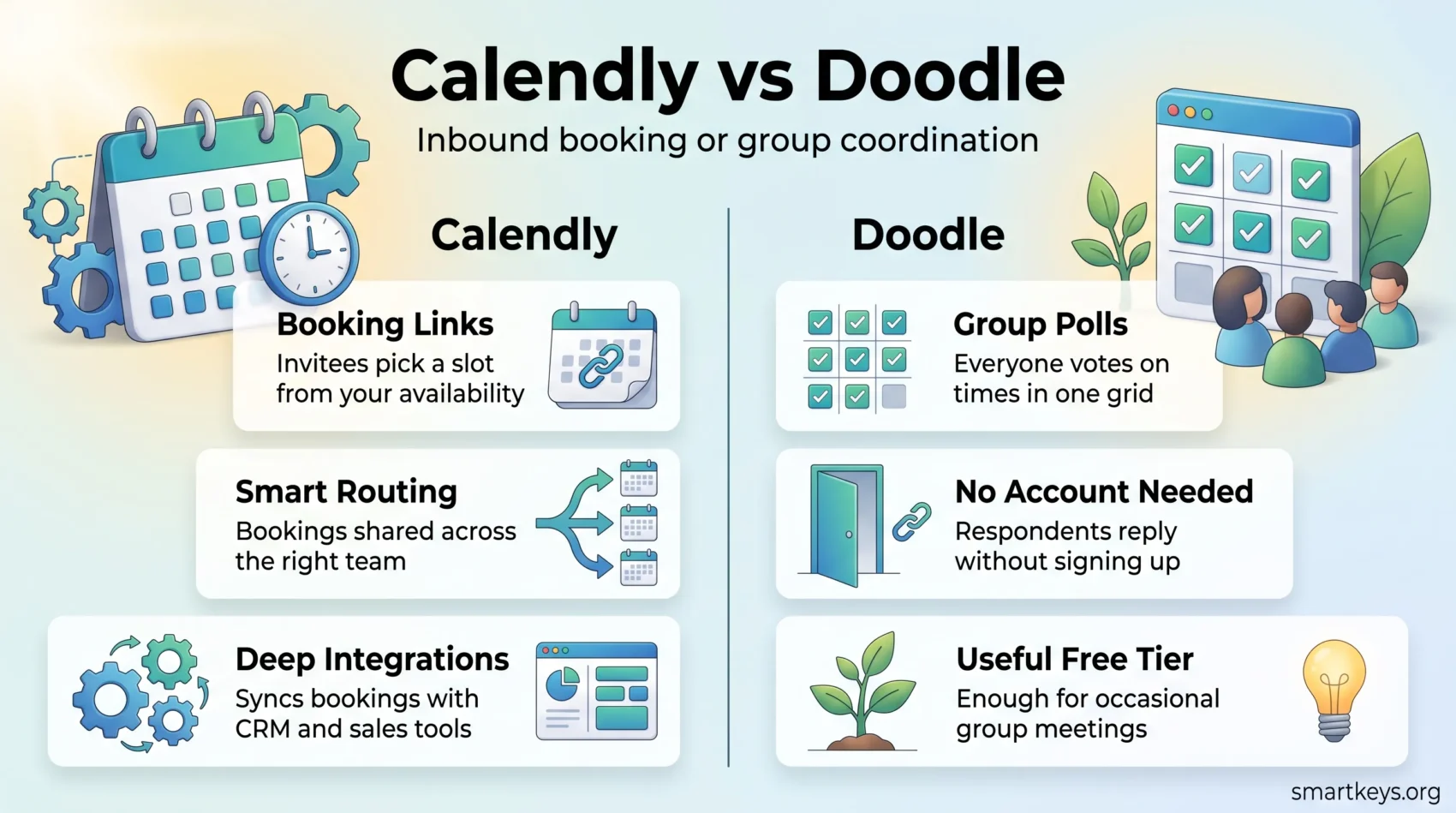
Calendly vs Doodle: The Core Difference
Both remove the back-and-forth, but they optimise for different moments.
Calendly optimises for the inbound booking: someone needs time with you, and you want it handled without your involvement. It suits repeating patterns such as demo calls, interviews, client sessions and office hours.
Doodle optimises for the group decision: six people need to be in one room, no calendar is public, and you need to see the overlap. A booking link does not solve that well.
A few consequences follow from that split:
- Calendly’s free tier allows only one event type, so it works as a trial rather than a long-term free plan.
- Doodle’s free tier includes a real Group Poll, which is enough for someone who organises a group meeting a few times a year.
- Calendly’s paid tiers buy routing, CRM sync and now AI meeting recaps. Doodle’s paid tiers mostly buy volume, branding and admin control.
- Both start Enterprise at $15,000 a year, so at large scale the price signal no longer separates them. The feature set does.
If your real problem is that you have too many meetings rather than badly scheduled ones, the tool choice is secondary. Our guide to running effective meetings is the better starting point.
Group Scheduling Capabilities
Group scheduling is where the two products diverge most clearly.
Doodle’s Group Poll
The host proposes a set of candidate times and shares one link. Participants mark the slots that work, and everyone sees the same grid. The strength is legibility: with fifteen respondents you can read the answer at a glance, and you can see who is blocking the best option.
It also works across organisations. Because respondents need no account and no calendar connection, it suits committees, boards and volunteer groups where you cannot assume shared software. That is the same reason it fits teams that already work largely in writing rather than in calls, a pattern we cover in our guide to asynchronous communication tools.
Calendly’s Meeting Polls
Calendly has a comparable Meeting Poll feature. It works, and it is convenient if you are already in Calendly for everything else. It is less visually direct than Doodle’s grid, and it is a secondary feature rather than the product’s core.
For hybrid teams, the harder problem is usually not finding the slot but running the meeting well once half the room is remote. Our notes on hybrid meeting etiquette cover that side.

Integrations and Compatibility
Integrations decide how much manual work a scheduling tool actually removes, so check them before you check the price.
Calendly’s Integrations
Calendly connects to more than 100 apps. The list includes Google Calendar, Outlook, Zoom, Microsoft Teams, Slack, Salesforce, HubSpot, Marketo, Pardot, Stripe, PayPal and Zapier. There is also a documented scheduling API and webhooks, so a developer can push booking events into your own systems.
That depth is the practical argument for Calendly in a sales context, where a booking should create or update a CRM record without anyone retyping it. Our guide to remote sales teams covers how that fits the rest of the stack. If you want to connect tools that have no native integration, our Zapier vs Integromat comparison is a useful next read.
Doodle’s Integrations
Doodle covers the essentials rather than the long tail: Google Calendar, Outlook and Microsoft 365, Zoom, Microsoft Teams, Webex, and Stripe for taking payment on paid plans.
For most teams that is enough, because the meeting still lands in the calendar and the video link still works. What you give up is the automatic connection to a CRM or marketing platform. If your video calls are the constraint rather than the scheduling, our Zoom vs Microsoft Teams comparison is more relevant than either scheduling tool.
Pricing in 2026
Both vendors publish per-seat pricing, and both discount annual billing. The figures below come from each vendor’s own pricing pages.
Calendly Pricing
- Free: 1 event type, 1 calendar connection, video conferencing links, mobile apps and the browser extension.
- Standard: $10 per seat per month billed annually, or $12 billed monthly. Unlimited event types, multiple calendars, HubSpot, Stripe, PayPal and Zapier connections, automated reminders and 24/7 chat support.
- Standard Plus: $18 per seat per month billed annually, or $24 monthly. Everything in Standard plus unlimited Notetaker recaps and the Callie assistant.
- Teams: $16 per seat per month billed annually, or $20 monthly. Adds Salesforce sync, round-robin routing, lead routing from web forms and advanced admin controls, with single sign-on available as an add-on.
- Teams Plus: $24 per seat per month billed annually, or $32 monthly. Teams features plus unlimited Notetaker and Callie for the whole team.
- Enterprise: from $15,000 a year, quoted for around 50 seats and up. Adds SAML single sign-on, domain control, audit logs, Microsoft Dynamics 365 and dedicated support.
The important detail is that the AI products are not included in Standard or Teams. Notetaker and Callie sit on the Plus tiers, which cost a flat $8 per seat per month more. Users on Free, Standard and Teams get a 14-day trial and then 5 recaps a month. Large accounts also see the per-seat rate fall in bands as seat count rises.
Doodle Pricing
- Free: 1 Group Poll, 1 Booking Page, 1 one-to-one page, basic Sign-up Sheets and 1 calendar connection. No credit card required.
- Pro: $132 a year, about $11 a month, or $15 billed monthly. Unlimited Group Polls, Booking Pages, one-to-one pages and Sign-up Sheets, advanced settings, Zoom, Microsoft Teams and Webex links, and no ads.
- Team: $8.95 per user per month billed annually with a two-seat minimum, or $19.95 billed monthly. Adds an admin console, roles and permissions, co-hosting, booking on behalf of colleagues, activity reports, custom branding, Stripe payments and AI-written meeting descriptions.
- Enterprise: from $15,000 a year. Adds AI time intelligence, engagement analytics, organisation-wide focus policies, single sign-on, multi-factor authentication, role-based access, a dedicated customer success manager and a 99.9% uptime commitment.
Two quirks matter. Doodle’s Team plan is cheaper per user than its solo Pro plan, so two colleagues pay less each than one person alone. Annual plans are also billed a year up front.
User Experience
Calendly
Calendly is polished, and the core booking flow is still quick to set up. The cost of two years of expansion is surface area: routing, workflows, contacts, payments and now two AI products. Someone who only wants a booking link will meet settings they do not need. If the calendar itself is the mess, no scheduler fixes that; our guide to calendar management deals with the habits underneath.
Doodle
Doodle is faster to learn and harder to get wrong. Creating a poll takes a couple of minutes, and respondents need no account. The trade-off is the ceiling: once you want conditional routing or a CRM record, you have reached it. For recurring conversations the format matters more than the tool, as our guide to the one-to-one meeting shows.
Which Tool Fits Which Team
Choose Calendly if bookings come to you from outside and something has to happen with them afterwards. Sales teams, recruiters, consultants and support organisations fit that shape, and the Teams tier is where routing and CRM sync start.
Choose Doodle if your problem is coordination rather than intake. Committees, project groups, clubs, teaching staff and small internal teams get most of what they need from Group Polls, often on the free or Pro tier.
Distributed teams sit between the two. If people rarely share working hours, a booking link is often the wrong instrument at all, as our guide to virtual offices in hybrid work explains. Budget decides little here: at the mid tier both cost between $9 and $16 per seat per month.
Pros and Cons
Calendly’s strengths are the integration catalogue, routing and the depth of its paid tiers. Its weaknesses are a free tier that is really a trial, growing complexity, and an AI suite that costs extra. If you budgeted for Notetaker at the Standard price, Standard Plus is an 80% jump per seat.
Doodle’s strengths are speed, a genuinely usable free tier and the best group poll on the market. Its weaknesses are thinner business functionality, a two-seat minimum on Team that penalises solo users, and AI features that are newer and less proven than Calendly’s.
Neither tool is a bad product. They are answers to different questions, priced as though they were answers to the same one.
Conclusion
Calendly in 2026 is a meeting platform with a scheduler at its centre. It books the meeting, routes it to the right person, syncs it to your CRM and, on the Plus tiers, writes up what was decided. Doodle is still the fastest way to get a group to agree on a time, with AI ambitions that are real but early and the most useful free tier in the category. Pick Calendly for inbound booking and post-meeting automation. Pick Doodle for group coordination and low friction. If you are still assembling the rest of your stack, our roundup of productivity apps and our comparison of Slack or Microsoft Teams cover the tools a scheduler usually sits next to.
Found this useful?
Make SmartKeys a preferred source on Google, and our articles will surface more often in your Top Stories, AI Overviews, and AI Mode.
Add as Preferred Source