
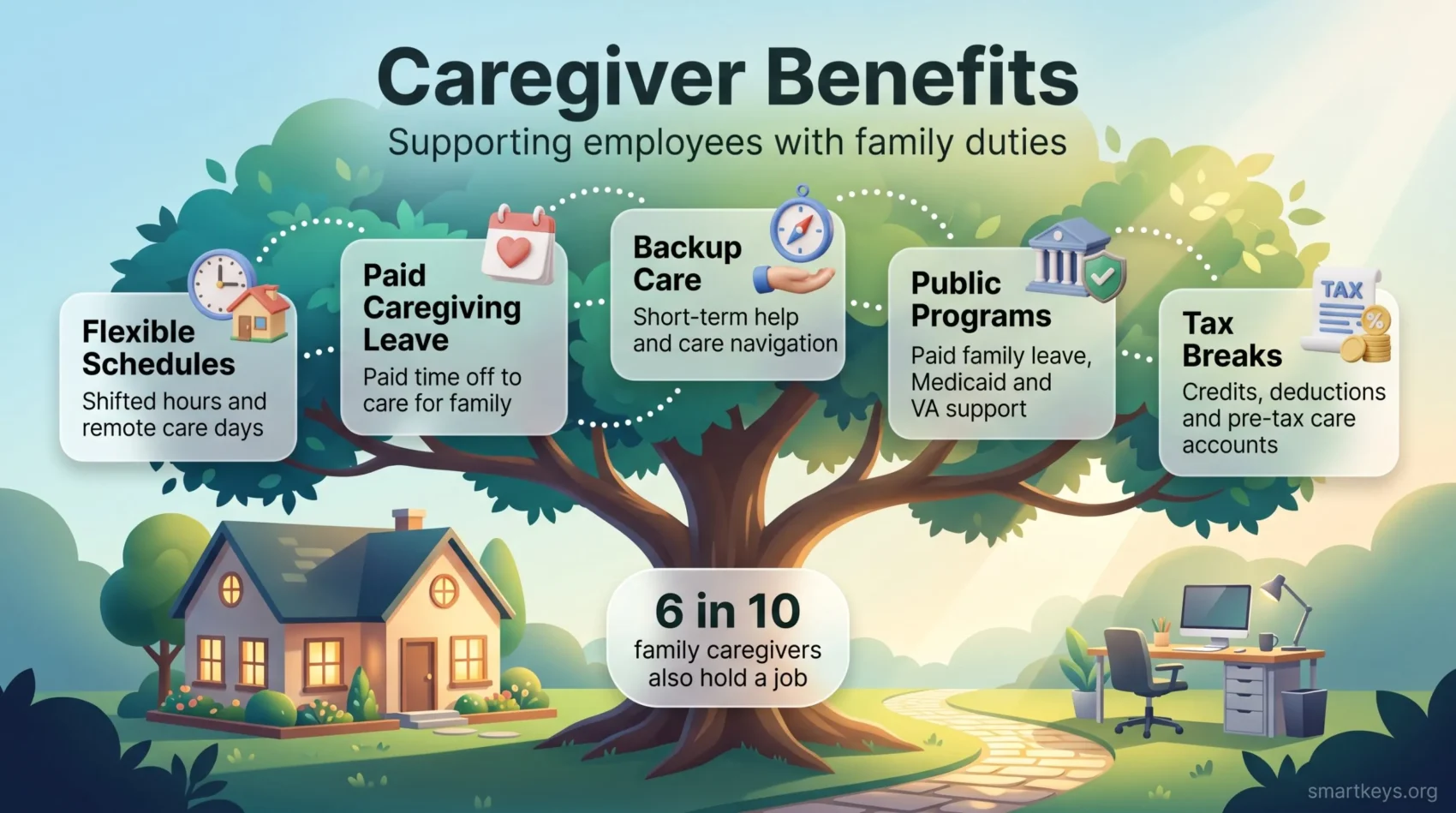
About 63 million Americans now care for a family member, according to AARP’s Caregiving in the US 2025 report. That is nearly one in four adults, and 20 million more than in 2015. Six in ten of these caregivers also hold a job.
So caregiving is not a niche issue for HR. A colleague who suddenly asks for part-time hours may be looking after a parent with dementia or a partner after surgery.
November is National Family Caregivers Month in the US, a good moment to check how well your workplace supports these employees. This guide explains what employers can offer, plus the public programs employees can use: paid family leave, Medicaid home care, VA support and tax breaks.
Key Takeaways
- About 63 million Americans are family caregivers, and 6 in 10 of them are employed.
- AARP values unpaid family care at about $1 trillion a year and puts average out-of-pocket costs at roughly $7,200 per caregiver.
- Caregiver benefits are employer programs such as flexible schedules, paid caregiving leave, backup care and care navigation.
- Public support comes from state paid family leave, FMLA job protection, Medicaid home care, VA caregiver programs and tax rules.
What Caregiver Benefits Are and Why They Matter at Work
Caregiver benefits are workplace programs that help employees look after a family member without losing their job or their health. The family member might be an aging parent, a spouse with a chronic illness or an adult child with a disability. Child care for healthy children is usually handled separately, in parental and childcare benefits.
The pressure on working caregivers is real. AARP’s 2025 survey found that about half of employed caregivers experience work disruptions, such as arriving late or leaving early. Across all caregivers, nearly one in four provides 40 or more hours of care per week, and nearly one in three is also raising children under 18. This group is often called the “sandwich generation”.
The money side is heavy too. AARP’s 2026 Valuing the Invaluable report estimates that family caregivers of adults provide about 49.5 billion hours of care a year. Those hours are worth about $1.01 trillion. On top of the unpaid time, AARP’s 2025 caregiving report found that caregivers spend roughly $7,200 a year of their own money on care.
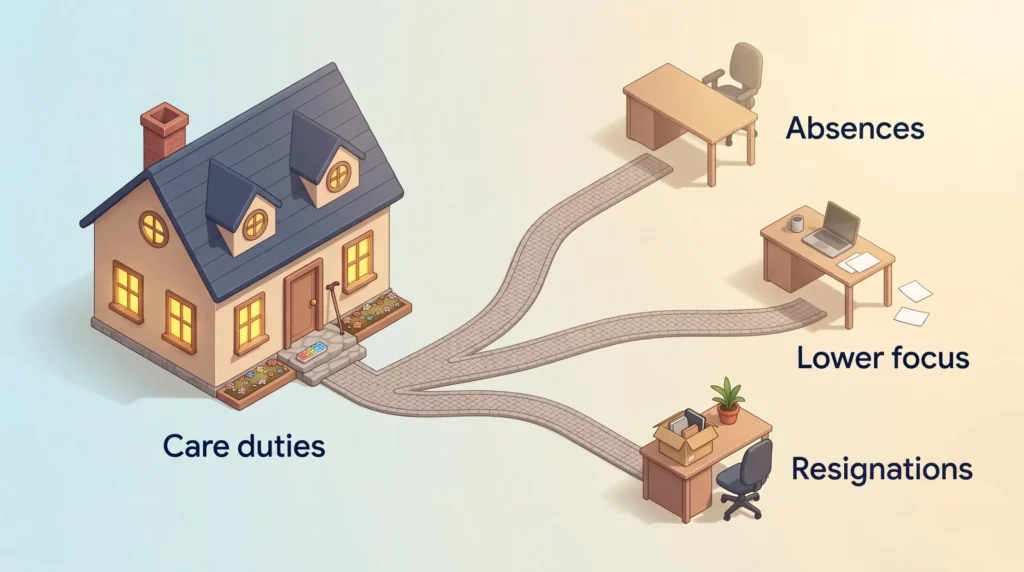
For employers, this shows up as absences, lower focus and quiet resignations. Caregiving strain is a common driver of employee burnout. It also affects talent retention, because experienced people in their 40s and 50s are the most likely to carry these duties. The demographic shifts in the workforce mean this group will only grow. As the population ages and the silver economy expands, more employees will be caring for older relatives.
What Employers Can Offer: The Core Caregiver Benefits
A good caregiver program does not have to be expensive. Most of the value comes from flexibility and clear information.
1. Flexible schedules and remote options
Flexibility is the benefit caregivers ask for most often. It can mean shifted start times, compressed weeks or the option to work from home on care days. Our guide to flexible work schedules covers the models that work. For roles that cannot flex, a job sharing model can keep a skilled caregiver on the team.
Flexibility only helps if managers support it. Judge caregivers on results, not visible desk time. The principles of outcome-based work help here.
2. Paid caregiving leave
Some employers top up state paid leave or offer their own paid days for family care. This matters most in states without a public program. Clarify whether your policy covers in-laws, grandparents and siblings, since federal FMLA does not. A flexible PTO policy can help, but caregivers often need more than vacation days.
3. Dependent care FSA
A dependent care flexible spending account (FSA) lets employees pay certain care costs with pre-tax money. From 2026, the annual limit rose from $5,000 to $7,500 per household under the One Big Beautiful Bill Act, as Mercer summarizes. Many employees don’t know that it can cover adult day care for a spouse or dependent adult who cannot care for themselves and lives with them.
4. Backup care and care navigation
Backup care provides short-term in-home or center-based care when the usual arrangement falls through. Care navigation goes further: a trained advisor helps the employee find home care agencies, compare facilities and understand Medicaid or insurance rules. After a sudden hospital discharge, this can save days of phone calls.
5. Employee assistance and peer support
An employee assistance program (EAP), a confidential counseling and referral service paid for by the employer, can connect caregivers with counseling and legal or financial advice. Caregiver support groups or employee resource groups add peer help. Both work best in a culture of psychological safety, where people feel safe to mention family duties.
For a wider view of how benefit packages are changing, see the evolution of employee benefits.
How to Build a Caregiver-Friendly Policy in Five Steps
These five steps help HR teams and small business owners turn the options above into a working policy.
- Ask first. Run a short anonymous survey to learn how many employees provide care and what they need. Short employee engagement surveys work well for this, as long as answers stay anonymous.
- Map what already exists. Check your state leave program, EAP, FSA and PTO rules. Many companies already offer more than employees realize.
- Close the biggest gap. Often that is flexibility or leave for relatives beyond parents, spouses and children.
- Train managers. Managers decide whether a policy is used or ignored. Give them simple scripts for care-related requests.
- Communicate plainly. Put all caregiver resources on one page and repeat the message during open enrollment.
If you already have a hybrid work policy, add a short caregiver section rather than writing a new document.
Paid Family Leave and FMLA: What Employees Can Claim
Beyond employer programs, employees have legal rights to time off: federal job protection and, in some states, wage replacement.
FMLA: unpaid but job-protected
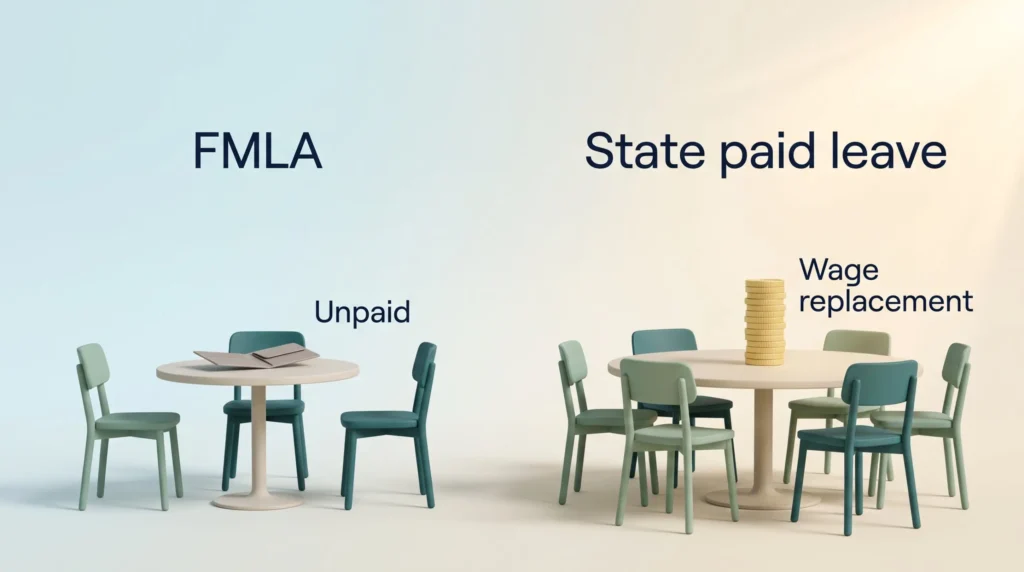
The federal Family and Medical Leave Act (FMLA) gives eligible employees up to 12 weeks of unpaid, job-protected leave per year. It can be used to care for a spouse, child or parent with a serious health condition. To qualify, an employee must have worked for the employer for at least 12 months and at least 1,250 hours in the past year. The worksite must also have 50 or more employees within 75 miles.
The catch: FMLA does not cover in-laws, grandparents or siblings. It also pays nothing.
State paid family leave programs
State programs fill the pay gap. According to New America, 12 states plus Washington, DC, are paying benefits in 2026. They are California, Colorado, Connecticut, Delaware, Maine, Massachusetts, Minnesota, New Jersey, New York, Oregon, Rhode Island and Washington. Delaware and Minnesota started paying on January 1, 2026, and Maine followed on May 1, 2026. Maryland and Virginia have passed programs that start paying in 2028. Virginia’s law, signed in spring 2026, is the first in the South.
These programs cover a wider circle of relatives than FMLA. All include grandparents, and most also cover siblings, grandchildren and parents-in-law. Benefit amounts and job protection differ by state.
A typical application checklist looks like this:
- Tell your employer about the need for leave, ideally 30 days ahead when it is foreseeable.
- Get a certification from the family member’s health care provider.
- File the state claim and any employer forms.
- Keep copies of medical records and all correspondence.
For the wider legal picture, see our overview of future of work legislation.
Medicaid Home Care: Getting Paid as a Family Caregiver
Paid leave covers a few weeks. For long-term care, Medicaid is the main source of paid home care in the US for people with low income and assets.
Medicaid personal care services can cover help with bathing, dressing, toileting and meals. Home and Community-Based Services (HCBS) waivers go further. They let people who would qualify for a nursing home get that level of care at home instead.
Many states run self-directed programs. In these, the person receiving care can hire and direct their own helper, and that helper can often be a family member. Rules vary widely. Some states exclude spouses or legal guardians, and many require background checks or training before payment starts. Income limits and pay rates also differ from state to state.
To get started:
- Confirm Medicaid eligibility for the person needing care.
- Contact the state Medicaid agency or the local Area Agency on Aging.
- Gather medical records and a doctor’s assessment of care needs.
- Ask specifically about self-directed care options.
Enrollment can take several months, so start early. The free Eldercare Locator (1-800-677-1116) connects families with their local Area Agency on Aging. These agencies can also point to counseling, meal delivery and respite care, which gives the regular caregiver a short break while someone else takes over.
VA Support for Caregivers of Veterans
Families caring for a veteran have extra options through the Department of Veterans Affairs (VA).
Program of Comprehensive Assistance for Family Caregivers (PCAFC)
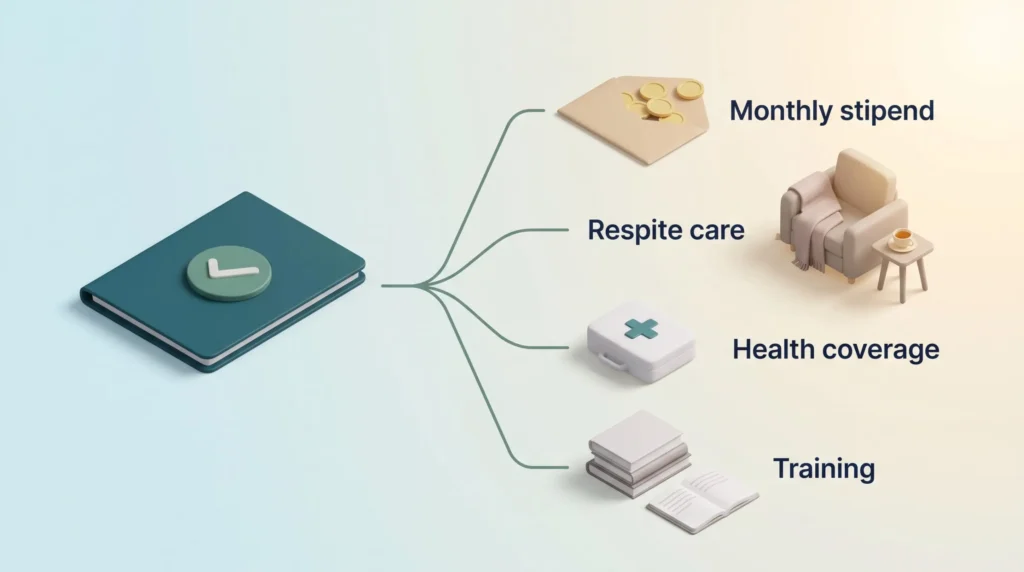
This is the VA’s most generous caregiver program. According to the VA, the veteran needs a VA disability rating of 70% or higher for conditions linked to military service (a service-connected rating) and at least six months of continuous, in-person personal care. Approved primary caregivers can receive:
- A monthly stipend paid directly to the caregiver.
- At least 30 days of respite care per year.
- Health coverage through CHAMPVA, the VA’s health program for eligible family members, if they have no other insurance.
- Education, training and mental health counseling.
Applications use VA Form 10-10CG. The VA Caregiver Support Line (1-855-260-3274) helps with questions.
Aid and Attendance, Housebound and Veteran Directed Care
Veterans or surviving spouses who receive a VA pension may qualify for extra monthly payments if they need help with daily activities (Aid and Attendance) or are largely confined to their home (Housebound). The money can help pay for in-home care.
Veteran Directed Care gives eligible veterans a flexible budget to hire their own caregivers, which can include family members. Availability depends on the local VA medical center.
Long-Term Care Insurance and Personal Care Agreements
Long-term care insurance (LTCI) pays for help with daily activities when someone can no longer manage alone. Whether it pays family members depends on the policy, so check the terms before making plans.
If a family member is paid for care, from any source, a written personal care agreement protects everyone. It should cover:
- The caregiver’s duties and weekly hours.
- Pay rate and payment schedule.
- How hours and expenses are recorded.
An elder-law attorney can review it, because the agreement can affect later Medicaid eligibility and taxes.
Tax Breaks for Working Caregivers
Several federal tax rules ease the cost of caring for a relative, whatever the employer offers.
- Credit for Other Dependents: up to $500 for a qualifying relative you support, such as a parent with low income.
- Child and Dependent Care Credit: covers care costs so you can work, for up to $3,000 of expenses for one qualifying person or $6,000 for two. From 2026, the maximum credit rate rises from 35% to 50% for lower incomes.
- Medical expense deduction: unreimbursed medical costs, including some home care, are deductible above 7.5% of adjusted gross income if you itemize.
- Head of household status: if you pay more than half the cost of keeping up a home for a qualifying relative, you may file as head of household. The 2026 standard deduction is $24,150 for this status, compared with $16,100 for single filers.
Some states add their own caregiver credits. A tax professional can confirm what applies to you.
Choosing the Right Support for Your Situation
Start from the need, not the program. A few weeks of care after surgery points to paid leave. Ongoing daily help points to Medicaid, VA programs or insurance. The income of the person receiving care decides Medicaid eligibility, and your state and employer decide which leave you can use.
Caregivers also need to protect their own health. Our guides on setting boundaries at work, stress management, burnout prevention and work-life balance offer practical steps. Parents juggling children and aging relatives may also find our working parents guide useful. If caregiving forced a career break, returnship programs can help with the way back.
Found this useful?
Make SmartKeys a preferred source on Google, and our articles will surface more often in your Top Stories, AI Overviews, and AI Mode.
Add as Preferred SourceFAQ
What are caregiver benefits?
Caregiver benefits are employer programs that help employees care for a family member while keeping their job. Common examples are flexible schedules, paid caregiving leave, a dependent care FSA, backup care, care navigation services and an employee assistance program. They mainly target people caring for aging parents, sick spouses or relatives with disabilities. Many benefits cost little, because flexibility and clear information deliver much of the value. Employees can combine them with public support such as state paid family leave, Medicaid home care or VA programs.
Can I get paid for caring for a family member?
Yes, in many cases. The most common route is a Medicaid self-directed care program, where the person receiving care can hire a relative as their paid helper. Rules vary by state, and some states exclude spouses. Caregivers of veterans may receive a monthly stipend through the VA’s PCAFC program. Some long-term care insurance policies also pay family members. State paid family leave replaces part of your wages while you take time off to provide care, but it does not pay you for the care itself.
How do I apply for paid family leave?
First check whether your state runs a paid family leave program. In 2026, 12 states and Washington, DC, pay benefits. Then notify your employer, ideally 30 days ahead if the leave is foreseeable. Ask the family member’s doctor for a medical certification and file the claim with your state agency, usually online. Also ask HR whether your employer offers its own paid leave, because some companies do even in states without a program.
Does FMLA cover caring for a grandparent or sibling?
No. Federal FMLA only covers care for a spouse, child or parent with a serious health condition. In-laws, grandparents and siblings are not included. However, most state paid family leave programs use a wider definition of family. All include grandparents, and most also include siblings and parents-in-law. Some employers extend their own leave policies to a broader circle of relatives too, so check your state rules and your employee handbook.
What is long-term care insurance and does it pay family caregivers?
Long-term care insurance pays for help with daily activities, such as bathing and dressing, when someone can no longer manage alone. Policies can cover home health care, personal care and adult day care. Whether a policy pays family members depends on its terms. Some allow it, while others only pay licensed agencies or require detailed invoices. Read the policy carefully or ask the insurer before you plan around it.
Can I get assistance from the VA for caring for a family member?
Yes, if the person you care for is a veteran. The Program of Comprehensive Assistance for Family Caregivers (PCAFC) offers a monthly stipend, at least 30 days of respite care per year, training and health coverage. The veteran needs a service-connected disability rating of 70% or higher and at least six months of continuous personal care. Other options include Aid and Attendance, Housebound benefits and Veteran Directed Care. The VA Caregiver Support Line at 1-855-260-3274 can help you find the right program.
Are there tax benefits for caregivers?
Yes. Caregivers may claim the $500 Credit for Other Dependents for a qualifying relative. The Child and Dependent Care Credit can apply to care costs for an adult who cannot care for themselves, and its maximum rate rises to 50% from 2026. Unreimbursed medical costs above 7.5% of adjusted gross income are deductible if you itemize. A dependent care FSA at work lets you set aside up to $7,500 pre-tax from 2026. A tax professional can confirm which rules fit your case.