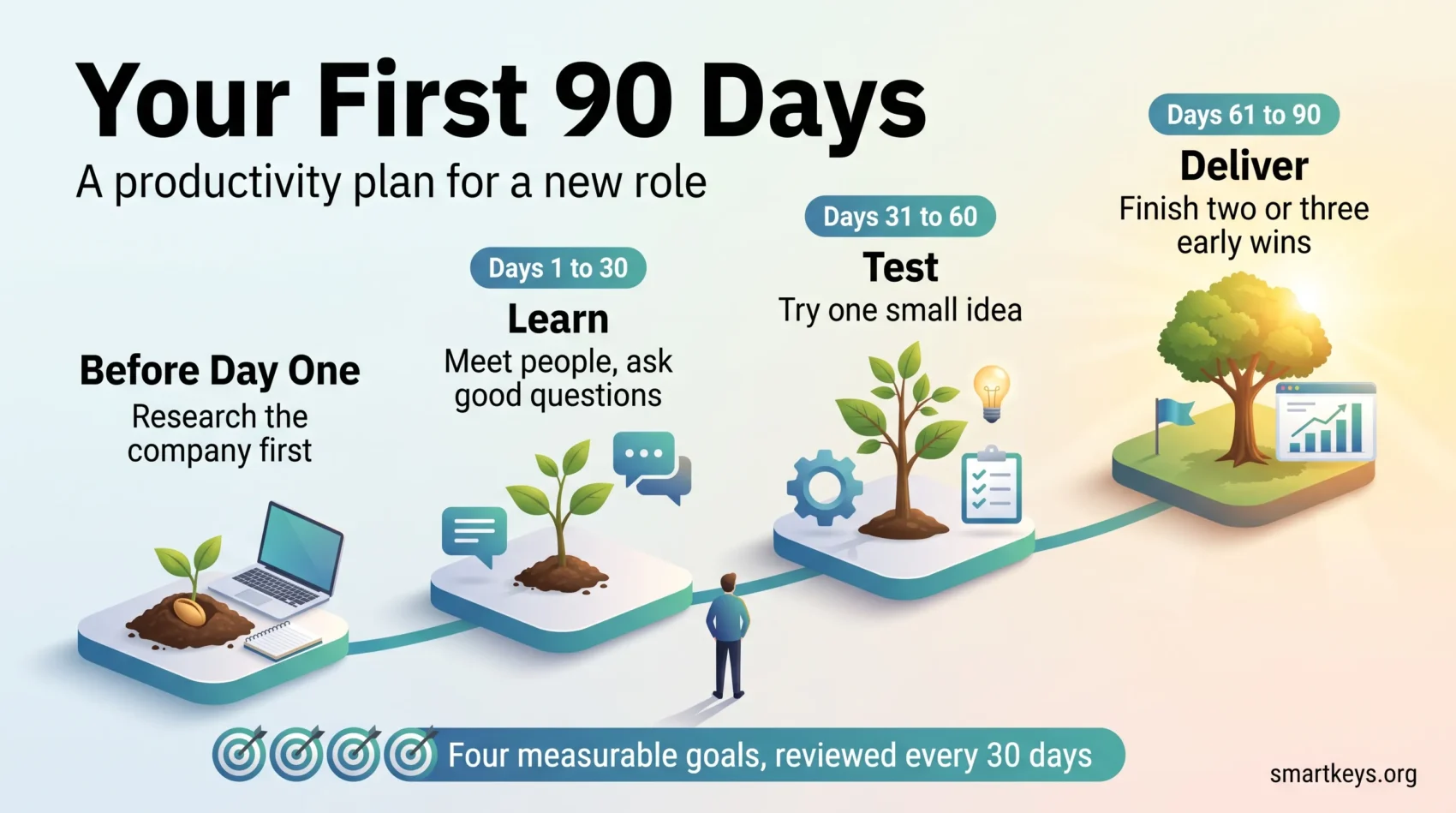
Starting a new job is exciting and unsettling at the same time. A first 90 days plan is a written answer to one question: what will you learn, and what will you deliver, in your first three months? Putting that on paper turns a vague sense of pressure into a short list you can work through.
The pressure is real. The room to manoeuvre is bigger than it feels. Gallup, which surveys employees worldwide, reports that only 12 percent of employees strongly agree their organization does a great job of onboarding, the process of bringing a new hire up to speed. Gallup also finds that only about half of employees strongly agree they know what is expected of them at work. Most people are never handed a clear plan. If you want one, you write it yourself.
That is good news. Nobody expects you to fix anything in week one. What colleagues notice is whether you ask sharp questions, listen properly, and turn what you hear into a few visible results.
Key Takeaways
- A first 90 days plan lists what you will learn and what you will deliver.
- Most employers have no structured onboarding, so writing the plan falls to you.
- Split the three months into learning, testing, and delivering.
- Four measurable goals beat a long list of good intentions.
- Pick two or three early wins your manager can actually see.
Prepare Before Your First Day
The week before you start is quiet, which makes it valuable. Read the company’s recent announcements, its published results, its help pages and its open job ads. What a company hires for tells you where it thinks it is short. From that reading, write down three guesses about what the business is trying to achieve this year. You are not trying to be right. You are giving yourself something specific to test in your first conversations.
Michael Watkins, whose book The First 90 Days is the standard reference on job transitions, argues that culture matters as much as strategy. Culture here means the unwritten rules: how decisions actually get made, which meetings count, who gets credit. Watch for the signals. Do leaders praise individual visibility or quiet teamwork? Does a decision need a meeting, a document, or a quick message? Getting this wrong is the fastest way to look tone deaf in an otherwise good first month. And whatever worked at your last employer is a hypothesis here, not a plan.
The 30-60-90 Structure: Learn, Test, Deliver
Three months is long enough to feel formless. Splitting it into three blocks gives the time a shape.
Days 1 to 30: learn. Meet people, read documents, watch how work moves through the team. Your output is understanding, plus a reputation for asking good questions.
Days 31 to 60: test. Check your early conclusions. Propose something small, run it past the people it affects, and see whether the reaction matches what you expected.
Days 61 to 90: deliver. Finish two or three things properly. One completed improvement says more about you than five half-started ones.
Write down what you expect to produce in each block, in terms someone else could check. “Understand the reporting process” is not checkable. “Document the current monthly reporting steps and flag the two slowest” is. Then book a short review at day 30, day 60 and day 90, so the plan gets corrected while there is still time. If you already run a weekly planning session, use it to keep these blocks on track.
Turn What You Learn Into Four Measurable Goals
A plan with fifteen goals is a wish list. Four is a plan.
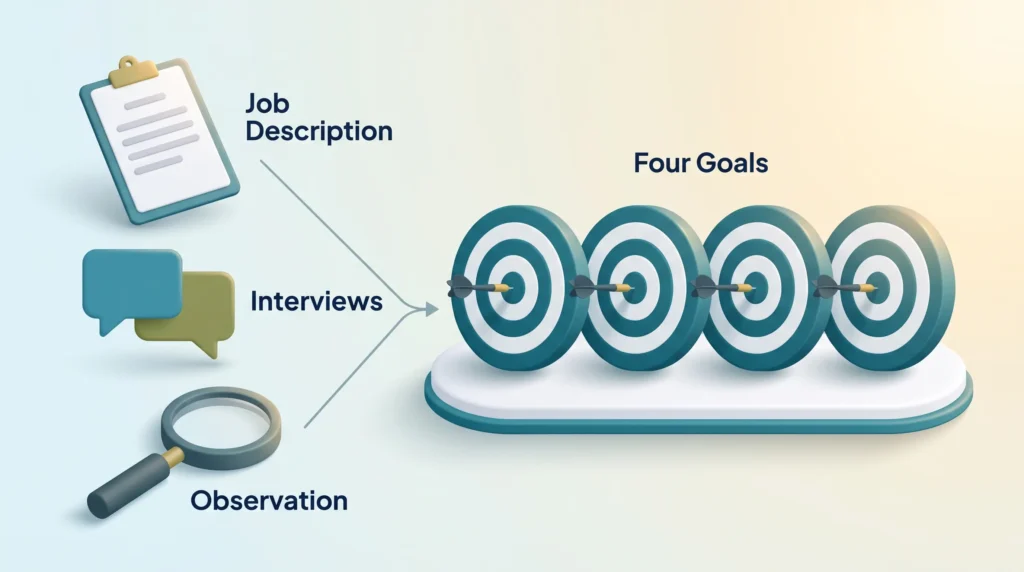
Build them from three sources: your job description, what you were told in interviews, and what you observe in the first two weeks. Where those disagree, you have found something worth asking about. Each goal needs a measure, a deadline, and one sentence on why it matters to the business.
Matt Spielman, an executive coach and author of Inflection Points, uses an ACHIEVE framework to keep goals concrete rather than aspirational. The mechanism matters more than the acronym: a goal you cannot measure cannot be reviewed, and a goal nobody reviews quietly disappears. For a tighter structure, a personal OKR framework pairs each objective with two or three measurable results, and general goal setting methods apply here too.
Keep learning goals and contribution goals in separate lists. “Learn how pricing approvals work” and “cut the approval step from five days to three” are different kinds of work. Two of each is a reasonable split.
Then send the plan to your manager and ask them to argue with it. That single step converts private guesswork into a shared agreement, and it surfaces the priority you missed. Keep a record of progress against each goal, whether that is a goal tracking template or a page in your notes, so the day 90 conversation is about evidence rather than memory.
Map the People Who Matter
Ask your manager for three lists: the people you will work with directly, the peers whose cooperation you will need, and the senior people whose decisions affect your goals. Fifteen names is plenty.
Prioritise three kinds of people. Those who control resources, because they decide whether anything you propose gets funded. Those who remember why things are the way they are, because they save you from re-opening a settled argument. And those whose teams have to adopt whatever you build, because their objections arrive eventually whether you invite them or not.
Open each conversation with the same three questions:
- What are you working on right now, and what went well recently?
- What slows you down that nobody has fixed?
- What would you want from my role in the next three months?
Asking everyone the same questions is deliberate. It lets you compare answers instead of collecting anecdotes. When two people describe the same process differently, that gap is usually where the real problem sits. Active listening, which means summarising what someone said before you respond to it, builds credibility faster than any early opinion you could offer.
Run Interviews That Produce Usable Answers
Book 30-45 minutes per person. Shorter turns into small talk; longer feels like an audit. Use one prepared question set for everyone, then follow the interesting answers. Cover what the team does well, what frustrates people, and what blocks the priorities you were hired to support. Send the questions in advance so people arrive with something better than a first reaction.
Two habits make the difference. First, ask for examples: “when did that last go wrong?” produces facts, while “is that a problem?” produces opinions. Second, close every conversation the same way. Ask what you should look at first, and who else you should talk to. Names you hear three times belong on your list. A simple one-on-one meeting structure keeps these sessions from drifting, and a shared meeting notes template makes the answers comparable later.
Turn Notes Into a Picture You Can Act On
Fifteen conversations produce a lot of raw material and no conclusions. Decide how you will capture it before the first meeting, not after the fifth, and pick one place to keep it.
A single digital note-taking system beats notes scattered across a notebook, three documents and your inbox. For recorded calls, an AI meeting notes workflow can handle the transcript so you can pay attention during the call. Ask permission before you record, every time.
After each conversation, write five lines: the person’s role, what they said their priority is, the evidence they gave, what they are worried about, and what you promised to follow up. That last line protects your reputation more than any of the others.
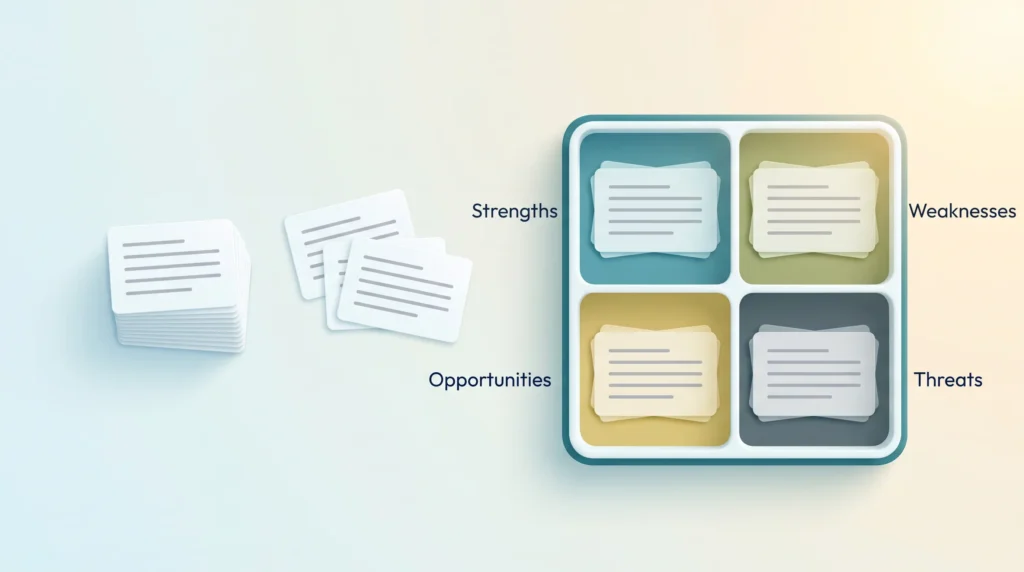
Once you have ten or so, look for patterns. Which problems came up repeatedly? Where did two people contradict each other? Sort the answers into a short strengths, weaknesses, opportunities and threats summary limited to your own area, then share an anonymised version with your manager. A new person’s outside view has a short shelf life.
Match Your Plan to the Situation
The same 90-day plan does not fit every job. Watkins sorts new roles into five situations, summarised by the word STARS: start-up, turnaround, accelerated growth, realignment, and sustaining success.
The difference is practical. In a turnaround, people know something is broken and will accept fast, decisive moves. In a realignment, the team believes things are fine, so the same speed reads as arrogance and you need evidence first. In a start-up you are building structure that does not exist yet. In sustaining success your main risk is breaking something that works.
Ask your manager which of the five they think you are walking into. If their answer differs from what your interviews suggested, that gap is the most important thing you will learn in month one. Judge the pace from the team as well: how much experience, energy and trust is already in the room decides how fast you can move.
Choose Early Wins That Count
An early win is a visible improvement you can finish inside your first quarter. Watkins recommends no more than three or four. Two done well is better than four announced.
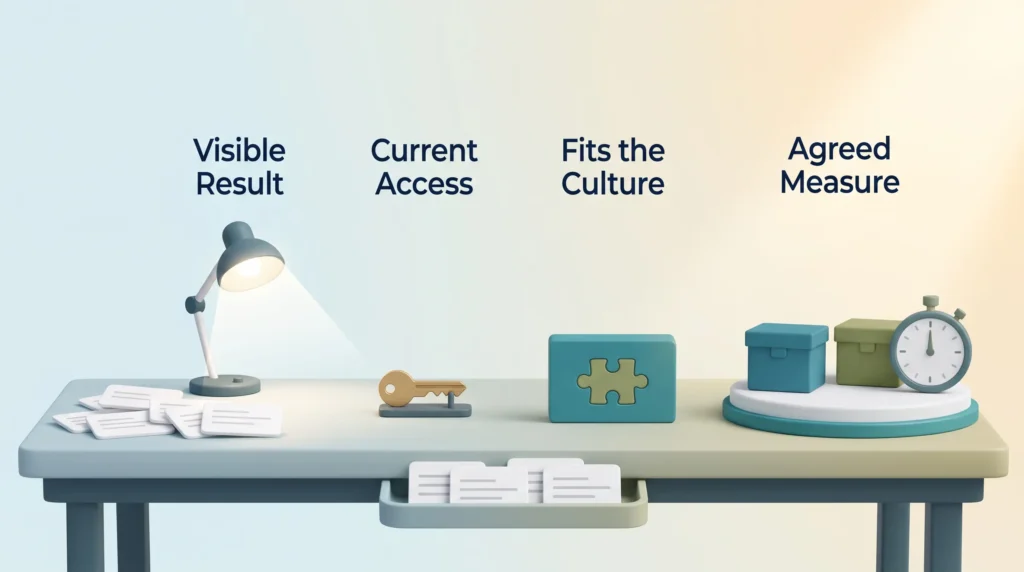
Good candidates share three traits. People can see the result without you explaining it. You can finish it with the access you already have. And it fits how the organisation likes to work, which matters more than the size of the improvement.
Before you start, find one or two colleagues who want the same thing and check your idea against the problem they actually have. Sequence the changes so the team absorbs the first before the second arrives. And write down the measure in advance: hours saved, errors avoided, days removed from a process. Without a number agreed beforehand, your win is a matter of opinion at review time.
Build a Learning Agenda
A learning agenda is a written list of what you still do not know, organised so you can close the gaps deliberately. Watkins suggests three buckets.
- Past: which initiatives succeeded or failed here, and what people believe the reason was.
- Present: how leaders describe the current strategy, and whether their descriptions match.
- Future: what the team expects to be hard in the next year.
The past bucket is the one most people skip. If your bright idea was tried in 2023 and abandoned, you want to hear that in week two, not from a room full of people in week ten. Watch the informal network too, since decisions often travel along paths no org chart shows.
The Conversations to Have With Your Manager
Watkins describes five conversations worth having early, and they work better as separate discussions than as one long meeting: how you each read the situation, what success looks like, what resources you need, how you prefer to work, and how you want to develop.
Put a recurring check-in in the calendar rather than relying on hallway contact. Bring three things each time: progress, risks, and one decision you need from them. Asking for feedback in month one is easier than in month six, because a small correction still feels routine. Companies moving toward continuous performance management, where feedback is ongoing instead of annual, make this simple; if yours has not, a short monthly review of your own gives you the same rhythm.
If You Are Starting Remotely
A remote start removes the accidental conversations that normally teach you how a place works. You have to schedule what would otherwise happen by chance.
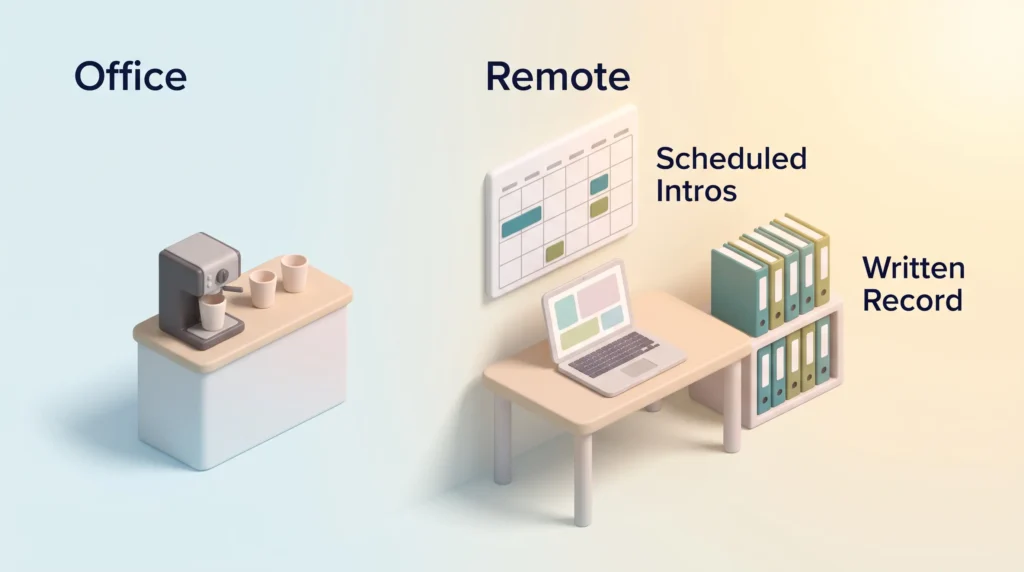
Book short introductions with people you would have met at the coffee machine, and say plainly that the call has no agenda. Read the written record, because in asynchronous teams the decision history usually sits in documents and channels rather than in anyone’s head. Ask early who is expected to see your work, because visibility from a distance does not happen on its own. Steady, predictable follow-through is also what builds trust in a remote team, and a formal or informal mentor shortens the guesswork considerably.
Common Mistakes in the First 90 Days
- Reusing your old playbook. The method that worked at your last company assumed customers, tools and a culture you no longer have. Re-test it before you install it.
- Acting before you understand. Slowing down for two weeks of proper diagnosis usually saves two months of rework.
- Promising more than your access allows. Commitments made before you know who controls what come due at the worst moment.
- Arriving with the answer already decided. If your first month cannot change your mind, you are not learning, you are confirming.
- Skipping relationships to look productive. Technical output alone does not create trust, and trust is what gets your later proposals accepted. Where the workload is genuinely too high, delegating properly beats absorbing it.
- Running at full speed for 90 days. A start is a sprint that lasts a quarter, which is how many new hires talk themselves into exhaustion. Protecting your recovery time is part of the plan, not a reward for finishing it.
Conclusion
Your first 90 days are not a test you pass by working the longest hours. They are a structured chance to replace assumptions with evidence, and evidence with a few results people can see.
Prepare before day one. Ask everyone the same questions and compare the answers. Write four measurable goals and let your manager argue with them. Pick two early wins with a number attached. Book the reviews at day 30, 60 and 90 while there is still time to change course. Do that, and by month four you are not the new person anymore. You are the person whose judgment the team has already seen working.
Found this useful?
Make SmartKeys a preferred source on Google, and our articles will surface more often in your Top Stories, AI Overviews, and AI Mode.
Add as Preferred Source