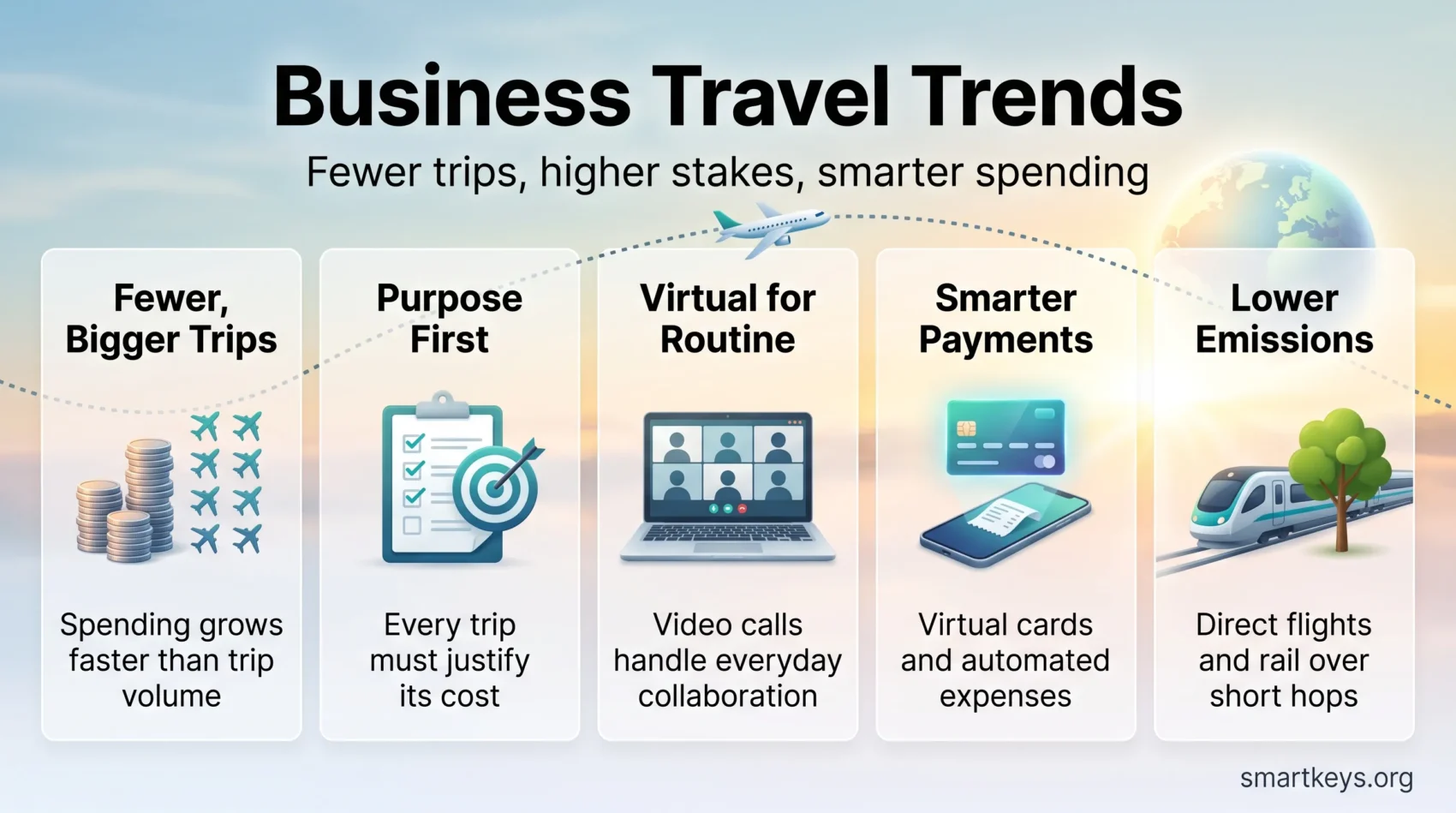
Business travel did not bounce back to what it was before 2020. It settled into something different: companies spend more money on fewer, more deliberate trips. The Global Business Travel Association (GBTA) expects global business travel spending to reach a record $1.71 trillion in 2026, up 7.2% on the year. Trip volume tells another story. GBTA forecasts 1.84 billion business trips in 2026, a rise of just 1.3%.
That gap is the single most useful fact about corporate travel right now. Spending is growing more than five times faster than the number of trips. Prices, not demand, are doing most of the work. For anyone who books, approves or budgets for travel, that changes what a realistic plan looks like.
This article sets out what the 2026 data shows: what travel costs, why companies travel less often but spend more, what technology changed, and which parts of a travel policy are worth rewriting.
Key Takeaways
- Global business travel spending is forecast at a record $1.71 trillion in 2026, while trip volume grows only 1.3% (GBTA).
- Air fares are broadly flat in North America and rising modestly in Europe, Asia and the Middle East (Amex GBT).
- Hotel rates in major North American cities are forecast to rise by roughly 3% to 4% in 2026.
- Frequent travellers expect fewer trips: 53% now anticipate three or more trips a month, down from 63% in 2024 (Deloitte).
- Virtual meetings absorbed routine collaboration, so the trips that remain carry higher expectations.
- Sustainability reporting has moved from voluntary pledges to measured emissions in company filings.
- Travel management is increasingly owned by a named senior role rather than split across departments.
Where Business Travel Stands in 2026
The recovery argument is over. Business travel is bigger in money terms than it has ever been. The interesting question is what companies are buying with that money.
Record Spending, Nearly Flat Trip Volume
GBTA’s 2026 forecast puts global spending at $1.71 trillion, following $1.59 trillion in 2025. Trips move far more slowly: 1.82 billion in 2025 to a projected 1.84 billion in 2026. GBTA attributes the divergence to rising transport and accommodation prices rather than a surge in travel activity, and describes companies as more selective and more focused on what a trip produces.
In practice that means a travel budget can grow year on year while your team is on the road less often. If you plan headcount, event attendance or client visits from a budget line alone, you will overestimate how much travel it buys. GBTA expects spending to pass $2 trillion by 2030.
Which Markets Are Growing
The United States and China dominate the picture. GBTA puts 2026 US spending at $423.0 billion and China at $403.7 billion, together roughly 48% of the global total. The fastest growth is elsewhere: Brazil at 13.8%, Australia at 11.5%, South Korea at 11.3%, Turkey at 10.9% and Japan at 10%.
Volume is not rising everywhere. GBTA reports a 12.3% fall in trip volume in the Middle East, driven by regional conflict, with air travel disruption also weighing on parts of Asia and Europe. If you run a regional budget, the global average is close to useless: a team covering Brazil and a team covering the Gulf face opposite cost curves in the same year. The same logic applies to managing teams across borders, where travel cost is only one of several regional variables.
What Business Travel Actually Costs in 2026
Two line items decide most travel budgets: the flight and the hotel. Both look calmer in 2026 than the spending headline suggests.
Air Fares Are Broadly Stable
American Express Global Business Travel (Amex GBT) forecasts North American fares essentially flat for 2026, with intra-regional business class down 0.3% and economy down 0.5%. Other regions see modest rises: intra-European business class up 4.8%, intra-Asian business class up 3.2% (while intra-Asian economy falls 1.4%), and intra-Middle East business class up 9.0%.
Airlines are leaning on revenue management and premium cabins rather than raising base fares across the board. So the headline fare may not move much while the total cost of a booking does, because seat selection, bag allowances, changes and cabin upgrades are priced separately. If your policy caps the fare but not the extras, your reported savings will not match the invoice.
Hotel Rates Rise Modestly
Amex GBT expects moderate hotel rate growth in 2026 rather than the sharp rises of recent years. Chicago leads its US sample at 4.2%, with New York City and San Francisco around 4%, Nashville 3.6% and Atlanta 2.9%. Toronto is forecast higher, at up to 5.8%.
Amex GBT links the restraint in US rates partly to weaker inbound international demand, alongside broader economic and geopolitical uncertainty. For a travel manager the practical read is that negotiated rate programmes have more room in the US than in Canada, and that a city-by-city view beats a single national assumption.
Fewer Trips, Higher Stakes
The clearest behavioural change is not that people stopped travelling. It is that each trip now has to justify itself.
What Counts as a Trip Worth Taking
Deloitte’s corporate traveller research shows frequent travellers expecting to go out less: 53% expect three or more trips a month in 2026, down from 63% in 2024. Deloitte frames the wider 2026 outlook as cautious, with economic uncertainty tempering both corporate and leisure momentum.
Companies are responding by defining the purpose of a trip more explicitly. A typical filter looks like this: does the meeting start or renew a relationship, close or rescue a deal, or bring a distributed team physically together for something that needs a room? Status updates, routine reviews and internal check-ins fail that filter. Written work and recorded updates increasingly replace the flights that used to carry them, which is one reason newer meeting technologies are being assessed on cost per avoided trip rather than novelty.
Virtual Meetings Took the Routine Work
Video calls and shared documents now handle the collaboration that once needed a plane. That is the mechanism behind the flat trip curve, and it is covered in more depth in our guide to virtual conferences and hybrid events. The consequence for the trips that survive is a raised bar: if someone flies for six hours, the agenda is expected to be worth six hours of flying.
There is a cost to getting this wrong in the other direction. Teams that cut travel to zero tend to lose the informal contact that keeps relationships and onboarding working, a pattern visible in the research on hybrid work and employee wellbeing. The aim is fewer, better trips, not no trips.
Bleisure and What Travellers Now Expect
Bleisure travel, meaning a business trip extended with personal days at the destination, moved from perk to standard practice. Employers allow it because it costs the company almost nothing: the flight is already paid for, and the employee covers the extra nights.
Two details decide whether it works. The first is insurance and duty of care, which usually stops at the end of the business portion unless the policy says otherwise. The second is tax and immigration, because extra days can affect permanent establishment risk or visa conditions in some countries. Companies that write those boundaries down avoid the awkward case-by-case decisions later.
Expectations around the trip itself have also shifted. Travellers want the booking to work on a phone, the reimbursement to be automatic, and the schedule to leave room for actual work between meetings. Practical habits for that are covered in our guide to staying productive while travelling for work. Younger employees in particular judge a travel policy by how little friction it creates.
Technology in Corporate Travel
Travel technology promises a great deal. It is worth separating what is now routine from what is still a pilot.
AI in Booking and Expense Work
The dependable uses are unglamorous. Booking tools flag when a fare breaches policy before the trip is confirmed. Expense tools read a receipt photo, extract the amount, currency and merchant, and match it to a card transaction. Forecasting tools use historical spend to predict what a route or a quarter will cost. Each of these removes manual work rather than making decisions.
What still needs supervision is anything that books, approves or reimburses on its own. The broader pattern of where workplace AI delivers and where it stalls is set out in our review of AI and automation at work. Travel is not an exception to it. Tools built for the job, such as Navan, combine booking and expense in one system, while finance teams often compare general options like Expensify and QuickBooks for the reimbursement side.
Virtual Cards and Contactless Payment
A virtual card is a single-use or single-purpose card number issued for one trip, one supplier or one budget. Because the limit and the validity window are set in advance, an out-of-policy charge is declined rather than argued about afterwards, and the transaction arrives already tagged to a cost centre. That is the practical reason they spread faster than most travel technology: they cut reconciliation work for finance and remove the personal-card float for the traveller.
Contactless and mobile wallet payment does the smaller job of making the trip itself less tedious, particularly across currencies. Both sit inside a wider shift covered in our piece on digital wallets and work payments.
Sustainability: From Pledges to Measured Emissions
Business travel is one of the most visible parts of a company’s carbon footprint, and it is one of the easier parts to measure. That combination is why it keeps appearing in reporting requirements.
Carbon Tracking Has Become Reporting
Travel emissions sit in Scope 3, the indirect emissions in a company’s value chain, and flights are a large share of that category for most office-based businesses. Booking data makes the calculation tractable: route, cabin and distance are already recorded. That is why travel is often the first Scope 3 category a company reports properly, usually with carbon accounting software attached to the booking tool.
The shift from voluntary claims to audited disclosure is the substantive change, and it is covered in our overview of corporate social responsibility moving from pledges to proof. Setting the targets themselves belongs to a wider ESG framework rather than to the travel team alone.
Sustainable Aviation Fuel and Its Price
Sustainable aviation fuel (SAF) is jet fuel made from waste, residues or synthetic processes rather than crude oil. Under the EU’s ReFuelEU Aviation rules, suppliers at covered EU airports must blend at least 2% SAF from 2025 through 2029, rising to 6% in 2030 with a small synthetic-fuel sub-target.
The cost gap is the constraint. EASA’s 2025 reference prices put conventional jet fuel at about €640 per tonne against roughly €1,925 per tonne for SAF, about three times the price. Airlines pass that premium on, which is one of several reasons European fares are drifting upward while North American fares are not. It also means a corporate SAF purchase is a real budget decision, not a marketing line.
Two other levers are cheaper and available now. Choosing direct flights avoids the extra takeoff and climb of a connection, which is where a disproportionate share of a flight’s fuel burn happens. Choosing rail over short-haul air where the journey time is competitive removes the flight entirely. Both are easier to enforce in a booking tool than to encourage in a memo. For the broader picture of how environmental pressure is reshaping the workplace, see our articles on climate change and workspaces and whether remote work is actually greener.
Travel Policy: What Is Worth Rewriting
Most corporate travel policies were written for a world of more frequent, cheaper trips. A few sections are now doing the wrong job.
Approval, Purpose and Budget
If trips are fewer and more expensive, approval should ask what the trip is for rather than only what it costs. A short stated purpose per trip gives finance something to review at the end of the quarter and gives travellers a defensible answer when a request is declined. Pair it with a per-trip budget rather than a per-item cap, so a traveller can spend more on a flight that saves a hotel night.
Duty of Care and Booking Channels
Duty of care means the employer’s legal and practical responsibility for employees while they travel. It only works if the company knows where people are, which breaks when travellers book outside the approved channel. The fix is usually to make the official channel the easier one rather than to police the alternative. Where teams work from many locations, the same tracking question arises for mobile and nomadic employees.
Travel also has a wellbeing cost that policies rarely name: disrupted sleep, lost weekends and back-to-back trips are a real contributor to exhaustion, as covered in our piece on managing employee burnout. Minimum recovery time between trips is a cheap clause to add.
Who Owns Travel Now
Travel used to be split between procurement, finance, HR and whoever booked the flights. As spending rose and reporting obligations arrived, more companies gave it a single owner, sometimes titled Chief Travel Officer or head of travel and mobility.
The value is practical: one person can negotiate airline and hotel contracts against the whole company’s volume, keep the policy consistent, and answer for the emissions number in the annual report. That consolidation follows the same logic as other emerging senior roles created when a scattered responsibility becomes measurable. Supplier selection increasingly draws on the same criteria used for sustainable supply chains.
Where the office itself sits in this matters too. Companies with a smaller, more flexible footprint often travel more to compensate, a trade-off explored in our look at the evolution of office design and at coworking costs and trends.
Conclusion
Business travel in 2026 is expensive, deliberate and closely measured. Spending is at a record, trip volume is barely moving, and the difference is mostly price. Air fares are stable in North America and rising modestly elsewhere. Hotel rates are climbing by low single digits in most major markets. Reporting rules mean the emissions from those trips now appear in documents that auditors read.
The practical response is not a blanket cut. It is a clearer definition of which trips earn their cost, a policy that budgets per trip rather than per receipt, and booking and payment tools that enforce the rules at the point of purchase. Companies that get that right travel less often and get more from each trip, which is what the 2026 numbers already describe.
Found this useful?
Make SmartKeys a preferred source on Google, and our articles will surface more often in your Top Stories, AI Overviews, and AI Mode.
Add as Preferred Source