
Your team is overloaded and you ask for one more hire. Instead of a yes or no, you get a question back: can you show that AI can’t do this job? At a growing number of companies, that question is official policy. It is usually called an AI-first hiring policy.
The idea went mainstream in April 2025, when Shopify CEO Tobi Lütke shared an internal memo. It told teams that before asking for more headcount (the number of people a team is allowed to employ), they must demonstrate why AI cannot do the work. Fiverr and Duolingo sent similar messages within weeks.
This article explains what these policies say, how common they are and where they backfire. It also shows how managers and employees can handle them in 2026.
Key Takeaways
- An AI-first hiring policy makes managers justify why AI can’t do a job before a new role is approved.
- Shopify, Fiverr and Duolingo made the idea public in 2025. A late-2025 Zip survey of 1,030 senior leaders found 17% of companies require this proof.
- Klarna’s partial reversal on AI customer service shows that cost savings can hide a drop in quality.
- A fair test measures quality, hidden workload and customer impact, not just speed.
- For employees, the best protection is clear evidence of how you use AI and what you do that it can’t.
What an AI-First Hiring Policy Actually Means
At its core, the policy flips the default. In the past, a manager asked for a role and explained why the team needed a person. Now the manager also has to show that software, usually generative AI or an AI agent, can’t cover the gap. Generative AI means tools like ChatGPT that write text, summarize documents or answer questions. An AI agent is a program that can carry out multi-step tasks on its own, such as sorting support tickets or drafting reports.
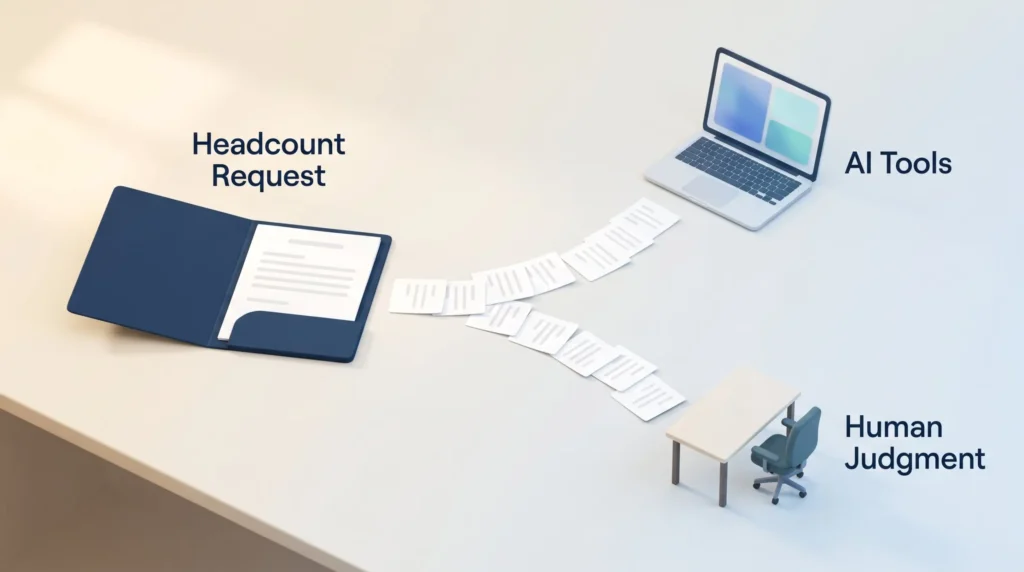
A typical headcount request, also called a requisition, now has to answer questions like these:
- Which tasks would the new person do, and which of them could AI tools handle today?
- Did the team actually try those tools on real work, and what happened?
- Which parts still need human judgment, relationships or accountability?
The policy does not ban hiring. It raises the bar for proof. Sometimes it works as a hiring freeze in disguise, but often it is simply a new approval step, similar to the way automation risk assessments look at which parts of a job are exposed to AI.
Where the Idea Came From: Shopify, Fiverr and Duolingo
The phrase “prove AI can’t do it” traces back to three company memos from spring 2025.
Shopify: AI as a baseline expectation
Lütke’s memo, which he posted publicly on X, said that reflexive AI use is now a baseline expectation at Shopify. The key line, reported by TechCrunch, was: “Before asking for more headcount and resources, teams must demonstrate why they cannot get what they want done using AI.” He also asked teams to imagine their area with autonomous AI agents already on board. According to HR Dive, the memo also added AI use to performance reviews.
Fiverr: become exceptional or fall behind
In the same month, Fiverr CEO Micha Kaufman told staff to help make the company more efficient with AI tools and warned that careers would stall for those who don’t adapt.
Duolingo: headcount only if you can’t automate
On April 28, 2025, Duolingo CEO Luis von Ahn sent an “AI-first” email. It said the company would gradually stop using contractors for work AI can handle. Headcount would only be given if a team could not automate more of its work. After a public backlash, he clarified that Duolingo was still hiring full-time staff at the same pace as before.
The lesson: a policy that reads as sensible internally can sound like a layoff notice to the outside world.
How Widespread Is the Policy?
It is no longer limited to a few tech companies. Zip, a company that makes software for business purchasing, surveyed 1,030 senior leaders with research firm Prolific for its first State of Spend report, published in October 2025. As Fast Company summarized, 17% of companies require hiring managers to prove a job can’t be done by AI before a role is approved. The same survey found that 60% of business cases already plan for flat or lower headcount because of AI.
The mindset has also spread beyond tech. In January 2026, Bloomberg reported that JPMorgan Chase CFO Jeremy Barnum had described “a very strong bias” against hiring when a new need comes up, pointing to productivity gains from AI.
So the formal rule is still a minority practice, but the habit of asking “could AI do this?” is common. It fits the wider shift toward hybrid jobs where humans and AI share the work, and the rewriting of job descriptions for the AI era.
What the Klarna Reversal Teaches
Klarna is the best-known warning about moving too fast. In early 2024, the payments company said its AI assistant was doing the work of 700 customer service agents. By May 2025, CEO Sebastian Siemiatkowski admitted that quality had suffered. He told Bloomberg that cost had been “a too predominant evaluation factor” and that customers should always be able to reach a human, as CX Dive reported. Klarna then started recruiting human agents again for complex and sensitive cases.
The lesson is not that AI failed. The chatbot still handled many simple requests. The test simply measured the wrong thing: speed and cost looked great while customer experience slipped. Before replacing a support role, read our guide to what works in AI customer service.
How to Run a Fair “Prove AI Can’t Do It” Test
If your company has this rule, you will probably build the case yourself. A fair test protects both the business and the team.
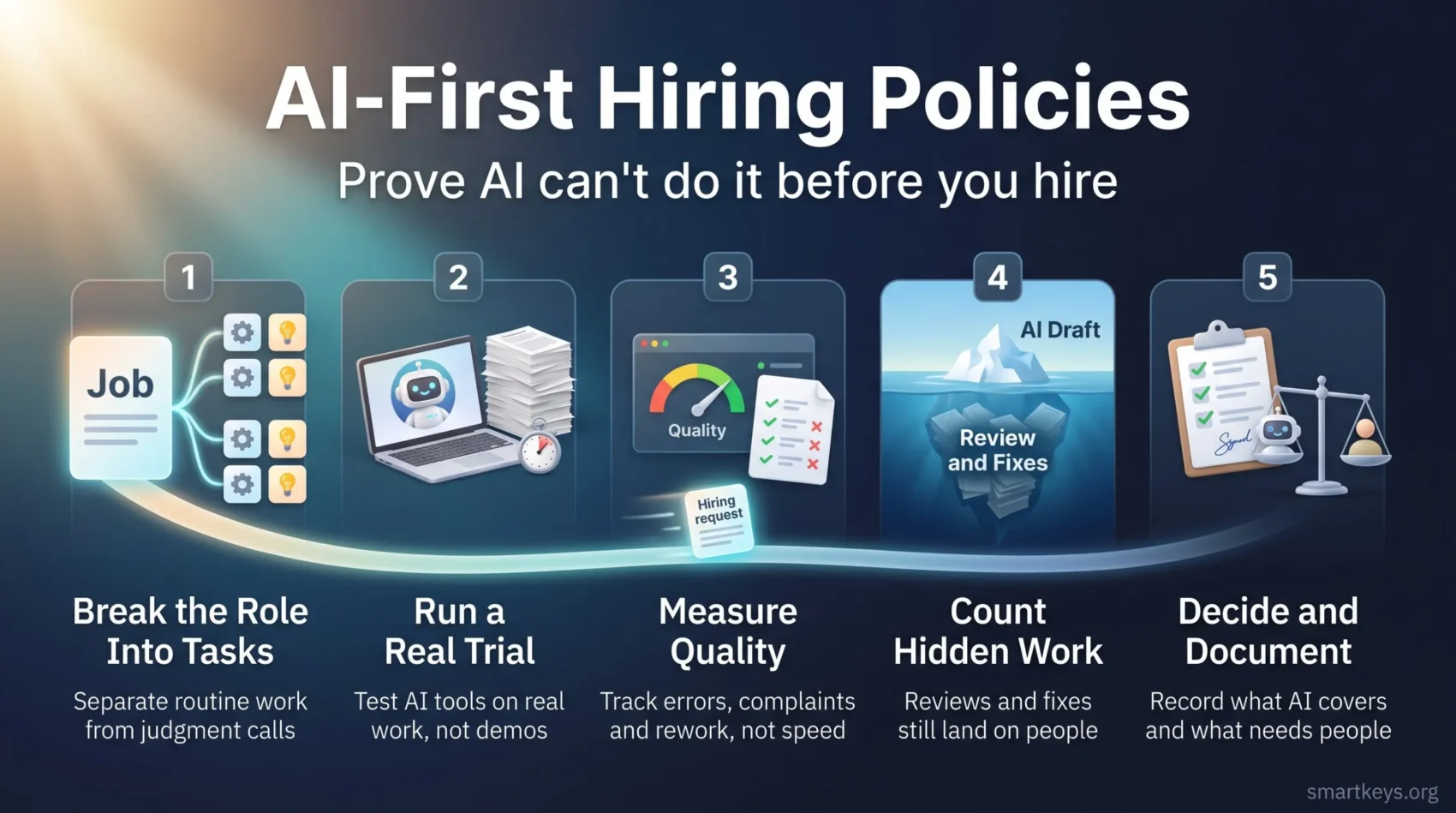
1. Break the role into tasks
List what the new person would do each week. Separate routine tasks (drafting, data entry, simple replies) from judgment tasks (negotiation, escalations, approvals). This is the same logic behind splitting work between people and AI.
2. Run a time-boxed trial on real work
Test the AI tools for a fixed period, such as a few weeks, on real tasks rather than demos. Log what worked, what needed fixing and what failed. If you are testing agents, our AI agent workflow playbook helps you set them up properly.
3. Measure quality, not just speed
Track errors, complaints and rework. An AI tool might draft support replies in seconds, but if a colleague fixes every third one, the saving is much smaller than it looks.
4. Count the hidden workload
Someone has to review AI drafts, fix mistakes and handle the cases the tool can’t. If that lands on already busy people, the company hasn’t saved a role. It has spread one across the team.
5. Decide and document
Write down which tasks AI now covers and which still need a person. A clear record also supports good AI-supported decisions later, when leadership asks why a role was or wasn’t approved.
Where the Policy Goes Wrong
Used carelessly, the rule creates problems the budget doesn’t show right away.
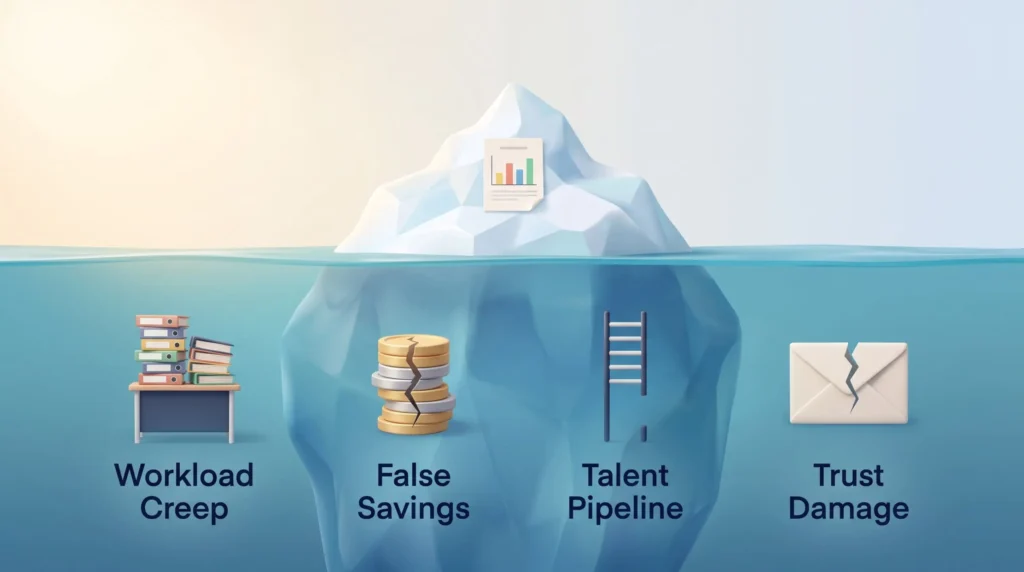
- Workload creep. Denied roles don’t make work disappear. Existing staff absorb it, which raises the risk of employee burnout.
- False savings. Counting every rejected requisition as money saved overstates the benefit. Savings are only real at the same quality, which is why measuring AI ROI beyond the pilot matters.
- A broken talent pipeline. Junior roles are the easiest to automate on paper. Cut too many and there is no one to grow into senior roles later, a risk covered in our article on AI and entry-level jobs.
- Trust damage. As Duolingo learned, a blunt memo can hurt morale and the brand.
Companies that avoid these traps pair the rule with a plan for people: redeploying workers into new roles, clear generative AI usage guidelines, and a deliberate look at how AI-era teams should be structured.
What It Means for Employees and Job Seekers
If your employer asks whether AI could do your job, answer with evidence. Keep a short record of how you use AI and what improved, for example “cut weekly reporting from four hours to one.”
Also document the work AI can’t do well: handling an upset client, making a judgment call with incomplete information, or coordinating people across teams. These are the soft skills that matter more in AI-heavy workplaces.
Job seekers should expect interview questions about working with AI, where concrete examples beat enthusiasm. Building in-demand future job skills and running your own skills gap analysis makes those examples easier to give. Many employers also now use skills-based hiring, so proven ability with AI can count for more than a degree.
Conclusion
At its best, an AI-first hiring policy is a discipline: consider automation before adding people. At its worst, it is a hiring freeze with a new name. The difference lies in how the test is run.
Managers need honest trials that measure quality and hidden workload. Employees need to show how they use AI and what they bring that it can’t. And Klarna reminds everyone that the cheapest option on paper is not always the one customers accept.
Found this useful?
Make SmartKeys a preferred source on Google, and our articles will surface more often in your Top Stories, AI Overviews, and AI Mode.
Add as Preferred SourceFAQ
What is an AI-first hiring approach?
An AI-first hiring approach means a manager must show that AI tools can’t do a job before a new role is approved. It is not about using AI to screen candidates. The idea spread in April 2025, when Shopify CEO Tobi Lütke told teams to demonstrate why AI cannot do the work before asking for more headcount. In practice, the manager splits the role into tasks, tests AI on the routine parts, and requests a person only for work that needs human judgment or accountability.
Why are companies adopting this hiring strategy?
Companies adopt it mainly to control costs and to make teams use the AI tools they already pay for. Leaders want managers to consider automation first instead of adding people by habit. That makes sense when routine work, such as first drafts or simple support questions, really can be automated. Zip’s 2025 State of Spend survey found that 60% of business cases already plan for flat or lower headcount because of AI. The risk is counting savings too early. Klarna learned that focusing too heavily on cost can lower quality.
Does an AI-first hiring policy mean layoffs?
Not necessarily. The policy controls new hires, not existing jobs, so its direct effect is fewer open roles. Duolingo’s CEO, for example, clarified after his AI-first memo that the company was still hiring full-time staff at the same pace. However, denied roles often shift work onto existing staff, and some companies combine the policy with contractor cuts. If you are worried, ask how denied roles will be covered and whether AI trials review team workload.
How long should an AI trial run before a hire is approved?
A trial should cover the normal ups and downs of the work, which for most roles means several weeks rather than a few days. More important than length is that the trial uses real tasks, not demos, and tracks quality, errors, rework and customer feedback. A short test that only measures speed tends to overstate what AI can handle. If the work has rare but high-stakes cases, add them deliberately.
How does this approach affect employee experiences?
It can go either way. When AI takes over repetitive tasks and the team keeps enough people, employees often spend more time on interesting work. When roles are denied and AI output still needs heavy checking, fewer people carry the same work, which raises burnout risk. Employees cope better when they know how trials are judged, how workload is monitored and how AI use counts in performance reviews.
How can I prepare for a job at a company that uses this strategy?
Show concrete evidence that you use AI well and add value it can’t. Prepare two or three examples with measurable results, such as a report you now produce in a fraction of the time. Then add examples of human work: calming an upset customer, making a judgment call or aligning people across teams. Expect questions about how you would handle a task with and without AI. Focus on results rather than listing tool names.