An AI team is only as good as the way its roles fit together. AI team composition means deciding who owns the data, who builds the model, who ships it, who checks it for harm, and who confirms it serves a real business goal. Get that wrong and you get impressive demos that never reach a customer.
The gap between using AI and profiting from it is well documented. In McKinsey’s State of AI survey published in August 2026, 89% of organisations reported regular AI use in at least one business function. Only 37% could attribute any positive EBIT contribution to it. EBIT is earnings before interest and taxes, the operating profit line a CFO watches. Only 44% had scaled AI across the enterprise rather than keeping it in pilots.
The same survey shows what separates the two groups. Among the roughly 6% McKinsey classes as high performers, 73% had fundamentally redesigned workflows around AI. Among everyone else, 25% had. Redesigning a workflow is people work before it is model work, which is why staffing matters as much as the algorithm.
Key Takeaways
- Tie every AI project to one business objective and one measurable KPI before any data work starts.
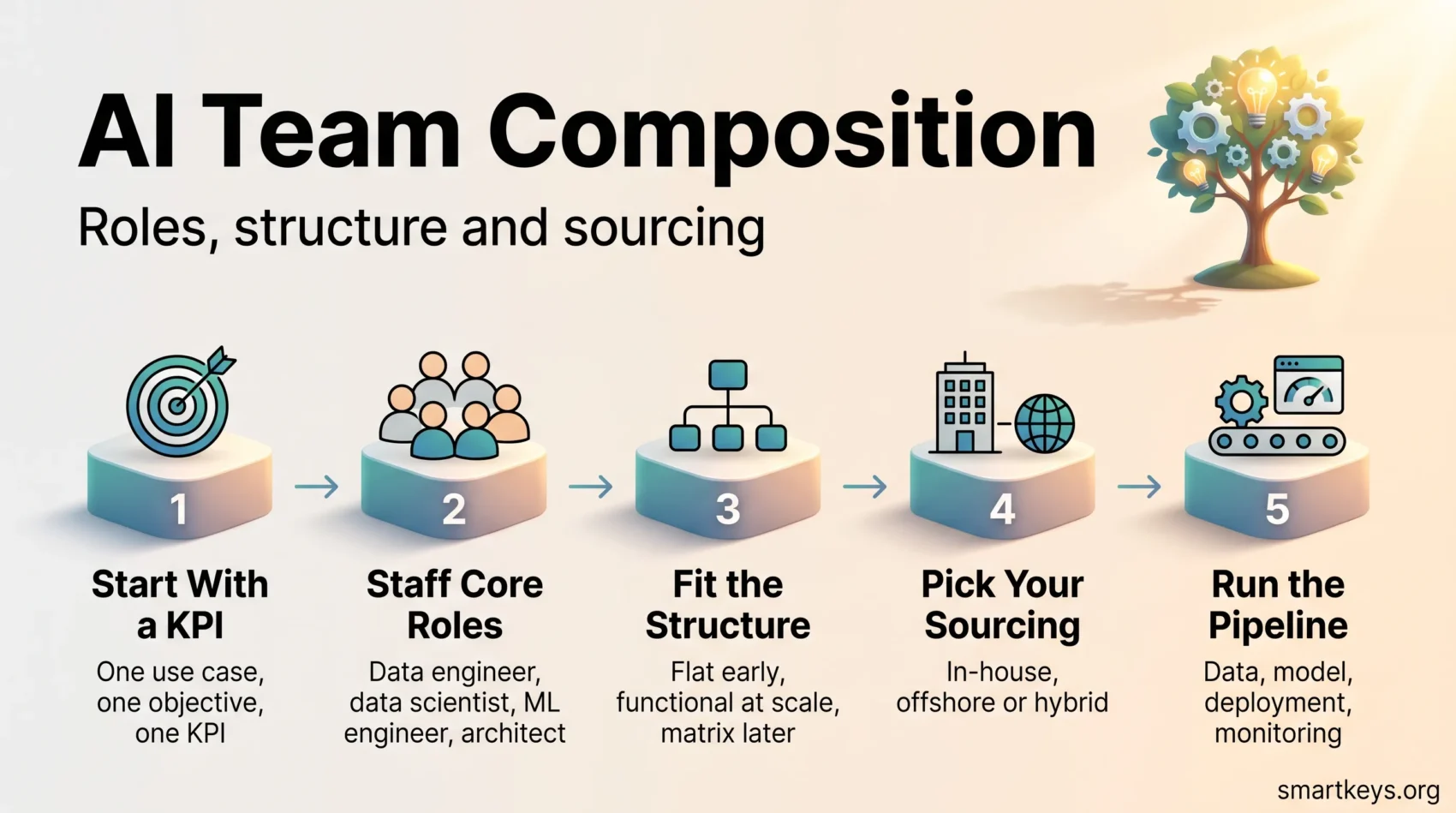
- Staff four core roles first: data engineer, data scientist, machine learning engineer and architect.
- Match the operating model to your stage: flat early, functional at scale, matrix for parallel projects.
- Secure an executive sponsor who can fund the work and clear blockers.
- Build governance and training into delivery rather than bolting them on afterwards.
Start with intent: tie every AI project to a business outcome
Decide what the model is supposed to change before you decide who builds it. Teams that skip this step staff for technology rather than for a result, and the result is what pays for the team.
Turn a use case into a measurable KPI
Write the problem in plain language first. “Billing tickets take three days to resolve and 22% get reopened” is a problem statement. “We should use machine learning” is not. Confirm it with the people who live with the problem, then translate it into requirements your engineers can act on.
A KPI is the one number that tells you whether the problem got smaller. Pick it before the project starts, because a KPI chosen afterwards is always the one the model happened to move. Shift planning shows the pattern. A system that predicts staffing demand only succeeds if overtime spend or unfilled shifts fall, which is why intelligent shift scheduling is judged on rota costs rather than forecast accuracy.
Get an executive sponsor who can unblock decisions
Name one senior sponsor per initiative. That person owns the budget, the fit with strategy, and the authority to settle disputes about data access and priorities. Without one, projects stall for weeks on approvals nobody feels able to give.
Three rules keep intent visible:
- One use case, one objective, one KPI. Anything with three objectives has none.
- Involve a business analyst early to capture the thresholds and constraints the model must respect.
- Write acceptance criteria covering both model metrics (accuracy, precision) and business metrics (cost, cycle time).
The same discipline separates useful from decorative analytics, as our guide to AI decision making for managers sets out.
The roles that make up an AI team
Clear roles reduce handoffs, and handoffs are where AI projects lose weeks. You do not need every role below on day one, but you should know which ones are missing.
Core delivery roles
Data engineers own the pipelines: moving data from source systems into a usable, documented, reliable form. The least glamorous role, and the one whose absence hurts most.
Data scientists frame the modelling problem, design features (the input signals a model learns from) and test which approaches work. The US Bureau of Labor Statistics projects data scientist employment to grow 35% between 2025 and 2035, far above the average for all occupations. The median wage was $120,230 in May 2025.
Machine learning engineers turn a working model into a service that runs reliably under real load. A model that scores well in a notebook but takes four seconds to respond is not a product.
AI architects design how it all connects to existing systems, so the work scales with IT operations rather than around them.
Bridge and specialist roles
An AI product manager and a business analyst translate business needs into the backlog. They are the reason engineers work on the right problem. Add specialists only when the work demands them:
- Researchers when the problem genuinely needs a novel method.
- An ethics lead for fairness reviews in sensitive domains. The AI ethics officer role has moved from novelty to a recognised job in regulated sectors.
- Prompt engineers when you build on large language models, where output quality depends on how the request is framed.
- Domain experts to check that the model’s assumptions survive contact with how the work is really done.
For templates and hiring guidance, see our AI job descriptions.
Skills and shared accountability
Hire for a mix of programming, statistics, large-scale data tooling, communication and problem framing. The last two are underrated: a model nobody can explain to a stakeholder rarely gets adopted.
Pair data scientists with domain experts during feature work, and machine learning engineers with operations during deployment. Make ownership explicit with a RACI, a simple table listing who is Responsible, Accountable, Consulted and Informed per task. Data quality, model approval and monitoring each need a name against them, not a department. Where teams span time zones, the practices in AI and remote collaboration apply too.
Choose an operating model that fits your stage
The right structure matches how many projects you run and how scarce your specialists are. Copying a large company’s org chart into a five-person effort adds approval steps and nothing else.
Flat: small teams, fast iteration
Start flat. One product lead coordinates a compact group: a machine learning engineer, a data scientist, a data engineer and, where needed, a researcher and an ethics reviewer. Decisions take hours rather than weeks, which is what early experiments need.
Functional: central standards at scale
As project numbers grow, centralise standards for data quality, governance and reusable components under a functional lead or the CTO. This is how you stop five teams building five slightly different customer tables. Our analytics maturity model helps you work out which stage you are actually at rather than which one you would like to be at.
Matrix: shared specialists across a portfolio
When several projects run at once, a matrix lets scarce specialists such as MLOps engineers and architects serve many efforts. It works only if you put two things in writing: who may promote a model into production, and how long an approval may take.
Whichever shape you pick, keep a lightweight portfolio view of projects, owners and risks, and align delivery cadence to the business release calendar.
In-house, offshore or hybrid: where the work should sit
Sourcing changes cost, speed and how much capability you keep. The honest question is which of the three you are willing to trade.
In-house keeps strategy, sensitive data and model governance inside the company. You pay more in salaries and tooling, and you keep the knowledge after the project ends.
Offshore partners add capacity quickly and usually cost less per hour. The trade-off is coordination: time-zone gaps, thinner context about your business, and more that must be written down rather than assumed. Overlapping hours, clear service level agreements (written commitments on response times) and thorough documentation make it work.
Hybrid is where most companies land: a small internal core owning direction and data, plus external specialists for surge capacity or niche skills.
Whatever the mix, require the same deliverables from partners as from staff. That means reproducible pipelines, infrastructure defined as code, and model cards: short documents describing what a model does, on what data, and where it should not be used. Judge the handover by whether your team can run the system alone.
Build the delivery pipeline from data to production
Treat the pipeline as the product. Most of the effort in a working AI system sits before and after the model, in data preparation and operations.
Who owns the data
Assign an owner to each stage. Source discovery needs domain input. Quality checks, security controls and lineage (a record of where each field came from and how it changed) make downstream work trustworthy.
Keep a catalogue of datasets and document the rules governing them. It prevents the most common failure: two teams reporting different numbers for the same thing. If you also treat data as a revenue source, our guide to data monetization covers what that requires.
Model development and selection
Standardise how experiments move from notebooks into pipelines, and track which dataset version produced which result. Without that you cannot reproduce a model you shipped six months ago.
Choose the method by what the decision demands. Favour interpretable models where a person must explain a decision to a customer or a regulator; favour raw accuracy for ranking or detection work where nobody justifies an individual output. The rules are set out in AI regulation in 2026, the techniques in explainable AI.
Productionization and MLOps
MLOps is the practice of running machine learning systems in production reliably: deployment, monitoring, retraining and rollback. It borrows most of its ideas from software operations and adds the ones models need.
Package models as containers, serve them through a dedicated serving layer to keep response times predictable, then monitor three layers:
- Technical: latency and error rates.
- Statistical: drift, meaning the incoming data has quietly stopped resembling the training data, plus accuracy over time.
- Business: whether the KPI you picked at the start is moving.
Release changes to a small share of traffic first so a bad model affects few users, keep a tested rollback, and compare each version against the one it replaces. Document every model with a model card and a change log.
Gartner expects more than 40% of agentic AI projects to be cancelled by the end of 2027, citing escalating costs, unclear business value and inadequate risk controls. Two of those three are operations problems, not modelling problems. For the wider picture, see hyperautomation, business automation trends and AI in business.
Keep domain experts in the loop
Domain expertise connects data work to a measurable result. Subject matter experts, the people who do the work the model supports, should be involved from the first week rather than shown a finished model. They frame what success looks like, they say which data reflects the process, and they spot outputs that look plausible but are wrong for reasons only a practitioner would notice.
Keep the rituals light: short standups, sprint reviews that put business owners, engineers and scientists in one conversation, and a single shared dashboard for model metrics. Give the business analyst a formal role as translator, and use documented interfaces, schema checks and drift dashboards so handoffs never depend on somebody remembering a detail.
Governance, ethics and upskilling
Oversight and training turn an experiment into something the business will rely on. Both work better built into delivery than added at the end.
Responsible practice
Set standards for how data is collected and labelled, how fairness is checked, and how decisions are explained. Involve whoever owns ethics early enough to change the design, not just to approve it.
The European picture is concrete. Since 2 August 2026, the EU AI Act’s transparency rules require telling people when they are interacting with an AI system. Obligations for high-risk uses, which include AI in recruitment and other employment decisions, were deferred under the Digital Omnibus agreement and now apply from 2 December 2027 for standalone systems. Deferred is not cancelled, and the prohibitions and AI literacy duties already in force apply today. Detail sits in EU AI Act compliance and building an AI governance model.
Three habits carry most of the weight: pre-release review with legal and domain sign-off; model cards plus per-decision explanations for high-stakes calls; and continuous oversight, meaning logged changes, drift monitoring and policies revisited as rules move.
Hiring is under the closest scrutiny: see AI hiring bias and what AI hiring tools can and cannot do. Monitoring employees raises parallel duties, covered in AI in employee monitoring and AI ethics at work.
Continuous learning
Build role-based training paths for scientists, engineers, analysts and product leads, and pair courses with mentored work on live projects. Knowledge that never touches a running system does not stick.
Three things work: an internal guild for code labs and model tear-downs; funded certifications tied to a project someone is about to start; and basic data literacy for everyone who reads a dashboard, not only for those who build them. Our guides to data literacy programmes and upskilling and reskilling cover how to structure this.
Conclusion
The composition of your AI team is a business decision, not an org-chart detail. Nearly everyone is using AI, a minority can show it in the profit line, and the difference lies in whether work was genuinely redesigned around it.
Start with one objective and one KPI. Staff the four core roles before the exotic ones. Pick the smallest structure that fits your stage. Keep governance close to delivery so it speeds safe releases instead of blocking them. Then reuse what you build: shared components and playbooks are how the second project costs less than the first.
Found this useful?
Make SmartKeys a preferred source on Google, and our articles will surface more often in your Top Stories, AI Overviews, and AI Mode.
Add as Preferred Source