RevOps, short for revenue operations, is the practice of running sales, marketing and customer success on one shared set of data, targets and processes instead of three separate ones. RevOps automation tools are the software that makes that possible: they keep records in sync, route leads, score accounts, forecast the quarter and take repetitive admin work off your reps.
This guide is a practical roundup for 2026: what each category of tool does, which platforms lead it, what they cost where the vendor publishes a price, and how to pick one without buying five overlapping products.
One thing changed the map this year. Clari and Salesloft completed their merger on 3 December 2025 and now operate as a single company under CEO Steve Cox, so forecasting and sales engagement increasingly arrive in one contract (Clari press room).
Key Takeaways
- RevOps automation fixes three things: messy data, weak forecast visibility and slow execution. Decide which hurts most before you shop.
- Clean, synced records come first. A forecasting tool cannot rescue a CRM nobody updates.
- Most vendors here quote rather than publish prices, so budget for a sales cycle as well as a licence.
- Buy for your existing stack: native Salesforce, HubSpot and Slack connectors decide how fast you see value.
- Start with one narrow pilot and measure it before rolling anything out company wide.
Why RevOps automation matters for your 2026 revenue goals
Most revenue problems look like sales problems and turn out to be data problems. A rep updates an opportunity three days late, the close date slips without a note, and the number the board sees on Monday is already wrong.
Automation attacks that at the source. Activity capture writes emails and meetings into the CRM without anyone typing. Routing rules assign an inbound lead in seconds. Validation rules refuse to let a deal change stage without a next step. None of it is glamorous, and all of it compounds.
“Clean, synced records are what make pipeline visibility and forecasting believable. Everything downstream inherits that quality, or that mess.”
- Less busywork. Sellers spend time on live opportunities instead of data entry.
- Better forecasts. Consistent fields make conversion and coverage models meaningful.
- Faster fixes. Alerts flag a stalled deal in week two, not at quarter end.
- Compounding returns. Reliable numbers improve where headcount goes next quarter.
For background on how this function grew out of sales ops and marketing ops, see the role of RevOps in modern sales and marketing, and the RevOps efficiency playbook for where revenue leaks in practice.
The RevOps tool categories that matter in 2026
Vendors describe themselves in overlapping language, which makes shortlists hard. Sort the market by the job each tool does.
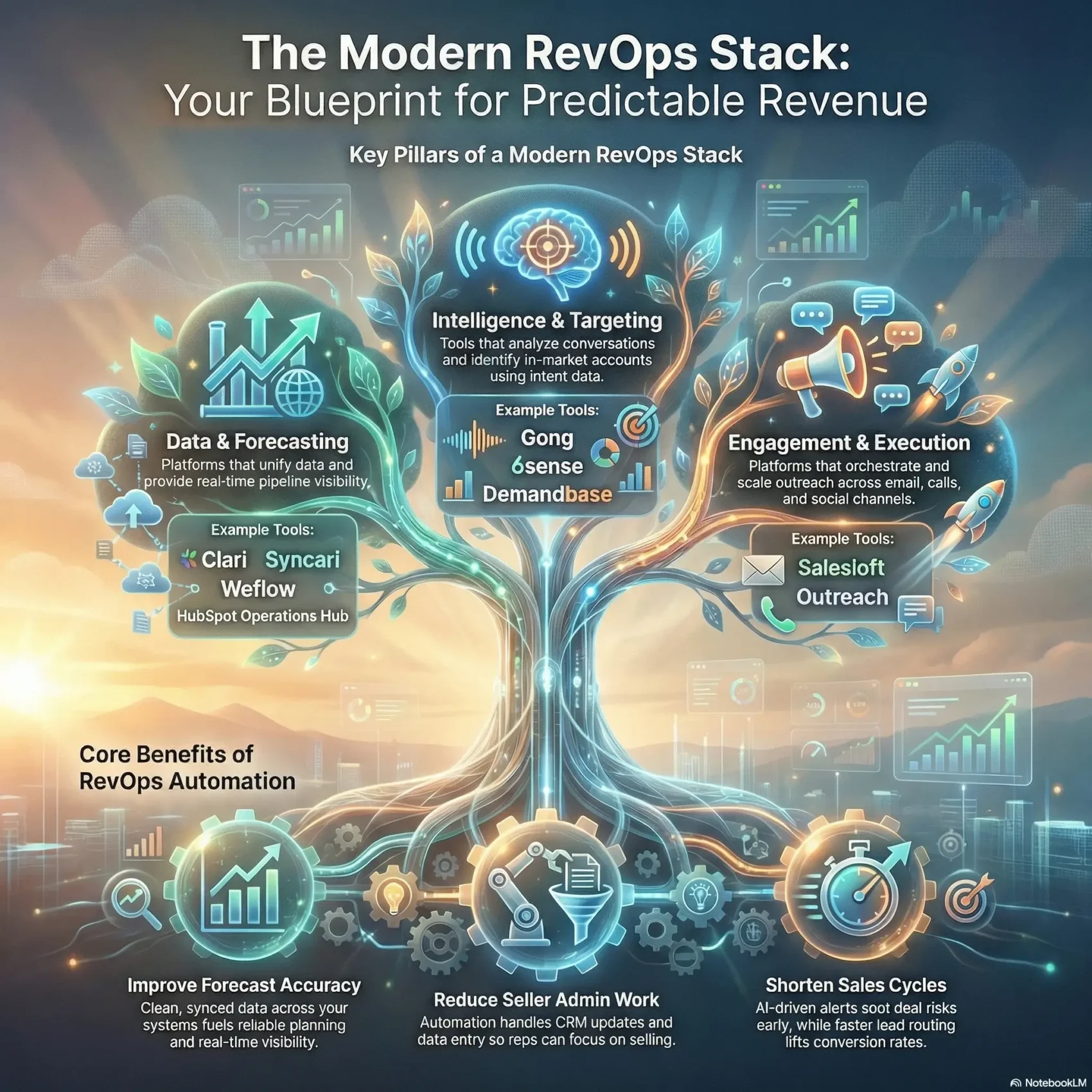
- Revenue intelligence. Analyses customer conversations and turns the patterns into coaching. Gong is the reference product.
- Forecasting and pipeline inspection. Scores deal health and makes weekly reviews evidence based. Clari and Mediafly Intelligence360 sit here.
- Routing and scheduling. Matches inbound leads to accounts and owners, then books the meeting. LeanData and Default lead this niche.
- Intent and account-based marketing. Flags companies researching your category while interest is live. 6sense and Demandbase compete here.
- Sales engagement. Runs multichannel sequences and daily task lists. Salesloft (now part of Clari) and Outreach are the large players.
- Data unification and quality. Keeps records consistent between systems. Syncari, Coefficient and HubSpot Data Hub cover different slices.
- Digital sales rooms. Give the customer one shared space through late-stage sales and onboarding. Dock is the best known.
- AI digital workers. Handle enrichment, first-touch outreach and CRM hygiene end to end. 11x is the most visible example.
Very few teams need all eight. Two or three well integrated beats a stack nobody trusts.
Revenue intelligence: turning calls into coaching
Every sales call contains information your CRM never captures. Conversation intelligence tools record and transcribe those calls, then look for patterns across hundreds of them.
What Gong actually gives you
Gong transcribes calls and makes them searchable, so a manager can find every conversation where a competitor came up rather than relying on memory. It surfaces signals such as talk-time ratios, question rates and how a deal’s engagement shifts over weeks.
The practical value is repeatability. Once you can see which behaviours show up in won deals, you can build a library of model calls that new hires learn from in week one.
Turning patterns into weekly coaching
Pick one behaviour at a time. If your discovery calls average four questions and the winners average twelve, that is a coaching topic with a measurable target. Vague feedback (“be more consultative”) does not survive a busy week. Aim for one short, measurable habit per rep per month, and pick behaviours that correlate with conversion rather than with longer calls.
Feeding conversation signals into pipeline health
Conversation data helps forecasting once it is tagged against CRM records. A deal where three buying-committee members joined the last call is healthier than one where the champion attended alone, and that belongs in your commit discussion. Our guide to sales enablement trends covers how coaching programmes are built around this, and dynamic pricing strategies shows how observed buyer behaviour feeds commercial decisions.
Forecasting, pipeline and deal inspection
A forecast is a claim about the future that someone has to defend. These tools make that defence evidential rather than optimistic.
Clari for forecasting and deal risk
Clari pulls CRM fields and activity signals together and scores deals on health, flagging the ones that have gone quiet or lost their champion. Managers use those scores to pressure-test the commit category in weekly reviews. Since the Salesloft merger completed in December 2025, Clari sells forecasting and engagement as one platform, which matters if you planned to buy both from different vendors.
Mediafly Intelligence360 for dashboards
InsightSquared, which older roundups still list as a standalone product, was acquired by Mediafly and now ships as Mediafly Intelligence360. It remains a dashboard-heavy analytics layer for stage conversion, forecast versus actual, and coverage. Build only the dashboards someone will act on; a reporting suite nobody opens is an expensive way to feel data driven, as our piece on business intelligence tools explains.
Weflow for pipeline hygiene
Weflow automates the CRM work reps skip. It captures emails, meetings and contacts from Outlook or Google into Salesforce and prompts for required fields. It now positions itself as a broader revenue orchestration layer at weflow.ai, adding conversation intelligence and a mobile assistant. Pricing is not published; there is a 14-day trial.
“Weekly deal inspection only works when the underlying fields are filled in. Hygiene first, then inspection, then forecasting.”
- Run one weekly inspection rhythm per segment, using deal health scores to pick which deals get discussed.
- Validate confidence with conversation signals, not rep sentiment alone.
- Size top-of-funnel targets from your own conversion and cycle time, not from a benchmark deck.
For the metrics worth tracking around this rhythm, see RevOps productivity metrics and how RevOps tools change business forecasting.
Buyer intent and account-based marketing
Account-based marketing (ABM) means treating a named list of companies as the market, instead of casting a wide net and sorting the responses. Intent data keeps that list current.
Intent signals show which companies are researching your category right now, inferred from content consumption across publisher networks. Used well, they tell you when to call. Used badly, they generate a list nobody follows up.
6sense for intent and predictive scoring
6sense identifies in-market accounts, scores them predictively, and feeds them into campaigns and routing rules. It publishes no prices: the pricing page lists three sales-intelligence editions and directs buyers to a demo, so treat it as an enterprise purchase with a quote and a negotiation.
Demandbase for lifecycle ABM
Demandbase combines account identification, personalised web experiences and engagement tracking across the buying cycle. Its strength is coordinating campaigns aimed at a whole buying committee rather than one contact, where tailored content by industry earns its keep.
Cognism for contact data
Cognism supplies verified B2B emails and phone-verified mobiles, plus Bombora intent data, with connectors for HubSpot, Salesforce, Salesloft and Outreach. Pricing is quote-based across its Standard and Pro packages, each with five seats, and it offers a free data sample rather than an open trial.
Better contact data improves scoring, routing and territory coverage at once, which is why enrichment is often the highest-leverage first purchase. Our Clay AI review looks at the workflow-first alternative.
Three rules keep intent programmes honest: route a surging account to an owner the same day, agree signals and response times before launch, and tie campaigns to sourced pipeline, win rate and cycle time so you can tell what worked.
Our guides to account-based strategy and aligning sales and marketing cover the process side of this in more detail.
Sales engagement and execution across channels
A sequence is a scripted series of touches across email, phone and social, with timing and content set in advance. Engagement platforms run them and report which ones work.
Salesloft and Outreach are the two established options. Both handle multichannel cadences, task management and reply analytics, and neither publishes per-seat pricing, so expect a quote. The relevant 2026 difference is structural: Salesloft is now part of Clari, so buying it also buys into that forecasting ecosystem, while Outreach remains independent.
On features they are close: both set cadences across calls, email and social, automate follow-up tasks, and report reply rate, meeting rate and conversion to opportunity. The deciding question is usually ecosystem fit rather than feature count.
Routing and scheduling with Default or LeanData
Engagement only pays off if the lead reaches the right person quickly. Default handles routing, scoring and scheduling and publishes its pricing: Growth is $1,250 per month ($15,000 a year) and Scale $3,000 per month ($36,000 a year), with seats sold separately at $45 per month for routing plus scheduling, or $20 for scheduling only. LeanData covers account matching and routing inside Salesforce, quote-based.
When routing and engagement are wired together, response times drop and meeting rates rise, because the follow-up lands while the buyer is still in the tab.
“Speed to lead is not a slogan. It is a routing rule, an owner, and an alert that fires whether or not anyone is watching the queue.”
Practical steps: test one variable at a time, embed scheduling directly in forms, and build opt-out handling into the workflow rather than trusting reps to remember it.
Data quality, unification and analytics
When your systems disagree about who owns an account, every report becomes a negotiation. This category exists to stop that.
Syncari for multi-directional sync
Syncari harmonises records between HubSpot, Salesforce and other go-to-market applications with no-code, multi-directional sync, so an update in one system resolves cleanly in the others. Pricing is custom, and implementation needs field standards, owners and conflict rules agreed before you switch it on.
Coefficient for live data in spreadsheets
Coefficient connects Google Sheets and Excel to CRMs and warehouses, so a spreadsheet pulls live records, refreshes on a schedule and pushes changes back. It is the pragmatic answer when a team needs a report this week and the BI backlog is three months long. Starter is $49 per month, Pro $99 per user per month, plus a free tier, with roughly 17% off for annual billing.
HubSpot Data Hub for data quality management
Operations Hub is now sold as HubSpot Data Hub. It offers a data quality command centre, programmable workflows in Python or JavaScript, and curation tools for reporting. Pricing starts free for two users, then $7 per seat per month for Starter, $720 per month for Professional and $2,000 for Enterprise, each with a monthly allowance of HubSpot credits.
- Governance: define field standards, owners and response times so the stack scales without collapsing.
- Recipes: enrich on record creation, de-duplicate nightly, alert when a critical field goes stale.
- Analytics: push curated metrics back into the tools customer-facing teams already open daily.
Change management decides whether any of this holds. Document the process, train the people who live with it, and publish a data quality score so problems stay visible. Our guides to data governance strategy, customer data platforms and first-party data strategy go further on the foundations.
Onboarding, customer success and retention
A clean handoff from sales to customer success is worth more than most retention campaigns. The information the seller collected has to arrive with the person who now owns the relationship.
Dock provides digital sales rooms: a shared workspace holding the mutual action plan, contract documents, order forms, onboarding steps and timelines, so the customer never has to search an email thread for the current version.
How a shared room changes the handoff
Use the room as the single source of truth from late-stage sales through implementation. Because the customer sees the same plan as your team, the first success call starts with context, not re-discovery. Dock also shows which documents the customer opened, so silence in week two becomes an early warning, and a guided setup call then costs far less than a renewal conversation later.
What Dock costs
Pricing is published: a free plan covers five internal users and ten workspaces, Standard is $350 per month for ten users, and Premium is $1,000 per month billed annually for larger teams, with extra seats at $50 per month. External collaborators, including prospects and clients, are not charged.
Three habits make it repeatable: define checkpoints and one owner per task, use pre-boarding content so implementation does not start from zero, and feed onboarding friction back into qualification. See customer success tools and customer retention strategies for the wider retention picture, and customer experience trends for what buyers now expect.
Go-to-market planning, territories and capacity
A go-to-market plan connects quotas, territories and hiring to the accounts actually in your CRM. Built on a spreadsheet once a year, it drifts by February. Built on live data, it can be corrected mid-quarter.
Planning tools such as Fullcast
Fullcast links planning to CRM data continuously, so quotas by role or territory reflect today’s accounts, and scenario models let you test what happens if a hire lands two months late. What that gives you:
- Quota models tied to live account records rather than last year’s snapshot.
- Segmentation that balances potential across regions instead of splitting alphabetically.
- Stress tests for seasonality, hiring delay and ramp assumptions.
Sizing the market with verified data
Cognism’s firmographic coverage across EMEA, North America and Asia-Pacific supports market sizing and stops two reps from working the same parent company under different names. Model headcount, ramp time and productivity together, then wire the output into your routing rules; territories that change three times a year cost more in lost relationships than they gain in balance. Our go-to-market strategy playbook covers the planning cycle end to end.
How to choose RevOps automation tools
Start with the problem, not the product demo. Write down the bottleneck in one sentence before you take a call.
Name the bottleneck: data, visibility or execution
Rank one need first. If records are unreliable, look at Syncari, Coefficient or HubSpot Data Hub. If nobody trusts the forecast, look at Clari or Mediafly Intelligence360. If leads sit unworked, add routing plus engagement.
Check integrations, depth and scale
Score vendors on native Salesforce and HubSpot connectors, API maturity, and whether the product still behaves at ten times your record count. Ask how many workflows need custom development; that is where timelines quietly double.
Weigh cost against time to value
Compare total cost, not licence cost: implementation, admin time and training all count. Then run a pilot with one success metric and a deadline.
- Problem first: define the outcome you expect in plain language.
- Integration check: confirm native connectors to what you already run.
- Feature map: route, engage, forecast, analyse. Note the gaps and the overlaps.
- Rollout plan: pilot, training, vendor commitments in writing.
- Governance: permissions, audit logs, data residency, and who owns the admin seat.
Broader context on automation choices sits in business automation trends, how AI is transforming business operations, and CRM trends for 2026.
What this actually costs in 2026
Published pricing here is the exception. Of the tools above, only Default, Coefficient, HubSpot Data Hub and Dock list rates. 6sense, Cognism, Salesloft, Outreach, LeanData, Syncari, Weflow and Fullcast quote instead, so your price depends on seat count, contract length and negotiation. Budget procurement time, not just software, and pilot on a published-price tool where you can, so you enter the enterprise negotiation with evidence.
Conclusion
Match each purchase to one outcome. Gong for conversation insight, Clari for forecasting, LeanData or Default for routing, 6sense or Demandbase for intent, Weflow for pipeline hygiene, Salesloft or Outreach for engagement, Syncari or HubSpot Data Hub for data quality, Dock for onboarding.
Then resist buying all of them at once. Write the problem statement, pilot one use case, measure a leading indicator, and scale only what moved. A small stack your team trusts beats a comprehensive one they work around. For the analytical layer on top, see how predictive analytics is changing business decisions and the 2026 sales trends shaping how buyers expect to be approached.
Found this useful?
Make SmartKeys a preferred source on Google, and our articles will surface more often in your Top Stories, AI Overviews, and AI Mode.
Add as Preferred Source