Every business decision rests on numbers somebody has to trust. A data governance strategy is the written answer to three questions: who owns each set of records, which rules apply, and how you check that the rules are followed.
That sounds like paperwork. In practice it decides whether two teams reporting “active customers” produce the same figure. It decides whether an auditor gets an answer in a day or a month, and whether your AI pilot runs on data anyone would bet a budget on.
Skip it and the costs arrive quietly: duplicated reports, analysts reconciling spreadsheets all week, regulatory exposure nobody owns. This guide covers what a governance strategy contains, how to build one in stages, and what the 2026 rules require.
Key Takeaways
- Governance sets the rules and names the owners. Data management is the daily work of applying them.
- Gartner found organisations with successful AI initiatives invest up to four times more of their revenue in data quality and governance.
- Twenty US states had comprehensive privacy laws in effect in 2026, so multi-state compliance is now the normal case.
- Start with one domain where value is provable, then reuse the catalog, roles and quality rules elsewhere.
- Rules only work when they are built into the tools people already use.
What a data governance strategy is, and how it differs from data management
The two terms get used interchangeably, which causes real confusion in budget meetings.
Governance is the plan. It decides who owns the customer record, how long invoices are kept, who may see salary fields, what “churn” means, and who signs off on exceptions.
Management is the execution. It is the pipelines, tickets, access requests and platform work that apply those decisions daily.
A useful test: if the answer lives in a document and a named person, it is governance. If it lives in a tool and a queue, it is management. You need both, and the second drifts without the first.
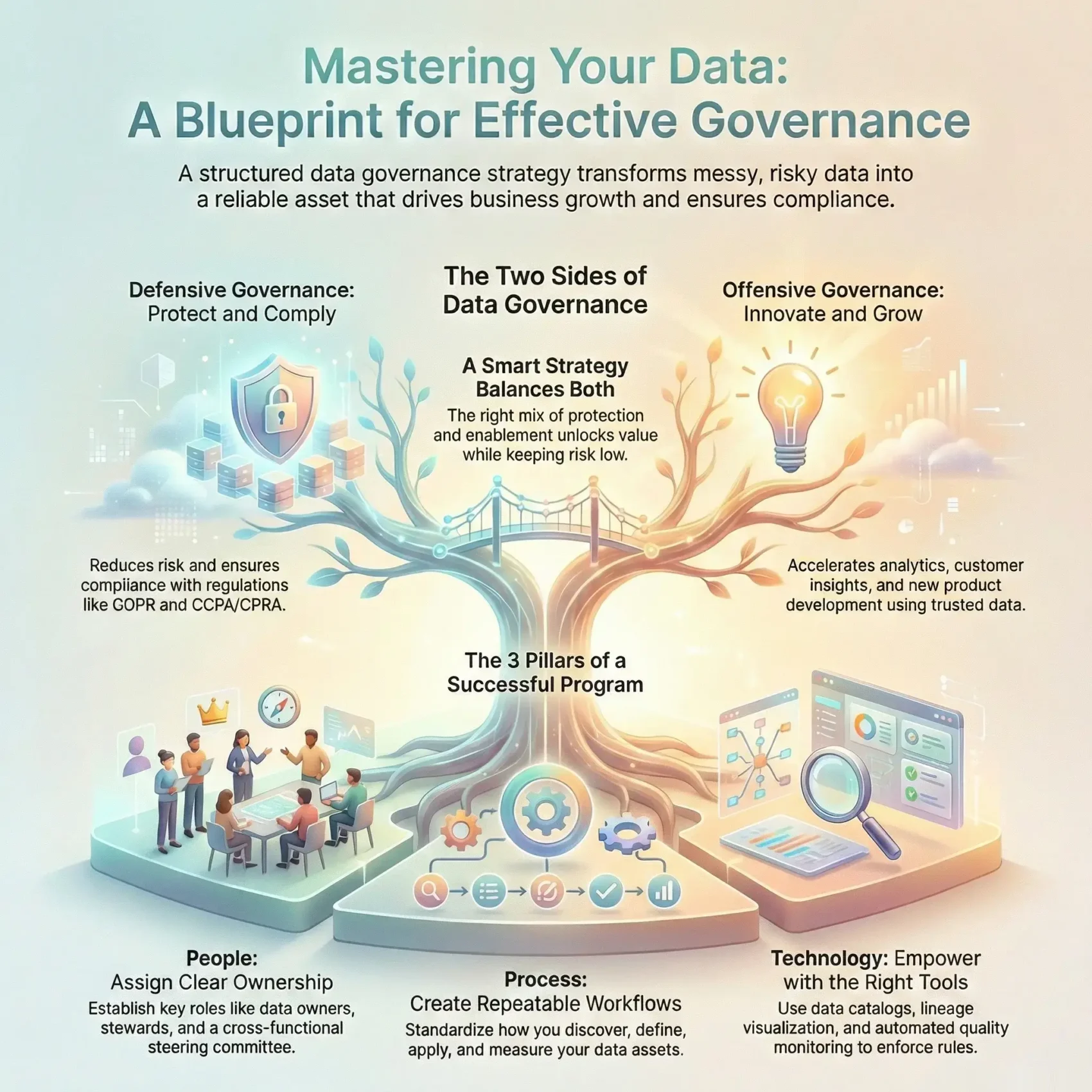
The operating model: people, processes, technology
A governance strategy becomes an operating model when it names three things.
People: owners who approve access, data stewards (the people who define what each field means and watch its quality), and custodians who implement the controls in the platform.
Processes: a repeatable loop of discovering what data exists, defining what it means, applying the rules, and measuring whether they held.
Technology: a data catalog, meaning a searchable index of what data exists, what it means and who owns it. Around it sit quality checks that raise alerts and access controls that enforce the policy automatically.
Miss one leg and the other two wobble. A policy with no owner is just a document, a catalog nobody maintains is a stale list, and clear roles with no tooling means governance by meeting.
“Practical frameworks win when they are measurable, auditable, and easy to use.”
Why this matters more in 2026 than it did in 2023
Two things changed: what companies are trying to do with their data, and what the law now asks of them.
The AI evidence points straight back at the foundations
Gartner surveyed 353 data, analytics and AI leaders between November and December 2025. Organisations reporting successful AI initiatives invested up to four times more of their revenue in foundational work (data quality, governance, AI-ready skills and change management) than those with poor AI results. In the same research, only 39% of technology leaders felt confident their current AI investments would improve financial performance. A separate Gartner survey of 360 IT leaders found just 23% were strongly confident they could manage security and governance while rolling out generative AI.
The pattern is consistent: the projects that work are rarely the ones with the cleverest model. They are the ones where somebody had already sorted out what the data means and who is responsible for it. If you are weighing an AI governance model, the data layer underneath it decides the outcome.
The rules that moved
Three developments matter for planning in 2026.
US state privacy law is now a patchwork you cannot ignore. Twenty states had comprehensive consumer privacy laws in effect in 2026, with Indiana, Kentucky and Rhode Island joining on 1 January. Each sets its own thresholds and consumer rights, so a company selling nationally needs one baseline that satisfies the strictest of them. A privacy compliance framework is the usual way to organise that, and data localization rules add a layer once you operate outside the US.
The EU Data Act is in force. It became applicable on 12 September 2025. From 12 September 2026, connected products newly placed on the EU market must meet “access-by-design” requirements. The relevant data has to reach users by default, free of charge, in a structured and machine-readable format where that is technically feasible. If you sell hardware that produces data, this reaches your product roadmap, not just your legal team.
The EU AI Act split into two timelines. The Article 50 transparency duties took effect on 2 August 2026, so people have to be told when they are interacting with an AI system. The obligations for high-risk systems in Annex III, which include recruitment, credit scoring and education, were deferred by the Digital Omnibus agreement to 2 December 2027. Deferred is not cancelled, and the lineage and documentation those rules will require is work governance already does.
Sector rules sit on top of all this. Health records in the US fall under HIPAA, financial services carry their own record-keeping and reporting duties, and both add retention and audit requirements that a general privacy policy will not cover. If you work in one of those sectors, map the sector rule first and treat privacy law as the floor rather than the ceiling.
As for the cost of getting it wrong, the reference point has not changed: the Irish Data Protection Commission fined Meta 1.2 billion euros in May 2023 over transfers of EU user data to the United States, still the largest GDPR penalty on record.
Defensive and offensive governance: finding the balance
Governance work splits neatly into two motives, and naming which one you are funding prevents a lot of arguing.
Defensive work protects you: privacy controls, retention limits, audit trails, and data lineage, the record of where a figure came from and every step that changed it. Lineage turns “we think this comes from the billing system” into a traceable answer during an audit. Typical controls include encryption, masking (swapping sensitive values for dummy ones where the real thing is not needed), and least privilege, meaning everyone gets the narrowest access their job requires.
Offensive work creates value: certified datasets analytics teams can reuse, one definition of “customer” across channels, faster reporting. This is where business intelligence tools and augmented analytics pay back, because they stop being arguments about whose number is right.
Most programmes fail by choosing one side. A defensive-only programme becomes the department that says no, and teams route around it. An offensive-only one builds fast on foundations that collapse at the first data subject request. Fund both, and label which projects belong to which, so nobody has to guess why a control exists.
Core components: people, process, technology
Effective oversight begins with named leaders and simple, repeatable workflows. Keep each part tied to a business outcome you can point at.
People and roles: who does what
Larger programmes appoint a Chief Data Officer to lead and a governance manager to run the weekly mechanics, with a steering group from the business units setting priorities. Smaller companies compress this into one part-time owner, which works as long as the role is named.
Below that sit three roles. Owners approve access. Stewards define terms and watch quality in their area. Custodians implement the controls in the platform.
Anchor the decisions with a RACI chart, a simple grid naming who is Responsible, Accountable, Consulted and Informed for each type of decision. It sounds bureaucratic and saves weeks of escalation. Broader data literacy training makes those roles stick, because stewards cannot carry an organisation that cannot read a dashboard.
Processes that scale: discover, define, apply, measure
Standardise four steps and run them in a loop.
Discover what data exists and where it lives. Define what each item means and which policy applies. Apply the rules inside the tools people work in. Measure whether quality and conformance are improving, and route the failures to a named person.
Automated profiling helps here. A nightly job that checks completeness and format, then raises a ticket to the right steward, catches problems while they are still cheap. That monitoring matters most on real-time data pipelines, where errors reach live dashboards before anyone notices.
Technology enablers: catalogs, lineage, quality, access
Centralise your metadata (field names, owners, definitions, sensitivity) in one catalog, so people can find an asset and see whether it is trustworthy before building on it.
Add three things around it: lineage visualisation, quality tooling that scores datasets and alerts on drift, and access controls tied to your identity provider so approvals are enforced rather than requested. Where your data physically sits matters too, and a data lake feeding business intelligence needs the same catalog discipline as a warehouse.
“People, process, and tools must work together; one without the others slows progress.”
Choosing your governance model
Pick the model that matches how your teams already work, not the one on the conference slide.
Centralised models concentrate decision rights in one group. Standards stay uniform, audits are simpler, and the central team becomes a queue as the company grows.
Federated models push authority out to domains, so a finance team sets finance rules. Teams move faster and definitions drift unless the centre holds a few non-negotiable standards.
Most organisations end up in the middle: central policy, tooling and a shared glossary, with execution and stewards inside each business area. That hybrid is also what makes data democratization workable, since self-service access is only safe when someone local is accountable for the domain.
Whichever you pick, benchmark against an established framework rather than inventing one. DAMA-DMBOK, the reference handbook from the professional body DAMA International, is the most widely used starting point. Adapt it, document your own practice, and revisit the model when your architecture or regulatory footprint changes.
Building the strategy step by step
Set objectives tied to business value and compliance
Translate goals and obligations into a short list of measurable targets. Three or four is plenty for year one: cut a week off the monthly close, answer data subject requests within the statutory window, move the top twenty reports onto certified sources. Vague objectives (“improve data quality”) cannot be funded or finished.
Inventory, classify, and curate your assets
You cannot govern what you have not listed. Inventory your sources, tag them by sensitivity, and record lineage automatically where the tooling allows it. Manual inventories are accurate for about a fortnight.
Curation makes the inventory useful. A certified dataset with a clear owner and a definition attached becomes a building block other teams reuse instead of rebuilding. This is where first-party data becomes an asset rather than a pile of logs.
Define policies and standards
Write rules that a tool can check. “Customer email must be present and validly formatted in 99% of records, measured nightly, owned by the CRM steward” is enforceable. “Data should be high quality” is not.
Cover naming, retention, sharing, access and quality thresholds. Keep the set small enough that people can remember it.
Embed governance into workflows
Most programmes skip this step, and it is the one that decides adoption. Put approvals into the ticketing system people already use, conformance checks into the deployment pipeline, and the glossary definition next to the field in the BI tool.
When a rule appears where the work happens, it gets followed. When it lives in a wiki, it gets discovered during the post-mortem.
Bringing people with you
Governance changes how people already work, so expect friction. Most resistance is not stubbornness. It is a team seeing an extra approval step and no benefit in return.
Four things reduce it. Involve the people who touch the data while the rules are still drafts, because a steward who helped write a definition will defend it. Explain the benefit in their own terms: fewer arguments about whose number is right, faster sign-off on access requests, less reconciliation at month end. Train people on the tools instead of publishing a policy and assuming it was read. And roll out one domain at a time, so each group sees a working example before their turn comes.
Pick stewards from inside the business areas rather than appointing them from the centre. Someone who already answers questions about the customer table is a steward in practice. Naming the role only makes it official, and it removes the feeling that governance is being done to the team rather than with it.
Done well, the effect shows up as trust. People stop querying where a figure came from, because the answer is visible and somebody owns it.
“Clear objectives and embedded controls turn policy from paperwork into daily practice.”
Policies that make governance real
Policies should be short, testable, and implementable in tools.
Quality, lineage, and classification standards
Set measurable quality standards across four dimensions: accuracy, completeness, consistency and timeliness. For each, define the threshold, how it is measured, and who fixes a breach.
Require lineage capture so every transformation is traceable from source system to finished report. Classify records by sensitivity and business value, because that classification drives every downstream control.
Access, security, retention, and disposal
Codify authentication, role-based authorisation, encryption and monitoring. Specify how long each category of record is kept and how it is deleted, tied to the legal basis for holding it in the first place.
Retention is where most companies are quietly non-compliant. Keeping everything forever feels safe and is the opposite: it widens the blast radius of any breach and makes deletion requests unanswerable. A risk management framework is a useful place to document those trade-offs, and distributed security architectures matter once data sits across several clouds.
Sharing, integration, backup, and audit
Standardise how data moves between systems so transformations and reconciliation stay consistent. Require tested backup and recovery plans with explicit RPO and RTO targets: how much data you can afford to lose, and how fast you must be running again.
Schedule periodic audits rather than waiting for an external one. Regular internal checks are how you find out that policy intent and platform behaviour have diverged, which they always eventually do. Where reporting obligations are involved, regtech tooling can automate a good part of the evidence gathering, and the same logic applies to ESG reporting frameworks.
Tooling and architecture
Favour modular services over one large platform, so you can add a capability without a migration. Cloud-first suits most companies because governance workloads are spiky: profiling a warehouse is expensive for an hour and free the rest of the week. Assembling the stack from small independent services rather than one program keeps that flexible.
Connect your critical applications early. Every month a key system stays outside the catalog is a month of integration debt. Since these platforms bill on consumption, pair the rollout with cloud cost control and the FinOps practices that keep the bill predictable.
Where automation genuinely helps
Use automation for the work humans do badly: discovering assets, suggesting sensitivity tags, capturing lineage, scoring quality and alerting on drift. Leave the judgement calls, which definition is right and who should own a domain, to people.
One note on vendors. The market has consolidated: Salesforce completed its acquisition of Informatica on 18 November 2025, so the large data management suites are now tied more tightly to their parent platforms. Whichever tools you shortlist, check lineage visualisation, quality scoring and policy publishing, and confirm they fit your existing stack before you sign.
Roadmap, first use cases, and sponsorship
Start with a project that proves value in weeks, not quarters. Three first use cases reliably work, because each has an obvious owner and a measurable result: financial reporting accuracy, a single customer view, or privacy request handling.
Measure the tactical and the strategic effect together. Analyst hours saved and error rates falling are the evidence for the next funding conversation; faster monthly closes and fewer privacy incidents are what the board hears.
Secure a senior sponsor with the authority to remove blockers, and make their backing visible. One visible win tends to unlock the next team and the next budget, which is why governance programmes usually grow sideways from a single successful domain rather than launching enterprise-wide.
Then reuse deliberately. The catalog, the quality rules, the steward definitions and the lineage patterns from your first domain are assets. Rebuilding them each time is how a programme stalls at the second project. Formalise the roles for ongoing operations, not just the pilot, and set explicit gates so progress stays visible.
Measuring success and continuous improvement
Pick a handful of indicators and report them on a schedule. Four are usually enough:
- Policy conformance: what share of assets meet their defined standard, and how quickly breaches are closed.
- Adoption: how much reporting runs on certified datasets rather than private spreadsheets.
- Quality trend: scores over time, which matter more than any single reading.
- Time to insight: how long a typical analytics request takes end to end.
Then keep the programme current. Review controls when regulations or your architecture change, run health checks on lineage and access, and put the numbers on a dashboard your sponsor actually looks at. An analytics maturity model helps you benchmark where you stand between reviews.
One caution. Governance metrics measure data, not people. Tracking individual behaviour turns a quality programme into surveillance and carries its own legal exposure, as the rules on AI employee monitoring make clear.
“Continuous improvement is an operating habit, not a one-time cleanup.”
Conclusion
A data governance strategy is not a document you finish. It is the set of habits that keep your records accurate, protected and usable while the business changes around them.
Three things decide whether it works. Name owners, so every domain has someone accountable. Write rules a tool can check, so conformance is measured rather than assumed. Build those rules into the systems people already use, so following them is the easiest path.
Start with one domain where the value is obvious, prove it, and reuse what you built. The regulatory floor keeps rising and AI keeps pushing the same question back at the data layer. Companies that sorted out ownership and definitions early are the ones moving fastest now.
Found this useful?
Make SmartKeys a preferred source on Google, and our articles will surface more often in your Top Stories, AI Overviews, and AI Mode.
Add as Preferred Source