
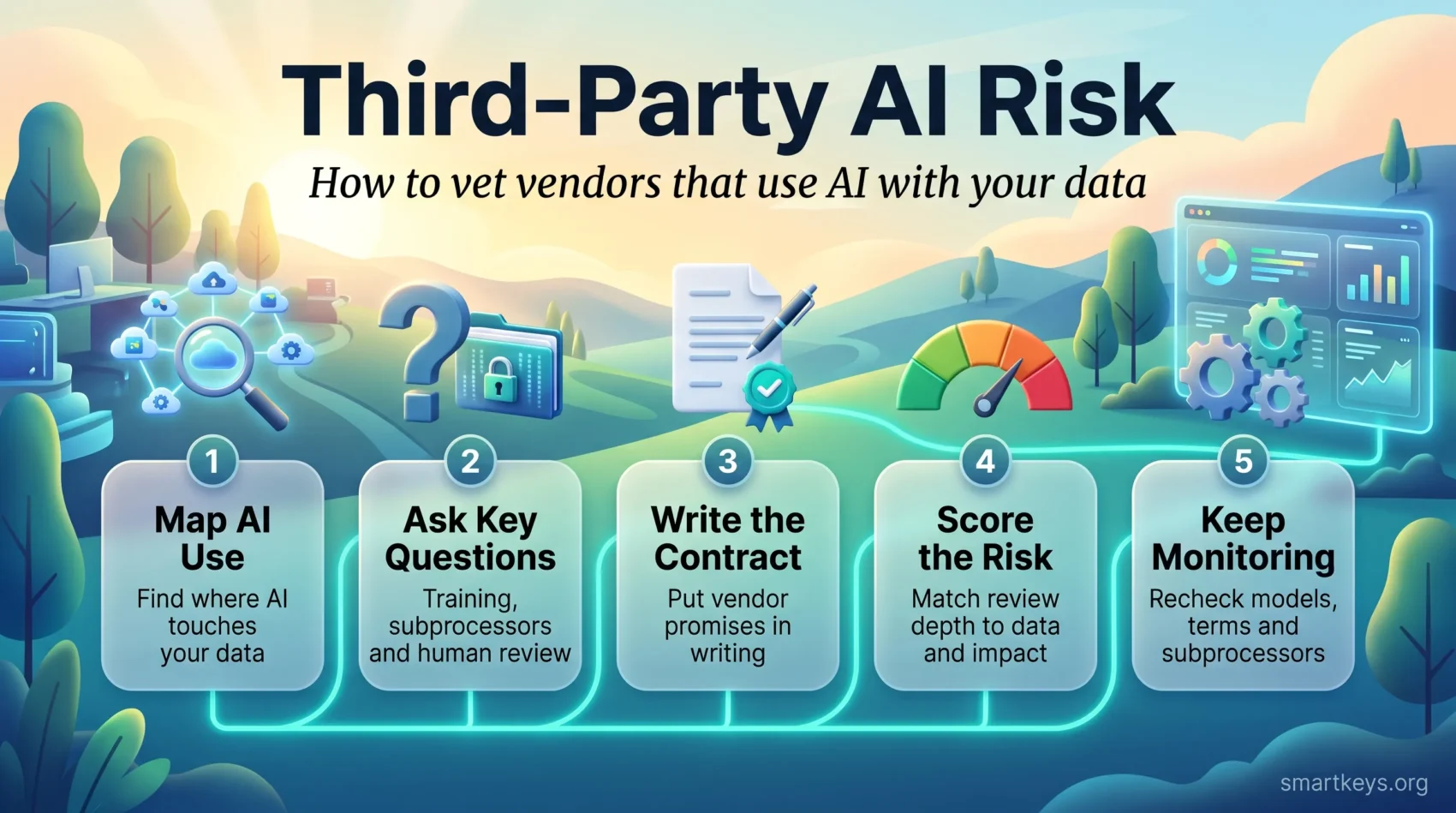
Almost every software vendor now sells some form of artificial intelligence. Your CRM (customer relationship management software) writes email drafts, your help desk tool suggests replies, and your HR platform ranks job applicants. Each of these features may send your data through a model you never chose and cannot see. That is third-party AI risk: the chance that a vendor’s use of AI exposes your data, your customers or your decisions to harm.
The problem is not that vendors use AI. The problem is that classic vendor reviews were built for a different era. A standard security questionnaire asks about firewalls, passwords and backups. It rarely asks whether your files train a model or which outside AI provider sits behind a feature.
This guide gives you a practical vetting process, whether you buy one tool or manage hundreds of contracts. The goal is not to block useful AI. It is to adopt it with your eyes open.
Key Takeaways
- Many vendors add AI features quietly through updates, so start by finding out where AI already touches your data.
- Ask three core questions: Is my data used for training? Which other companies process it? Who reviews high-impact outputs?
- Put the answers into the contract, not just a sales call or a questionnaire.
- Score vendors by data sensitivity and decision impact, so the riskiest ones get the deepest review.
- Recheck after onboarding, because models, subprocessors and terms change over time.
Why third-party AI risk belongs in your vendor review
Third-party risk management (TPRM) is the process of checking the companies you depend on before and while you work with them. For years it focused on security and financial stability. AI adds new questions that those reviews were never designed to answer.
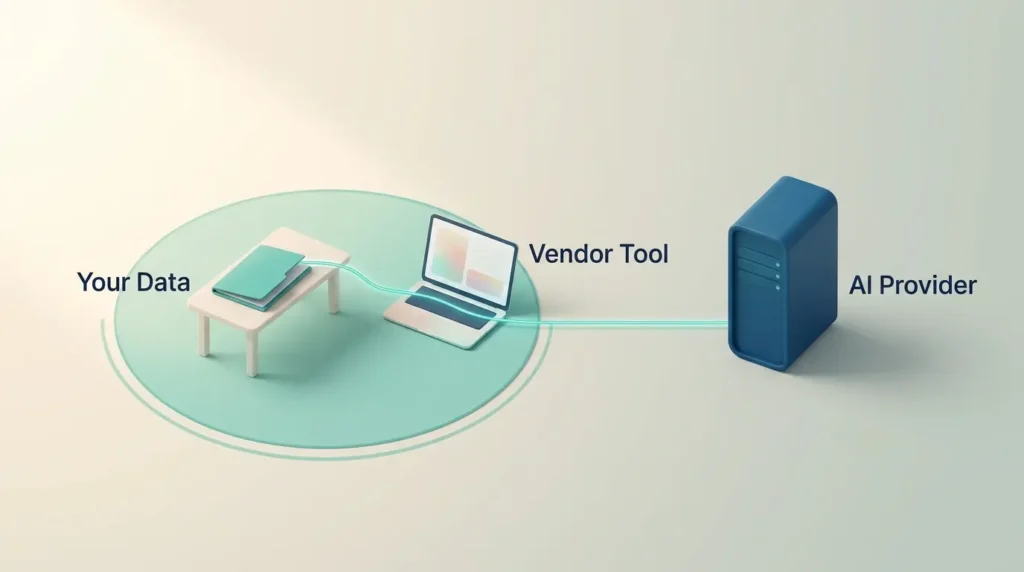
Here is a simple example. A marketing agency uploads client briefs into a writing assistant. The assistant forwards each prompt to a large language model run by another company. If that company keeps the prompts or uses them to improve its model, confidential client plans have now left the agency’s control. Nobody broke a firewall. The data simply went where the terms of service allowed it to go.
Other problems follow the same pattern:
- Privacy breaches: personal data is processed for purposes your customers never agreed to.
- Biased or wrong decisions: a vendor’s model screens applicants or flags transactions unfairly, and your company carries the blame.
- Opaque outcomes: you cannot explain to a customer or regulator why a decision was made.
- Hidden dependencies: an outage or policy change at the vendor’s AI provider breaks a tool you rely on.
Because these risks run through the whole relationship, AI questions should be part of every stage: selection, contracting, monitoring and renewal. A structured risk management framework gives you a natural place to slot them in.
Map where your vendors use AI and access your data
You cannot assess what you cannot see. The first step is an inventory of where AI already touches your information, including features that arrived through routine software updates.
List all vendors and the data each one receives, then add AI details. For each tool, record:
- which features use AI and what they do (drafting, scoring, summarizing, deciding);
- whether the vendor runs its own model or calls an outside provider;
- which subprocessors, meaning the other companies a vendor hands your data to, are involved;
- where the data is stored and processed geographically;
- which of your business processes depend on the output.
Besides questionnaires, IT teams can check network or DNS logs (records of which web addresses company devices look up) for traffic to well-known AI services. This often reveals tools nobody officially bought. It overlaps with the challenge of shadow AI, where employees adopt AI tools on their own, and with older patterns of shadow IT in remote teams.
Do not try to review everything at once. Prioritize vendors that handle sensitive data such as customer records, health or financial information, or that support critical operations. Outsourcing partners belong on this list too, because they often run AI tools on your behalf (see our overview of BPO trends and data security).
Define your AI risk criteria before assessing vendors
Once you know where AI is used, decide what “too risky” means for your company. Clear criteria keep reviews consistent and stop every assessment from becoming a debate.
Useful criteria include:
- Data sensitivity: Does the tool see public content, internal documents or personal data?
- AI purpose: Does the AI assist a person, or does it act on its own?
- Decision impact: Could an error affect someone’s job, credit, health or legal position?
- Access scope: How many systems and users can the vendor reach?
- Business criticality: How badly would an outage or a bad output hurt operations?
Then set escalation triggers. For example: any vendor whose AI makes decisions about people without human review goes to legal and privacy for approval. Any vendor that trains on your confidential data needs a written opt-out before signing. Your internal AI governance model should own these rules, so vendor reviews and in-house AI projects follow the same standards.
Ask vendors how they collect, use and protect your data
This is the heart of the review. Sales teams often give reassuring but vague answers, so get specific answers in writing.
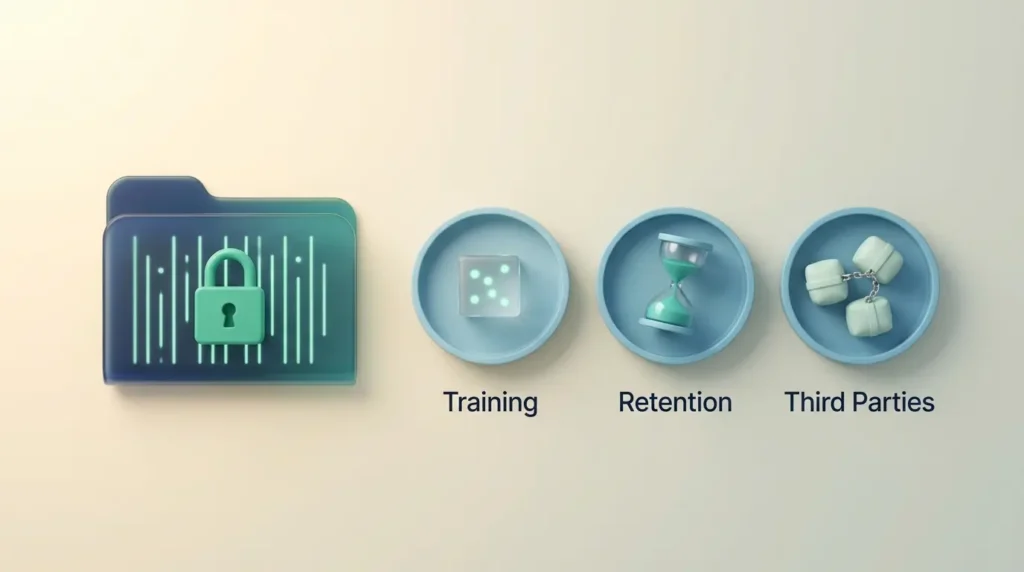
Confirm whether your data is used to train or improve AI models
Ask directly whether your data is used to train, fine-tune or evaluate any model. Fine-tuning means adjusting an existing model with new examples, and your data could be those examples. Also ask whether the answer differs by plan. Free and consumer tiers often have looser terms than business contracts, and an opt-out may need to be switched on manually.
Review data retention, reuse, consent and deletion practices
Ask how long prompts, uploaded files and outputs are stored, and in which countries. Ask whether the vendor’s AI provider keeps its own copies, for example for abuse monitoring. Find out how deletion works when you leave and whether you get confirmation. If you operate in several regions, check the answers against data localization laws.
Ask about subprocessors, access controls and data sources
Request a current subprocessor list that names the AI providers involved. Under the GDPR, the EU’s General Data Protection Regulation, a processor needs your prior authorization before adding new subprocessors, as set out in Article 28. Also ask who at the vendor can see your data, whether access is logged, and whether the data is encrypted in storage and in transit.
Finally, compare every answer against the contract and the published terms. If the sales deck says “we never train on your data” but the terms allow it, the terms win.
Evaluate AI governance, security and model safeguards
Good data handling is only half the picture. You also need to know how the vendor builds, tests and controls its AI features.
Ask about the vendor’s governance process: who approves new models, how changes are tested before release, and how problems are rolled back. Ask how they test for bias and accuracy, and request a summary of results for the features you plan to use. If a feature affects people, such as hiring, lending or customer eligibility, ask how the vendor explains individual results. The principles behind explainable AI help you judge whether those explanations are meaningful.
For high-impact uses, confirm there is human oversight. That means a person can review, correct or override the output, and the system keeps an audit trail of what happened.
Certifications help, but read what they actually cover:
- SOC 2 reports and ISO/IEC 27001 certificates, two common security audits, show that general security controls exist. They say little about how a model behaves.
- ISO/IEC 42001, published in 2023, is the first international standard for an AI management system. Certification signals a structured approach to AI risk, though it does not guarantee a specific model is safe. (ISO)
- The NIST AI Risk Management Framework is a free, voluntary U.S. framework. Its 2024 Generative AI Profile (NIST AI 600-1) explicitly lists risks from third-party components in the AI value chain, which makes it a useful checklist for vendor questions. (NIST)
Security questions should also cover new attack types. One example is prompt injection, where hidden instructions in a document or web page trick an AI feature into leaking data or taking unwanted actions. Ask how the vendor tests for it. Broader context is in our overview of cybersecurity trends and the move toward zero-trust security.
Review contracts and compliance obligations for AI use
Answers in a questionnaire are helpful. Promises in a contract are enforceable. Wherever possible, turn the key answers into clauses. Many companies add an AI addendum to their standard data processing agreement (DPA), the contract that governs how a vendor handles personal data.
Useful clauses include:
- AI disclosure: which features use AI and which outside providers power them.
- Training restrictions: a clear statement on whether your data may be used to train or improve models.
- Subprocessor changes: advance notice before new AI providers are added, with a right to object.
- Material changes: notice before the vendor swaps models or changes how a feature makes decisions.
- Incident reporting: deadlines for reporting data breaches and serious model failures.
- Audit rights: access to documentation, test results and security reports.
Regulation shapes these terms too. In the EU, the AI Act places duties on companies that deploy high-risk AI systems, not just on the vendors that build them. The Digital Omnibus on AI entered into force on July 27, 2026. It moved the start date for standalone high-risk systems, such as hiring tools, from August 2, 2026 to December 2, 2027. High-risk AI built into regulated products follows on August 2, 2028. (National Law Review) The extra time is useful for building contract terms now. Details are in our guides to EU AI Act compliance and broader AI regulation. In the U.S., obligations depend on your sector and state, so involve legal counsel for regulated uses. Our guide to data privacy trends shows which privacy rules apply now.
Score vendor risk based on exposure and business impact
A scoring method decides how much effort each vendor deserves. Without one, every tool gets the same lengthy review, and people start skipping the queue.
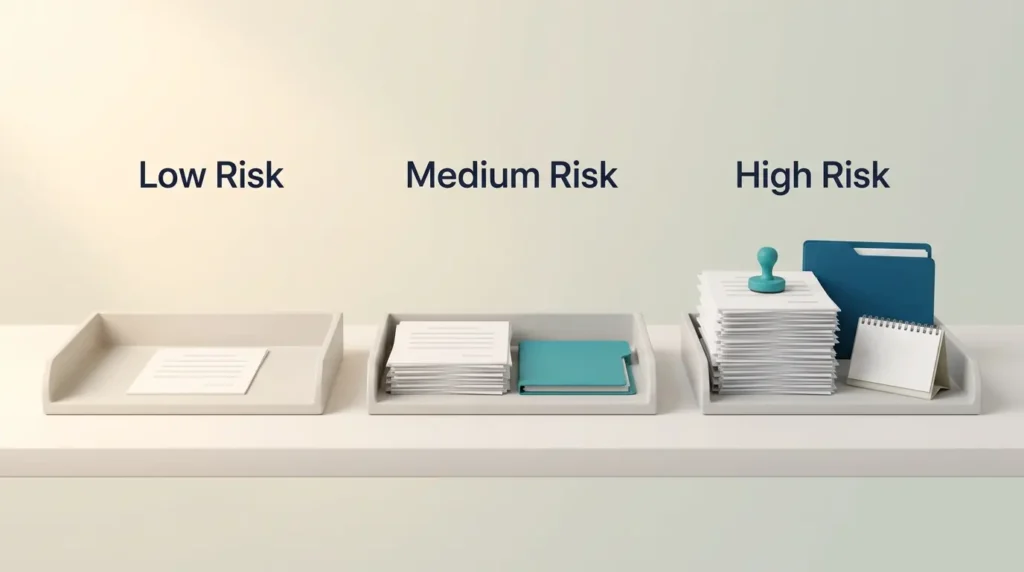
Score each vendor on the criteria you defined earlier: AI use case, data sensitivity, access scope, geographic exposure and potential harm. Then separate two numbers:
- Inherent risk: how risky the use is before any safeguards. An AI that screens job applicants is high, an AI that suggests meeting titles is low.
- Residual risk: what remains after the vendor’s controls and your contract terms. Strong opt-outs, human review and audit rights lower it.
In practice, a simple three-tier system works for most companies. Low-risk vendors get a short questionnaire. Medium-risk vendors get the full question set and contract review. High-risk vendors get all of that plus legal and privacy sign-off and a yearly reassessment. Automated scoring tools can speed up triage, but a person should make the final call for high-impact vendors.
Monitor third-party AI risk after onboarding
A vendor that passed review last year may look different today. AI products and their terms change quickly, so ongoing monitoring matters.
Track at least these signals:
- Model changes: new model versions or a switch to a different AI provider.
- New AI features: capabilities added through updates and sometimes switched on by default.
- Subprocessor updates: new companies added to the vendor’s list.
- Terms changes: revised privacy policies or data use clauses.
- Security events: breaches, outages or public reports of model failures.
Assign an owner for each high-risk vendor and subscribe to their change notices. Schedule reassessments when contracts renew, when you use the tool for a new purpose, or when regulation changes. A clear data governance strategy makes this easier, because you already know which data sets are sensitive.
Strengthen third-party risk management across your organization
Vendor AI risk crosses departments. Procurement signs, IT connects, legal reviews terms and privacy checks data. When each team works alone, gaps appear.
A few practices help:
- Create one intake path: every new tool with AI features goes through the same request form, whichever team buys it. Modern digital procurement systems can route requests automatically.
- Keep an approved list: pre-vetted tools let employees move fast without a new review each time.
- Publish usage rules: clear generative AI usage guidelines tell staff what data they may put into approved tools.
- Train the reviewers: procurement and security teams need enough AI knowledge to spot weak answers.
- Start small: pilot the process on your ten most important vendors before rolling it out to all of them.
These steps fit naturally into a wider privacy compliance framework and support the principles in your AI ethics framework.
Conclusion
Treat third-party AI risk as an ongoing part of risk management, not a one-time checkbox. It runs from discovery to assessment, contracting, monitoring and renewal, with a clear owner at every stage.
Ask vendors how they use your data, whether they train models on it, who else processes it and how they respond to incidents. Apply the same criteria to every vendor, put the important promises in the contract and pair automation with human judgment for high-impact decisions. Done well, vendor vetting lets teams use AI tools with confidence.
Found this useful?
Make SmartKeys a preferred source on Google, and our articles will surface more often in your Top Stories, AI Overviews, and AI Mode.
Add as Preferred SourceFAQ
Why is it important to assess vendors that use AI with my data?
Because your company usually stays responsible for your data and your customers, even when a vendor’s AI processes it. If a vendor trains on your files or makes unfair automated decisions, the legal and reputational damage often lands on you. Classic security reviews rarely cover model behavior. A short AI-specific review shows where your data goes, who else sees it and who checks the outputs. That lets you decide whether the tool is worth the exposure.
What questions should I ask vendors about data protection?
Start with three: Is our data used to train, fine-tune or evaluate any model? Which outside AI providers and subprocessors receive it? How long is it kept, and how is it deleted when we leave? Then ask about access controls, encryption and where data is stored. Check whether free and paid plans differ, since consumer tiers often have looser terms. Get everything in writing and compare it with the contract and terms of service.
What should I include in contracts regarding AI use?
The contract should state which features use AI, which outside providers power them, and whether your data may be used for model training. Add advance notice for new subprocessors and for material model changes, ideally with a right to object. Include deadlines for reporting data breaches and serious model failures, plus audit rights to documentation and test results. For high-risk uses such as hiring or credit decisions, involve legal counsel, because sector rules and the EU AI Act may require specific terms.
What steps should I take to monitor vendor risk after onboarding?
Assign an owner to each high-risk vendor and subscribe to their change notices, release notes and subprocessor updates. Watch for new model versions, new AI features switched on by default, revised privacy terms and security incidents. Reassess the vendor when the contract renews, when you start using the tool for a new purpose, or when regulation changes. Low-risk vendors can be checked less often. The goal is to catch changes before they become incidents.
Is a vendor’s promise not to train on my data enough?
No, it is a good start but not the full picture. A vendor can avoid training on your data and still store prompts for a long time. It may also pass them to an outside AI provider with different terms. The promise might only cover certain plans or require an opt-out you must switch on. Ask how long data is retained, which subprocessors see it and whether the commitment is written into the contract.
Do small businesses need a formal third-party AI risk process?
They need a lightweight one, not a heavy program. A small business can start with a simple spreadsheet listing each tool, the data it receives and whether it uses AI. Ask the three core questions about training, subprocessors and retention before buying any tool that touches customer or employee data. Read the AI section of the terms and switch off training where an opt-out exists. Review the list once or twice a year. This takes a few hours and prevents the most common problems.