A driverless truck steers, brakes and changes lanes by itself, guided by sensors and software instead of a person at the wheel. In 2026 this is no longer a demo. Freight is moving on public highways in Texas and Arizona with nobody in the cab.
It is also far smaller than the headlines suggest. Aurora Innovation, the company furthest ahead in the United States, reported passing 250,000 cumulative driverless miles in January 2026 across ten routes. Its regulatory filing listed 109 vehicles, with a target above 200 by the end of 2026. The American Trucking Associations counts about 3.58 million professional drivers.
That gap is the starting point. Autonomous trucking works today on specific lanes and will not touch most freight for years. Here is what it changes about cost, safety, jobs and rules.
Key Takeaways
- Driverless trucks carry paying freight on mapped corridors in Texas and Arizona today.
- Fleets are still measured in dozens of trucks, not thousands.
- The clearest gain is time: software has no legal limit on daily driving hours.
- Federal rules are unfinished, so deployment runs on case-by-case exemptions.
- Long-haul highway jobs are the exposed ones, local and vocational driving far less so.
What Autonomous Trucking Actually Means
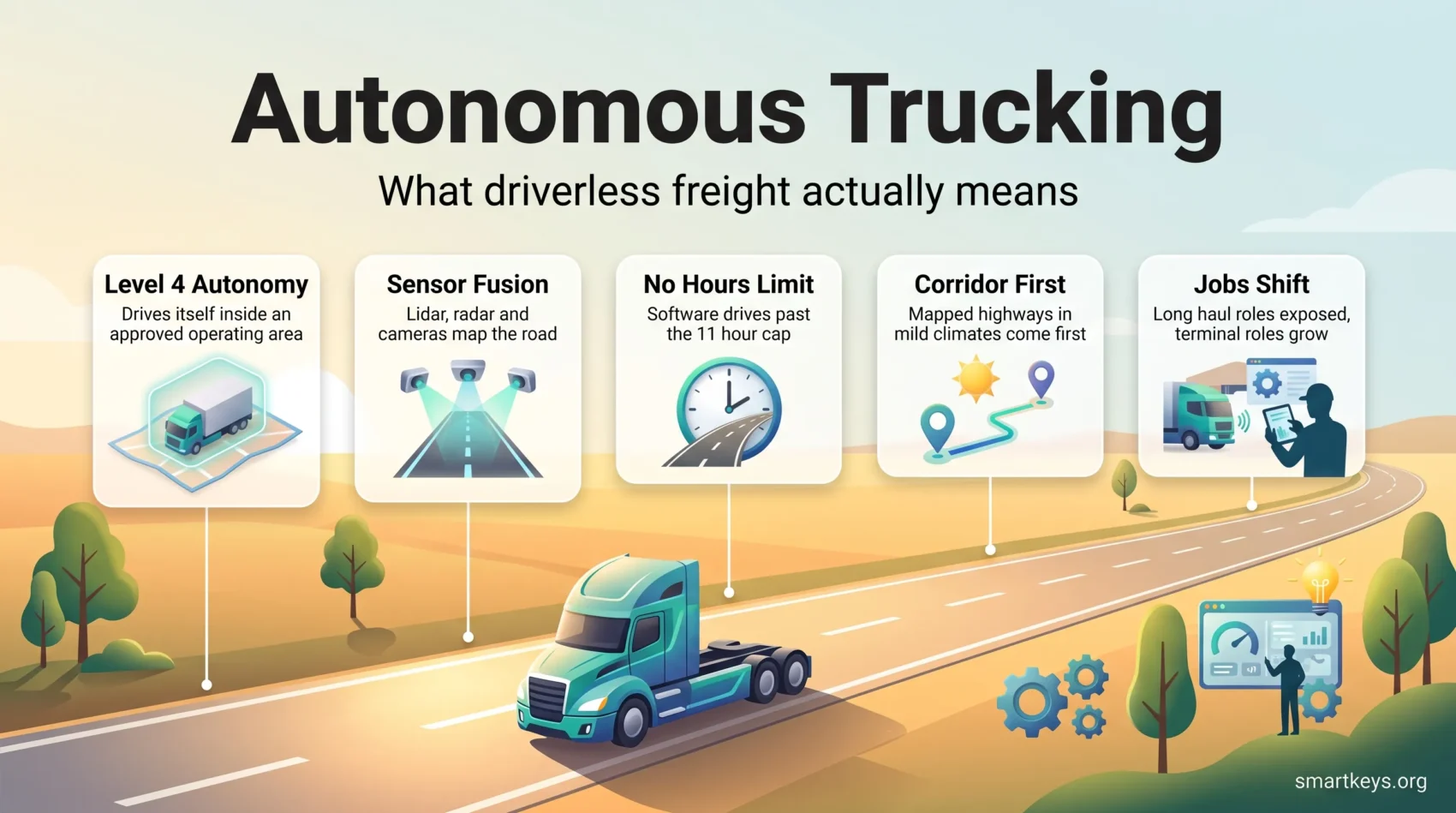
Vehicle automation runs on levels 0 to 5. Level 2 covers the driver assistance most new trucks already have, such as adaptive cruise control and lane keeping, with the person responsible throughout. Level 4 is the one that matters for freight: the truck handles the entire drive inside a defined operating area, meaning the specific roads, weather and times of day it has been approved for. Nobody needs to be ready to take over there. Level 5, driving anywhere in any condition, does not exist as a product.
One distinction is worth keeping straight: driverless is not the same as unsupervised. Several programmes still put a ride observer in the cab or keep remote staff who can advise a stopped truck, the same cautious pattern seen in autonomous delivery in e-commerce and autonomous retail.
The Technology Behind Driverless Freight
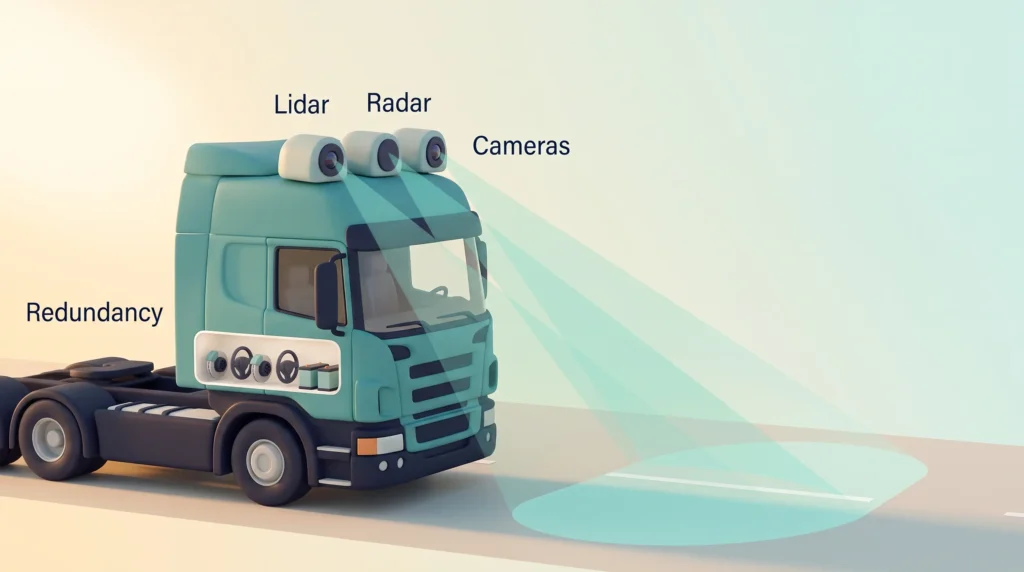
A driverless truck builds a live picture of the road from three sensor types. Lidar fires laser pulses and times the reflections, giving precise distance. Radar sees through rain and dust; cameras read lane markings and signs. Software fuses the three and replans the path many times a second. Underneath sits the part that is easy to overlook: two braking paths, two steering paths and two power supplies, because no person can pull over if one fails.
Weather used to be the hard ceiling. Aurora said poor conditions had constrained its Texas operations roughly 40 percent of the time. In February 2026 it reported that new software let its trucks run in rain, fog and heavy wind, turning a part-time service into one a shipper can schedule around. Snow and ice remain outside the approved area.
Volvo took the factory route rather than retrofitting. It built 25 VNL Autonomous tractors in Dublin, Virginia in late 2024 with redundant brakes and steering designed in, and began second-generation production in late 2025 using software from the Canadian developer Waabi. The same move toward purpose-built machines shows up across robotics automation and commercial drones.
Safety and Efficiency: What Is Proven and What Is Not
The safety case is simple. Fatigue, distraction and speeding are recurring factors in serious truck crashes, and software does not get tired. The evidence is encouraging but thin. Aurora reports more than 250,000 driverless miles with no collision attributed to its own driving system. That is a real milestone, and a small sample next to the billions of miles US trucks cover each year, gathered on mapped Sun Belt highways in mostly good weather. It is not yet proof that driverless trucks beat experienced human drivers everywhere.
The efficiency case is easier to pin down, because it is a rules problem. A human driver may drive at most 11 hours in a 14-hour window. Aurora validated a roughly 1,000 mile lane from Fort Worth to Phoenix, more than one driver can legally cover in a day. That load needs two drivers or an overnight stop today. A driverless truck keeps going. Fleets already running IoT in business operations, predictive maintenance and real-time data in decisions have a head start, because all three feed on the same telematics data.
What Autonomous Trucking Does to Costs and Operations
Start from a real number. The American Transportation Research Institute put the industry-average marginal cost of operating a truck at 2.336 dollars per mile in 2025, and 1.854 dollars excluding fuel. Driver pay and benefits are the largest single line in that figure, which is why long, repetitive highway lanes get automated first.
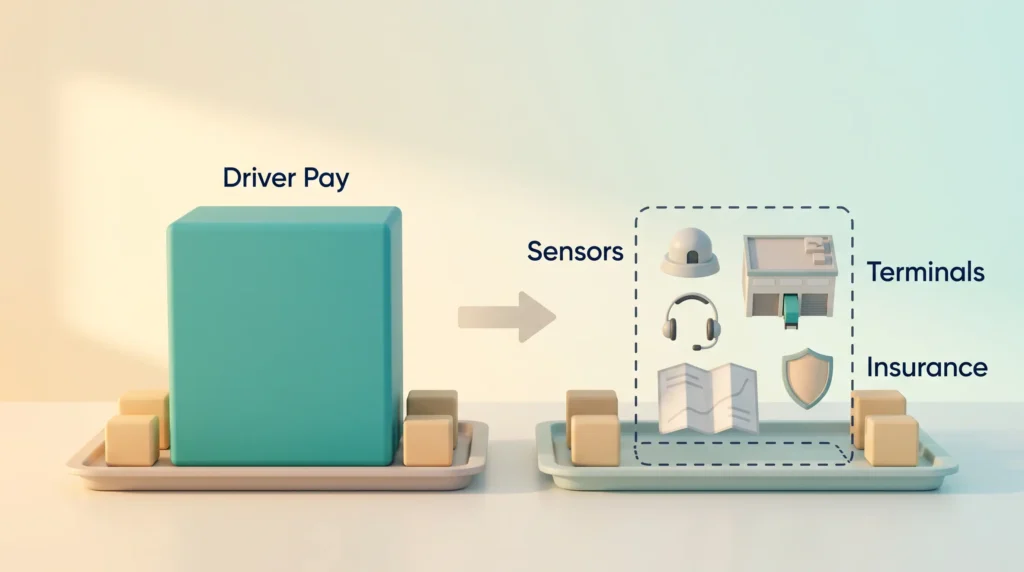
The saving is not the whole driver cost, though. Autonomy adds sensor hardware, terminals at each end of the lane, remote support staff, mapping, and an insurance question nobody has fully priced. Two models have emerged: Aurora sells the driving as a service, while Kodiak licenses its system to customers who own the trucks.
For a shipper or fleet manager, the practical move is unglamorous. Pick one repeatable lane, instrument it, and measure your own cost per mile, so you can judge a vendor quote. Raise liability early: the insurtech market is still working out how to underwrite a truck with no driver.
Who Is Actually Hauling Driverless Freight
Aurora and the Texas Corridors
Aurora began commercial driverless runs between Dallas and Houston in 2025. By February 2026 it had tripled its network to ten routes across Texas and Arizona, including Fort Worth to El Paso and Dallas to Laredo. Named customers include Hirschbach Motor Lines, Detmar Logistics, Driscoll’s and Capital Sand. Aurora said capacity was committed through the third quarter of 2026, a better demand signal than a forecast.
Volvo, Waabi, Kodiak and the Rest of the Field
Volvo supplies the truck and the redundant hardware, with Waabi’s software driving. Kodiak, public since 2025, delivered customer-owned RoboTrucks to Atlas Energy Solutions, which completed 100 loads of frac sand on a 21 mile route in West Texas. Torc and Plus are still testing.
One correction is worth making, because the two ideas get blurred. The Tesla Semi is an electric truck, not an autonomous one; it entered volume production in Nevada in April 2026. Electrification and autonomy are separate tracks arriving together, much like private 5G networks and edge AI in factories.
The model has changed too. Early plans centred on hub-to-hub transfers; most developers now aim for direct-to-customer routes including surface streets. Anyone running digital twins in manufacturing will recognise the method: simulate first, then widen the operating area.
Jobs, Wages and the Rules
The most cited job estimate is still a 2018 report for the UC Berkeley Labor Center by Steve Viscelli, which put up to 294,000 long-distance jobs at risk: roughly 211,000 truckload, 51,000 less-than-truckload and 32,000 parcel positions. Read it with its date in mind, since it predates every driverless mile driven so far. Against 3.58 million professional drivers, the exposure is real but concentrated.
The driver shortage argument has weakened too. After estimating a shortfall above 80,000 drivers in 2021, the ATA’s chief economist Bob Costello now frames it as a shortage of qualified drivers rather than of people. The case for autonomy has to stand on cost and utilisation instead.
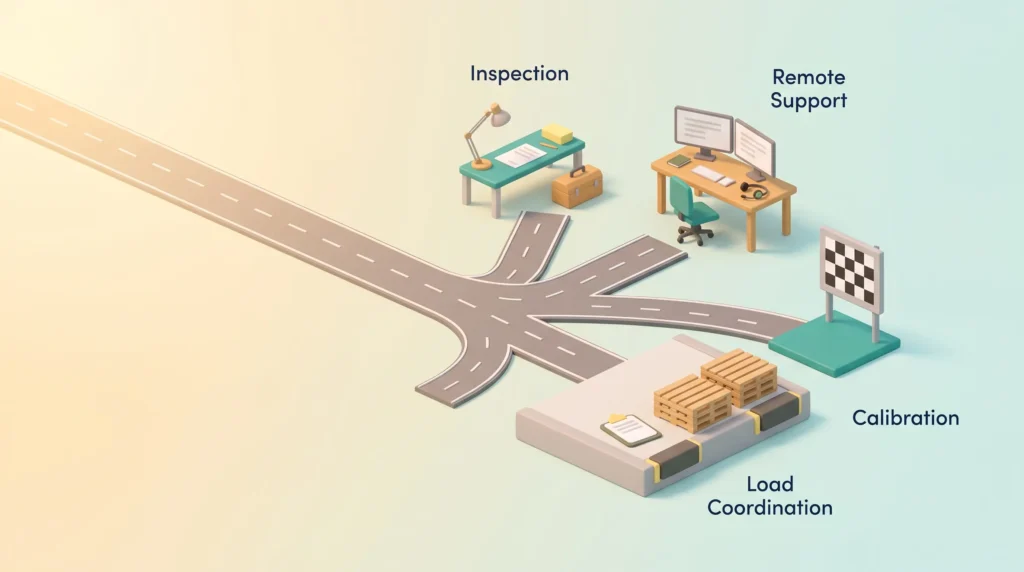
Newer roles are appearing at the terminals: inspection technicians, remote support operators, load coordinators, sensor calibration. The Berkeley report warned these could pay less. Employers should start with an honest automation risk assessment, then plan mid-career retraining and upskilling and reskilling before roles disappear rather than after. Some firms already redeploy workers internally, and the wider argument reaches into automation in blue-collar jobs and the robot tax debate.
The federal picture is unfinished. The Federal Motor Carrier Safety Administration has an automated driving systems rulemaking on its agenda, still at the proposed-rule stage in 2026, so gaps are handled by exemption. Aurora asked for a five-year exemption to use cab-mounted warning beacons instead of the warning triangles a driver would place on the shoulder, with comments closing in May 2026. Small rule, large consequence: nobody is in the cab to walk the triangles out. State rules differ, so the question is lane by lane, and AI regulation and cybersecurity duties apply on top.
How to Prepare Without Betting the Business
Driverless freight will spread the way it started: one mapped corridor at a time, in mild climates, on lanes that repeat. Preparing costs far less than reacting. Four steps are worth taking now. Identify your two or three most repetitive long lanes and note their weather exposure. Get telematics data clean enough to state your own cost per mile per lane. Ask your insurer how liability would work if a vendor’s software is driving. And tell your drivers what you are exploring, because the people who leave first are usually the ones you wanted to keep. None of this requires buying an autonomous truck, only knowing your numbers well enough to judge one.
Found this useful?
Make SmartKeys a preferred source on Google, and our articles will surface more often in your Top Stories, AI Overviews, and AI Mode.
Add as Preferred SourceFAQ
Are driverless trucks legal on US public roads?
Yes, in some states and under conditions still being worked out. No single federal rule authorises or bans them. The Federal Motor Carrier Safety Administration has an automated driving systems rulemaking in progress but had not finalised it as of 2026, so operators run under existing regulations plus specific exemptions. Aurora asked for a five-year exemption to use cab-mounted warning beacons instead of the reflective triangles a human driver would place on the shoulder. State law varies widely, which is why current operations cluster in Texas and Arizona.
Can autonomous trucks handle rain, fog and night driving?
Rain, fog, heavy wind and darkness are now inside the approved operating area for at least one commercial operator. Aurora reported in February 2026 that new software let its driverless trucks run in those conditions, having previously been constrained by weather roughly 40 percent of the time in Texas. Night driving is validated too, which makes round-the-clock service possible. Snow and ice remain outside the approved area, one reason the first corridors run through the Sun Belt.
How do companies prove a driverless truck is safe?
Through simulation, supervised road miles and hardware redundancy, published as a safety case. Developers run large numbers of simulated scenarios, then drive real routes with a safety operator on board before removing that person. The truck carries duplicated braking, steering and power systems, so a single failure cannot leave it uncontrolled. Aurora cites more than 250,000 driverless miles with no collision attributed to its driving system. That record is real but small next to the billions of miles US trucks cover annually, so it is early evidence rather than settled proof.
How much does autonomous trucking cut cost per mile?
No operator has published audited figures, so treat any specific savings claim with caution. The documented starting point is that the American Transportation Research Institute measured the industry-average marginal cost of operating a truck at 2.336 dollars per mile in 2025, with driver pay and benefits the largest single component. Removing the driver removes part of that, but autonomy adds sensor hardware, terminals, remote support and mapping, and insurance pricing is unsettled. The larger near-term gain is probably utilisation, because a truck with no mandatory rest breaks covers more miles per day.
Will autonomous trucks replace truck drivers?
Not across the board, and not quickly. The exposure sits in long-distance highway work. A 2018 UC Berkeley Labor Center report by Steve Viscelli estimated that up to 294,000 long-distance jobs could eventually be automated, including roughly 211,000 truckload positions. That is a fraction of the 3.58 million professional drivers in the United States, and it was modelled years before commercial driverless operations began. Local delivery, vocational work and anything involving loading or difficult sites stays with people. Expect the job mix to shift toward terminals and remote support rather than vanish.