
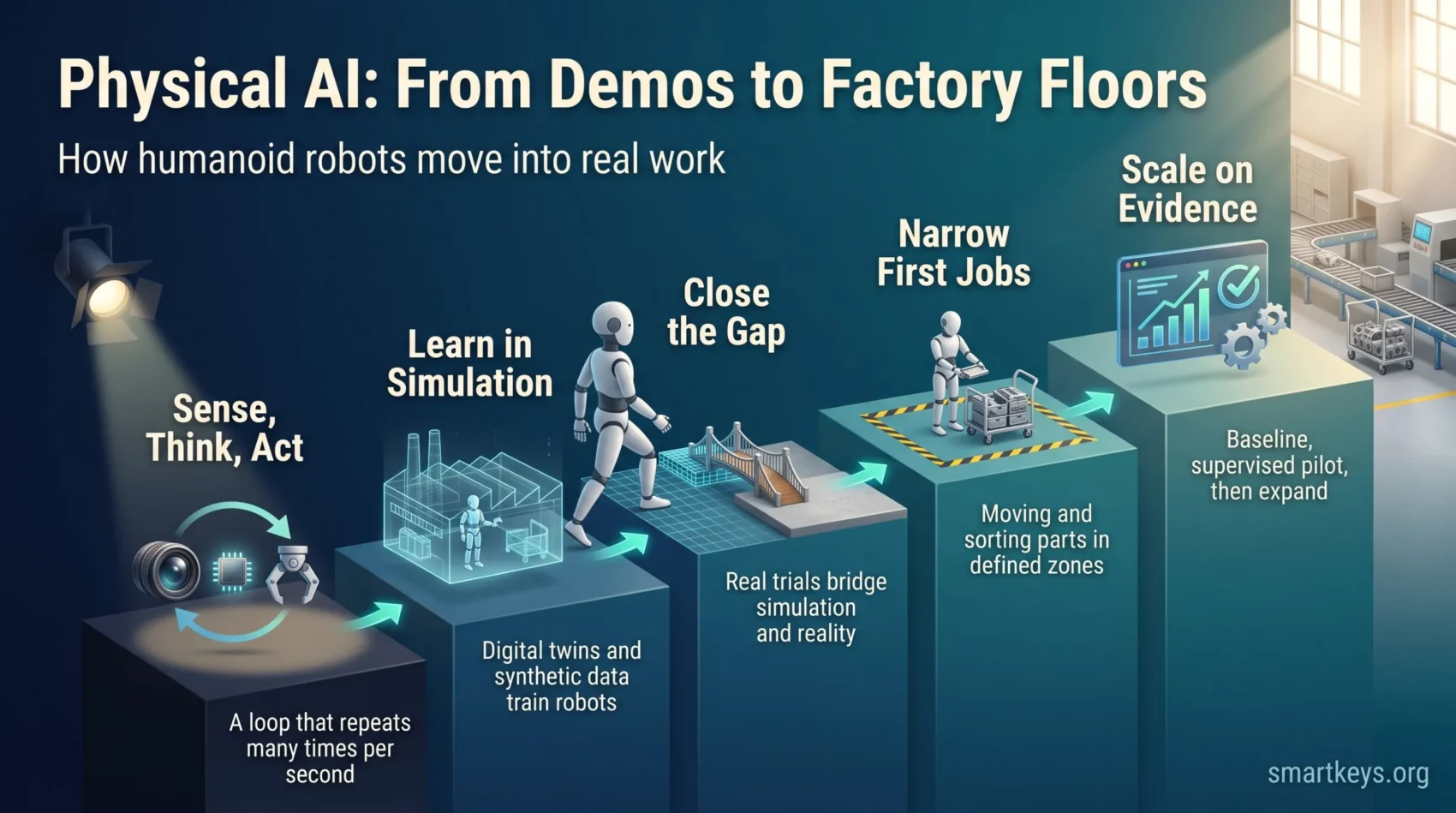
For years, humanoid robots were trade show material. In 2026 that is starting to change. A small number of humanoids now do paid work in real factories, mostly moving and sorting parts.
The technology behind this shift is called physical AI. It is the branch of artificial intelligence that controls machines in the real world instead of producing text or images on a screen. At CES in January 2026, NVIDIA CEO Jensen Huang put it bluntly: “The ChatGPT moment for robotics is here.” That is a vendor talking, so treat it as a signal of ambition, not a guarantee.
This guide explains what physical AI is, how robots learn, what is actually deployed on factory floors today and what still holds humanoids back. It ends with a practical way to judge whether physical AI fits your operation.
Key Takeaways
- Physical AI lets a machine sense its surroundings, decide what to do and act on that decision in the physical world.
- Humanoid robots matter because factories, warehouses and tools are built for the human body.
- Robots now learn largely in simulation, then transfer those skills to real machines. Closing that “sim-to-real” gap is the hard part.
- Real deployments in 2026 are narrow: BMW uses Figure robots for parts handling, and Boston Dynamics is building its Atlas humanoid for Hyundai plants.
- Reliability, safety certification and cost still limit how fast humanoids spread.
- The safest entry point is one measurable workflow, a baseline and a supervised pilot.
What Is Physical AI?
Physical AI is artificial intelligence that controls a machine acting in the real world. A chatbot works with words. A physical AI system works with objects, distances, weight and people moving around it.
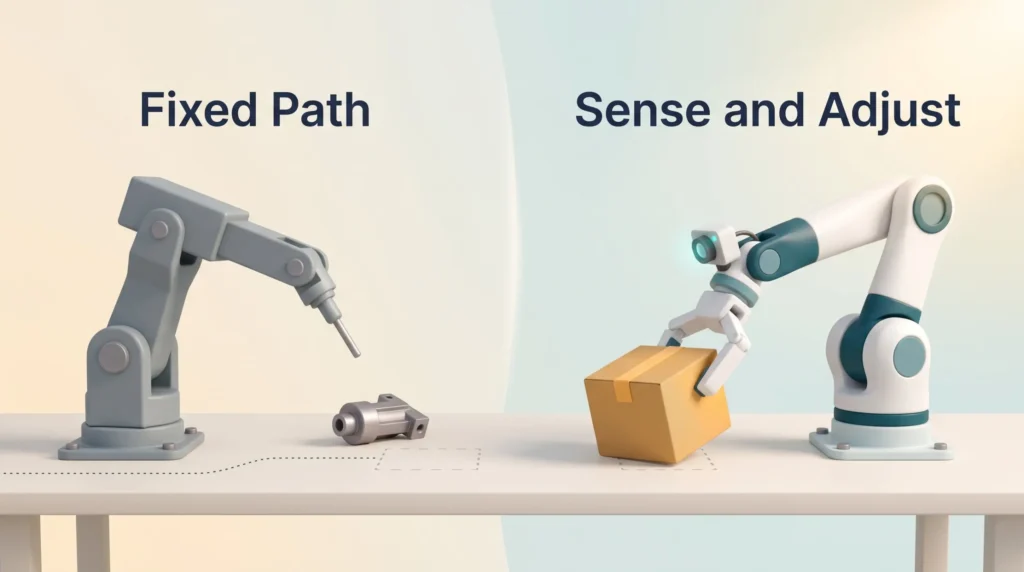
Every physical AI system runs the same basic loop:
- Sense: cameras, depth sensors and touch sensors collect data about the surroundings.
- Think: an AI model interprets that data and decides on the next step.
- Act: motors and grippers turn the decision into movement.
The loop repeats many times per second. If a box slips two centimeters, the robot sees it and adjusts its grip.
That is the key difference from a classic welding arm, which repeats one programmed path and fails if a part sits in the wrong spot. BMW describes physical AI as the technology that “connects digital AI with real machines and robots.” For the wider picture of fixed arms, cobots and software bots, see our guide to robotics automation in 2026.
Why Humanoid Robots, and Why Now?
A humanoid robot has a roughly human shape: two arms, hands or grippers, a head with cameras and, usually, legs. The shape is practical: factories, stairs, shelves and tools are designed for people, so a human-like robot can in theory work there without rebuilding the site.
Three developments made the idea practical enough to test in production:
- Robot foundation models. These are large AI models trained on huge amounts of data that can handle many tasks, not just one. They give robots a general starting skill set.
- Better simulation. Robots can now practice millions of times in a virtual factory before touching a real part.
- Cheaper, faster onboard computers. Chips small enough to fit inside a robot can now run these models in real time.
Investors have noticed. In September 2026, Goldman Sachs raised its forecast for the humanoid market to about 6.5 million units and roughly $138 billion by 2035, up from 1.4 million units and $38 billion in its earlier estimate. The bank still names reliability, limited real-world training data, autonomy and cost as obstacles. Part of the interest comes from companies moving production back to high-wage countries, where factory labor is scarce. Our article on reshoring and nearshoring covers that trend.
How a Physical AI System Is Built
Every humanoid combines three layers: sensors, an onboard computer and actuators.
Sensors: the robot’s senses
Cameras identify objects and depth sensors measure distance. An inertial measurement unit (IMU), a small sensor that tracks tilt and acceleration, helps with balance. Force sensors tell the robot how hard it grips.
No single sensor is reliable on its own, since glare can blind a camera. Robots therefore use sensor fusion: they combine several signals into one more trustworthy picture of the scene.
The onboard computer: the robot’s brain
A robot cannot wait for a cloud server before it stops in front of a person, so decisions happen on the robot itself, within milliseconds. This is the same logic behind edge AI in business: process data where it is created.
NVIDIA’s Jetson Thor platform is one common choice. Boston Dynamics, Humanoid and RLWRLD build it into their humanoids, according to NVIDIA. In January 2026 the company also launched the Jetson T4000 module at $1,999 per unit when bought in batches of 1,000, aimed at robots and other machines.
Actuators: the robot’s muscles
Actuators are the motors and gears that move joints and grippers. They decide how much a robot can lift and how long it lasts before parts wear out. For factory buyers, durability often matters as much as the AI model, because a robot down for repairs earns nothing.
The Robot Brain: Foundation Models and VLA Models
Much of the recent progress comes from a new type of model called a vision-language-action (VLA) model. It takes in camera images and an instruction in plain language, such as “put the blue parts in the left trolley.” It then outputs motor commands.
Think of it as a language model that has learned to use its hands. The robot does not need a separate program for every object and can handle parts it has never seen before.
Several VLA families lead the field in 2026:
- NVIDIA Isaac GR00T, an open model family for humanoids. Version N1.6 arrived in January 2026, and N1.7, which adds step-by-step reasoning, followed later in the year. Developers can fine-tune these models through Hugging Face’s open LeRobot framework.
- Google DeepMind’s Gemini Robotics, first released in March 2025. Boston Dynamics announced at CES 2026 that it will work with DeepMind to run Gemini Robotics models on the new Atlas.
- Physical Intelligence’s π models, a research line built to generalize. The company says π0.7, announced in April 2026, can work out tasks it was never explicitly trained on.
These models still make mistakes a human worker would not, especially in cluttered scenes. That is why training and testing matter so much.
Training Robots: Simulation, Synthetic Data and the Sim-to-Real Gap
Training a robot only in the real world is slow, expensive and sometimes dangerous. So most training now happens in simulation first.
Digital twins and virtual factories
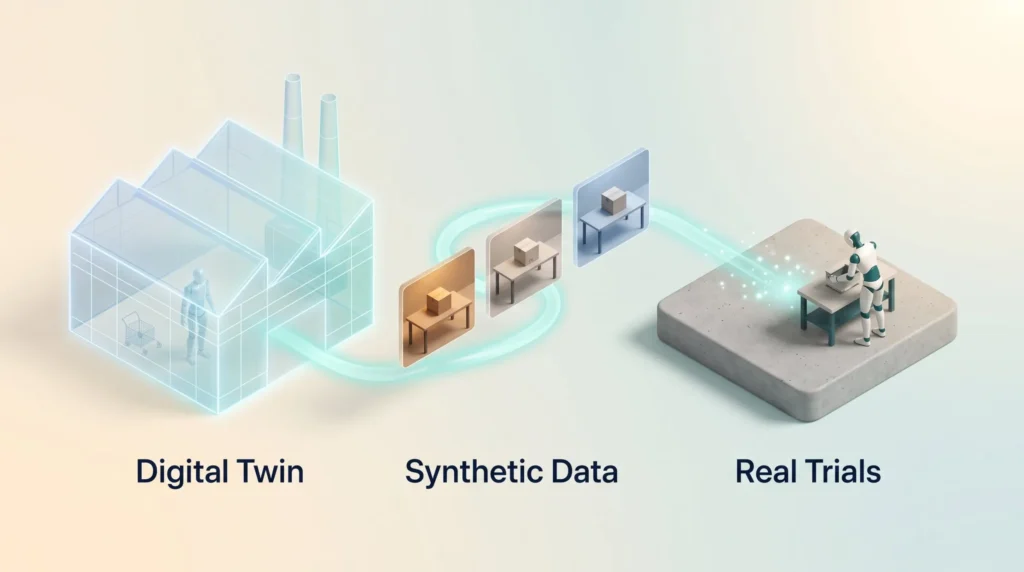
A digital twin is a detailed virtual copy of a real place, such as a production hall. It reproduces the layout, lighting and physics. Developers build these worlds with tools such as NVIDIA Omniverse and the open OpenUSD file format, which lets different 3D tools share the same scene. Our article on digital twins in manufacturing explains the concept in more depth.
Synthetic data and world models
Robots need huge numbers of training examples, far more than anyone can record in real factories. Developers therefore generate synthetic data: artificial but realistic images and scenarios created by software.
A technique called domain randomization helps here. The simulator changes lighting, colors, object positions and floor textures at random, thousands of times. A robot trained this way is less likely to be confused by a flickering lamp. NVIDIA’s Cosmos world models go further and generate realistic training video.
Two ways robots learn
- Reinforcement learning works by trial and error. The robot gets a reward when it does something right, such as grasping a part without dropping it, and slowly learns what works.
- Imitation learning works by example. A human demonstrates the task, often by remotely controlling the robot, and the model learns to copy it.
Most systems combine both and keep classic, predictable control software for balance and basic motion.
Why the sim-to-real gap matters
A robot that performs well in simulation can still struggle on a real floor. Real sensors are noisy, real motors respond with small delays, and real parts are never exactly the same. This difference is called the sim-to-real gap. Tools such as NVIDIA Isaac Sim, the new Isaac Lab-Arena benchmarking framework and the open-source CARLA simulator help test robot behavior before deployment. None of them removes the need for careful real-world trials.
From Demo to Factory Floor: What Is Actually Deployed in 2026
Real humanoid deployments exist, but they are few, small and focused on material handling. Two well-documented examples show what that looks like.
BMW and Figure AI
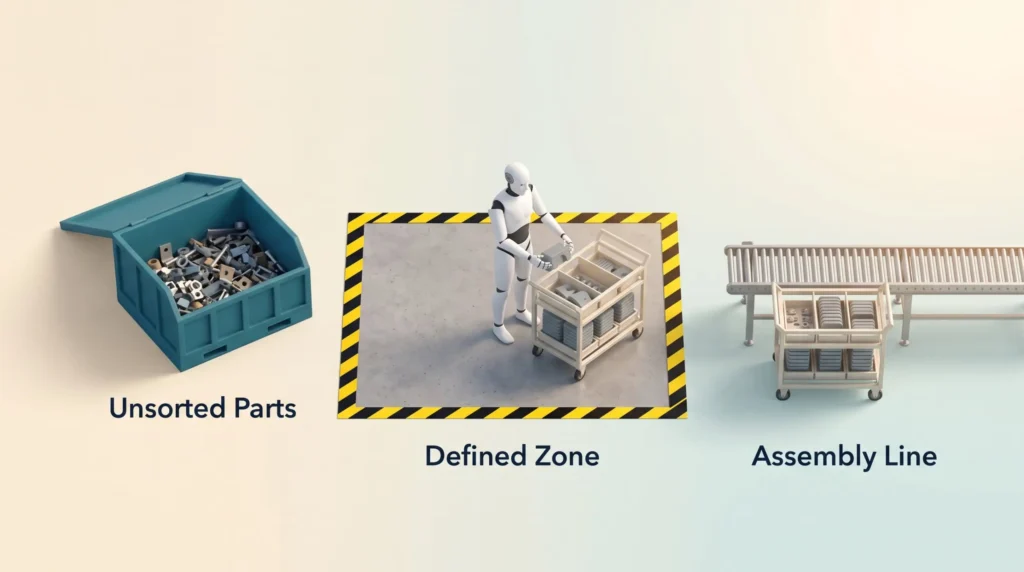
In an 11-month pilot in 2025, Figure 02 robots at BMW’s plant in Spartanburg, South Carolina, placed sheet-metal parts for welding. BMW says the pilot supported production of more than 30,000 BMW X3 vehicles. In June 2026, BMW announced a follow-up project there. The newer Figure 03 picks unsorted components from large containers and sorts them into trolleys that deliver parts to assembly workers in the right order.
Hyundai and Boston Dynamics
At CES 2026, Boston Dynamics presented a production version of its electric Atlas humanoid. According to the robotics trade association A3, production was scheduled to begin in 2026. The first units go to Hyundai’s Robotics Metaplant Application Center and to Google DeepMind, with other customers following in early 2027. The robot can lift up to 66 pounds (about 30 kg) and swaps its own battery in about three minutes. Hyundai has said it plans to deploy humanoid robots at its US factory from 2028.
How to read these announcements
Notice the pattern: repetitive tasks, known parts, a defined zone. Fast, precise welding and delicate assembly still belong to conventional robot arms. Also check who publishes a number, since many deployment figures come from the robot makers themselves.
What Still Holds Humanoids Back
The gap between a convincing demo and a reliable coworker is still large. Five issues come up again and again.
- Reliability and uptime. A robot that needs frequent human rescue slows a line instead of speeding it up.
- Speed and precision. Humanoids are generally slower than people or specialized machines at the same task.
- Training data. Unlike text for language models, there is no internet-sized library of robot movement data. Every new task needs examples.
- Safety certification. The main industrial robot safety standard, ISO 10218, assumes a robot that will not tip over. A legged humanoid that loses power can fall. A dedicated standard for robots that actively balance, ISO 25785-1, is still in draft.
- Cost and energy. Hardware prices are falling, but a humanoid is still a large investment. Some vendors therefore rent robots by the hour or month, a model known as robotics as a service. Training the underlying models also needs substantial computing power, which ties into the growing debate about AI data center energy costs.
Together, these issues explain why most companies still run pilots rather than fleets.
How to Evaluate Physical AI for Your Operation
You do not need a humanoid to benefit from physical AI. Mobile robots, camera-based inspection and robot arms with AI vision use the same technology and are often a better fit. The real question is which task costs you the most today.
- Pick one measurable workflow. Good candidates are repetitive, physically tiring and clearly defined, such as moving totes, sorting parts or visual inspection.
- Measure a baseline first. Record cycle time, downtime, defect rate and safety incidents for at least two weeks. Without these numbers you cannot prove any return later. Our guide to measuring AI ROI shows how to set up that baseline.
- Look at your video data. Existing camera footage often reveals bottlenecks people overlook.
- Test in simulation where possible. A digital twin of the work cell shows whether the robot can even reach, lift and turn in the available space.
- Run a supervised pilot. Keep a person in charge who can stop the robot at any time. Log every intervention and every failure.
- Scale only on evidence. Expand when the pilot meets agreed targets for uptime, safety and cost, not when the vendor’s roadmap says so.
Consider the alternatives, too. If the real problem is strain on workers, exoskeletons may help faster and cheaper. If machines break down unexpectedly, predictive maintenance may pay off sooner than any robot. For outdoor inspection of pipelines, roofs or solar farms, commercial drones are a proven option today.
An automation ethics board can check safety, data use and effects on staff before a project goes live.
What Physical AI Means for Workers
In 2026, humanoids mostly take over tasks, not whole jobs. Early deployments target heavy, repetitive handling work that is hard to staff, while people set up, monitor and fix the robots.
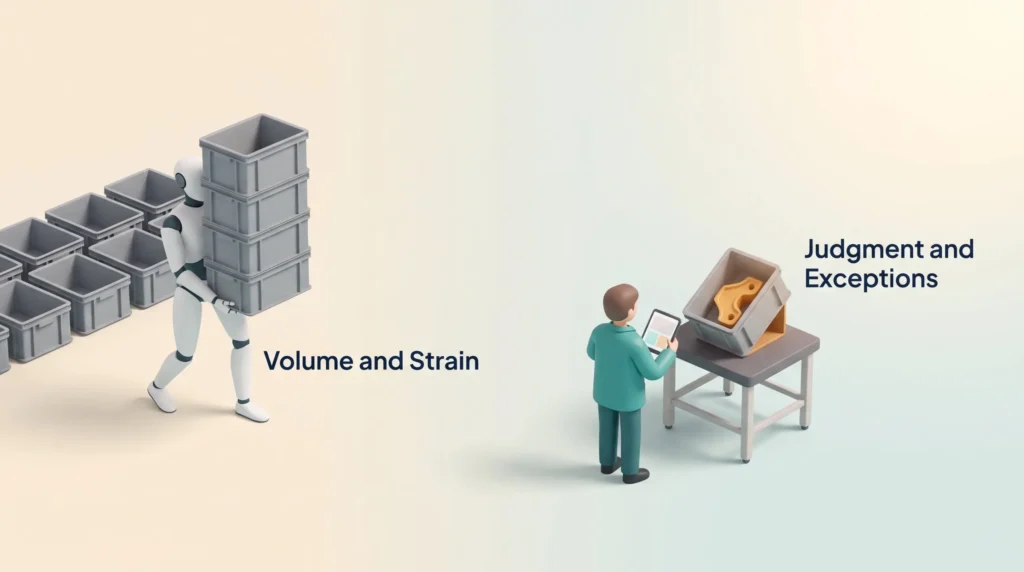
Roles in maintenance, robot operation and process improvement grow, while pure carrying work shrinks. Our guides on automation in blue-collar jobs, automation risk assessment and redeploying workers into new roles cover the practical steps. The idea behind the best setups is collaborative intelligence: machines handle volume and strain, people handle judgment and exceptions.
For the policy side, see our overview of the robot tax debate and how robots are changing future workplaces.
Conclusion
Physical AI turns a robot from a machine that repeats one motion into one that can see, adapt and learn. In 2026, humanoids have moved from stage demos to their first real jobs at companies like BMW and Hyundai. Those jobs are still narrow, and reliability, safety standards and cost will decide how fast the technology spreads.
The winners will not be the companies that buy the most robots. They will be the ones that pick a clear task, measure it honestly and scale only on evidence.
Start small: write down which physical task in your operation causes the most delays, injuries or overtime. That is where physical AI, humanoid or not, has the best chance to prove itself. For related concepts, our AI glossary explains the terms, and our article on AI agents in business shows the software side of the same trend.
Found this useful?
Make SmartKeys a preferred source on Google, and our articles will surface more often in your Top Stories, AI Overviews, and AI Mode.
Add as Preferred SourceFAQ
What is Physical AI?
Physical AI is artificial intelligence that controls machines acting in the real world, such as robots, rather than software that only produces text or images. It combines sensors that collect data about the surroundings, an AI model that decides what to do, and motors that carry out the movement. This loop repeats many times per second, so the machine can react when something changes, for example when a part sits in a slightly different position than expected. Humanoid robots are the most visible example, but mobile warehouse robots and camera-based inspection use the same technology.
How do humanoid robots transition from demos to factory floors?
Humanoid robots reach factory floors through narrow, supervised pilots on simple, repetitive tasks. They usually train in simulation, then in a controlled area of the plant, before taking a limited production role. BMW followed this pattern: Figure robots placed sheet-metal parts during an 11-month pilot in 2025, and a newer model now sorts components for assembly. Success depends less on the demo and more on uptime, safety and how the robot recovers from errors. Most companies in 2026 are still at the pilot stage.
What role does simulation play in developing Physical AI?
Simulation lets robots practice safely and cheaply before they touch real equipment. Developers build a virtual copy of a work area, called a digital twin, and let the robot repeat a task thousands or millions of times. Randomly changing lighting and object positions prepares it for real-world variation, and simulated scenes supply synthetic training data. It does not replace real testing, though. Differences between the virtual and real world, known as the sim-to-real gap, still have to be closed with careful trials on the actual floor.
How can I use Physical AI in my business?
Start with one physical task that is repetitive, clearly defined and expensive today, such as moving totes, sorting parts or visual inspection. Measure its current cycle time, downtime, defect rate and incidents before you change anything. Then compare options: a mobile robot, an AI camera or a robot arm may solve the problem more cheaply than a humanoid. Run a supervised pilot with clear targets and log every failure. Only expand when the results beat your baseline on uptime, safety and cost.
Are humanoid robots safe to work next to people?
Humanoid robots can work near people in controlled settings, but the safety rules for them are not finished yet. The main industrial robot standard, ISO 10218, assumes a robot that stays stable when it stops. A legged humanoid that loses power can fall, which is a different kind of risk. A dedicated standard for robots that actively balance, ISO 25785-1, is still in draft. Until then, companies rely on risk assessments, defined work zones, speed limits and emergency stops. If a supplier offers you a humanoid, ask which safety framework the installation will be certified against.
Will physical AI replace factory workers?
In the near term, physical AI mainly replaces specific tasks rather than entire jobs. Current humanoid deployments focus on heavy, repetitive handling work that many plants struggle to staff. People are still needed to set up and supervise robots, maintain them, handle exceptions and improve processes. Over time, manual carrying roles shrink while technical and supervisory roles grow. How smoothly that goes depends largely on whether employers plan retraining and redeployment before the robots arrive, rather than after.