
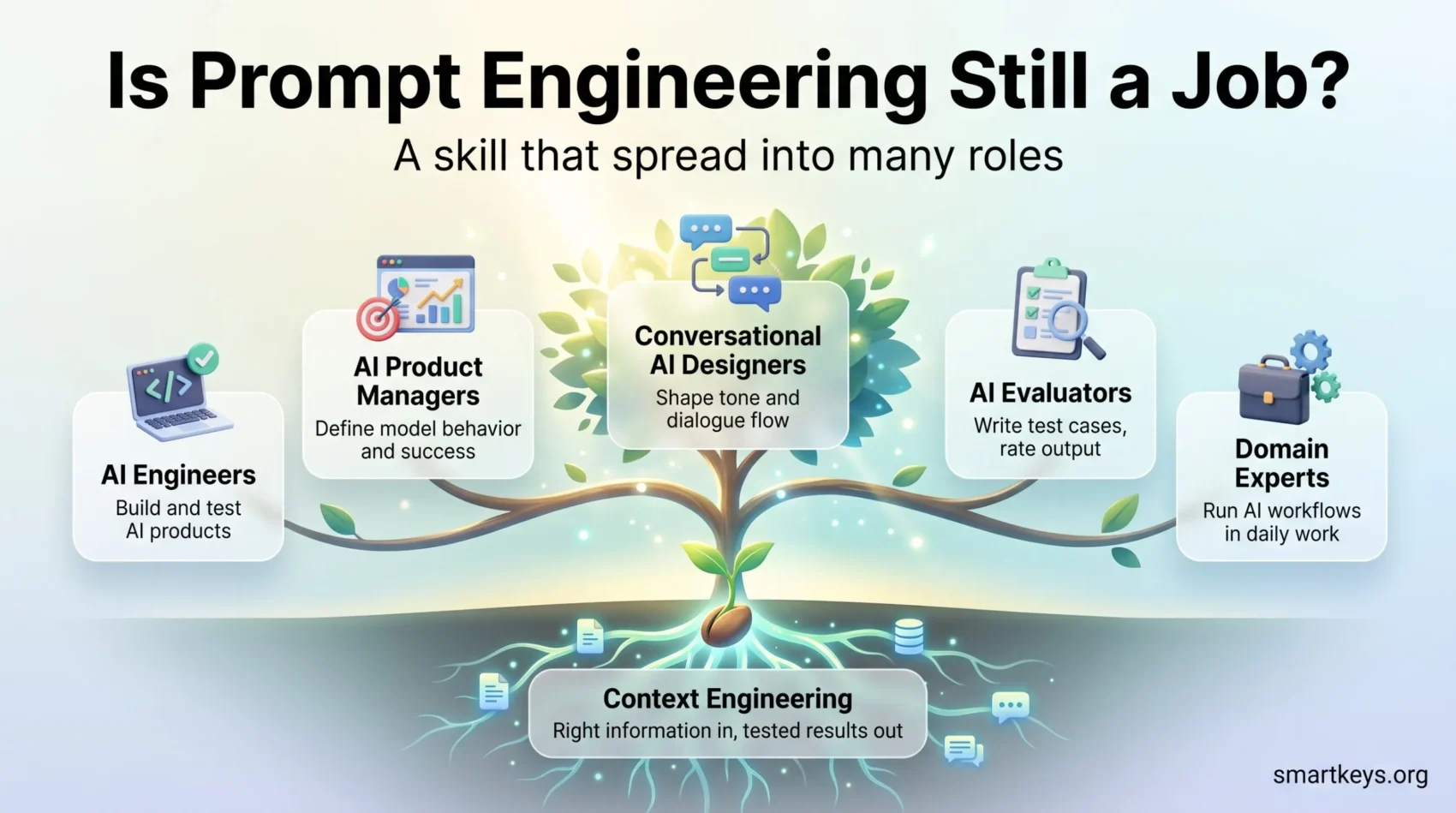
Three years ago, “prompt engineer” was the AI job everyone talked about. Headlines promised six-figure salaries for people who knew how to talk to ChatGPT. In 2026, the picture looks different. The standalone title has become rare, but the work behind it has not disappeared.
Instead, prompt engineering, the practice of writing and testing instructions that get reliable results from AI models, has moved into many other jobs. Software engineers, product managers, support leads and marketers now do it as part of their normal work. This article explains what happened, which roles took over the work, what they pay, and how to position your skills if you want to work in this field.
Key Takeaways
- Dedicated prompt engineer jobs still exist, but they are a small niche. Most prompt work now sits inside broader AI, product and operations roles.
- Better AI models made clever phrasing less important. What matters now is feeding the model the right information and testing its output.
- “Context engineering” is the term many teams now use for this wider job.
- Employers want proof: projects with test results beat certificates and job titles.
What Prompt Engineering Actually Means
A prompt is the instruction you give an AI model, such as “Summarize this contract in five bullet points for a sales manager.” Prompt engineering is the discipline of designing those instructions so the answers are accurate, consistent and useful every time, not just once.
In a business setting, that goes well beyond typing a good question. A typical prompt engineering task looks like this: a support team wants an AI assistant to answer refund questions. Someone has to write the instructions and decide which policy documents the assistant may use. Then they test it against a few hundred real customer emails and fix the cases where it gets things wrong. That testing and fixing is where most of the effort goes.
These skills rely on large language models (LLMs), the AI systems behind tools like ChatGPT, Claude and Gemini that generate text by predicting likely next words. Knowing how these models behave, and where they fail, is the foundation of the job.
Why the Standalone Job Title Faded
The prompt engineer title peaked quickly. In spring 2025, the Wall Street Journal reported on a Microsoft survey in which prompt engineer ranked second to last among new roles companies were considering adding. Roles like AI trainer, AI data specialist and AI security specialist ranked much higher. Microsoft executive Jared Spataro summed it up: “Two years ago, everybody said, ‘Oh, I think prompt engineer is going to be the hot job.’ It’s not turning out to be true at all.”
Indeed economist Allison Shrivastava made a similar point to Fortune: prompt engineering is “still definitely a good thing to have, but it’s not an entire title.”
Three forces explain the shift:
- Models got better at understanding plain requests. Early models needed carefully worded tricks. Current models follow ordinary instructions far more reliably, so the “magic phrasing” skill lost value.
- AI tools help write prompts. Many platforms now suggest or improve prompts automatically.
- Companies want outcomes, not prompts. A prompt is only useful as part of a working product or process. Employers prefer people who can build and run that whole process.
This pattern is not unique to prompting. As our guide on how job descriptions changed in the AI era shows, many AI skills are being written into existing roles rather than creating new titles.
What Replaced It: Context Engineering
The term that gained ground in 2025 and 2026 is context engineering. Anthropic, the company behind Claude, describes it in its engineering guide as a set of strategies for curating the information a model sees while it works. That includes everything outside the prompt itself.
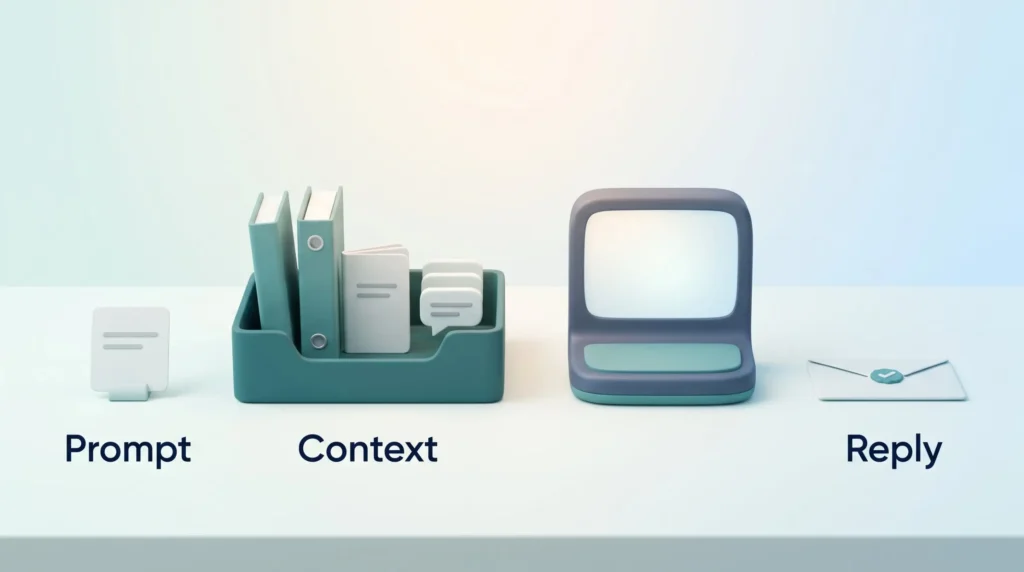
In plain terms: prompt engineering asks “How do I word the instruction?” Context engineering asks “What does the model need to know to do this job well, and how do I make sure it has exactly that?”
An example makes the difference clear. Imagine an AI assistant that drafts replies to customer complaints:
- The prompt tells it to be polite, brief and to offer a solution.
- The context includes the customer’s order history, the current refund policy, the tone guidelines, and the last three messages in the conversation.
If the context is wrong or outdated, no prompt wording can save the answer. This wider view matters most for AI agents. These are AI systems that carry out multi-step tasks on their own, such as researching, filling in forms or updating records.
Where Prompt Work Lives in 2026
If the title is rare, where does the work happen? Job listings in 2026 show prompt skills spread across several role families. Titles still vary a lot between companies, so read the task list, not just the headline.
AI Engineer or LLM Application Engineer
These engineers build products on top of AI models. They write system prompts, connect the model to company data and set up automated tests. This is the closest successor to the technical prompt engineer and usually requires programming skills.
AI Product Manager
Product managers decide what the AI feature should do and how success is measured. They translate customer needs into rules for the model’s behavior and decide when a version is good enough to ship.
Conversational AI Designer
These specialists design chatbots and voice assistants. They focus on tone, conversation flow and what happens when the assistant does not know the answer.
AI Trainer, Evaluator or Quality Specialist
These roles review AI output, write test cases and rate answers. The work is closely related to prompting because good evaluation shows exactly which instructions need to change.
Domain Experts Who Use AI Daily
The largest group has no AI title at all. Marketers, analysts, recruiters and operations managers build prompt workflows inside their own jobs. Our article on hybrid jobs where humans and AI share the work covers this trend in more detail, and AI job augmentation vs replacement explains why most roles change rather than vanish.
What the Work Looks Like Day to Day
Whatever the title, the core tasks are similar. A typical week for someone doing prompt work in a company includes:
- Designing reusable templates. One well-built prompt for “summarize a sales call” can serve the whole team instead of everyone writing their own.
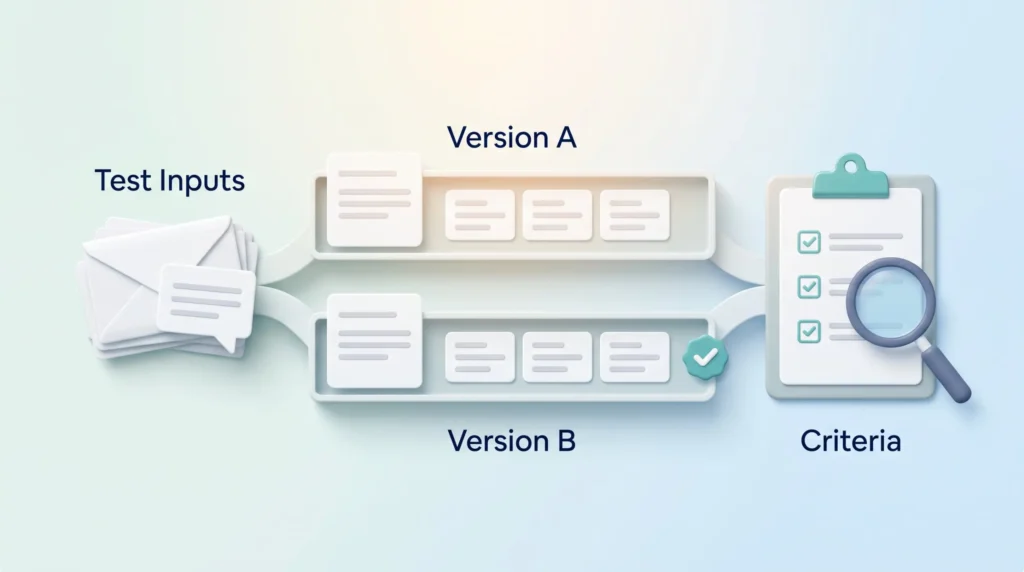
- Testing variants. Two versions of an instruction run against the same set of inputs. The better one wins, based on agreed criteria.
- Defining what “good” means. Typical criteria are accuracy, tone, usefulness and consistency. For classification tasks, teams also track how often the model misses real cases and how often it flags false ones.
- Keeping versions and notes. When a prompt changes in a live system, the team needs to know what changed and why, just like with software code.
- Handling failures. The most valuable work is studying where the model goes wrong and fixing the cause, whether that is the instruction, the data or the process.
If you want to start small, a personal prompt library is a practical first step. It teaches you to document, reuse and improve prompts the same way teams do.
What Prompt Engineering Jobs Pay in 2026
Salary data for this field is messy because the titles are so mixed. With that caveat, ZipRecruiter listed the average US prompt engineer salary at $97,940 per year in September 2026. Most salaries in its data fell between $74,500 (25th percentile) and $126,500 (75th percentile).
Keep in mind what these numbers do and do not show:
- They are estimates based on job ads and user data, not a full survey of all employers.
- Engineers who combine prompt skills with programming and system design usually earn more than people in content-focused prompt roles.
- Location, seniority and industry shift the numbers a lot. Contract and freelance rates vary even more.
You may also see market forecasts quoted in job guides. Grand View Research, for example, projects the global prompt engineering market to reach $2.06 billion by 2030, growing at 32.8% per year from 2024. That figure measures spending on prompt engineering tools and services. It does not tell you how many people will hold the job title.
How to Spot Prompt Work in Job Ads
Because the title is rare, searching only for “prompt engineer” misses most openings. Try combining these terms with your field:
- LLM, generative AI or GenAI
- AI evaluation, AI quality or AI trainer
- Conversational AI or chatbot
- AI automation or AI workflow
Then read the responsibilities. Phrases like “design and test prompts,” “build evaluation sets,” “improve model output quality” or “maintain AI knowledge bases” signal real prompt work, even under a title like “Operations Analyst” or “Content Strategist.”
This matters especially for newcomers. Our guide on AI and entry-level jobs explains how the first career step is changing and where junior candidates still find openings.
Skills That Matter Now
Writing clear instructions is still the base, but employers now expect a wider toolkit. These are the skills that show up most often:
- Evaluation. Building a set of test cases and measuring results. This is the skill that separates hobby prompting from professional work.
- Context design. Choosing which documents, data and examples the model should see. This often involves RAG, short for retrieval-augmented generation: the system looks up relevant documents first and hands them to the model with the question.
- Basic technical skills. Python and SQL are not always required, but they help you automate tests and work with data. Engineering roles require them.
- AI security awareness. Understanding prompt injection, where hidden text in a document or email tricks the model into ignoring its instructions.
- Domain knowledge. A healthcare, legal or finance expert who can prompt well is often worth more than a generalist, because they can judge whether the answer is actually right.
For a broader view of which abilities employers value, see our overview of future job skills.
Build a Portfolio That Proves Results
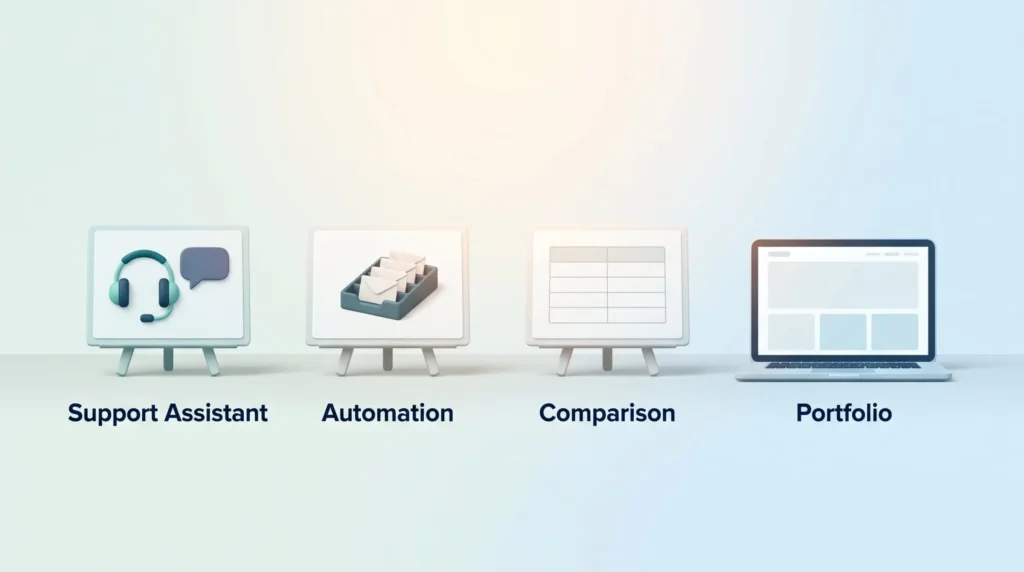
In a field without standard degrees, a portfolio is your strongest signal. The key is to show measurable results, not just clever prompts. Three project types work well:
- A customer support assistant. Build a small assistant that answers questions from a public FAQ. Show your test set, the error rate before and after your changes, and how you handled questions it should refuse.
- A workflow automation. Automate one real task, such as sorting incoming emails or drafting meeting summaries. Document the time saved, the failure cases and how you fixed them.
- A prompt comparison study. Test two or three prompt versions against the same inputs and present the results in a simple table with your conclusions.
Publish your projects on a personal site, GitHub or LinkedIn. Write short case studies that explain the problem, your approach and the outcome. Our guide to AI agent workflows offers ideas for realistic automation projects.
Where to Find the Work
General job boards like LinkedIn and Indeed remain the main sources for full-time roles. Use the search terms above and set alerts for them.
For contract and project work, freelance marketplaces such as Upwork, Fiverr and Toptal list AI-related gigs. Clearly defined services sell better than a vague “prompt engineering” offer. Examples are a prompt audit for an existing chatbot, a test suite for an AI feature, or a documented workflow for a specific team. Our overview of freelance talent platforms compares where clients look for this kind of expertise.
Contract work is also a practical way to gain experience across industries before committing to a full-time role.
Training and Credentials
Structured courses help if you want a guided start. Two widely used options on Coursera are Vanderbilt University’s Prompt Engineering for ChatGPT course and Google’s AI Essentials program, which also covers responsible AI use.
Certificates alone rarely win a job, though. They work best combined with portfolio projects that prove you can apply what you learned. Our article on micro-credentials in hiring explains how employers weigh short certificates, and mid-career retraining covers how experienced professionals can add AI skills without starting over.
What This Means for Employers
For team leads and business owners, the lesson is simple: you probably do not need to hire a “prompt engineer.” You need people who understand your processes and can make AI work inside them.
Practical steps:
- Give existing staff time and training to build AI workflows in their own area.
- Assign clear ownership for shared prompts and AI tools, so they are tested and kept up to date.
- Set rules for what data may go into AI tools. Our guide to generative AI usage guidelines shows how, and managing shadow AI covers what happens without them.
- For larger deployments, plan how models are monitored and updated. Our LLM Ops strategy guide explains the basics.
If you are planning new AI roles, AI team composition and a digital skills gap analysis help you decide what to build internally and what to hire.
Conclusion
Prompt engineering did not die. It grew up and spread out. The standalone title is now a niche, while the underlying skill has become part of many jobs, from AI engineering to customer support.
If you want to work in this area, focus on what employers actually pay for: reliable results. Learn to test and measure AI output, understand how context shapes answers, and build projects that prove your impact. Then search broadly, because the right role may not have “prompt” in its title at all.
Found this useful?
Make SmartKeys a preferred source on Google, and our articles will surface more often in your Top Stories, AI Overviews, and AI Mode.
Add as Preferred SourceFAQ
Is prompt engineering still a viable career option in 2026?
Yes, but mostly as a skill inside other roles rather than as a standalone job title. Dedicated prompt engineer positions still exist, yet they are a small niche. Most prompt work now happens in AI engineering, AI product management, conversational AI design, AI evaluation and everyday business roles. If you want a career built on these skills, aim for one of those role families and present prompting as one strength alongside testing, context design and domain knowledge. That combination is what employers hire for in 2026.
What is context engineering, and how is it different from prompt engineering?
Context engineering is the wider practice of managing all the information an AI model sees while it works, not just the instruction itself. Prompt engineering focuses on wording the request well. Context engineering also decides which documents, data, examples and conversation history the model gets. For example, a support assistant needs the current refund policy and the customer’s order history, not only a polite instruction. As AI agents take on multi-step tasks, getting this information right matters more than clever phrasing.
What skills should I develop to stay relevant in AI roles?
The most valuable skill is evaluation: building test cases and measuring whether AI output is accurate and consistent. Add context design, meaning you know which information to give the model and how retrieval systems supply it. Basic Python or SQL helps you automate tests and work with data, and it is required for engineering roles. Awareness of AI security risks such as prompt injection is increasingly expected. Finally, deep knowledge of one field, such as finance, law or healthcare, lets you judge whether an answer is actually correct.
How much do prompt engineers earn in 2026?
ZipRecruiter listed the average US prompt engineer salary at $97,940 per year in September 2026, with most salaries between $74,500 and $126,500. Treat these figures as rough estimates, because they are based on job ads and user data, and the job title covers very different kinds of work. People who combine prompt skills with programming and system design usually earn more than those in content-focused roles. Location, seniority, industry and contract type also change the numbers significantly.
Can I get a prompt engineering job without a computer science degree?
Yes, especially in non-engineering roles such as conversational AI design, AI evaluation, content operations or AI-supported business functions. In these jobs, employers care more about proof of results than about formal degrees. A portfolio with tested projects, clear documentation and measurable improvements carries a lot of weight. Domain expertise can also be your advantage: a lawyer or nurse who can build reliable AI workflows is valuable. Engineering roles that build AI products usually still expect programming experience, with or without a degree.
How can I build a portfolio for AI positions?
Build two or three small projects that solve a realistic problem and show measurable results. Good options are a support assistant that answers questions from a public FAQ, an automation for a repetitive task, or a comparison of several prompt versions on the same inputs. For each project, document the goal, your test set, the results before and after your changes, and the failures you fixed. Publish short case studies on a personal site, GitHub or LinkedIn so employers can see how you think, not just what you built.
Where can I find freelance prompt engineering work?
Freelance marketplaces such as Upwork, Fiverr and Toptal list AI-related projects, and LinkedIn is useful for direct client contacts. Specific services sell better than a general “prompt engineering” offer. Examples include auditing an existing chatbot, building a test suite for an AI feature, or setting up a documented AI workflow for one team. Contract work is also a good way to gain experience in different industries and collect portfolio material before applying for full-time roles.
Which certifications help a career in AI prompting?
Beginner courses such as Vanderbilt University’s Prompt Engineering for ChatGPT and Google’s AI Essentials program on Coursera give a structured introduction and a certificate for your resume. For technical roles, courses in machine learning, data analysis or specific AI platforms add more weight. On their own, certificates rarely decide a hiring process. They are most useful when paired with portfolio projects that show you applied the skills to a real problem and measured the result.