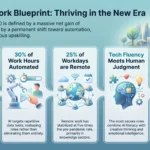
A resilient workplace is one that keeps functioning, and keeps its people, when the way work gets done changes underneath it. Automation is the change most organisations are dealing with right now. It is not simply machines taking over manual tasks. It is software absorbing parts of a job, which shifts what the person in that job spends their day on.
The World Economic Forum’s Future of Jobs Report 2025 puts numbers on the scale. By 2030 it expects 170 million new jobs to be created and 92 million to be displaced, a net gain of 78 million. Around 22% of today’s jobs are affected in one direction or the other. That is a churn problem before it is a headcount problem: most of the disruption lands on people who keep their employer but not their old routine.
That is what resilience has to solve for. Not surviving a single shock, but staying productive through repeated small ones. This guide covers what the 2026 evidence actually supports, which strategies hold up, and what employers now have to do by law. For the wider context, see our overview of future work trends.
Key Takeaways
- Automation mostly reshapes jobs rather than deleting them, so plan for role change, not just headcount.
- The WEF expects 39% of the skills workers use today to shift by 2030.
- Global employee engagement sits at 20%, which limits how much change any workforce can absorb.
- Training only builds resilience when people can see where the new skill leads.
- Managers, not policies, decide whether staff treat automation as opportunity or threat.
- EU transparency rules on workplace AI have applied since 2 August 2026.
- Resilience is measurable: track internal moves, time to fill, and voluntary exits during change.
What a Resilient Workplace Actually Means
The word gets used loosely, so it helps to be concrete. A resilient workplace has three practical properties.
It can see change coming. Someone knows which roles are exposed, and roughly when. It can move people. A warehouse planner whose scheduling is now done by software can be retrained into inventory analysis, because a path exists and someone owns it. And it keeps trust intact while doing so, because people who expect to be discarded do not volunteer for retraining.
Compare two companies introducing the same invoice-processing automation. The first announces it in a company meeting, names the four affected roles, and publishes what each person will do instead within six months. The second says nothing and lets the rumour spread. Both have the same technology. Only one still has its accounts team a year later.
Resilience, in other words, is an operational capability. It is not a mood or a poster in the break room.
What the 2026 Evidence Shows
Three data points frame the problem honestly.
First, the skills shift is real but not total. The WEF expects 39% of the skills workers use today to change by 2030. That is significant, and it also means roughly six in ten skills carry over. Wholesale reinvention is rarely the right response.
Second, the workforce absorbing this change is not in great shape. Gallup’s State of the Global Workplace 2026 puts global employee engagement at 20%, the lowest since 2020. Manager engagement fell from 31% in 2022 to 22%, which accounts for most of the drop. Gallup estimates the cost of that disengagement at roughly $10 trillion, or 9% of global GDP. Employee thriving edged up to 34% after three years of decline, the first improvement in a while.
Third, people are worried, and the worry tracks exposure. Gallup found that 18% of US employees expect their job to be eliminated within five years because of technology. Among those working in organisations actively adopting AI, that rises to 23%. Anxiety is not evenly distributed, and pretending otherwise is what breaks trust.
Put together: a partial skills shift, a disengaged and under-supported management layer, and rising job insecurity concentrated exactly where automation is arriving. Our analysis of how workers are adapting to job automation looks at where the pressure falls hardest.
Workplace Resilience Strategies That Hold Up
Four things separate organisations that handle automation well from those that stumble.
Map exposure before you buy the tool. List the tasks each role performs, then mark which ones the software will actually take over. Usually it is fewer than the vendor implies. A structured automation risk assessment turns a vague fear into a specific, solvable planning problem.
Decide the destination in advance. If a role loses 30% of its tasks, what fills the gap? Answering that before deployment gives you a redeployment plan instead of a redundancy conversation. Our guide to redeploying staff after automation covers how to build those paths.
Invest in the manager layer. Gallup’s data points at managers as the weak link, and managers are the people who deliver every change message. Training them in how to hold difficult conversations does more for resilience than any all-hands announcement.
Protect wellbeing during the transition, not after it. Change fatigue is cumulative. Teams pushed through three tool migrations in a year do not bounce back on the fourth. The patterns in employee burnout at work show up well before people resign.
Communication runs through all four. Open dialogue, honest timelines and visible leadership are not soft extras; they are the mechanism that makes the other three land. Tools help here too: remote presence technology and AI collaboration tools keep distributed teams connected through a transition, provided the message itself is straight.
Upskilling and Reskilling for an Automated Future
Training is the most common resilience investment and the most commonly wasted one. The WEF found that 63% of employers name the skills gap as their main barrier to transformation, and 77% plan to upskill their workforce. It also found that 41% expect to reduce headcount where AI can do the work. Both things are true at once, and employees know it.
That tension is the reason training programmes fail. If staff suspect the course is preparing their replacement, participation stays polite and shallow. Credibility comes from naming the destination role, not from the quality of the slides.
Identifying Key Skills in Demand
The WEF’s fastest-growing skills split into two groups. On the technical side: AI and big data, networks and cybersecurity, and general technological literacy. On the human side: analytical thinking, resilience and flexibility, leadership, and creative thinking.
For most non-technical staff, the useful target is not “learn AI” but a narrower competence:
- Working with AI output. Judging when a model’s answer is wrong, which requires domain knowledge rather than coding.
- Data literacy. Reading a dashboard critically and knowing what a number does not tell you. Our piece on digital literacy in business covers the baseline.
- Process design. Seeing where a workflow breaks, which is what actually makes automation pay off.
- Communication and judgement. The parts of a job that survive precisely because they are hard to specify.
Our guide to the job skills that matter next goes deeper on each, and current upskilling trends covers how employers are prioritising them.
Investment in Training Programs
The WEF estimates that 59 out of every 100 workers will need reskilling or upskilling by 2030, and that 11 of those 100 are unlikely to receive it. That gap of roughly one in nine workers is where displacement risk concentrates.
Actual investment has been moving in the right direction. TalentLMS’s 2026 L&D report found that 57% of employees received upskilling training in 2025, up from 50% in 2022, and that $1,000 to $3,000 per employee per year is now the most common budget range. It also found that 47% of HR managers say their AI training is designed at least partly to make jobs easier to automate, which is exactly the ambiguity employees sense.
Practical guidance:
- Tie every course to a named role or task, so people can see the point.
- Give learning protected time. Training scheduled on top of a full workload is training that does not happen. Microlearning fits real schedules better than day-long sessions.
- Build internal mobility, not just courses. An internal talent marketplace lets a trained employee actually move.
- Measure outcomes rather than completions. The return on upskilling is best read through internal fill rates and retention, not course sign-ups.
Partnerships with colleges and training providers help for specialised skills, and mid-career workers deserve particular attention, since that group is both the most exposed and the most often overlooked.
Fostering a Culture of Lifelong Learning
A learning culture is what makes the training above stick. The signal employees read is not the L&D budget. It is whether the last person who retrained got a better job.
Four things reinforce that signal. Protect time for learning rather than expecting evenings. Reward the people who move sideways into new roles, publicly. Let mistakes made while learning a new system be discussed openly, because a team that hides errors cannot improve a process. And measure whether learning is changing anything, so the budget survives the next cost review.
Personalised development plans work better than catalogue access. A person who chooses their own next step has a reason to finish it. The link between development and retention is well documented: TalentLMS found 73% of employees said better development opportunities would keep them longer.
Building Resilient Teams Amidst Automation
Resilience is easier to build at team level than at company level, because that is where the working relationships are.
Collaborative Team Dynamics
Four dynamics make the difference:
- Psychological safety. People say what is not working with a new system only if raising problems is safe. Without this, you discover failures late.
- Adaptability. Teams that have changed tools before change them again more easily. Practice compounds.
- Clear communication. Who is doing what after the change should be written down, not inferred.
- Shared goals. When the team objective is stable, a change in method is a detour rather than a threat.
Cross-training is the most underrated of these. A team where two people can cover each role absorbs an absence, a resignation or a system failure without stopping. Structured resilience training can help, though it works only where the underlying conditions above already hold.
Leadership and Communication in Resilience Building
Leaders set the interpretation. The same automation project can be framed as “we are cutting costs” or “we are removing the worst part of your job”, and staff will believe whichever the behaviour supports.
Three practices carry most of the weight. Regular one-to-one check-ins surface concerns while they are still small. Honest timelines beat reassuring vagueness, because vagueness reads as bad news withheld. And leaders who say clearly what they do not yet know keep more credibility than those who over-promise and revise later.
Manager training matters more than executive messaging, since managers absorb the questions. The wider shifts in leadership expectations and the practices covered in future work culture point in the same direction: consistency beats charisma during a transition.
The Role of Government and Policy Support
Public policy shapes how much of the adjustment burden falls on individuals. Several countries have built systems worth studying. Singapore’s SkillsFuture scheme gives adults credits they can spend on approved training. Denmark’s flexicurity model pairs light dismissal rules with strong income support and active retraining, so job changes are less financially frightening.
The common thread is that both treat retraining as infrastructure rather than charity. Employer partnerships matter too, particularly for mid-career workers who fall outside both the education system and graduate schemes. Regional differences are real: automation exposure is concentrated in some local economies, and a national average hides that.
For employers, the practical takeaway is smaller. Check what public training subsidies and tax incentives apply in your jurisdiction before funding a programme entirely from your own budget. Many go unclaimed.
Digital Transformation Resilience
Technology decisions either build resilience or quietly erode it.
Integrating Automation into Work Processes
Robotic process automation (RPA), meaning software that mimics the clicks and keystrokes a person would perform, works well on high-volume, rule-based tasks: invoice matching, data transfer between systems, standard report generation. AI handles less structured work such as drafting, summarising and classification, with output that needs checking.
Two failure modes are common. Automating a broken process just makes the mess faster, so fix the workflow first. And automating without documenting leaves you unable to run the process manually when the system breaks. Both are resilience problems, not technology problems. Our overview of automation tools covers what fits which task, and low-code platforms let non-specialists build small automations under supervision. A broader view sits in our guide to digital transformation.
Ensuring Security and Compliance
Every automated workflow is a new dependency and a new attack surface. Access control, logging and a tested manual fallback are the basics; current cybersecurity practice covers the rest.
Compliance moved recently. The EU AI Act’s transparency obligations under Article 50 have applied since 2 August 2026. Where they apply, people must be told when they are dealing with an AI system rather than a person, AI-generated content must be machine-readably marked, and anyone subject to emotion recognition or biometric categorisation must be informed. Penalties reach 15 million euros or 3% of global annual turnover, whichever is higher. The Act’s fuller high-risk obligations for employment systems, covering hiring and performance evaluation, were deferred by the Digital Omnibus to 2 December 2027.
Practically, that means an AI chatbot handling employee HR queries needs to identify itself now, while a scored interview tool has a longer runway before the heavier duties bite. Our guides to EU AI Act compliance and AI hiring tools go into the detail on both deadlines.
Conclusion
Resilience in the age of automation comes down to something unglamorous: knowing which roles are changing, having somewhere for those people to go, and being honest about it while it happens.
The numbers support optimism about jobs overall and caution about individuals. A net gain of 78 million jobs by 2030 says little to the person whose role is among the 92 million displaced. What decides their outcome is whether their employer built a path, and whether they trusted it enough to take it.
Start with exposure mapping, fund training that leads somewhere specific, support the managers who deliver the news, and check your legal obligations before deployment rather than after. None of that requires predicting the future accurately. It requires being ready to change course when the prediction turns out wrong, which is what resilience has always meant.
Found this useful?
Make SmartKeys a preferred source on Google, and our articles will surface more often in your Top Stories, AI Overviews, and AI Mode.
Add as Preferred SourceFAQ
What is a resilient workplace?
A resilient workplace keeps operating, and keeps its people, when the way work gets done changes. In the context of automation, that means three practical capabilities. It can identify which roles are exposed to change and roughly when. It can move affected employees into new roles, because retraining paths exist and someone is responsible for them. And it maintains enough trust that staff engage with those paths instead of quietly job hunting. Resilience is an operational capability rather than a cultural mood. You can tell whether an organisation has it by looking at concrete measures: how many people moved internally during the last major change, and how many left.
How many jobs will automation actually displace?
The World Economic Forum’s Future of Jobs Report 2025 projects 92 million jobs displaced and 170 million created by 2030, a net gain of about 78 million. Roughly 22% of current jobs are affected in one direction or the other. Two caveats matter. These are employer survey projections, not measurements, and forecasts of this kind have been revised before. More importantly, a positive net figure offers no comfort to an individual whose role disappears, because the new jobs frequently appear in different sectors, skill sets and locations. Planning should treat the churn as the problem, not the net number.
How do I prepare my team for automation?
Start by mapping tasks rather than job titles. List what each role actually does, then mark which tasks the new system will take over. This is usually a smaller share than vendors suggest, and it turns a general worry into a specific plan. Next, decide what fills the freed-up time before the tool goes live, so you can present a redeployment path instead of an open question. Then train against that named destination. Finally, tell people the timeline honestly, including what you do not yet know. Teams handle uncertainty far better than they handle the suspicion that something is being withheld.
Which skills matter most as automation spreads?
The WEF expects 39% of the skills workers use today to change by 2030, with the fastest growth in AI and big data, networks and cybersecurity, and technological literacy, alongside analytical thinking, resilience, leadership and creative thinking. For most non-technical employees the practical targets are narrower than “learn AI”. Being able to judge when an AI output is wrong depends on domain knowledge, not coding. Reading data critically, spotting where a workflow breaks, and communicating clearly all remain valuable precisely because they resist specification. Note also that around six in ten current skills carry over, so most people need extension rather than reinvention.
Why do reskilling programmes fail?
Usually because employees cannot see where the training leads. The WEF found that 77% of employers plan to upskill staff while 41% expect to cut roles where AI can do the work, and employees are aware of both. TalentLMS reported that 47% of HR managers say their AI training is designed at least partly to make jobs easier to automate. If people suspect a course is preparing their replacement, engagement stays shallow. The fixes are structural rather than motivational: name the destination role, protect time for learning during working hours, build internal mobility so a trained employee can actually move, and measure outcomes instead of course completions.
What does the EU AI Act require of employers now?
Since 2 August 2026, the Act’s Article 50 transparency obligations have applied. Where they are in scope, people must be told when they are interacting with an AI system rather than a person, AI-generated content has to be marked in machine-readable form, and anyone subject to emotion recognition or biometric categorisation must be informed. Fines reach 15 million euros or 3% of global annual turnover, whichever is higher. The heavier high-risk obligations covering employment uses such as hiring and performance evaluation were deferred by the Digital Omnibus to 2 December 2027. In practice, an HR chatbot must identify itself today, while scored interview tools have longer to prepare.
How do you measure workplace resilience?
Use behaviour rather than survey sentiment. Four measures work well. Internal mobility shows how many affected employees moved into a different role instead of leaving. Voluntary attrition during and just after a change tells you whether people believed the plan. Time to fill for newly created roles shows whether you can grow skills internally or must always buy them. And training completion measured against actual role changes reveals whether learning leads anywhere. Engagement scores are a useful supporting signal, particularly among managers, since Gallup’s data identifies the manager layer as the point where organisational change most often stalls.