If you stepped away from work for a career break, you can restart your career with a clear, supported path. In 2026 dozens of U.S. employers run paid, structured programs that help experienced professionals rebuild skills and confidence.
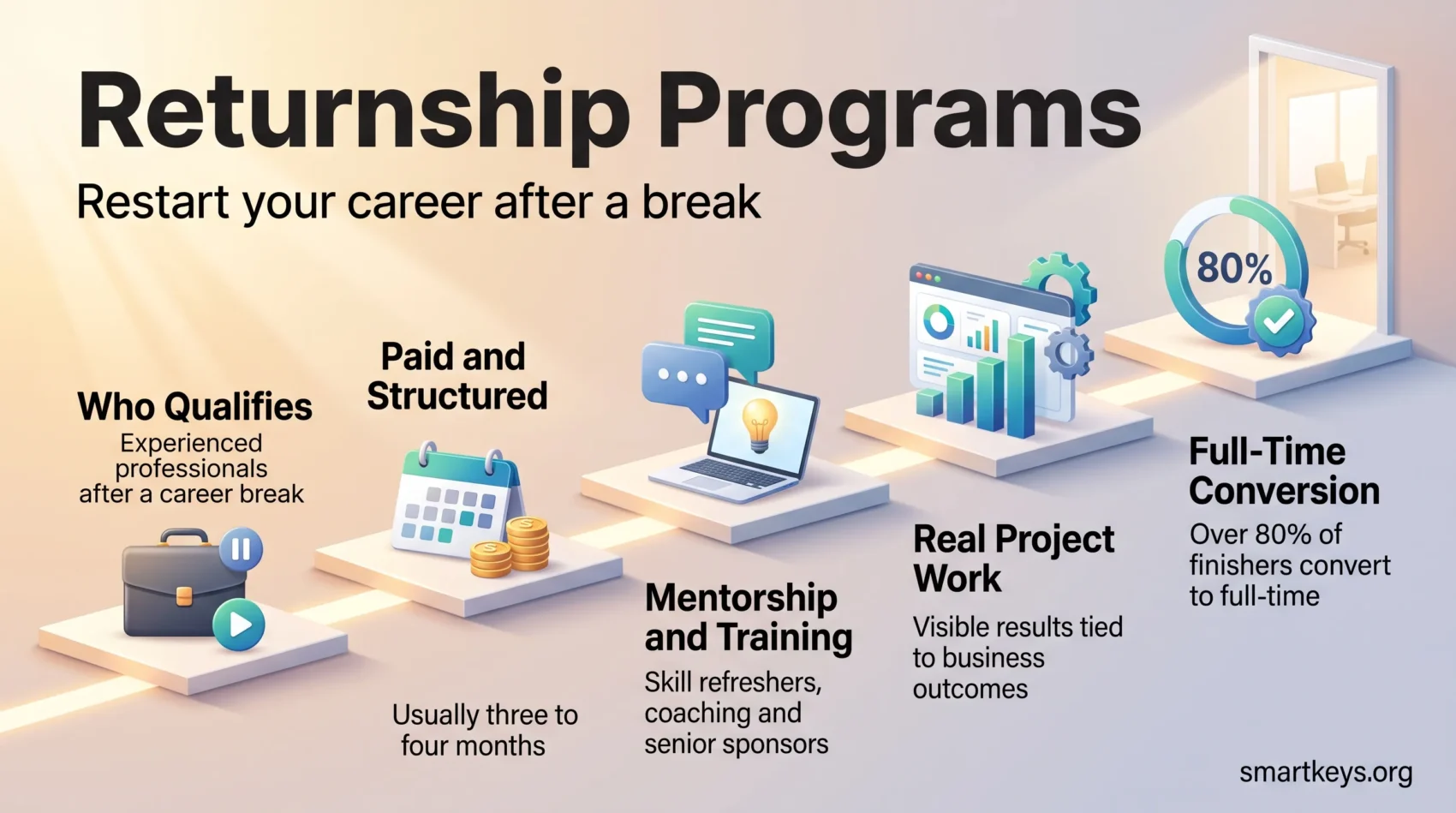
These programs are called returnships. A returnship is a paid, fixed-length job for someone coming back after time away, with mentorship, targeted training, and real project work built in. Most run three to four months, and the full range stretches from about eight weeks to six months. Path Forward, a nonprofit that maintains a weekly-updated directory of U.S. returnships, reports that more than 80% of returners who complete a program convert to a full-time position.
You will find roles across finance, technology, engineering, and corporate business lines. Employers keep building these paths because a career break says little about the judgment you developed before it.
This guide covers timelines, application windows, training, and how to position your experience so you can move back into employment with momentum.
Key Takeaways
- Paid, structured programs usually run three to four months and combine mentorship with real projects.
- More than 80% of returners who finish a returnship move into a full-time role, according to Path Forward.
- Opportunities span finance, tech, engineering, and corporate functions.
- Applications may open seasonally or roll year-round, so plan your timing ahead.
- These paths focus on development, training, and translating your experience into new careers.
What a returnship is and why it matters right now
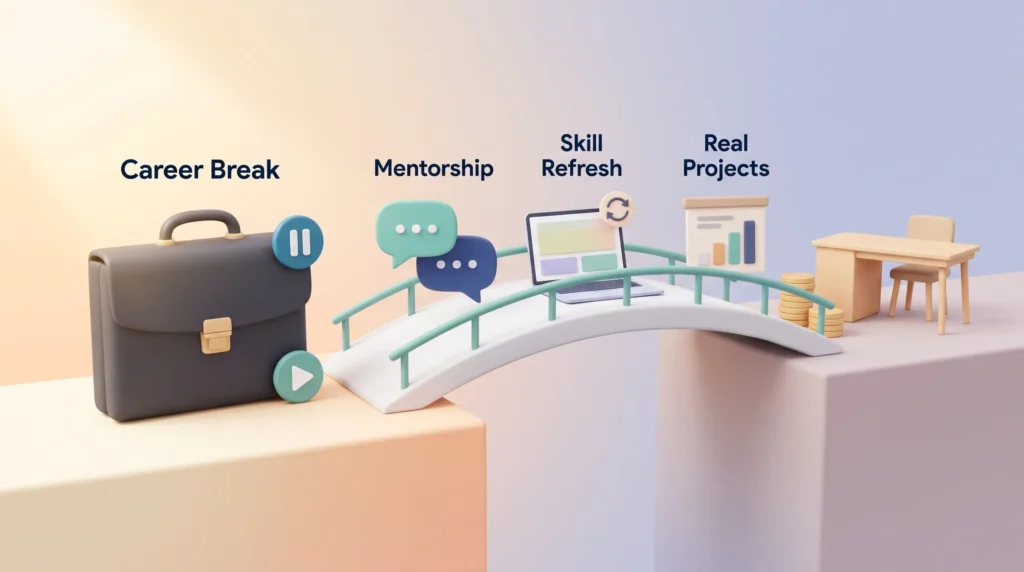
Think of a returnship as a short, paid bridge that refreshes your technical skills and rebuilds workplace confidence. It is built for mid-career professionals who stepped away for two years or more, and most employers expect several years of prior experience.
How they differ from traditional internships
Unlike internships for students, a returnship mixes real business work with structured learning. You get mentorship, focused skill refreshers, and projects tied to outcomes. Pay is usually comparable to the prevailing market rate for that position, not an intern stipend.
Key differences:
- Paid roles with clear goals, not entry-level tasks.
- Onboarding designed for prior experience and updated tools.
- A short, measurable path toward full employment, closer to contract-to-hire arrangements than to a student placement.
Why employers value experienced talent after a career break
Employers want your accomplishments, judgment, and transferable skills. Returnships serve the same goal as internal talent marketplaces and talent pipeline partnerships: filling roles with proven people instead of competing for the same pool of active job seekers.
Breaks are also becoming normal rather than exceptional. As working lives stretch out, the tidy sequence of school, one career, then retirement gives way to the stop-and-start pattern described in the 100-year life career.
- Maturity and perspective: you bring context that benefits the whole team.
- Refreshed technical skills: training updates you on current technology and processes, much as cross-training does for existing staff.
- Clear path to employment: check-ins and manager advocacy help strong performers convert, the industry term for moving from a fixed-length placement into a permanent job.
Top returnship programs in the U.S. right now
Here is a concise guide to leading employer options so you can match length, locations, and eligibility to your background. The details below come from each company’s own careers pages, checked in August 2026, and windows shift every year.
- Goldman Sachs Returnship: a paid 12-week program. You need at least three years of prior work experience and two or more years out of the full-time workforce. The Americas cohort, a fixed group that starts and finishes together, runs January to March 2027, with U.S. locations including New York, Chicago, and Dallas.
- JPMorganChase ReEntry: a 15-week paid fellowship running April through July, across 16 North American cities. It is aimed at people who left at Associate or Vice President level, two mid-senior grades in banking, after a break of at least two years. Placements are matched to business needs and to your own skills and interests.
- Amazon Returnship: a 16-week paid program for people who have been unemployed or underemployed for at least a year. Full-time offers go to participants who excel during the placement. Open roles appear on Amazon’s careers site and through Path Forward.
- IBM Tech Re-Entry: a full-time, paid technical returnship for people who have been away from the workforce for one or more years. It runs in the United States, Canada, the UK, Germany, India, China, and Australia, and pairs a learning plan built around the role with current tools and team projects.
- Dell Career ReStart: returnship and direct-hire roles that include resume and interview coaching, mentorship and career coaching, professional development training, and an executive speaker series. Applications close between cohorts, so join the notification list rather than waiting for a posting to appear.
- More employers to check: Path Forward’s returnship directory is updated weekly and lists more than 60 U.S. programs, among them CDK Global, Deloitte, GE Aerospace, Lockheed Martin, Morgan Stanley, and Swiss Re.
- Adjacent routes: no cohort fits your timing? Look at fractional executive work, meaning senior roles bought by the day or month instead of full time. Remote internships and newer remote roles also rebuild recent, citable experience while you wait.
Quick tip: Compare length, locations, and application windows before you commit to one target.
What makes a great returnship program
A great returnship focuses on clear expectations, fair pay, and a training plan that helps you contribute from day one.
Structured onboarding, skills training, and measurable goals
Look for a clear onboarding timeline with learning goals and regular feedback cycles. Good programs cover both soft-skill refreshers and technical updates, and some fund short certifications, which matters more now that micro-credentials carry real weight in hiring.
Meaningful projects that build in-demand experience
You want assignments tied to real business outcomes. Picture a returner in a reporting role who rebuilds a monthly sales report the team has postponed for a year. She then presents it to the manager who decides on offers. That kind of work makes your contribution visible and shows how your experience maps to current roles.
Clear pathways to full-time employment and transparent conversion
Strong employers explain their success criteria and how managers advocate for high performers. Ask where returners typically land, and whether an internal mobility policy lets you move again once you are inside.
Mentorship, community, and resources that support your return to work
- Mentorship: access to senior sponsors and a peer group going through the same transition. Some employers run this through mentorship matching platforms rather than informal pairing.
- Resources: learning platforms, credentials, and networking support.
- Process: clear reviews, performance checkpoints, and advocacy for employment.
Map these elements to your needs and you will spot the difference between surface-level offers and paths built for lasting success. For additional guidance on skills and future roles, see education and future jobs and the wider shifts in business education and training.
Eligibility, timelines, and application details you should know
Before you apply, know the eligibility rules and key dates so you can plan a focused return to work. This helps you pick the right opening and prepare materials without a last-minute rush.

Who typically qualifies
Typical eligibility asks for roughly five years of professional experience and a career break of at least two years. Both thresholds vary by employer, and IBM sets the bar lower at one year away. Freelance, consulting, or volunteer work during your break generally does not disqualify you, and it often strengthens the application.
Caregiving drives many career breaks, so the scheduling questions that shape life for working parents apply here too. Employers that run a sabbatical policy often handle returners well, having practiced bringing people back.
Seasonal cohorts versus rolling admissions
Some companies recruit in seasonal cycles: applications open once a year, everyone starts on the same date, and missing the window costs you close to twelve months. Goldman Sachs and JPMorganChase both work this way and recruit months in advance. Other employers, including Amazon, accept applications year-round and hire against specific open roles as they appear.
Key dates to bookmark
- JPMorganChase ReEntry: applications open around November 16 and close February 28 for the following April start.
- Goldman Sachs Americas: the next cohort runs January to March 2027, and you can register in advance to be invited when applications open.
- Goldman Sachs EMEA: the Alternative Pathways Programme runs in autumn 2026. Check the program page for the current application window.
- Amazon: rolling admissions, with roles posted throughout the year.
“Plan your materials early: refresh your resume, write a focused cover letter, and document recent learning.”
Action steps: set job alerts on careers sites, map a personal calendar for applications and interviews, and highlight mentorship or training milestones in your application. Write plainly and name the break without apology, since many first-pass screens are automated and algorithmic hiring tools handle gaps inconsistently.
How to choose the right program for your skills and goals
Choose openings that align with what you already do well and what you want to learn next.
Match your technical skills and business experience to program offers
Map roles to results: list the technical skills you can use on day one and the business experience that proves impact.
Compare options: IBM leans technical and learning-plan driven. Goldman Sachs and JPMorganChase run structured cohorts inside financial services. Dell mixes returnship placements with direct hire. A sideways move can be the fastest way back, which is the logic behind the career lattice.
Consider mentorship depth, training resources, and team culture
Ask about mentor-to-candidate ratios, coaching support, and how teams welcome returning professionals.
- Weigh training intensity: a 12-week cohort demands more upfront readiness than a six-month track.
- Check flexibility: ask directly about hybrid schedules, core hours, and school-run realities before you accept.
- Factor conversion history and role fit to forecast long-term career growth.
“Prioritize a clear path to employment and the kinds of learning you need to advance.”
Where to find openings and how to prepare for them
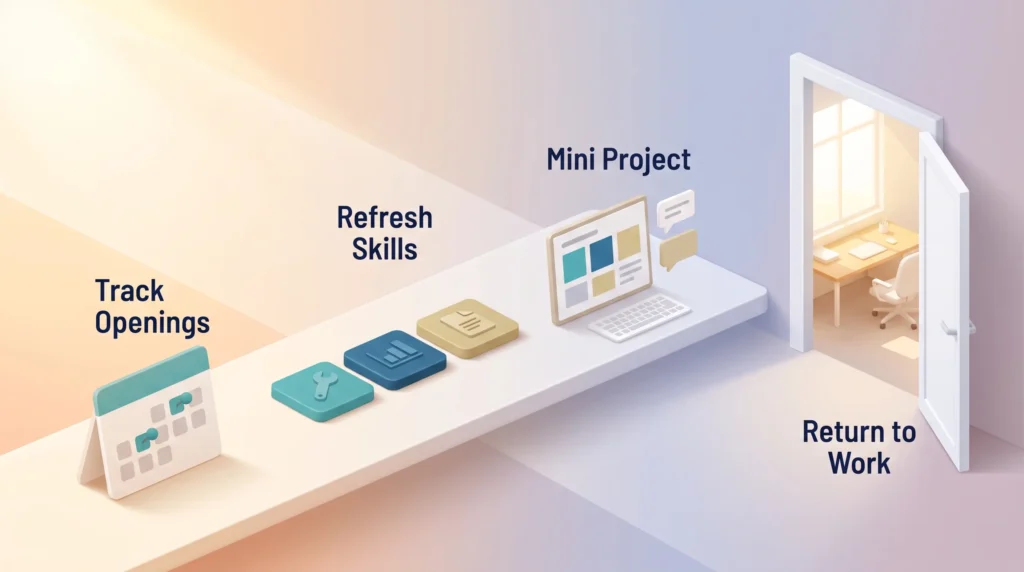
Track hiring pages and talent networks so you spot openings that fit your background. That lead time lets you apply, refresh skills, and plan your return to work.
Using career pages, directories, and talent networks to stay current
Start with a directory. Path Forward’s Returnship Matcher lists U.S. programs and filters by location, required experience, career-gap length, and whether roles are technical or corporate. iRelaunch runs return-to-work conferences and employer guidance that surface openings early.
Read role summaries fast: scan eligibility, dates, and core responsibilities.
- Track three to five target employers and check their pages weekly.
- Save key dates and application windows in a simple calendar.
- Subscribe to talent networks and company newsletters for early notices.
- Reconnect through corporate alumni networks if you are returning to a former employer or industry.
Building a learning plan to refresh technical skills during your returnship
Create a short learning plan that maps three skills you will refresh and one project you can finish in the time available. IBM Tech Re-Entry supplies a learning plan built around the role; if your program does not, write your own before week one.
- Pick the tools most used in your target role and set two to four weekly practice goals.
- Align a mini project with measurable outcomes such as dashboards, repositories, or reports.
- Use weekly check-ins with mentors or peers to adjust focus and gather feedback.
By tracking roles, using talent alerts, and building focused learning milestones, you create momentum that proves your readiness to restart your career and return to work full-time.
Conclusion
Use this guide to turn your past experience into a clear, timed plan that leads back to work.
Pick a program that fits your years away and the function you want to grow in. Most participants who complete a returnship convert to full-time employment, and some employers run seasonal cycles while others use rolling admission.
Focus on meaningful projects, strong mentorship, and transparent outcomes. Time your application, set a weekly routine to learn and network, and highlight your most relevant experience. With a targeted plan, an opening becomes a durable career path.
Found this useful?
Make SmartKeys a preferred source on Google, and our articles will surface more often in your Top Stories, AI Overviews, and AI Mode.
Add as Preferred Source