
Does your business bring coffee, cocoa, palm oil, soy, rubber, wood or cattle products into the European Union? Then a new rule decides whether those goods can cross the border. The EU Deforestation Regulation (EUDR) requires companies to prove that these products did not cause forest loss. From December 30, 2026, the proof becomes mandatory for large and medium-sized companies.
The rule is Regulation (EU) 2023/1115. The European Commission expects the law to cut carbon emissions linked to EU consumption by at least 32 million tonnes a year.
This guide explains what importers must prove and by when, what changed in 2025 and 2026, and how to start now.
Key Takeaways
- Large and medium operators must comply from December 30, 2026. Most micro and small operators follow on June 30, 2027.
- Products must be deforestation-free since December 31, 2020, legally produced and traceable to the plot of land where they were grown.
- Only the company that first places a product on the EU market files a due diligence statement. Downstream companies mainly pass on reference numbers.
- A July 2026 delegated act (a Commission rule that updates the product list) adds soluble coffee and some palm oil derivatives from December 30, 2027, and removes leather.
What the EU Deforestation Regulation Covers
The EUDR targets seven commodities: cattle, cocoa, coffee, oil palm, rubber, soy and wood. It also covers many products made from them, such as chocolate, furniture, tyres, paper or beef. Annex I of the regulation lists the exact products by customs code (the CN code used on import declarations).
The EUDR replaces the older EU Timber Regulation (EUTR), which still applies to some timber harvested before June 29, 2023.
If you sell across borders, this adds to the rules covered in our guide to cross-border e-commerce and the import cost questions in our tariff strategy guide. The law applies to two main groups. “Operators” are companies that place a product on the EU market for the first time or export it. “Traders” are companies that later sell the product within the EU. Your role decides how much paperwork you carry, as the section on simplification below explains.
For teams working on greener supply chains or a sustainability strategy, the EUDR turns voluntary goals into legal duties.
The Three Things Importers Must Prove
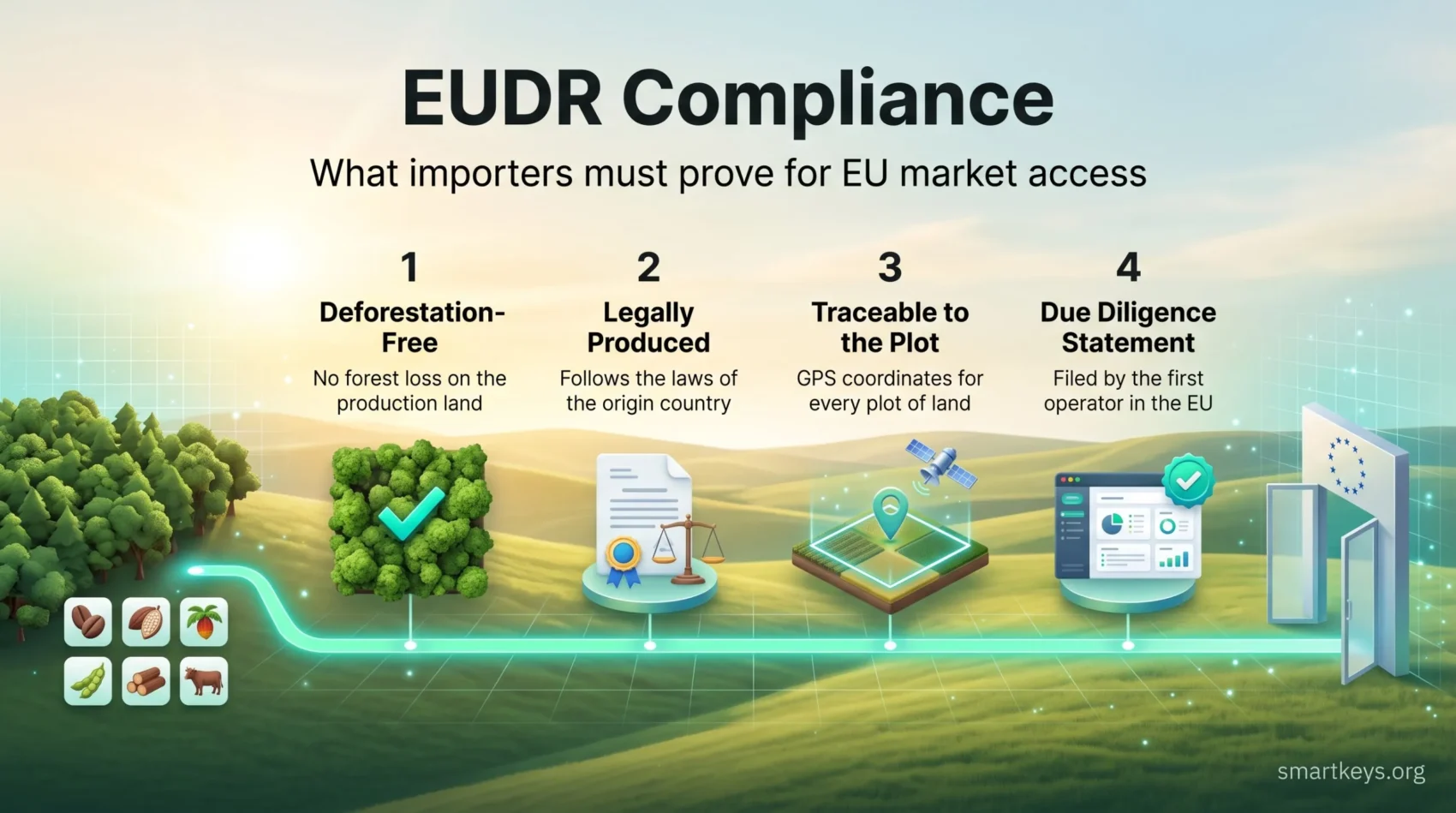
EUDR compliance rests on three proof points. Every relevant product needs all three.
- Deforestation-free: the land where the commodity was produced was not deforested after December 31, 2020. For wood, the forest was not degraded after that date.
- Legally produced: production followed the laws of the country of origin. That includes land rights, labour rights, environmental and tax rules.
- Traceable: you know the geolocation (the GPS coordinates) of every plot of land that contributed to the product. Plots above four hectares need a polygon, which is an outline of the plot’s borders. Smaller plots can use a single point.
Here is a concrete example. A roaster importing green coffee from three cooperatives needs the coordinates of the farms that grew those beans. A generic “Region X, Country Y” is not enough.
How the Due Diligence Process Works
Due diligence means checking your supply chain in a structured, documented way before you import. Under the EUDR, it has three steps.
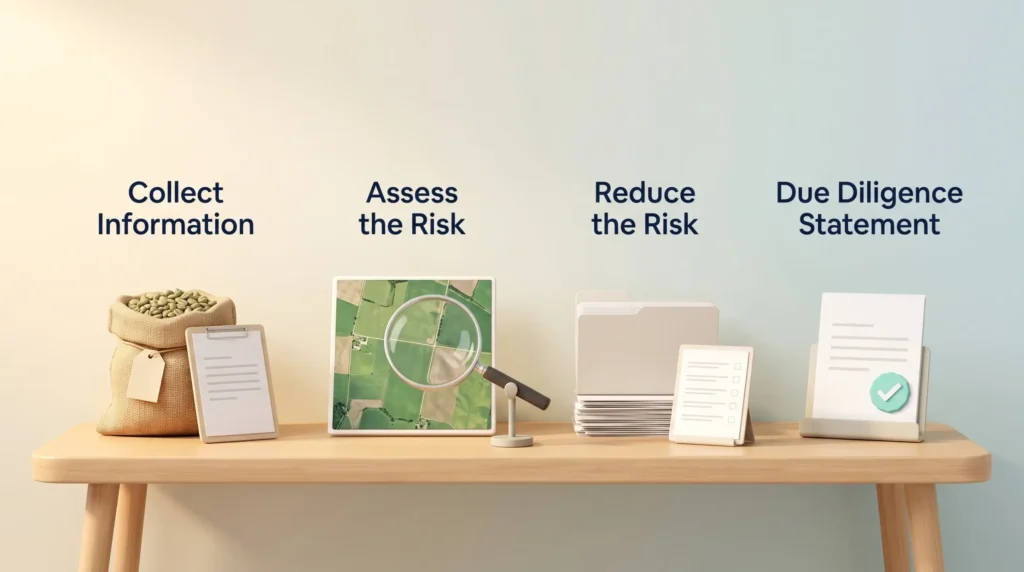
- Collect information: supplier names, product descriptions, quantities, country of production and plot geolocation.
- Assess the risk: check whether anything suggests deforestation or illegal production. Satellite data, country risk levels and supplier history all count.
- Reduce the risk: if the risk is not negligible, take action. Typical steps are extra documents, independent audits or a different supplier.
After these steps, the operator submits a due diligence statement (DDS) in the EU Information System, which went live on December 4, 2024. The statement confirms that the product meets the rules and generates a reference number. Operators must keep the underlying records for five years.
If you already run a risk management framework or an ESG framework, reuse it. The EUDR simply asks for more detail at plot level.
EUDR Deadlines for 2026 and 2027
The EUDR has been postponed twice. The current dates come from the December 2025 amendment, Regulation (EU) 2025/2650. No further delay had been announced by late October 2026, so plan around these dates.
- December 30, 2026: large and medium operators and traders, plus micro and small timber operators already covered by the EUTR.
- June 30, 2027: all other micro and small operators.
- December 30, 2027: products newly added by Delegated Regulation (EU) 2026/2102, such as soluble coffee, certain palm oil derivatives and frozen cattle tongues.
The same July 2026 delegated act removes cattle hides and leather, some rubber goods and soybeans for sowing. Samples, waste, used goods and packing material get exemptions. Check your CN codes against the current Annex I.
Who Does What After the 2025 Simplification
The December 2025 amendment moved most of the work to one point in the chain. Only the operator who first places a product on the EU market files a full due diligence statement.
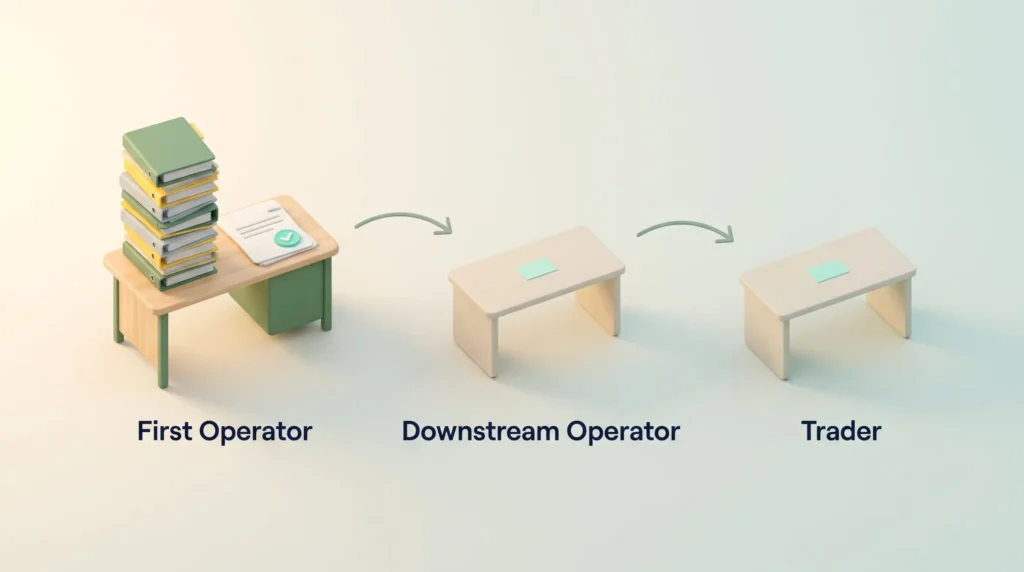
Downstream operators and traders no longer file their own statements. They still need to register in the Information System, collect the reference numbers from their suppliers and pass them on to their customers. Think of it as a relay: the first company carries the proof, and everyone after it passes the baton.
Micro and small primary operators, meaning farmers or producers selling their own harvest, get a lighter regime. In low-risk countries, they submit a one-time simplified declaration instead of repeated statements.
The same amendment removed printed products such as books and newspapers from scope. In its simplification review of May 2026, the Commission estimated that all changes together cut annual compliance costs by almost 75% compared with the original rules. It kept the core legal text unchanged.
Country Benchmarking: How Risk Levels Affect Checks
The Commission sorts countries into low, standard or high risk, a process called benchmarking. The first list, in force since May 2025, rates Belarus, Myanmar, North Korea and Russia as high risk. Major producers such as Brazil and Indonesia sit in the standard category, and most other countries are low risk.
The risk level matters in two ways. First, products from low-risk countries qualify for simplified due diligence. You still collect the information, but you can usually skip the risk assessment and mitigation steps. Second, national authorities must check at least 9% of operators sourcing from high-risk countries each year, 3% for standard risk and 1% for low risk.
Low risk does not mean no work: you still need geolocation and legality evidence.
Penalties for Non-Compliance
Member states set the penalties, but the maximum fine must reach at least 4% of a company’s total annual turnover in the EU. Authorities can also confiscate goods and revenue and exclude companies from public contracts for up to 12 months.
Beyond fines, goods without a valid reference number can be held at the border, which delays orders and ties up cash.
Building a Traceable Supply Chain
Traceability means you can follow a product back to its source at any time. Digital tools help here. Supplier portals collect geolocation files, and satellite monitoring flags forest loss near your plots. The Commission’s free EU Observatory on deforestation tracks forest-cover change with Copernicus satellite data. Some companies test blockchain for logistics, though a well-kept database often does the job.
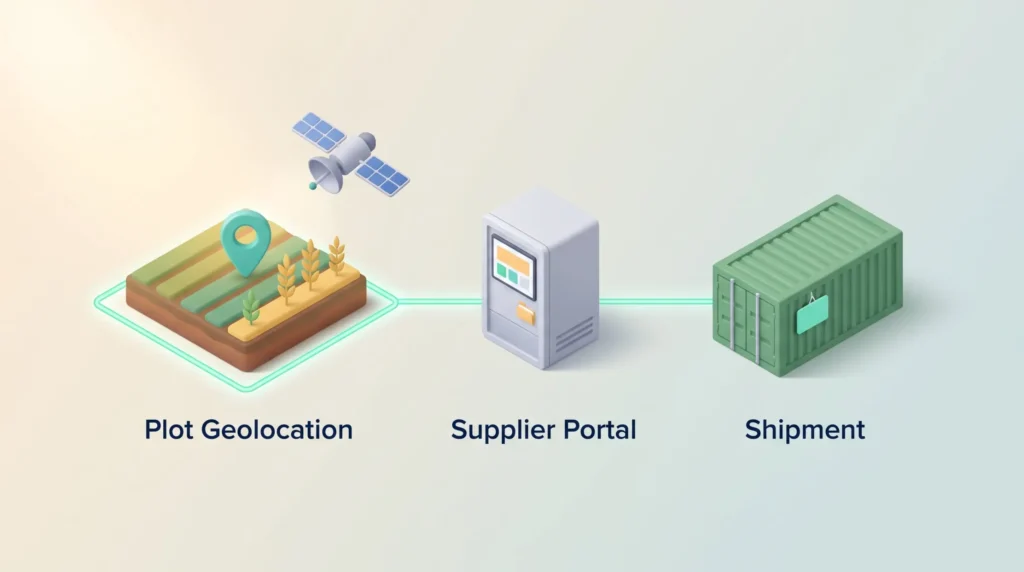
Traceability also pays off beyond the EUDR. The same data supports CSRD sustainability reporting, feeds carbon accounting software and prepares you for the EU digital product passport. It also makes your supply chain more resilient and supports carbon neutrality goals that depend on reliable sourcing data.
Practical Steps to Prepare for EUDR Compliance
With the first deadline less than two months away, use these steps as a starting checklist.
- Map your products: list every imported item and match its CN code against Annex I. Mark which products fall under the 2026 and 2027 dates.
- Clarify your role: operator, downstream operator or trader, per product.
- Contact suppliers early: request plot geolocation and legality documents.
- Update contracts: require suppliers to deliver EUDR data on time and to allow audits. Tie this to your procurement process.
- Test the Information System: register, file a test statement and consider RegTech tools that automate filing.
- Set up record keeping: store all evidence for at least five years in a searchable system.
Conclusion
The EUDR asks importers for one clear thing: proof that their products are legal, deforestation-free since the end of 2020 and traceable to the plot. From December 30, 2026, large and medium companies must deliver that proof for every shipment.
The 2025 simplification helped downstream companies and small producers, but the first operator in the EU still carries full responsibility. If that is you, start supplier outreach and plot mapping now. The same data also prepares you for wider supply chain trends, rising expectations on corporate responsibility and customer demand for sustainable products.
Found this useful?
Make SmartKeys a preferred source on Google, and our articles will surface more often in your Top Stories, AI Overviews, and AI Mode.
Add as Preferred SourceFAQ
What is the purpose of the EUDR?
The EUDR aims to stop EU consumption from driving deforestation and forest degradation worldwide. It does this by allowing only products that are deforestation-free, legally produced and covered by a due diligence statement onto the EU market or into export. The cut-off date is December 31, 2020, so land cleared after that date disqualifies a product. It also supports the EU’s climate and biodiversity goals.
Which commodities are covered under the EUDR?
The EUDR covers seven commodities: cattle, cocoa, coffee, oil palm, rubber, soy and wood. It also applies to many products made from them, such as chocolate, furniture, paper, tyres and beef. Annex I of the regulation lists all covered products by customs code. A July 2026 delegated act adds soluble coffee, certain palm oil derivatives and frozen cattle tongues from December 30, 2027, and removes leather and some rubber goods.
What does the due diligence process involve?
EUDR due diligence has three steps: collecting information, assessing risk and reducing any risk that is not negligible. You gather supplier details, quantities, the country of production and the geolocation of every plot. You then check for signs of deforestation or illegal production, for example with satellite data. If doubts remain, you ask for more evidence, commission an audit or change supplier. Finally, you file a due diligence statement and keep records for five years.
How can micro and small enterprises simplify compliance?
Micro and small enterprises benefit from a later deadline and lighter duties. Most of them only need to comply from June 30, 2027. Micro and small primary operators in low-risk countries, such as farmers selling their own harvest, can submit a one-time simplified declaration instead of repeated statements. Small downstream operators and traders file no statement of their own. They register and pass on the reference numbers they receive from suppliers.
What are the critical deadlines for compliance?
The main EUDR deadline is December 30, 2026 for large and medium operators and traders. The same date applies to micro and small timber operators already covered by the old EU Timber Regulation. All other micro and small operators must comply from June 30, 2027. Products newly added to the scope in July 2026, such as soluble coffee, follow on December 30, 2027. Earlier dates in 2024 and 2025 no longer apply.
How can I enhance traceability in my supply chain?
Start by asking suppliers for the GPS coordinates of every plot that produces your commodities, with polygons for plots above four hectares. Store this data centrally and link it to each shipment and reference number. Supplier portals and compliance software make collection easier, and satellite monitoring flags forest loss near your plots. Where many smallholders supply you, work with cooperatives that already collect farm-level data.
Does a sustainability certification replace EUDR due diligence?
No, a certification does not replace your own due diligence under the EUDR. Labels and schemes for coffee, cocoa, palm oil or wood can provide useful evidence for your risk assessment. However, the legal responsibility stays with the operator who places the product on the EU market. You still need to check that the certificate covers the specific plots and the December 31, 2020 cut-off date, and you still file your own due diligence statement.
Does the EUDR apply to suppliers outside the EU?
Not directly, but they feel its effects. The company that first places a covered product on the EU market is the operator and files the due diligence statement. For imports, that is usually the EU importer, not the foreign producer or exporter. A supplier outside the EU therefore has no filing duty of its own. In practice, it still has to deliver plot geolocation and legality documents, because its EU customer cannot file without them. Suppliers that cannot provide this data risk losing EU buyers.