
AI tools can produce a slide deck or a long report in seconds. But some of what lands in your inbox only looks finished. It does not help anyone move the work forward. Researchers call it workslop.
The term comes from a 2025 study by BetterUp Labs and the Stanford Social Media Lab, published in Harvard Business Review. It describes AI-generated work that looks polished but lacks the substance to advance a task. The sender saves time, and the recipient has to fix it.
This guide explains what workslop costs, why it happens and how to prevent it in your team.
Key Takeaways
- Workslop is AI-generated work that looks complete but lacks the context, accuracy or thinking needed to be useful.
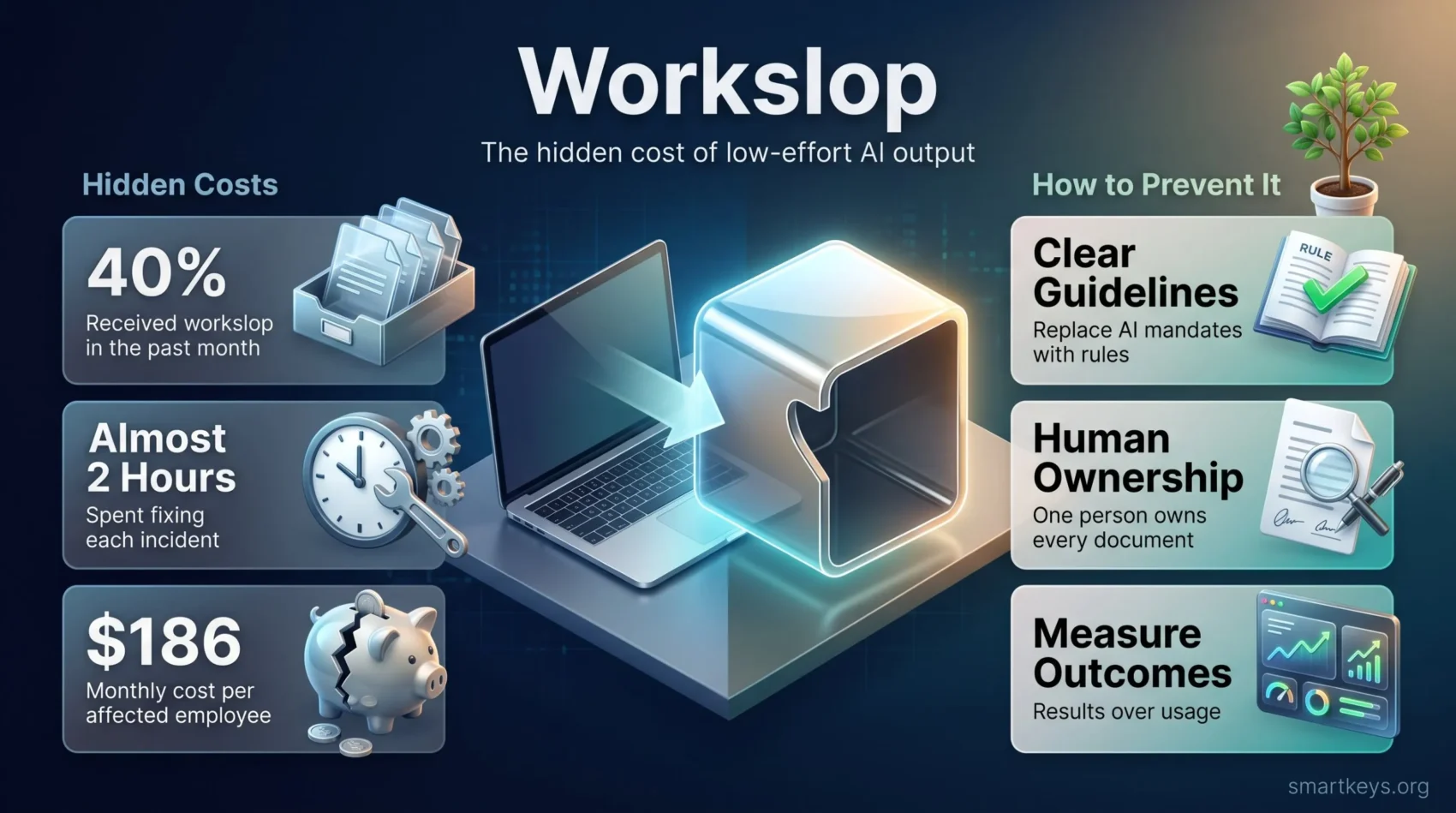
- In the BetterUp and Stanford survey, 40% of US desk workers said they had received workslop in the past month.
- The main causes are organizational: AI mandates without guidance, missing review steps and success measured by usage instead of results.
- Clear usage rules, human review and a named owner for every AI-assisted document reduce the problem.
What Is Workslop?
Workslop “masquerades as good work,” in the researchers’ words, but does not do the job. Picture a project update full of confident bullet points that never says what is late or why.
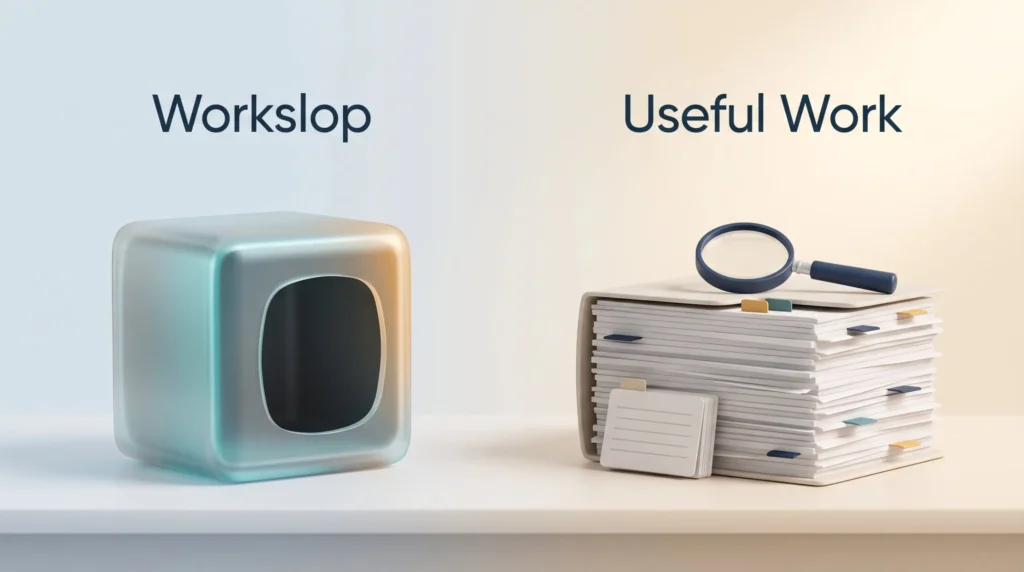
Not every AI-assisted document is workslop. The difference is whether a person added judgment and context before passing it on. For a practical test, see our guide on which tasks to delegate to AI and which to keep.
How Common Is Workslop?
AI use at work has grown fast. By early 2026, about half of employed US adults said they used AI in their role at least a few times a year, according to Gallup. For the bigger picture, see how companies use AI in the workplace today.
Low-quality output grew with it. The BetterUp and Stanford team surveyed about 1,150 full-time US desk workers in September 2025:
- 40% said they had received workslop in the last month.
- Respondents estimated that about 15% of the work they receive qualifies as workslop.
- The largest share (40%) moved between peers. About 18% was sent up to managers, and 16% came down from managers and executives.
The Hidden Costs of Low-Effort AI Output
Time and money
Recipients spent almost two hours on each incident decoding, questioning or redoing the work. Based on respondents’ salaries, the researchers put the cost at about $186 per month for each affected employee. For a 10,000-person company, they estimate more than $9 million in lost productivity a year.
A January 2026 Workday study of 3,200 leaders and employees found that roughly 37% of the time saved with AI is lost to rework. That means fixing errors and checking outputs. Only 14% of respondents said they consistently get clearly positive results from AI. A fair AI ROI calculation subtracts that cleanup time.
Trust and collaboration
In the BetterUp survey, 53% of recipients felt annoyed and 22% felt offended. About half saw the sender as less creative, capable and reliable, and 42% saw them as less trustworthy. Roughly a third said they were less likely to want to work with that person again.
People start to hide early drafts and avoid asking for feedback. That undermines psychological safety, the shared belief that it is safe to speak up and make mistakes.
Knowledge decay
In a June 2026 Harvard Business Review article, Matthias Holweg and Thomas Davenport warned of a longer-term effect. When unchecked AI output piles up in wikis and reports, its errors get reused later as facts. A wrong figure in last quarter’s summary can quietly end up in next year’s plan. Strong knowledge management practices help catch this before it spreads.
Why Workslop Happens
The researchers do not blame lazy employees. They point to pressure from the organization: rushed rollouts, vague instructions and a push to show adoption. Three patterns stand out:
- Blanket mandates. “Use AI for everything” encourages people to pass along raw output to prove they are complying.
- Wrong success metrics. Counting logins or prompts rewards volume, not useful work.
- No review step. When nobody owns the quality of a document, the next person in the chain inherits the checking.
This helps explain why AI spending often fails to show up in results. A 2025 MIT report found that most companies saw no measurable return from their generative AI pilot projects, although its method has been debated. Our AI glossary explains terms like generative AI.
How to Reduce Workslop in Your Team
The fix is not to ban AI but to use it with intention. The researchers contrast two mindsets. “Pilots” combine a sense of control with optimism and use AI to improve their work. “Passengers” use it to avoid work.
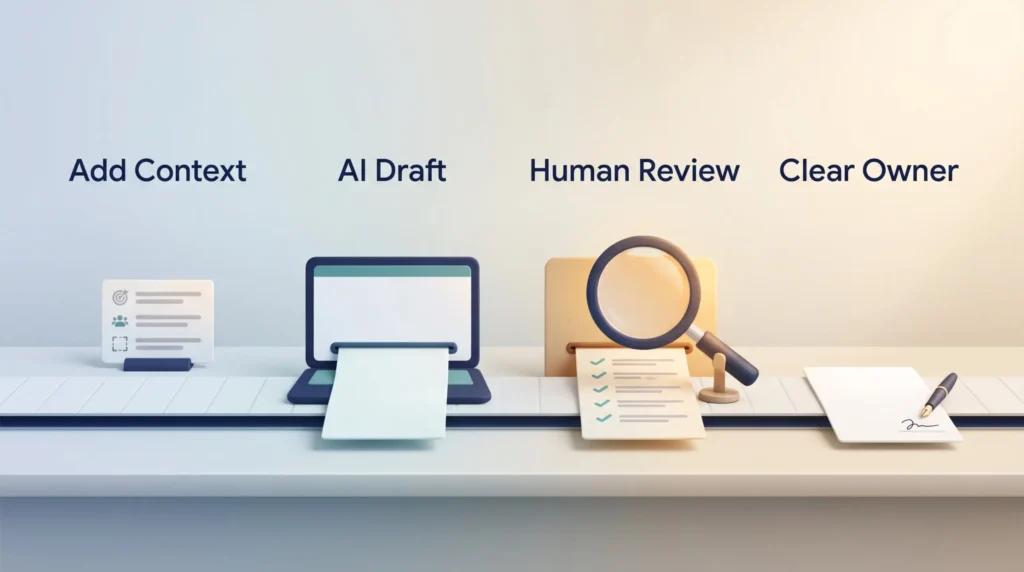
1. Replace mandates with clear guidelines
Spell out where AI helps and where a person must review the output. Written generative AI usage guidelines for employees also reduce shadow AI, meaning AI tools employees use without approval.
2. Make one person own every document
Whoever sends a piece of work owns its accuracy. Before sharing, ask two questions: does this answer what was asked, and would I defend every sentence? The same rule applies when AI agents produce the work on their own: a named person signs off.
3. Add context before you prompt
Give the tool the goal, the audience and the constraints. For example, “a one-page update for the finance lead, focused on budget risks” beats “summarize this project.” A personal prompt library helps you do this consistently.
4. Be open about AI use
A short note such as “AI drafted, I checked the figures” tells recipients how much to trust the content. See AI communication etiquette at work.
5. Measure outcomes, not usage
Judge AI by results such as fewer revision rounds and fewer errors, in line with outcome-based work.
6. Train people, not just tools
Workday found that only 37% of the most frequent AI users said they had better access to training. Structured upskilling and reskilling helps, as do proven change management strategies.
Conclusion
Workslop shifts effort from the person who creates a document to the person who receives it, costing time, money and trust. Every AI-assisted document needs accurate context, real substance, a clear owner and a human review before it reaches a colleague. Read more about collaborative intelligence and how work splits between people and AI.
Found this useful?
Make SmartKeys a preferred source on Google, and our articles will surface more often in your Top Stories, AI Overviews, and AI Mode.
Add as Preferred SourceFAQ
What is workslop?
Workslop is AI-generated work that looks polished but lacks the substance needed to move a task forward. Researchers at BetterUp Labs and the Stanford Social Media Lab coined the term in 2025. Typical examples are reports that never answer the real question, slides filled with generic statements or emails that miss key context. The defining feature is that the sender saves time while the recipient has to interpret, correct or redo the work. That hidden transfer of effort is what makes workslop costly for teams.
Is all AI-generated work workslop?
No. AI-assisted work only becomes workslop when nobody adds the judgment and context the task requires. A draft that a person has checked for accuracy, adapted to the audience and is willing to stand behind is simply good work produced faster. The problem starts when raw AI output is forwarded as if it were finished. A useful test is whether the sender could explain and defend every point if a colleague asked about it.
How does workslop affect a team?
Workslop costs teams time and trust. In the BetterUp and Stanford survey, recipients spent almost two hours on each incident, and more than half felt annoyed. About half viewed the sender as less capable and reliable, and roughly a third were less likely to want to work with that person again. Over time, this makes people more guarded about sharing work and asking for feedback. It also adds rework that cancels out much of the time AI was supposed to save.
How can I tell if a document I received is workslop?
Look for content that is long but vague. Common signs include generic phrases that could fit any project, missing specifics like names, dates or constraints, and claims or numbers without a source. Another signal is that the document does not answer the question you actually asked. If you are unsure, ask the sender a specific follow-up question. Someone who reviewed the work can answer it quickly, while someone who forwarded raw AI output usually cannot.
How can leaders promote better AI use instead of workslop?
Leaders can start by replacing blanket AI mandates with clear guidelines on when AI helps and when human review is required. They should model careful use themselves and make every sender responsible for the quality of what they share. The researchers recommend encouraging a “pilot” mindset, where people use AI actively to improve their work rather than to avoid it. Finally, measure success by outcomes such as fewer revisions and errors, not by how often employees open an AI tool.