Brand storytelling means explaining what your company does through a story about a person, not a list of features. Instead of “our software reduces admin time by 30%”, you show a customer who used to spend Friday afternoons on invoices and now leaves at four. Same fact, different shape, and people remember the second.
That shape matters more in 2026 than it did a few years ago. Buyers now compare products with the help of AI answers and a wall of reviews before they reach your website, and claims are cheap to generate. A story tied to real customers and real proof is harder to fake, so it does more of the work.
This guide covers the four-part framework behind most good brand stories, how to build one, where to publish it, and how to tell whether it is doing anything for your revenue.
Key Takeaways
- Make the customer the main character and your brand the guide who helps them.
- Trust now rivals quality and price as a reason people buy, so only claim what you can show.
- One story adapted per channel beats a different message on every platform.
- Customer voices carry more weight than your own copy, and US rules govern how you use them.
- Measure attention, engagement, trust and revenue separately; they move at different speeds.
What Brand Storytelling Is and Why It Matters Today
A brand story connects what you sell to something the buyer already cares about. Product marketing answers “what does it do”. A brand story answers “why should this matter to me”, the question people ask first.
A working definition you can use in a meeting
Brand storytelling is the practice of describing your company through a narrative: a person with a problem, an obstacle, a change, and a point. It is not a longer advert. It is a way of organizing everything you publish so the pieces add up to one idea instead of forty disconnected ones.
The test is simple. If a customer had to describe your company to a colleague in two sentences, would those sentences be about them or about you? A working brand story makes the first version easy.
Why trust now sits alongside quality and price
The 2026 Edelman Trust Barometer special report on brands surveyed 17,688 people across 15 countries in April and May 2026. It found that 88% of respondents call trusting a brand an important or critical purchase criterion, putting it level with quality (89%) and value (88%). The same report found that people weight unpaid voices, meaning customers, peers and advocates, more heavily than messages that come from the brand itself.
That is the commercial case in one line. You cannot assert trust. You can only show a pattern of behaviour over time, and a story is how people hold that pattern in their heads. For the psychology behind why narrative sticks better than claims, see our guide to neuromarketing and consumer decision-making.
The Core Framework: Conflict, Hero, Plot, and Moral
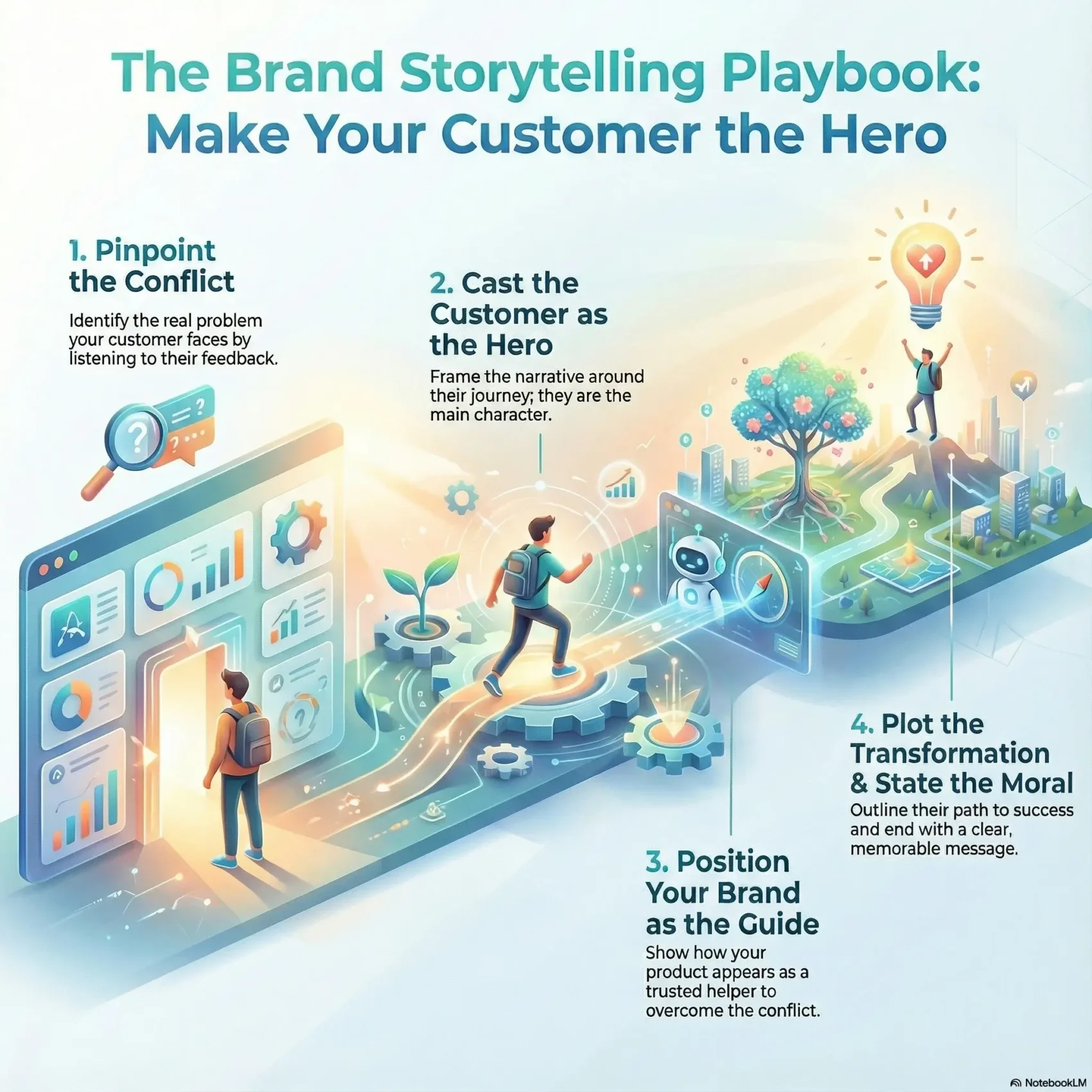
Almost every brand story worth reading has four parts. Get these right and the rest is production work.
Pinpoint the conflict your customers actually feel
The conflict is the problem your customer lives with before you show up. Find it in support tickets, sales notes and your own reviews: look for the complaint that keeps repeating in different words. Be specific: “inefficiency” is not a conflict, while “the finance team rebuilds the same report by hand every Monday because two systems disagree” is, because a reader either recognizes it or does not.
Position your customer as the hero and your brand as the guide
The customer changes over the course of the story. Your product makes the change possible, the way a map matters in a travel story without being the point of it. That ordering is what makes the story about the reader, which is the only reason they keep reading. In practice it changes your sentences. “Our platform automates reconciliation” becomes “Her Monday morning stopped being a reconciliation exercise.”
Develop a plot that shows a real change
A plot needs a before and an after with something in between. Four beats are enough: the situation, the moment it stopped working, what they did, and what is different now. Case studies fail when they skip the middle, because the middle is where the credibility lives.
Name the moral so the story has a point
The moral is the one sentence you want repeated when you are not in the room: “good design should not require a manual”, say. Write it down, because it is also what an AI answer engine is most likely to quote when someone asks what your company stands for. Our guide to generative engine optimization explains why plainly stated positions travel further than clever ones.
Key Elements of a Memorable Brand Story
Two things separate stories people believe from stories people scroll past.
Authenticity: claim only what you can show
Authenticity is not a tone of voice. It means every claim has something behind it: a named customer, a published number, a policy you actually follow. Purpose claims get checked now, and the gap between what a company says and does is the fastest way to lose the trust the story was built to earn. A rule before publishing: for each claim, name the evidence you would show a journalist. If there is none, cut the claim.
Consistency across messaging, visuals, and design
Consistency turns individual posts into a recognizable brand: the same core idea, tone and visual identity everywhere, adapted to each format rather than reinvented. Two tools do the practical work. A CMS, or content management system, is where you publish and update pages. A DAM, or digital asset management system, is the single library of approved logos, images and templates, so nobody rebuilds a two-year-old banner from a folder on their desktop.
- Keep templates and tone-of-voice rules in one place everyone can reach.
- Retire old assets properly instead of leaving them in shared drives.
- Review the guidelines a few times a year, not once at launch.
Using Brand Storytelling Across Your Marketing Strategy
Every touchpoint is a chance to repeat the same idea in a different format. That includes your website, your product pages, social media and the box the product arrives in.
From website to social media to product and packaging
Split the work by what each channel does well. Your site carries the long version: the founding story, the case studies, the proof. Social media carries single scenes. Packaging and onboarding emails carry the moral in a sentence. Our guide to omnichannel tactics covers the sequencing, and the 2026 customer experience trends piece covers what buyers expect at each step.
Be helpful, not hype-ful: human-first content practices
Useful content earns trust faster than impressive content. Answer the questions people actually type, show the product doing the thing, and say plainly who it is not for. That last one is unusual enough that readers tend to believe the rest of the page afterwards. Our overview of AI in marketing covers where AI tools help with this and where they flatten your voice.
Incorporate your customers: reviews, testimonials, and case studies
Customer voices are the most persuasive material you have, and none of it is written by you. BrightLocal’s 2025 Local Consumer Review Survey of 1,026 US adults found only 4% say they never read online business reviews.
There are rules attached. The US Federal Trade Commission’s Consumer Reviews and Testimonials Rule took effect on 21 October 2024. It bans buying or creating fake reviews, paying for reviews conditioned on positive sentiment, suppressing negative reviews through intimidation, and presenting a site you control as an independent review platform. Insider reviews, from employees for example, need a clear and unavoidable disclosure. Only businesses face liability, not the customers who post. Practically: collect testimonials with permission, quote them accurately, and never edit one into something the customer did not say.
Brand Story Types You Can Use to Reach Different Audiences
Match the story type to where the buyer is in their decision. Four types cover most situations.
Functional and underdog stories
Functional stories suit someone comparing options who wants to know whether the thing works: show a concrete problem being solved, constraints intact. Mavi’s “Perfect Fit” work on extended sizing is one example. Underdog stories work differently, making a company feel like a group of people. Nantucket Nectars built its identity on “we’re just two guys”, and small companies can borrow the structure without the tone.
Lifestyle, creator, and mission stories
Lifestyle stories sell a way of living the product fits into, which suits categories where taste matters more than specification. Creator partnerships work on the same logic: the credibility belongs to the person, not the brand. Our guide to B2B influencer marketing covers how to do this without buying reach that never converts. Mission stories connect what you sell to something you are willing to be judged on, as Dove’s Real Beauty work has for two decades. The risk is obvious: a mission claim invites scrutiny, so only run one if the operational side holds up.
Brand Storytelling Examples That Inspire Action
Copy the mechanics of these campaigns rather than the creative.
Nike and Airbnb: hand the story to the people living it
Nike makes the athlete the subject and the product almost incidental. Airbnb built its content around hosts and guests telling their own stories. The mechanic in both cases: give the camera to the person using the thing. Your customers already produce material about you, so find it, get permission and give it a stage.
Dove and ServiceNow: take a position and stay with it
Dove built a long-running platform by challenging how its category portrays people. ServiceNow published an editorial magazine rather than a product blog. The mechanic: pick something worth saying, then stay with it for years rather than a quarter. If your buyers are senior, a publication worth their time buys more attention than a campaign.
Gymshark: let other people co-create
Gymshark grew by treating fitness creators as collaborators rather than ad space. The mechanic: hand over part of the story and accept that you will not control every frame.
Video is the default format for these stories, and production costs have dropped. Tools such as HeyGen and Synthesia handle localized talking-head video, while Canva covers day-to-day design. On how far to let AI into the creative process, our piece on AI in creative work weighs the trade-offs.
How to Build Your Brand Story From the Ground Up
Start with one purpose, not a workshop full of adjectives.
Clarify purpose, values, and audience insights
Write one sentence on why the company exists beyond making money, and pick two or three values you would turn down revenue for. Then talk to customers, listening for the words they use, which are almost never the words in your marketing. Our guide to design thinking covers running research that produces usable insight instead of a folder of quotes.
Craft your narrative arc and messaging pillars
Draft the arc in four beats: setup, tension, resolution, proof. Then write three messaging pillars, meaning three claims you repeat everywhere, each with evidence attached. Three is the practical limit for what a team can keep consistent.
Create a content playbook and brand guidelines
Write rules, not restrictions. A playbook covers voice, visual standards, what needs approval, and where approved assets live. Keep it short enough that a new hire reads it on day one. Marketing and sales must work from the same version, which is the practical half of sales and marketing alignment.
Channels, Campaigns, and Content Formats That Amplify Your Story
Choose platforms first, then build campaigns that respect each format.
Owned platforms: website, blog, email, and CMS
Your website, blog and email list are the only channels you fully control. They carry the long version and the proof, and they are where paid and social traffic should land. Our 2026 digital marketing overview covers how these channels are performing now.
Social platforms, creators, and your own employees
Social media rewards native formats, so adapt rather than cross-post. Colleagues are an underused channel: an employee advocacy programme gives the story human faces no brand account can match, and community-led growth turns an audience into participants.
Video series, audio, documentaries, and events
Long-running formats build depth. A recurring video series, a podcast or a documentary gives people a reason to come back, which a campaign does not.
Digital asset management and campaign planning
A DAM keeps every team pulling from the same approved library, which stops the visual identity drifting once more than three people produce content. Pair it with a calendar that ties paid, earned and owned activity to the same story beats.
Measuring the Impact of Your Story on Attention, Connection, and Sales
Measure in four layers, because they move on different timelines. Attention responds in days, revenue in months.
Awareness and reach: impressions, views, share of voice
Track impressions, views and share of voice, meaning the proportion of category conversation that mentions you rather than a competitor. These tell you whether the story is seen, not whether it landed.
Engagement and community: watch time, comments, saves
Watch time, saves, comments and shares beat likes as signals, because they cost the viewer something: a save means the content was worth keeping. Behavioural analytics shows which parts of a page or video people actually reach.
Trust and loyalty: reviews, brand lift, retention
Watch review volume and sentiment, repeat purchase rate and, if budget allows, brand lift studies, which survey people exposed to a campaign against those who were not. Retention is the slowest and most honest signal. Our guides to customer retention and customer loyalty in the digital age cover what moves it.
Revenue impact: conversions, assisted attribution, CAC and LTV
Tag campaigns with UTM parameters so analytics can attribute traffic, and look at assisted conversions rather than last click, since story-led content sits early in the journey. Watch customer acquisition cost (what you spend to win a customer) against lifetime value (what they are worth over the relationship). Then talk to a few buyers, because numbers show what happened and never why. To turn those findings into something an executive team will act on, see data storytelling.
Brand Storytelling Pitfalls and Best Practices
Most brand stories fail quietly rather than dramatically.
Avoiding inconsistent visuals and off-brand messaging
Old logos in circulation, three versions of the tagline and a tone that changes by author all send one signal: nobody is in charge. Keep a single asset library, add a light approval step for public work, and refresh templates on a schedule.
Keeping stories people-centric, not product-centric
The most common failure is a story where the product is the hero. Watch for it in drafts: if the customer appears only in the last paragraph to be grateful, rewrite it. Personalization helps as long as it stays useful rather than intrusive, and our guides to e-commerce personalization and AI personalization in customer experience cover where that line sits. Social commerce covers what happens when the story and the checkout share a screen.
- Test a story on one channel before rolling it out everywhere.
- Check every draft against three questions: is it clear, is it proven, does it fit the goal?
- Resist formats that suit your brand badly just because they perform for someone else.
Conclusion
Brand storytelling is a discipline, not a campaign. The framework is small enough to hold in your head: find the conflict your customer feels, make them the hero, show a real change, and name the point.
What changed in 2026 is the value of the raw material. Generic copy is effectively free to produce, and buyers have adjusted. Specific stories about identifiable people, backed by evidence you would show a journalist, are the part that cannot be generated.
Start small. Pick one story type, write one arc, publish it on the channel you know best, and measure the four layers separately.
Found this useful?
Make SmartKeys a preferred source on Google, and our articles will surface more often in your Top Stories, AI Overviews, and AI Mode.
Add as Preferred Source