Workforce demographics are moving faster than most workforce plans assume. The US labor force is projected to grow by only about 0.3% a year through 2034, participation is set to fall rather than rise, and the pool of workers under 25 is shrinking while the share aged 65 and over grows by half. At the same time, automation is rewriting which skills matter. Together these changing workforce trends decide who you can hire in five years and what they will need to know.
This guide sets out what the current evidence shows, which older claims no longer hold up, and what employers can do now. Alongside aging, the picture includes increasing workforce diversity, migration, caregiving and the settled reality of hybrid work. For the parallel technology story, see what the 2026 evidence shows about AI and automation at work.
Key Takeaways
- US labor force growth has slowed to roughly 0.3% a year, and participation is projected to fall from 62.6% in 2024 to 61.1% in 2034 (BLS).
- The 16-24 share of the labor force shrinks from 13.0% to 11.3%, while the 65-and-over share rises from 6.9% to 8.4%.
- Foreign-born workers made up 19.1% of the US civilian labor force in 2025 and participate at a higher rate than native-born workers.
- The World Economic Forum expects 170 million new roles and 92 million displaced by 2030, with about 39% of core skills changing.
- Retention, redeployment and a wider talent pool matter more than hiring targets when the pipeline narrows.
The Changing Landscape of Workforce Demographics
Workforce demographics set the hard limit on how many people are available to hire, at what age and with what experience. Start with official projection data rather than survey headlines.

What the Numbers Actually Show
The US Bureau of Labor Statistics projects the civilian labor force to rise from 168.1 million in 2024 to 173.5 million in 2034, a compound annual growth rate of about 0.3%. Total employment is projected to grow 3.1% over the decade, adding 5.2 million jobs to reach 175.2 million.
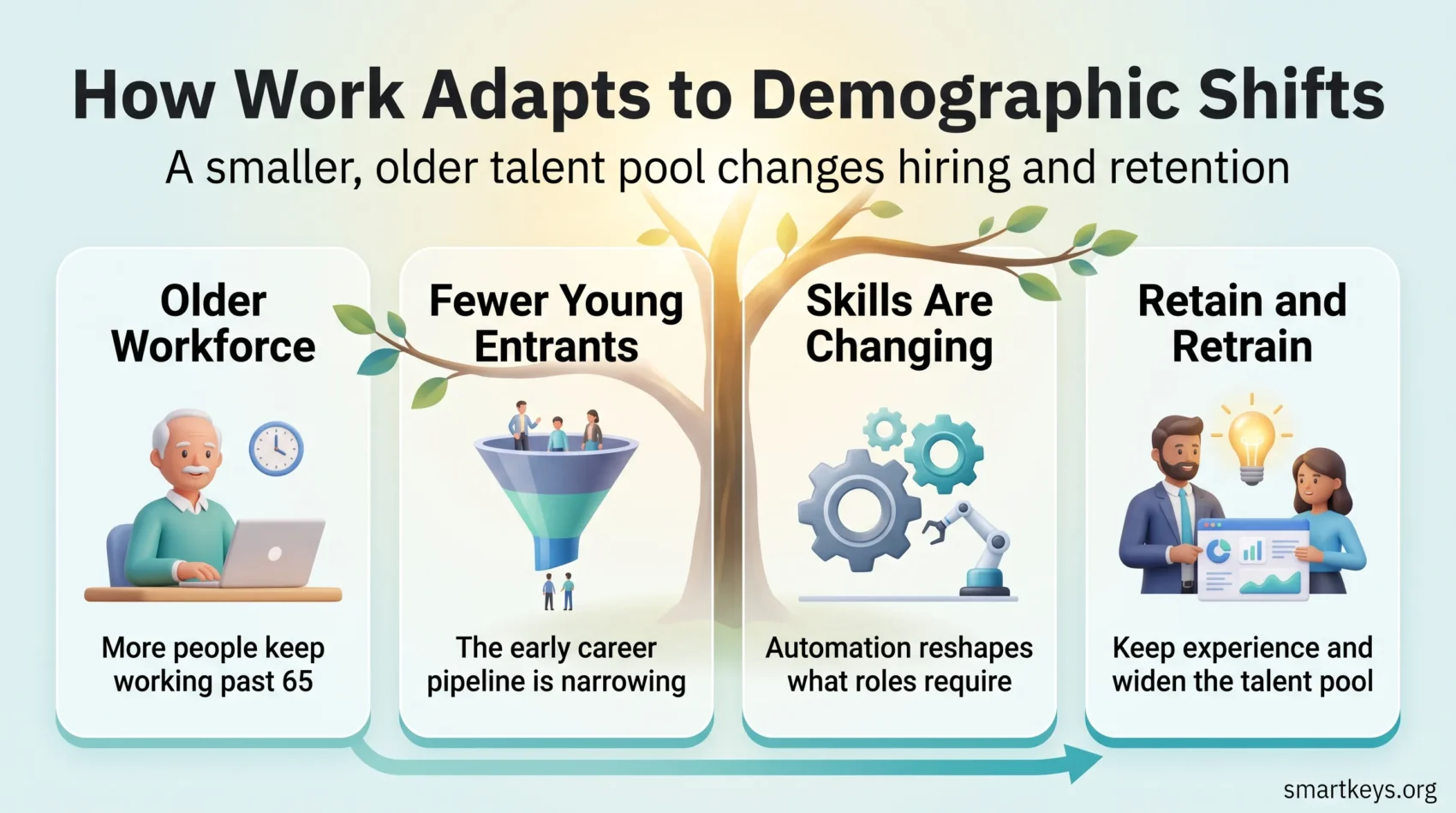
The composition changes far more than the total. Between 2024 and 2034 the 16-to-24 share of the labor force falls from 13.0% to 11.3%, while the 65-and-over share rises from 6.9% to 8.4%. Workers aged 55 and over hold steady at roughly 23%. The entry-level pipeline narrows while the retirement-age tail thickens.
Globally the direction is the same. The United Nations projects that by 2050 one in six people worldwide will be over 65, up from one in 11 in 2019. Higher-income countries feel this first, while several lower-income regions still have expanding working-age populations, which is why talent strategies increasingly diverge by region.
How an Aging Workforce Changes Planning
An older workforce is not automatically a problem, but it changes what planning has to cover. Retirements concentrate in specific trades rather than spreading evenly, so construction, manufacturing, utilities and skilled healthcare feel shortages long before headline unemployment moves.
Two responses have matured. The first is phased retirement, which keeps experienced people working part-time while they hand over what they know. The second is deliberate knowledge management, so expertise leaves in documented form rather than walking out the door.
You will still see the claim that 85 million roles could go unfilled globally by 2030. It comes from a 2018 Korn Ferry study and is a scenario, not a measurement. For planning, contingency planning against your own retirement and attrition data is far more useful.
Demographic Shifts at Work and Their Implications
Two forces dominate: who takes part in the labor market at all, and where new workers come from.
What Is Happening to Labor Force Participation
The overall US labor force participation rate was 62.6% in 2024 and is projected to fall to 61.1% by 2034. Men’s participation is projected to drop from 68.0% to 65.8%, women’s from 57.5% to 56.7%. The one group moving the other way is older workers: participation among 65-to-74-year-olds is projected to rise from 27.1% to 29.6%, and among those 75 and over from 8.6% to 10.2%.
Overall participation falls because the population is aging into lower-participation age bands, not because older people are dropping out. Employers that make later-career work practical are fishing in the only pool that is growing. For individuals, the same trend is why planning a multi-stage career now matters more than planning a single exit date.
Caregiving as a Workforce Issue
Caregiving is the clearest link between demographic change and staffing. AARP’s 2026 Valuing the Invaluable report counts about 59 million family caregivers in the United States, whose unpaid care was valued at more than $1 trillion in 2024. As populations age, more of those caregivers are also employees, and the load still falls disproportionately on women. That is why caregiving support has moved from perk to retention lever, and why benefits designed around real life now beat packages built around headcount averages.
Migration as a Growth Lever
Migration is now a decisive variable in labor supply. BLS data shows the foreign born accounted for 19.1% of the US civilian labor force in 2025, with a participation rate of 66.3% against 61.6% for native-born workers. They also skew towards prime working age: 70.1% are aged 25 to 54, against 62.7% of native-born workers. Immigration policy is therefore a direct input into hiring plans, and sectors that rely on it need contingency thinking rather than assumptions.
Technological Impact on Workforce Evolution
Demographic pressure and automation arrive together. A shrinking entry pipeline makes automation more attractive; automation changes which of the remaining people you need.
Automation and Changing Job Requirements
The World Economic Forum’s Future of Jobs Report 2025 projects 170 million new roles created and 92 million displaced by 2030: a net gain of about 78 million, with around 22% of jobs disrupted in some form. Roughly 39% of the skills workers need are expected to change over the same period, and 59 of every 100 workers are projected to need reskilling or upskilling by 2030.
Employers are not passive. In the same report, 77% plan to reskill and upskill staff in response to AI, while 41% expect to cut headcount where AI automates tasks. Skills gaps are the biggest barrier employers name, cited by 63%. Companies that handle this well tend to redeploy people rather than replace them.
Emerging Job Sectors
Aging populations create demand directly: healthcare and social assistance remain among the strongest sources of projected job growth in the BLS 2024-34 projections, alongside technology. Physically demanding work is being reshaped rather than eliminated, which is where robotics in the workplace has the clearest effect. Getting people into those roles is the constraint. Structured upskilling and reskilling, mid-career retraining and micro-credentials that verify skills without a degree filter widen the funnel where the demographic funnel narrows, provided you know which skills the next decade rewards.
Workforce Generational Changes and Their Significance
Workforce generational changes are usually discussed in terms of values. The more consequential change is arithmetic.
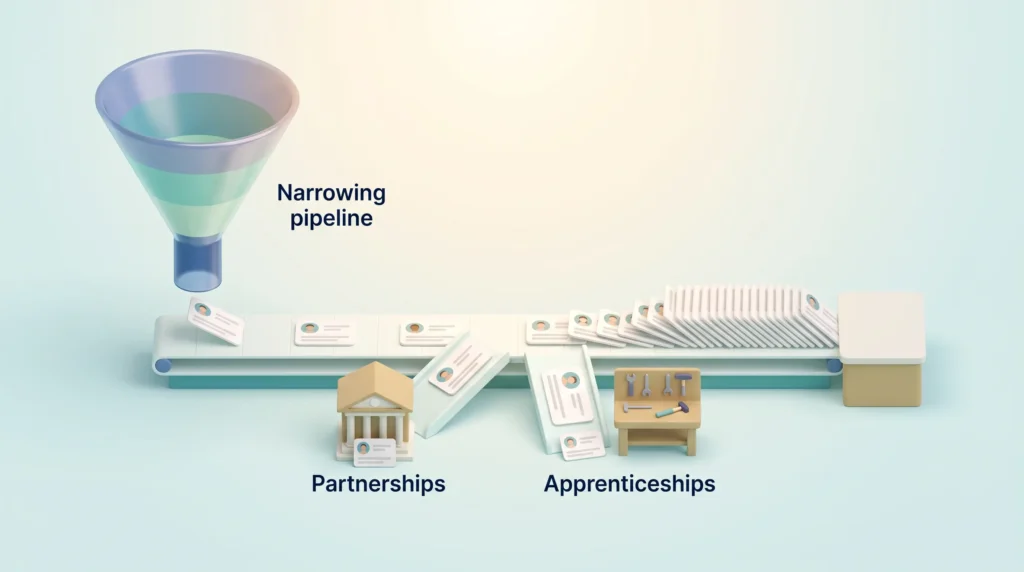
A Narrowing Young Talent Pipeline
The projected fall in the 16-to-24 group from 13.0% to 11.3% of the labor force means competition for early-career talent intensifies even if nothing else changes. Employers that treat graduate hiring as a tap they can turn on will get less from it each year.
That argues for building supply rather than bidding for it: talent pipeline partnerships with colleges and training providers, apprenticeships and structured early-career routes. It also raises the stakes on getting the experience right. Our guide to what Gen Z employees expect from employers covers pay, flexibility and development priorities in detail.
Intergenerational Collaboration and Knowledge Transfer
When cohorts sit at very different career stages, intergenerational collaboration stops being a culture initiative and becomes a continuity requirement. The mechanics are unglamorous: pairing, documented handovers, reverse mentoring on tools, and mentoring that is scheduled rather than encouraged. Practical guidance sits in our piece on bridging age gaps in multigenerational teams, and cross-training is the cheapest insurance against a single retirement removing a capability.
Workforce Diversity Trends and Business Strategies
A workforce drawn from a shrinking pipeline has to be drawn from more of it. That is the strongest practical argument for inclusion work: it widens the set of people you can hire and keep.
Where the Evidence Is Strong and Where It Is Not
Be careful with the claim that diverse teams are simply more profitable. Headline correlations from consultancy studies have proved hard to replicate, and causation runs both ways. What holds up better is narrower and more useful: inclusive practices improve retention and widen access to candidates. Treat inclusion as a talent-supply question and measure it that way.
Strategies for Widening the Talent Pool
- Remove job requirements that exclude capable candidates without predicting performance, such as unnecessary degree filters.
- Audit hiring technology, since automated screening encodes past patterns at scale.
- Open internal mobility through an internal talent marketplace so people can move before they leave.
- Measure with workforce analytics and act on retention gaps, not just hiring numbers.
Flexibility and the Gig Economy
Hybrid work has settled rather than disappeared. Gallup’s Q2 2025 data on remote-capable US employees found 52% working hybrid, 28% fully remote and 21% fully on-site. That stability matters demographically: flexibility is what keeps caregivers, older workers and people with health conditions in the labor market at all.
Contingent work has grown alongside it. Upwork’s 2026 Future Workforce Index, based on a survey of 2,400 US workers, reports that 39% did some freelance work and that freelancers earned around $1.5 trillion in 2024. Upwork sells freelance services, so read those numbers as a directional signal rather than an official statistic.
For employers the point is access to skills you cannot recruit permanently. Our look at the gig economy in 2030 covers where this is heading.
Adapting to Labor Shortages: Responsive Strategies
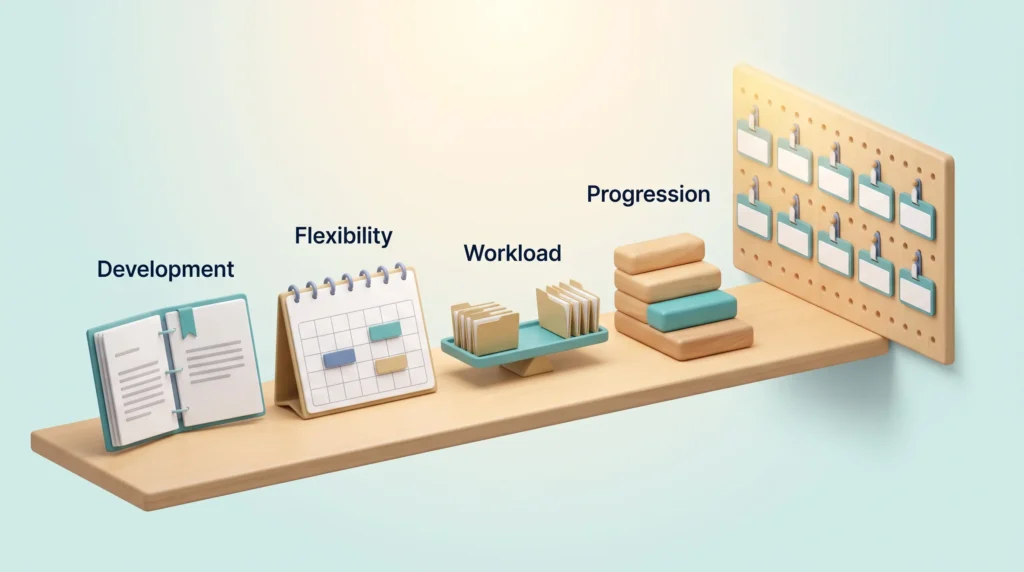
When the pipeline narrows, keeping people is cheaper than replacing them. The tactics that hold up are specific rather than motivational:
- Continuous development: fund training that visibly leads somewhere, not compliance modules.
- Real flexibility: hours and location arrangements that survive contact with a manager’s calendar.
- Workload management: shortages create overload and overload creates more shortages; see managing burnout in the future of work.
- Visible progression: people leave when the next step is invisible, not only when pay is low.
None of this works without measurement. Track retention and internal movement against your own baseline, and review it on the same cycle as headcount planning.
Conclusion
The demographic picture for the next decade is not dramatic, and that is the problem: slow labor force growth, falling participation, a narrower young pipeline and a thicker older tail are easy to ignore until a specific team cannot be staffed.
Organizations that handle it well do a few unspectacular things consistently. They plan against their own retirement and attrition data rather than headline forecasts. They keep experienced people working on terms that suit them. They widen the funnel through retraining, credentials and internal mobility instead of competing for the same shrinking pool. And they treat flexibility as infrastructure, because it keeps a large share of the workforce participating. Future workforce adaptation is mostly a question of doing that work early, while the shortage is still a projection rather than a vacancy you cannot fill.
Found this useful?
Make SmartKeys a preferred source on Google, and our articles will surface more often in your Top Stories, AI Overviews, and AI Mode.
Add as Preferred Source