Active listening means giving a speaker your full attention, checking that you understood them, and showing that you did. In practice, most workplace conversations are a queue of people waiting for their turn to talk.
The difference matters because almost everything at work travels through conversation: briefs, handovers, status updates, customer calls. When listening is poor, the cost rarely looks like a listening problem. It looks like rework, a missed requirement, or a decision that gets reopened three weeks later.
This guide covers what active listening actually is, what the research supports, why listening has become harder, and which techniques hold up in a normal working week.
Key Takeaways
- Active listening is a set of behaviours: undivided attention, clarifying questions, and a short summary before you reply.
- Peer reviewed research links high quality listening to lower anxiety and defensiveness in the speaker, and to lower burnout and turnover intention.
- The popular claim that most communication is nonverbal is a misreading of a narrow 1960s experiment.
- Listening got harder for structural reasons: Microsoft’s usage data puts interruptions at roughly one every two minutes during core hours.
- Gallup ties feeling heard to creativity at work, and finds that few employees get meaningful feedback on their suggestions.
What Active Listening Actually Means
Hearing is automatic. Listening is work. Active listening has three observable parts, each one something a colleague could watch you do.
First, you give the speaker an uninterrupted turn: no finishing their sentence, no reply forming mid thought.
Second, you check your understanding out loud, with a question or by repeating the point back: “So the launch date moves, but the copy deadline stays. Is that right?”
Third, you signal that you received it: a nod, a note taken, a follow up action. People can tell the difference between someone processing what they said and someone politely waiting.
A concrete example. A designer tells a project manager that the new form “might be a problem on mobile”. A passive listener hears a minor caveat and moves on. An active listener asks which part, learns that the date picker breaks on small screens, and finds out before launch rather than after two hundred support tickets.
What the Research Supports
Listening is one of the better studied soft skills, so evidence is available instead of folklore.
Guy Itzchakov and Avraham Kluger reviewed the field in The Power of Listening at Work, published in the Annual Review of Organizational Psychology and Organizational Behavior in 2022. Across the studies they summarise, speakers become clearer about their own position rather than just louder about it. Anxiety and defensiveness drop, so people can acknowledge weaknesses in their own argument without feeling attacked. Listening also correlates with better job performance, higher engagement, and lower burnout and turnover intention. Being listened to is not only pleasant. It changes how people think while they are speaking, which is why a good listener often gets a better answer than a good interrogator.
One widely repeated claim does not survive scrutiny. You will often read that 65%, 80% or 93% of communication is nonverbal. Those numbers come from Albert Mehrabian’s 1960s experiments, which measured how people judged the feeling behind a single spoken word when tone and expression disagreed with it. Mehrabian himself has said the findings do not generalise to communication as a whole. Tone and body language do carry information, especially about emotion, but the percentages do not mean what they are used to mean.
Why Listening Has Become Harder
Poor listening is usually blamed on individual rudeness. Most of it is structural.
Microsoft’s Work Trend Index special report Breaking down the infinite workday analysed anonymised usage signals from Microsoft 365. It found that employees are interrupted roughly every two minutes during core hours by a meeting, an email or a chat, that 57% of meetings are called without a calendar invite, and that meetings starting after 8pm rose 16% year over year.
The engagement picture is no better. Gallup’s State of the Global Workplace 2026 report put global employee engagement at 20% for 2025, its lowest level since 2020. Manager engagement fell to 22%, down from 31% in 2022. Managers are the people most expected to listen, and they are under the most pressure.
None of this makes listening impossible, but it does mean that “concentrate harder” is not a plan. Attention is a scheduling problem before it is a willpower problem, which is why a team wide no meeting block and a deliberate approach to work notifications do more for listening than good intentions.
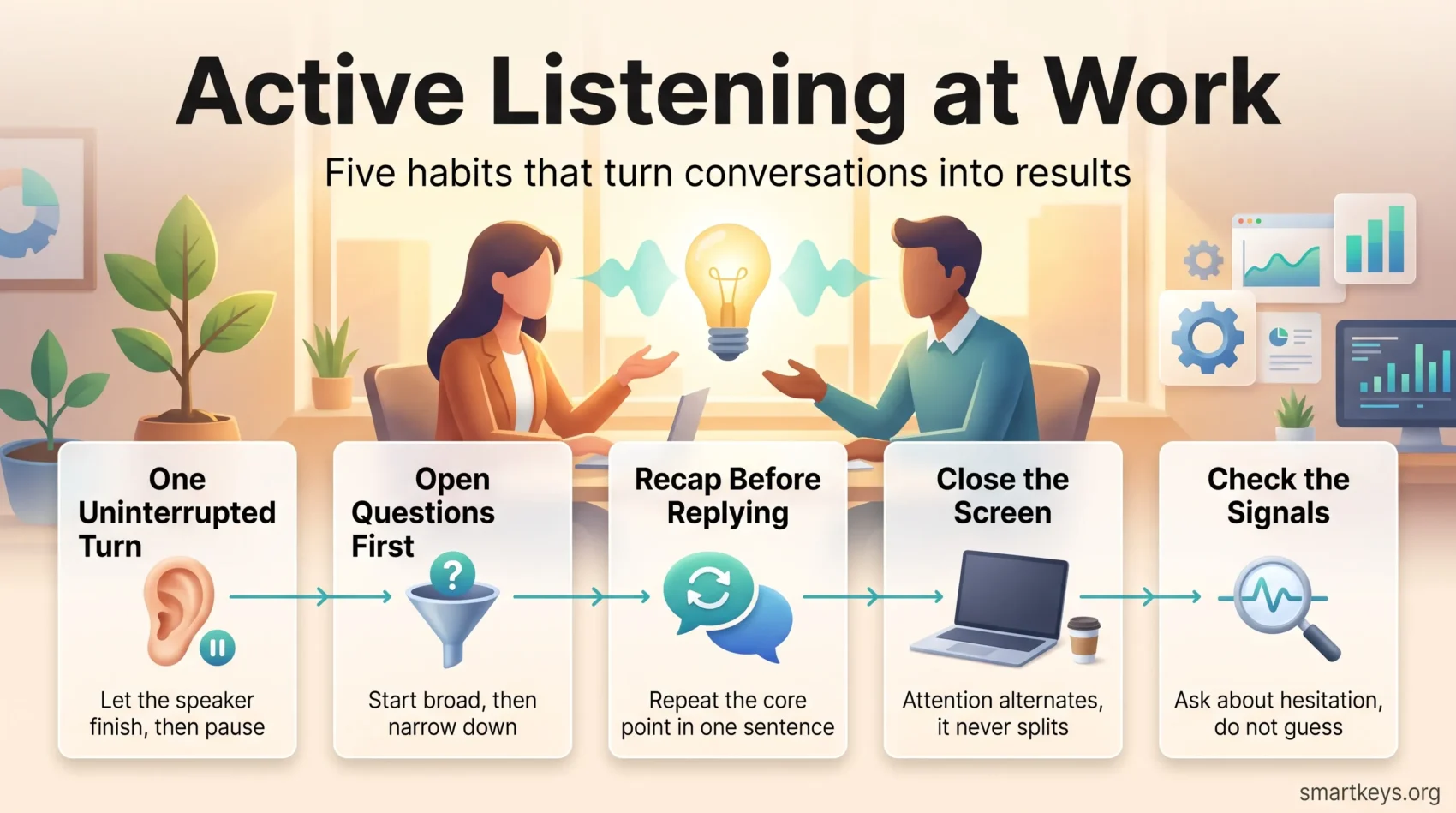
Five Techniques That Actually Work
These are behaviours, not attitudes. Practise them in your next call.
Give One Uninterrupted Turn
Let the speaker finish, then pause for a beat before responding. The pause feels long to you and normal to them. In groups, say it out loud: “Let’s hear the whole thing first, then questions.”
Ask Open Questions, Then Narrow Them
Start with questions that cannot be answered yes or no: “What happens if we ship it as is?” Then narrow: “Which step breaks first?” Open questions surface what you did not know to ask for. Closed questions confirm what you already think. Most people use them in the wrong order.
Summarise Before You Reply
Repeat the core of what you heard in one sentence, then respond. It takes five seconds and catches misunderstandings while they are still cheap. It also proves you were listening, which no amount of nodding does. This matters most in asynchronous handovers, where a wrong assumption can sit unchallenged for a day.
Remove the Competing Screen
You cannot listen to a person and read a message thread at the same time. The research on task switching is consistent: attention does not split, it alternates, and every switch costs time and accuracy. Close the laptop in one to one meetings, or say plainly that you need two minutes to finish something first.
Read Tone and Body Language With Care
Hesitation, a change in pace, or a phrase like “I guess that could work” usually signals an unspoken objection. Notice it and ask. What you should not do is treat crossed arms or broken eye contact as reliable evidence of anything. Nonverbal signals are worth checking, not decoding, and on video calls asking directly beats guessing.
RASA: A Framework for Meetings
Sound expert Julian Treasure set out a four step listening pattern in his TED talk 5 ways to listen better. He calls it RASA, the Sanskrit word for juice or essence.
Receive means paying attention to the speaker instead of preparing your answer. Appreciate means small acknowledgements, a nod or an “mm hmm”, that tell the speaker the signal is arriving. Summarise means condensing what you heard, often with a simple “so”. Ask means following up with a question that goes deeper rather than sideways.
RASA works well as a shared team standard because it is short enough to remember mid conversation. It fits naturally into a regular one to one, and it gives a chair something concrete to enforce in a group discussion. If your meetings still feel like parallel monologues, the problem is probably the meeting itself, and a meeting audit or a move to silent meetings may be the better fix. Removing distractions helps too, which is the practical case for asking people to focus on the discussion rather than their inbox.
Listening and Employee Engagement
Feeling heard is not a soft benefit. It is one of the items Gallup uses to measure engagement, and it behaves like a leading indicator.
Gallup’s guidance on the survey item “At work, my opinions seem to count” reports two things worth knowing. Fewer than one in five workers strongly agree that they receive meaningful feedback when they make a suggestion. And among employees who feel their opinions count, close to half say their job brings out their most creative ideas, compared with 8% of those who do not.
That gap is the argument in one line. Ideas are not distributed by seniority. They are distributed by who feels safe enough to say them.
The practical lever is the loop, not the survey. If someone raises an issue and nothing visible happens, they learn that raising issues is unpaid work. Closing the loop means telling people what you did with their input, including when the answer is no and why. That habit turns listening into a culture of transparency rather than a suggestion box.
Distributed teams need this more, not less, because casual signals of being heard are thin over video. Deliberate listening holds remote company culture and remote engagement together, alongside the ordinary social contact that shared audio updates provide.
Listening in Customer Service
Customer service is where listening shows up fastest in the numbers, because a misunderstood problem becomes a second contact.
Research published in the International Journal of Hospitality Management in 2021 examined why active listening raises customer satisfaction after a service failure. It matches what service teams report: when something has gone wrong, being properly heard changes how the customer judges the recovery, not just the outcome.
Three habits do most of the work. Let the customer describe the whole problem before diagnosing it. Repeat the issue back in their words before proposing a fix, so a wrong assumption is caught in the first minute rather than the tenth. And separate the emotional part from the technical part, because acknowledging frustration is not the same as admitting fault. The same logic applies to automated channels, where a bot that classifies a query wrongly is a listening failure with a technical cause. Current customer service trends put a lot of weight on where that handover happens.
How to Tell Whether It Is Working
There is no clean metric for listening, and inventing one usually produces theatre. Instead watch the things poor listening damages: rework from misunderstood requirements, repeat customer contacts on the same issue, decisions reopened after they were agreed, and how often the same two people do all the talking. None of these measures listening directly. All of them move when listening improves.
Team surveys help if you ask about behaviour, not feelings. “Did you get a chance to make your point?” is answerable. “Do you feel heard?” invites a polite yes.
For individuals, the most honest feedback comes from asking one colleague a specific question: “In our last three conversations, did I cut you off?” It is uncomfortable, and far more informative than a self assessment. Managers can build that into their leadership routine rather than an annual review.
Where Active Listening Falls Short
Listening is not a universal fix, and pretending otherwise is how it turns into a ritual.
It does not resolve genuine disagreement. Two people can understand each other perfectly and still want different things. At that point the job is a decision, not more conversation.
It costs time. Full attention in every interaction is not available to anyone with a real workload. Spend it where misunderstanding is expensive: briefs, handovers, escalations, and conversations with people who rarely speak up. Elsewhere a fast answer is kinder.
It can also become performative. Summarising back is a verbal tic if nothing changes as a result. Listening without follow through is a slower way of ignoring someone, which is why clear delegation and precise communication have to travel with it.
Conclusion
Active listening is not a personality trait. It is a small set of repeatable behaviours: one uninterrupted turn, an open question, a short summary, a visible follow up.
The evidence supports something more interesting than “listening is nice”. High quality listening changes how the speaker thinks, lowers defensiveness, and correlates with lower burnout and turnover. Feeling heard is closely tied to whether people contribute their better ideas at all.
The obstacles are mostly structural, so the fixes are too. Protect blocks of attention, cut the meetings that do not need to happen, and close the loop when someone tells you something. Those changes cost less than most productivity initiatives, and they are what make focused work and productive meetings possible. Listening is also one of the soft skills that keeps its value as routine work is automated.
Found this useful?
Make SmartKeys a preferred source on Google, and our articles will surface more often in your Top Stories, AI Overviews, and AI Mode.
Add as Preferred Source