The global gig economy is all paid work done outside a permanent contract and arranged through apps or online marketplaces, added up across every country. A delivery run in Jakarta, a logo designed in Lagos for a client in London and a six-week data project run from Manila all count.
Measuring it is harder than it sounds. Most countries do not count platform workers at all, and published estimates range from about 150 million to over 400 million people. This guide collects the most reliable global gig economy statistics, shows where gig work is growing fastest by region, and explains what the numbers mean for workers and the companies that hire them. For the market as a whole, including drivers and the long-term outlook, see our main guide to where the gig economy is heading by 2030.
Key Takeaways
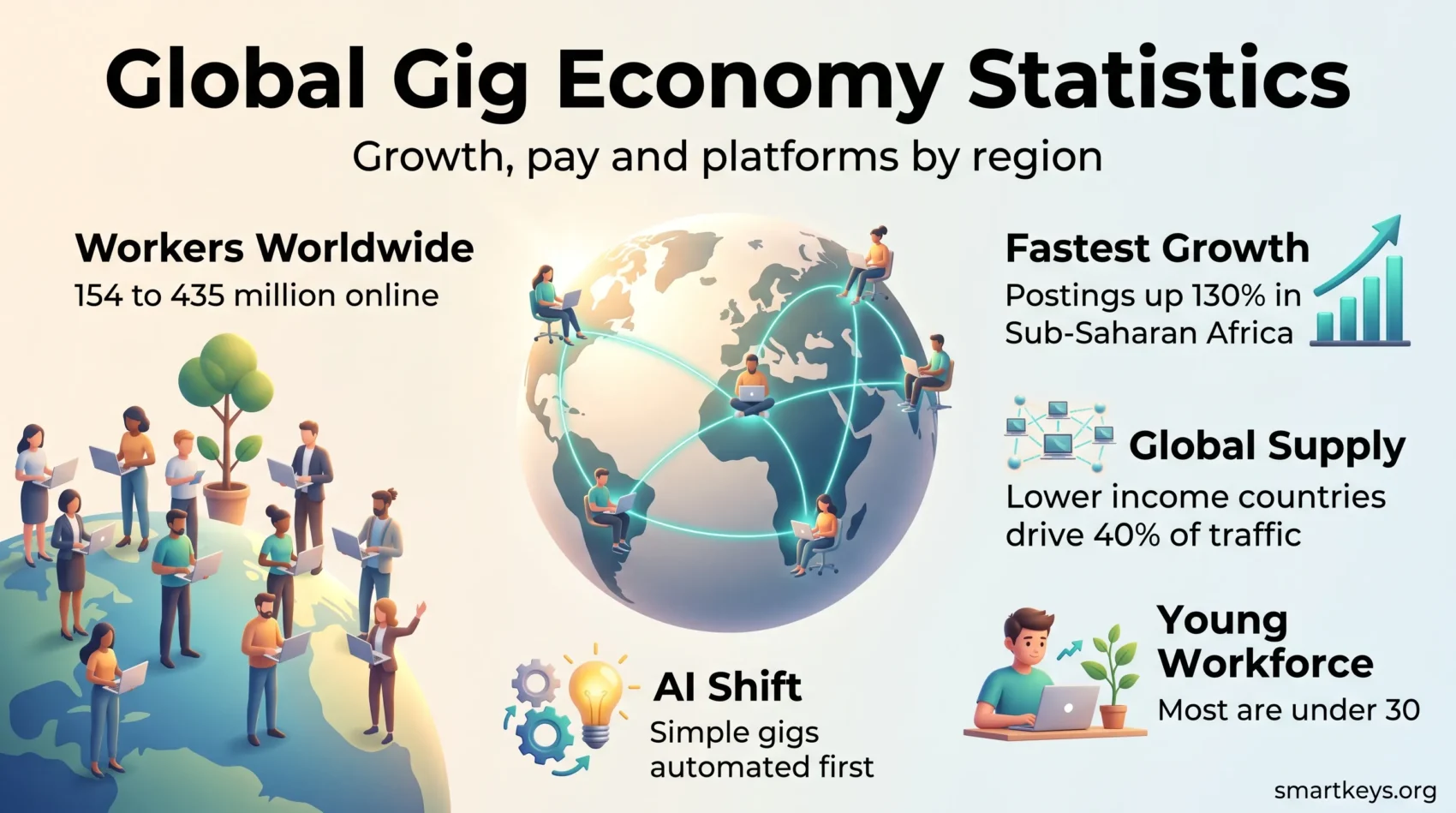
- The World Bank estimates 154 million to 435 million online gig workers worldwide, or 4.4% to 12.5% of the global labour force.
- Low- and middle-income countries generate around 40% of online gig platform traffic.
- Job postings grew 130% in Sub-Saharan Africa against 14% in North America in the World Bank’s data.
- The ILO counted at least 653 active digital labour platforms in late 2025, and only 40 of 133 countries it reviewed measure platform employment.
- Most online gig workers are under 30, and six in ten live outside their country’s largest cities.
- AI is automating low-complexity gigs first, which hits the regions that compete mainly on price hardest.
Why Global Gig Economy Statistics Disagree
Gig work reaches workers through a platform that sits between them and the client, handling matching, ratings and payment for a commission. Almost everywhere, the worker is an independent contractor, a self-employed person who invoices clients instead of drawing a salary. How that plays out for pay, taxes and benefits is covered in our overview of gig economy trends and data.
The statistics disagree for two reasons. First, definitions differ: some surveys count anyone who earned a single dollar on a platform, others only people who rely on it for most of their income. Second, very few governments collect the data. An ILO review found that only 40 of 133 countries measure platform employment at all, so most global figures are estimates built from platform traffic, job postings and online surveys.
The World Bank’s Working Without Borders report, the largest study to date, handles this by giving a range: 154 million online gig workers on a narrow definition and up to 435 million if you include people who do it occasionally. That is between 4.4% and 12.5% of the world’s workforce. Treat the upper figure as a ceiling, not a headcount.
Online Versus Location-Based Gig Work
Researchers split gig work into two very different halves, and confusing them is why published statistics disagree so wildly.

Online web-based work is delivered over the internet and can be done from anywhere: design, writing, software development, data annotation, virtual assistance. Competition here is genuinely global, which is why a developer in Lagos and one in Lisbon bid for the same brief.
Location-based work has to happen in a specific place: ride-hailing, food delivery, home cleaning, care visits. Pay is set locally, the work cannot be offshored, and this is where most regulatory fights have happened.
An ILO research brief published in February 2026 counted at least 653 active digital labour platforms worldwide as of October 2025, down from 777 in 2021, with around 204 of them web-based. The fall reflects consolidation rather than decline.
Where Gig Work Is Growing Fastest by Region
The fastest growth is not where the platforms were invented. The World Bank found that online job postings grew 130% in Sub-Saharan Africa over the period it studied, against 14% in North America. Low- and middle-income countries already account for around 40% of platform traffic, and demand from those countries is also rising faster than demand from rich ones.
South Asia has long been the largest supplier of online freelance labour. The Oxford Internet Institute’s Online Labour Index has repeatedly found India, Bangladesh and Pakistan near the top of worker supply, with the Indian subcontinent especially strong in software development and technology work.
Southeast Asia and Africa are where governments bet most openly on platforms. The Philippines, Nigeria and India have all built job-creation programmes around digital work, because online gigs let a skilled worker earn at rates set by clients in high-income countries without emigrating.
North America and Western Europe still supply most of the demand. Companies there buy the bulk of online services, and they also host most location-based work such as ride-hailing and delivery. Growth in these markets is slower, but pay per task is far higher.
There is a real caveat. The World Bank found that on one major platform reviewed, women earned 68% of what men earned, and that most gig workers in low-income countries have no social insurance. See also globalization and future work trends for the wider shift.
Why Workers in Different Regions Choose Gig Work
Ask gig workers why they do it and the answer depends heavily on where they live. In high-income countries, control over the schedule comes up more often than money. In lower-income countries, access to better-paid clients is usually the main draw.

For a parent in Germany, flexibility means working between 9am and 2pm and again after bedtime, which no shift rota allows. For a developer in Nairobi, it means billing a US client at a rate no local employer would pay. For a mid-career specialist anywhere, it means charging four clients a day rate instead of one employer a salary.
Flexibility has limits platforms rarely advertise. Ride-hailing and delivery apps use surge pricing and acceptance-rate scoring, so the hours that pay well are not always the hours you wanted. For the employer’s side, see our guide to flexible work schedules.
Freelance Marketplaces and What AI Is Doing to Them
Marketplaces solved a real problem: a small business can hire a specialist for two weeks without a recruiter, a contract lawyer or a payroll change. That is why freelance talent platforms became a standard hiring channel.
AI is now reshaping what they sell. Upwork’s second-quarter 2026 results give the clearest public read. Gross services volume fell 3.6% to $966.4 million and active clients dropped 4% to 763,000. Meanwhile AI-related work grew more than 22% year over year to roughly a $330 million annual run rate, and AI strategy and consulting work grew more than 50%. Upwork cut its 2026 revenue guidance and said plainly that low-complexity assignments are being automated faster than it expected.
The pattern is clear. Simple, repeatable tasks such as basic copy, routine data entry and straightforward translation are being absorbed by AI tools clients now run themselves. Work requiring judgement or context about a specific business is holding up. The safe ground is work an AI cannot finish alone, meaning tasks where someone must be answerable for the result. Our guides to future job skills and adapting to automation go deeper on where that line sits.
The effect differs by region. Workers who compete mainly on price, often in lower-income markets, feel the loss of simple tasks first. Those who combine a specialist skill with AI tools can still win international work.
Who Does Gig Work Around the World
The typical online gig worker is young. The World Bank found most are under 30, and six in ten live outside their country’s largest cities, so platform work reaches places traditional employers do not. Women take part at higher rates online than in local labour markets, though pay gaps persist.
In the United States, where the data is richest, the picture is similar. Gen Z made up 28% of the independent workforce in MBO Partners’ 2025 study, and Upwork found 53% of skilled Gen Z knowledge workers already freelancing in some form. Education cuts against the casual-labour image: Upwork reported that 37% of independent knowledge workers hold postgraduate degrees, against 20% of full-time employees.

Three groups explain most of the growth: specialists who left staff jobs and now sell the same expertise to several clients, people who freelance alongside employment, and workers in countries where local wages sit below what an overseas client pays.
MBO Partners also found 74% of US independent workers use generative AI in their work, while 42% rely on online platforms as their main source of jobs. That second figure is a useful corrective: even in the largest market, most independent work still arrives through referrals. Our analysis of Gen Z and the future of work and of longer-running freelancing trends points the same way.
What Gig Work Pays Across Borders
Pay is where regional differences show most clearly. US freelancers earned an estimated $1.5 trillion in 2024, on Upwork’s numbers, and MBO Partners counted 5.6 million American independents earning over $100,000 in 2025. Those figures describe skilled knowledge work in the richest market, so read them as a ceiling.
For online work, a single global marketplace does not mean a single global rate. Clients compare bids from many countries, which pushes simple tasks towards the lowest price while specialists can charge close to rich-country rates wherever they live. Our look at how global competition affects pay covers the debate on pay parity.
Whatever the headline rate, gig workers everywhere carry their own costs: tax, health cover, retirement saving and the unpaid hours spent finding clients. Our guides to freelancer productivity and micro-entrepreneurship cover the running side.
How the Rules Differ by Region in 2026
Regulation now pulls in different directions depending on the region.
Globally, the International Labour Conference adopted Convention No. 193 on decent work in the platform economy in June 2026, the first international standard for this kind of work. It binds a country only once that country ratifies it.
In the EU, the Platform Work Directive must be national law by 2 December 2026. It presumes a platform worker is an employee unless the platform shows otherwise, and it limits algorithmic management, the use of software to assign, rate and discipline workers.
In the United States, the Department of Labor proposed a narrower contractor test in February 2026, while several states passed voluntary portable benefits laws instead of reclassifying workers.
Our dedicated guide to gig economy regulation and platform work compliance tracks the detail, and future of work legislation covers the wider picture.
What the Regional Data Means for Workers and Employers
For workers, the data points one way: global competition rewards skills that are hard to automate and hard to buy on price. If your work fits a two-line brief, expect competition from AI tools and from lower-cost regions. If it needs judgement and context, a global client base is an advantage.
For companies, a global talent pool means specialist skills without a permanent headcount, but rules now depend on where each worker sits. Our guides to managing freelancers, on-demand workforce strategy and project-based work cover how to do it without creating a classification problem.
Found this useful?
Make SmartKeys a preferred source on Google, and our articles will surface more often in your Top Stories, AI Overviews, and AI Mode.
Add as Preferred Source