Automation is no longer a forecast about the 2030s. It is visible in payroll data, hiring plans and job ads, which makes Job Automation Adaptation a practical question rather than a philosophical one. The task in 2026 is not to guess whether machines will take jobs, but to see which tasks are being absorbed and which are not.
The honest answer is that automation is uneven. Some roles are shrinking, others growing, and a large middle group is simply changing shape. This guide sets out what the evidence shows and how to prepare without betting on a single prediction.
Key Takeaways
- The World Economic Forum’s Future of Jobs Report 2025 projects 170 million new roles and 92 million displaced by 2030, a net gain of 78 million jobs.
- Employers expect 39% of workers’ core skills to change by 2030, down from 44% in 2023, so skill churn is high but not accelerating.
- Stanford payroll research through June 2026 found an 11% employment decline for workers aged 22 to 25 in the most AI-exposed occupations, with no comparable gap for older workers.
- Displacement concentrates where AI substitutes for a task; occupations where AI complements the worker have held steady or grown.
- About 59 of every 100 workers will need training by 2030, and 11 of them are unlikely to get it.
- Hybrid work has settled rather than reversed: roughly 27% of paid full days in the US were worked from home as of March 2026.
The Rise of Job Automation
Job automation means using technology to carry out work people used to do by hand or by judgment. That has happened since the Industrial Revolution, but the current wave differs in one way: earlier automation mostly replaced physical and routine tasks, while generative AI reaches into cognitive work such as drafting, summarizing, coding and first-line support.
What Automation Means in 2026
Today’s workplace automation is a stack rather than a single technology. Robotic process automation handles rule-based back-office steps, machine learning handles pattern recognition, and large language models handle unstructured text and code. Most organizations run all three at once, which is why the effects appear gradually across many roles instead of as one replacement event.
That stack brings its own problems. Integration with legacy systems, data quality, model oversight and cybersecurity all consume time that leaders routinely underestimate. Businesses that treat automation as a procurement decision rather than an operating change tend to stall.
What History Actually Shows
Past automation waves rarely produced permanent mass unemployment, but they did produce painful, uneven transitions. Regions and occupations that lost work did not always recover, and the workers who adapted best were usually those with access to retraining and mobility.
The useful lesson is not “it will be fine.” It is that aggregate job counts and individual outcomes are different questions. A labor market can add jobs overall while a specific 45-year-old administrative specialist has a difficult decade. Closing that gap is why redeploying workers into new roles matters more than headline forecasts.

The Impact of Automation on Employment
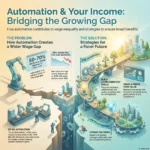
The 2026 employment picture is best described as concentrated disruption: a minority of occupations absorb most of the change, while the majority see task shifts rather than job losses.
Which Jobs Are Most Exposed
The common claim that “half of all jobs could be automated” misreads the research behind it. McKinsey’s estimate covers work activities, not whole jobs: with generative AI, activities accounting for up to 30% of hours currently worked across the US economy could be automated by 2030, against 21.5% without it. Few occupations disappear entirely; many lose a slice of their tasks.
Where losses concentrate is clear enough. McKinsey projects the sharpest declines in office support, customer service and sales, food services and production work, including roughly 1.6 million fewer clerks and 630,000 fewer cashiers by 2030. The WEF’s employer survey points the same way, naming cashiers, administrative assistants and graphic designers among the fastest-declining roles.
The most striking recent evidence is generational. Stanford researchers Erik Brynjolfsson, Bharat Chandar and Ruyu Chen analyzed ADP payroll records covering millions of US workers through June 2026. Employment for 22 to 25 year olds in the two most AI-exposed quintiles of occupations fell about 11% since late 2022, while the three least-exposed quintiles grew about 10%. Experienced workers in the same occupations showed no comparable gap. Our automation risk assessment sets out a structured way to judge your own position.
Where New Demand Is Growing
Growth is not limited to technology roles. The WEF’s 2025 survey puts frontline and essential jobs at the top of the list: farmworkers, delivery drivers, construction workers, nursing professionals and secondary school teachers, alongside specialist roles in AI, robotics, renewable energy and environmental engineering.
The Stanford data adds a nuance that matters more than any list of “safe jobs.” Declines clustered in occupations where AI substitutes for the worker, while roles with a high complementarity share, where AI makes the person more productive rather than redundant, held steady or grew. That is the core idea behind AI augmentation versus replacement.

Job Automation Adaptation
Adapting well is less about learning a specific tool than about shifting toward work machines handle badly and organizations still need.
Understanding Skills Necessary for Adaptation
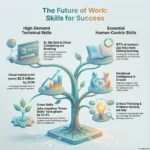
The WEF’s employer survey ranks the fastest-growing skills to 2030 as AI and big data, networks and cybersecurity, technological literacy, creative thinking, and resilience, flexibility and agility. Analytical thinking remains the most cited core skill, named by seven in ten companies. That points to three layers worth building:
- Judgment skills: framing problems, weighing trade-offs and deciding what is worth doing at all
- Interface skills: working with AI systems, checking their output, and knowing when not to trust them
- Relationship skills: negotiation, coaching, client trust and cross-team coordination
Technical fluency still matters, but it depreciates fastest. The three layers above age more slowly, which is why working alongside the tools beats competing with them.
The Role of Education and Continuous Learning
Continuous learning is easy to recommend, hard to sustain. The WEF projects that of every 100 workers in 2030, 41 will need no significant training, 29 will be upskilled in their current role, 19 will be reskilled and redeployed, and 11 will need training but not receive it. That last group is the policy problem in one number.
Employers are moving, if unevenly: 77% plan to upskill their workforce, half expect to move staff out of AI-exposed roles, and 63% name skill gaps as the main barrier to transformation. Training that works tends to be short, frequent and tied to real tasks rather than delivered as an annual course, which is why a microlearning strategy suits busy teams better than long-form programs. For a broader view, see our overview of upskilling and reskilling in 2026.
Future of Work: Trends and Predictions
Labor market forecasts age badly, so it helps to separate measured numbers from projected ones.
How Technology Will Shape Job Markets
The most widely cited projection is the WEF’s: 170 million jobs created and 92 million displaced by 2030, a net gain of 78 million, with 22% of all jobs disrupted in some form. Treat that as a scenario built from employer surveys, not a measurement. What is measured is narrower: the Stanford payroll analysis shows declines already underway for young workers in substitutable roles, and the adjustment runs through hiring and headcount rather than wage cuts. Employers are hiring fewer people rather than paying existing staff less.
That combination argues for a specific kind of caution. Mid-career workers are not seeing the same exposure yet, but the entry-level pipeline that feeds mid-career roles is thinning, which raises the value of cross-training existing staff.
The Importance of Hybrid Work Models
Hybrid work has stabilized rather than reversed. Survey of Working Arrangements and Attitudes data puts roughly 27% of paid full days in the US at home as of March 2026. Over the year to March 2026, 62% of full-time employees worked fully on site, 26% hybrid and 12% fully remote.
The link to automation is practical: distributed teams document more of their work in writing, and written process is exactly what AI tools can read, summarize and eventually execute. See also the future of workspaces and flexible work schedules.
The Role of AI in Job Automation
AI behaves differently from earlier automation. It is general-purpose, it improves quickly, and it lands on tasks rather than whole roles.
AI’s Influence on Skill Requirements
Job postings increasingly ask for AI fluency in roles that have nothing to do with data science: marketing, legal, operations, HR. What employers usually mean is the ability to use the tools competently and check their work, not to build models. Verification is becoming a core professional skill in its own right, because the cost of an unchecked AI error falls on whoever signed off on it.
New roles have appeared alongside this shift, from workflow design to model oversight and AI governance, but they remain a small share of employment. Most adaptation happens inside existing jobs, as our look at AI and automation at work shows.
Job Displacement vs. Job Creation
Both effects are real and do not cancel out for any individual. Displacement is concentrated by age, occupation and region; creation happens elsewhere and often demands different skills. A cashier position lost in a mid-sized town is not offset by a robotics technician role opening in another state.
This is why the substitution versus complementarity distinction keeps returning. If AI can do your core task end to end with light review, exposure is high. If it speeds up parts of your work while you keep the judgment, the client relationship or the physical presence, exposure is much lower. Workers in substitutable roles usually find the shortest route forward is mid-career retraining into an adjacent field rather than a full career change.

Skills Development for a Transitioning Workforce
Skills planning works best when it starts from the tasks a person actually performs, not from a job title.
Identifying In-Demand Skills
Rather than chasing a list, audit your own week and sort recurring tasks into three buckets:
- Fully substitutable: routine drafting, data entry, standard reporting, first-pass research. Expect these to shrink.
- Assisted: analysis, design, coding, planning. AI speeds these up, so value moves to setting direction and checking quality.
- Resistant: negotiation, physical work, accountability, care, and anything needing context the organization never wrote down.
If more than half your week sits in the first bucket, that is a signal to act now rather than later. Teams can run the same exercise collectively, and workforce analytics tools make the result far more reliable than a manager’s intuition.
Reskilling and Upskilling Programs
Programs that succeed share a few traits. They are tied to a specific internal role, they protect time during working hours rather than expecting evening study, and they end with a real placement instead of a certificate.
Practical priorities for 2026:
- Applied AI fluency for the tools already in use, including their failure modes.
- Data interpretation, so staff can challenge a dashboard rather than accept it.
- Communication, negotiation and coaching, which grow in value as routine output gets cheap.
- Structured mobility, so trained workers have somewhere to go. An internal talent marketplace makes internal moves visible.

The Need for Policy Changes
Individual effort cannot close a gap this size. The 11 in 100 workers who need training and will not get it are the clearest argument for public action.
Government Initiatives for Workforce Support
The measures most often proposed are well understood:
- Funded vocational training tied to sectors with documented demand, not generic digital courses.
- Portable benefits and transition income, so changing occupation does not cost healthcare or pension continuity.
- Removing practical barriers such as childcare, transport and course fees, which block access more often than motivation does.
Debate continues about more structural responses. Proposals to tax automation directly, discussed in our piece on the robot tax debate, and broader income guarantees such as universal basic income both have serious advocates and serious critics. Whether the gains from automation are distributed at all is a separate live question, examined in automation and inequality. Older workers facing a shortened runway to retirement may be better served by phased retirement programs than by full retraining.
Technology Integration and Workplace Automation
How automation is introduced matters more than which tool is chosen. The same technology can strengthen a team or hollow it out depending on the rollout.
Strategies for Successful Integration
- Start with the workflow, not the tool. Map the process and find where the delay actually sits. Automating a badly designed process makes it fail faster.
- Involve the people doing the work. They know which steps are genuinely routine and which only look routine from a distance.
- Train on failure modes. Staff need to know where the system is unreliable, not just how to operate it.
- Set clear review rules. Define which outputs need human sign-off before they leave the building.
- Roll out incrementally and measure. Small pilots with honest metrics beat large launches with optimistic ones.
- Say what happens to the time saved. If automation quietly means headcount reduction, saying so is fairer than letting people guess.
Organizations that handle this well end up more resilient in the age of automation, because their people trust the tools enough to use them properly. Manual trades face a different timeline, covered in automation in blue-collar jobs.

Conclusion
Job automation in 2026 is neither the jobs apocalypse nor the non-event that competing headlines suggest. Aggregate projections still point to net job growth by 2030, while the first solid payroll evidence shows concentrated losses for young workers in substitutable roles. Both are true at once, and both should inform how you plan.
The practical response is unglamorous. Audit which of your tasks a machine could plausibly do end to end. Move toward work where you add judgment, accountability or relationships. Build AI fluency as a working skill rather than a badge, including the habit of verifying output. Ask your employer which training is funded and protected. For organizations the obligation runs the other way: if you automate the tasks, you own the transition for the people who used to do them.
Found this useful?
Make SmartKeys a preferred source on Google, and our articles will surface more often in your Top Stories, AI Overviews, and AI Mode.
Add as Preferred Source